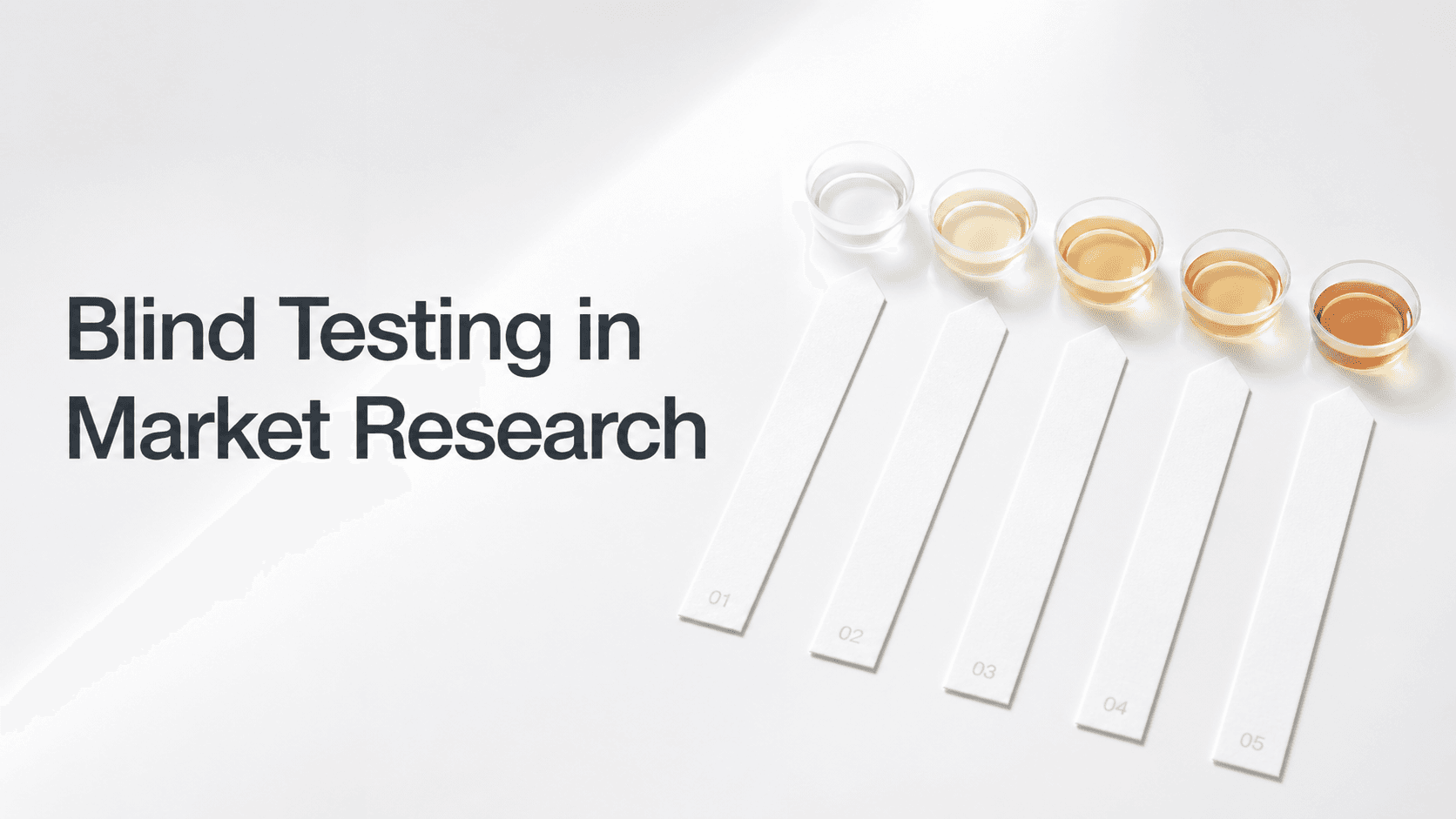
Blind testing is a research method where participants evaluate a product, service, or ad without knowing the brand behind it, removing logos, packaging, and other identifying cues. This gives researchers a clearer, more objective view of how people respond to the actual experience, separate from the influence of brand familiarity or reputation.
Why It Matters for Unbiased Consumer Insights
Consumers do not always evaluate products objectively. Brand perception, familiarity, and past experience can all shape how people judge quality, usability, and performance.
That creates a key question for brands: are people reacting to the product itself, or to the brand behind it?
Blind testing helps answer that question. By removing brand influence, it gives teams a clearer view of how people respond to the actual experience. In product testing market research, that makes it easier to gather more objective feedback, improve decision-making, and reduce bias before launch.
What Is It?
Blind testing is a research method where participants evaluate a product, service, or experience without knowing the brand behind it.
To do this, researchers remove identifiers such as:
logos
packaging
brand names
visual cues linked to familiarity
This helps ensure feedback is based more directly on:
product quality
usability
performance
overall experience
Brands use this method across multiple contexts, including consumer product testing, UX and digital research, creative evaluation, and taste-based studies.
Why This Method Matters More Than Ever
Modern consumers are heavily influenced by branding. A strong brand can increase perceived quality, shape preference, and even hide product flaws. At the same time, lesser-known brands may be undervalued even when the experience is stronger.
This approach helps brands:
identify real strengths and weaknesses
reduce perception-led bias
improve product-market fit
make more confident decisions
In a competitive market, that clarity becomes a real advantage.
How It Works
A typical blind testing process follows a simple structure:
1. Define the research objective
Clarify what needs to be tested, such as taste, usability, design, or performance.
2. Remove brand identity
Present the product without logos, packaging, or brand cues.
3. Conduct the test
Let participants interact with the product naturally and record their responses.
4. Capture feedback and behaviour
Collect both qualitative opinions and behavioural observations.
5. Analyze the results
Look for patterns in preference, confusion, satisfaction, and performance.
6. Compare with branded testing
Compare blind and branded responses to understand how brand perception changes judgment.
This is one reason product testing market research often benefits from both blind and branded approaches.
Examples
1. Food and beverage evaluation
A blind taste test is one of the most familiar examples. Participants sample products without brand labels, which helps researchers see whether taste preferences change when brand cues are removed.
In many cases, a blind taste test reveals that lesser-known brands perform better than expected.
2. UX and product evaluation
Brands can also use this approach in digital experiences. Users interact with a product or interface without brand context, helping teams identify:
usability issues
confusion points
experience gaps
This makes consumer product testing more useful when teams want to understand how a product stands on its own.
3. Advertising and creative evaluation
Ads can also be assessed without brand identifiers. This helps brands measure:
emotional impact
attention
message clarity
Blind Testing vs Branded Testing
The difference matters.
Blind testing shows what works when brand influence is removed. Branded testing shows how familiarity, trust, and brand associations shape choice.
In practice:
this method is more useful for objective evaluation
branded testing is more useful for understanding preference in real market conditions
The strongest research strategies often use both.
Benefits in Market Research
1. More objective feedback
By reducing brand influence, this method helps teams collect clearer and less biased feedback.
2. Better product development
It becomes easier to see what actually needs improvement.
3. Stronger competitive comparison
Brands can compare products more fairly in consumer product testing environments.
4. Better customer experience decisions
Teams can identify friction points, usability issues, and weak moments earlier.
5. Smarter strategy
Better evidence leads to more confident choices in product, UX, and marketing.
These are some of the clearest advantages of blind testing in market research.
When Brands Should Use It
This method is especially useful when brands are:
launching new products
comparing with competitors
evaluating digital experiences
validating creative performance
improving customer experience
If the goal is to understand the real experience without brand distortion, this approach is often the right method.
Challenges to Consider
Like any research approach, it has limits:
it removes real-world brand context
it requires careful execution
it can take more setup effort
That is why it should be used with the right objective and, where needed, paired with branded testing.
How to Conduct It Effectively
To make blind testing more effective:
define the objective clearly
ensure true anonymity
use the right audience sample
combine feedback with behavioural data
compare results with branded testing where relevant
Modern teams also strengthen product testing market research by combining this approach with:
attention tracking
emotional analysis
behavioural signals
That creates a more complete view of decision-making.
The Future of Blind Testing
Blind testing is evolving alongside technology.
Brands can now run studies remotely, collect richer behavioural data, and use AI-supported analysis to interpret attention, emotion, and engagement more efficiently.
This is also changing consumer product testing, making it easier to scale research without losing depth.
How Decode by Entropik Helps
Blind testing already provides valuable insight. But combining it with behavioural and emotional data creates a deeper understanding of how people actually respond.
Decode by Entropik helps teams:
capture real consumer behaviour at scale
measure attention and engagement
understand emotional response
identify friction points in experience
test products, creatives, and campaigns before launch
This helps brands move beyond stated opinion toward more evidence-based decisions.
Final Thought
Blind testing is not just a research method. It is a way to uncover how people respond when brand influence is removed.
For brands that want more objective feedback, better product choices, and stronger customer understanding, this approach remains a powerful tool.
Frequently asked questions
1. What is blind testing in market research?
Blind testing is a method where participants evaluate a product without knowing its brand, removing brand bias so researchers can assess the product on its own merits.
2. What are the benefits of blind testing?
It isolates genuine product preferences from brand perception, helping companies understand whether success is driven by the product itself or brand reputation.
3. How does blind testing typically work?
Products are presented to participants without visible branding or labeling, and participants rate or compare them based purely on attributes like taste, feel, or performance.
4. What industries commonly use blind testing?
Blind testing is widely used in food and beverage, cosmetics, and consumer packaged goods industries to assess product attributes independent of brand influence.
5. How is blind testing different from A/B testing?
Blind testing hides brand identity to isolate product preference, while A/B testing typically compares two variants of something (like an ad or webpage) to see which performs better, with or without brand visibility.
Related Topic: