Focus groups gather 6-10 participants to observe group interaction and shared reactions, while in-depth interviews are one-on-one conversations designed for deeper, more personal insight without social influence. Focus groups work best for exploring group dynamics and reactions to concepts, while in-depth interviews suit sensitive topics or complex individual decision-making that benefits from undivided attention.

You need deeper customer insights.
Should you bring participants together in a group discussion?
Or should you speak to them one-on-one?
Both focus groups and in-depth interviews are widely used qualitative research methods. Both can uncover valuable insights, reveal consumer motivations, and help organizations make better decisions.
However, they are designed to answer different types of questions.
Choosing the wrong approach can result in incomplete insights, missed opportunities, and unnecessary research costs. Understanding when to use focus groups versus in-depth interviews is essential for building an effective research strategy.
In this guide, we'll explore the differences between these two qualitative research methods, their strengths and limitations, and how modern research teams often combine both to develop a more complete understanding of consumer behavior.
What Are Focus Groups?
A focus group is a moderated discussion involving multiple participants who share opinions, experiences, perceptions, and reactions around a specific topic.
Rather than collecting individual perspectives in isolation, focus groups encourage participants to interact with one another, building on ideas and reacting to different viewpoints.
Typical Characteristics of Focus Groups
6–10 participants
Moderator-led discussion
Structured discussion guide
Group interaction and debate
Shared exploration of topics
The group dynamic often helps uncover perceptions, beliefs, and reactions that may not emerge during individual interviews.
Common Use Cases for Focus Groups
Focus group research is frequently used for:
Concept testing
Advertising evaluation
Product feedback
Brand perception studies
Packaging research
Message testing
Idea generation
When researchers want to understand collective reactions and explore multiple perspectives quickly, focus groups are often a strong choice.
What Are In-Depth Interviews?
An in-depth interview (IDI) is a one-on-one qualitative conversation designed to explore individual experiences, motivations, attitudes, and decision-making processes.
Unlike focus groups, there is no group interaction. The discussion is entirely focused on a single participant, allowing researchers to probe deeper into personal experiences and underlying motivations.
Typical Characteristics of In-Depth Interviews
One participant at a time
Open-ended discussion
Flexible questioning
Personalized exploration
Deep investigation of attitudes and behaviors
This format creates an environment where participants can speak freely without influence from others.
Common Use Cases for In-Depth Interviews
In-depth interviews are commonly used for:
Customer journey research
Sensitive topics
B2B research
Healthcare studies
Financial decision-making research
Innovation research
Behavioral exploration
When understanding individual motivations is the primary objective, interviews often provide richer insights than group discussions.
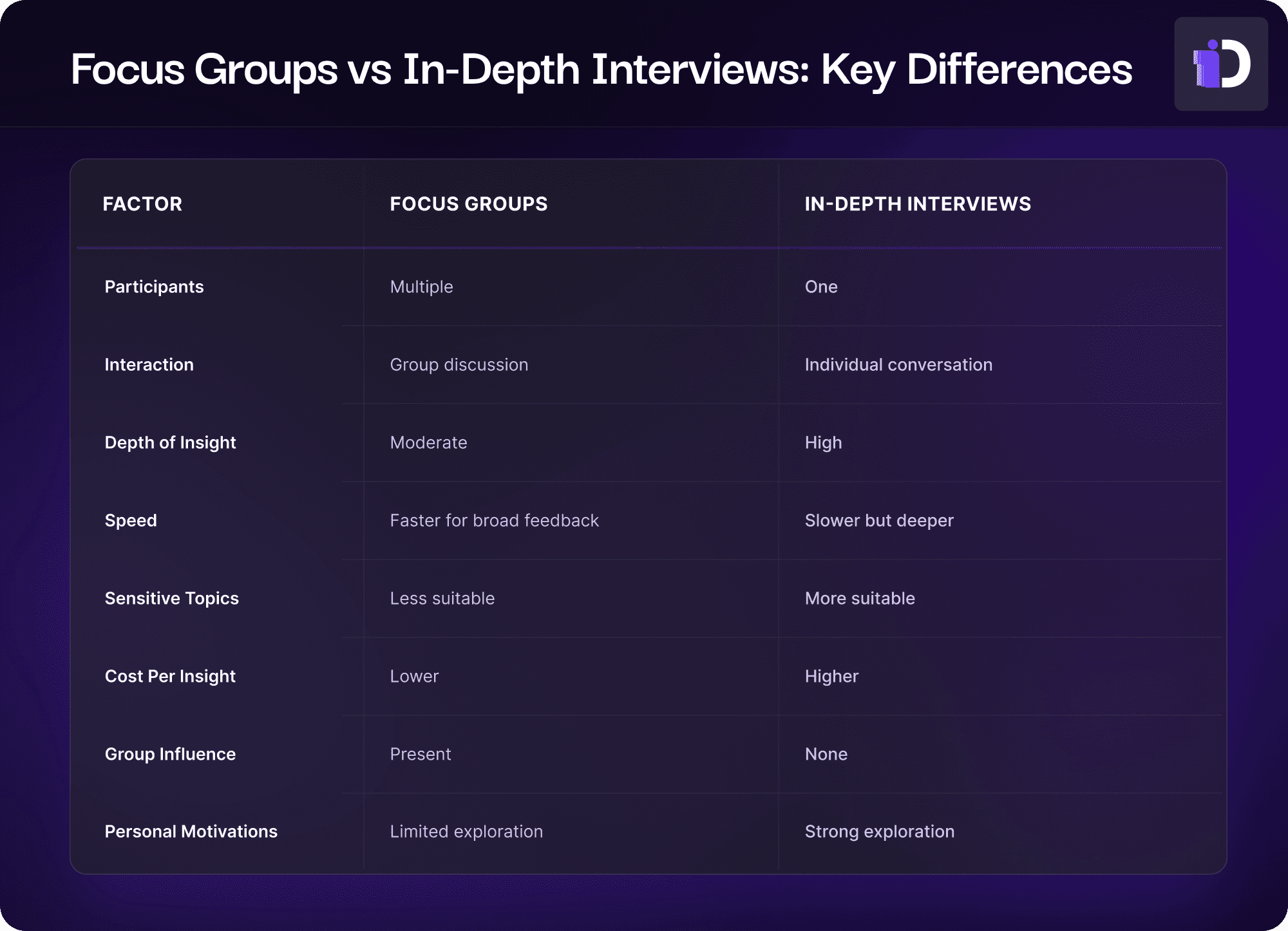
While both approaches fall under qualitative research methods, their strengths differ significantly.
The choice often depends on whether the research objective requires breadth of perspectives or depth of understanding.
When Should You Use Focus Groups?
Focus groups work best when participant interaction adds value to the discussion.
Exploring Multiple Perspectives
Researchers can gather opinions from several participants simultaneously, making it easier to identify common themes and contrasting viewpoints.
Testing Early Concepts
Focus groups are useful for evaluating reactions to:
New product concepts
Packaging designs
Advertising ideas
Brand positioning statements
The group environment often stimulates discussion that generates additional feedback.
Understanding Group Dynamics
Some decisions are influenced by social interactions and shared perceptions.
Focus groups help researchers understand how opinions form, evolve, and influence others.
Generating New Ideas
The collaborative nature of focus groups makes them particularly effective for brainstorming and exploratory research.
When Should You Use In-Depth Interviews?
In-depth interviews are often the preferred method when researchers need to understand the "why" behind behavior.
Exploring Sensitive Topics
Participants are generally more comfortable discussing personal experiences in a private setting.
Examples include:
Healthcare decisions
Financial behavior
Career choices
Personal challenges
Understanding Decision-Making
Interviews allow researchers to explore how consumers evaluate options, weigh trade-offs, and ultimately make decisions.
Mapping Customer Journeys
Researchers can investigate experiences across every stage of the customer journey in detail.
Investigating Complex Behaviors
For example, understanding why customers switch brands often requires probing beyond surface-level explanations.
These nuanced conversations are often difficult to achieve in a group environment.
The Advantages and Limitations of Focus Groups
Like any methodology, focus groups have both strengths and weaknesses.
Advantages
Faster feedback collection
Multiple perspectives in a single session
Dynamic discussions
Efficient idea generation
Cost-effective for exploratory research
Limitations
Dominant participants may influence discussion
Groupthink can affect responses
Social desirability bias may emerge
Less opportunity for individual depth
Sensitive topics may be underexplored
Researchers must carefully moderate sessions to ensure balanced participation and meaningful insights.
The Advantages and Limitations of In-Depth Interviews
In-depth interviews offer a different set of benefits and challenges.
Advantages
Richer insights
Greater privacy
Stronger emotional understanding
Detailed customer narratives
Flexible questioning and probing
Limitations
Smaller sample sizes
Longer research timelines
Higher moderation effort
Greater analysis requirements
While interviews require more time and resources, they often deliver a deeper understanding of consumer motivations.
Can You Combine Focus Groups and In-Depth Interviews?
Absolutely.
In fact, many of the strongest qualitative research programs use both methods together.
A common approach looks like this:
Phase 1: In-Depth Interviews
Researchers conduct interviews to uncover:
Motivations
Decision drivers
Pain points
Emotional responses
Customer experiences
Phase 2: Focus Groups
Researchers then use focus groups to:
Validate themes
Explore reactions collectively
Test ideas
Evaluate messaging
Identify broader patterns
This combination helps balance depth and breadth while improving confidence in research findings.
How Qualitative Research Is Evolving
The way organizations conduct qualitative research is changing rapidly.
Advances in technology have expanded what is possible beyond traditional in-person sessions.
Today's research teams increasingly use:
Remote Focus Groups
Participants can join discussions from anywhere, improving accessibility and geographic reach.
Video Interviews
Researchers can conduct one-on-one conversations remotely while preserving valuable visual and verbal context.
AI-Assisted Analysis
Artificial intelligence can help summarize discussions, identify themes, and accelerate analysis.
AI Moderated Interviews
AI-powered moderators can conduct interviews at scale while maintaining consistency across participants and markets.
As a Unified Human Insights Platform, Decode by Entropik enables research teams to conduct interviews and focus group discussions while bringing together quantitative, qualitative, behavioral, and emotional insights in a single workflow. Capabilities such as AI Moderated Interviews, automated transcription, summarization, analysis, and centralized insight management help teams move from research execution to decision-making faster.
Which Method Is Right for Your Research?
The right choice depends entirely on your research objectives.
Use Focus Groups When:
You need diverse opinions quickly
Group discussion adds value
You are exploring concepts or ideas
You want to observe reactions across participants
Use In-Depth Interviews When:
You need deeper understanding
Topics are sensitive
Individual motivations matter
Customer journeys require detailed exploration
Use Both When:
Research requires both breadth and depth
Strategic decisions require stronger evidence
Multiple perspectives need validation
You want a complete understanding of consumer behavior
Conclusion
Focus groups and in-depth interviews are not competing research methods.
They answer different questions.
Focus groups help researchers understand collective reactions, shared perceptions, and group dynamics.
In-depth interviews uncover personal motivations, emotions, experiences, and decision-making processes.
The most effective qualitative research programs recognize the value of both approaches and use them strategically to create a more complete picture of consumer behavior.
The key is not choosing the "better" method.
It's choosing the right method for the insight you're trying to uncover.
Frequently Asked Questions
What is the difference between focus groups and in-depth interviews?
Focus groups involve moderated discussions among multiple participants, while in-depth interviews are one-on-one conversations designed to explore individual experiences, perspectives, and motivations.
When should researchers use focus groups?
Focus groups are ideal for concept testing, idea generation, advertising feedback, product evaluations, and understanding group dynamics.
When should researchers use in-depth interviews?
In-depth interviews are best for sensitive topics, customer journey research, B2B studies, healthcare research, and understanding individual motivations.
Are focus groups or interviews better for qualitative research?
Neither is universally better. The best choice depends on the research objective, target audience, and type of insight required.
Can focus groups and interviews be used together?
Yes. Many research teams conduct interviews to uncover themes and then use focus groups to validate, expand, and refine those findings.
What are the advantages of in-depth interviews?
In-depth interviews provide richer context, deeper emotional understanding, greater privacy, and more detailed exploration of consumer behavior and decision-making.
Related Topic: