BCG's latest report shows AI now shapes how luxury consumers research and compare products. The bigger challenge isn't how shoppers use AI - it's how brands uncover the emotional signals that actually drive purchase decisions.
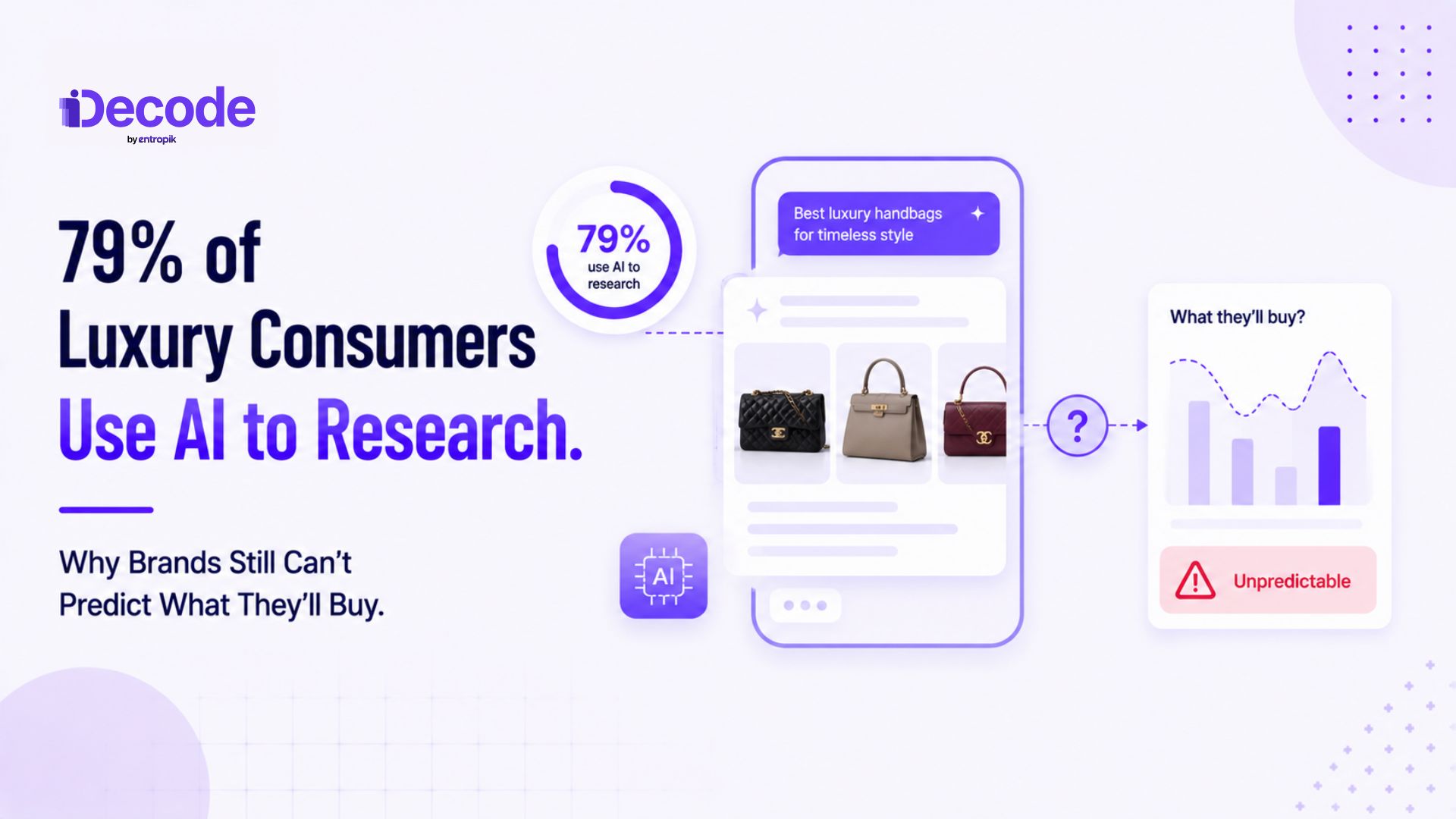
A BCG and Altagamma report confirms AI has reshaped how luxury shoppers evaluate products. What it doesn't tell you is why brands are still getting the consumer wrong.
The research gap hiding in plain sight
In July 2026, BCG and Altagamma published findings from their annual luxury market study. One number stood out: 79% of luxury consumers now use AI to research, compare, and evaluate products before making a purchase. Nearly 90% use AI or generative AI tools every week.

On the surface, this looks like a validation story. Luxury consumers are more informed, more intentional, more digitally engaged than ever before. BCG's Abheek Singhi, Managing Director and Senior Partner at BCG India, described it plainly: "Consumers are becoming more intentional in their purchases, placing greater emphasis on quality, craftsmanship and lasting value."
And yet the same report flags that 60% of fashion and luxury companies remain at "emerging or stagnating" levels of AI maturity.
These two numbers don't contradict each other. They describe the same problem from opposite ends.
Luxury consumers are using AI to form preferences. Luxury brands are not yet using AI to understand them.
What AI research actually captures
When a consumer asks a generative AI tool to compare two luxury handbags or explain what makes a Swiss watch worth €20,000, what gets captured is stated preference. The consumer is describing what they believe they value.
This is useful. But it is only one layer of a purchase decision.
Consumer insights research distinguishes between three types of signal:
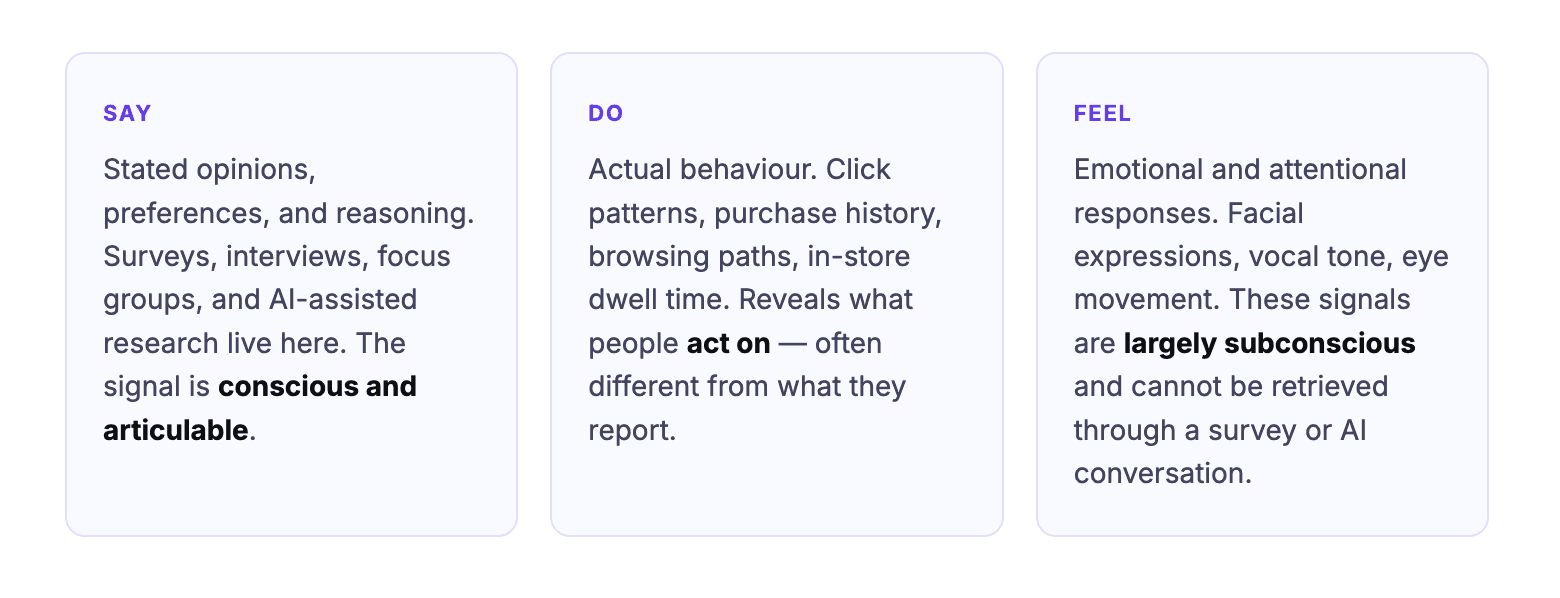
The BCG report documents a significant shift in "say" data collection — AI is accelerating how consumers articulate and compare preferences. What it does not address is the growing gap between those articulated preferences and the emotional triggers that actually drive luxury purchases.
Why the say–do gap is most acute in luxury
The say–do gap — the divergence between what people report and what they actually feel and do — exists across every category. In luxury, it is structurally amplified.
Luxury purchases are disproportionately emotional. A consumer buying a €500 fragrance rarely does so on rational evaluation alone. The purchase carries associations: identity, self-reward, aspiration, a specific sensory memory. BCG's data reflects this shift: consumers are moving away from status-driven motivations toward self-reward, time, health and longevity.
These new motivations are no easier to surface through stated preference research. Consumers can report a preference for "craftsmanship" or "lasting value" — but whether a specific product actually activates those values emotionally is not something they can reliably tell you.
This is not a failure of honesty. It is how preference formation works.
Psychologist Daniel Kahneman's research on System 1 and System 2 thinking establishes that fast, emotional, associative thinking drives the majority of purchase intent. Slow, deliberate, analytical thinking — System 2 — is what consumers engage when asked to explain their decisions to a researcher. The two systems produce different answers.
The result: a consumer tells an AI tool they prioritize "understated elegance." But in a consumer research session, their attention concentrates immediately on the logo. Their emotion signal shows positive arousal during the brand heritage story, and disengages during the craftsmanship explanation.
The survey said one thing. The emotion data said another.
The 60% maturity gap is a consumer insights gap
BCG's finding that 60% of luxury brands are at emerging or stagnating AI maturity is typically read as a technology adoption story. It is also a consumer insights story.
The specific AI capability most luxury brands are missing is the application of emotion recognition, attention measurement, and behavioural analytics to understand what shoppers actually respond to — not just what they say they prefer.
Most AI adoption in fashion and luxury today is happening at the operational layer: supply chain optimization, trend forecasting, generative content. These are valuable. But they compound the problem when the emotional truth of the consumer is not being captured at the insight layer.
A brand can optimize its content calendar using AI and still produce creative that misses emotionally — because it is optimizing against stated preferences and past engagement metrics, not real-time emotional response.
Effective consumer insights research in luxury requires capturing all three signal layers and triangulating across them.
What a complete consumer insights picture looks like
Consider a luxury fragrance brand conducting consumer research before a product launch. They run focus groups across three markets. Participants consistently describe a preference for "natural ingredients" and "authentic storytelling."
That is say data.
The brand also runs AI moderated interview sessions — structured qualitative interviews conducted alongside real-time emotion and attention measurement. During the sessions, participants' stated preference for "natural ingredients" is consistent. But the emotion data tells a different story: participants show the strongest positive arousal responses to the brand's manufacturing heritage and the design history of the bottle. The natural ingredients narrative generates low arousal throughout.
Note: The scenario above is illustrative. It depicts a pattern observed across consumer research studies where say-data and feel-data diverge — particularly in premium and luxury categories.
The brand launches with a heritage positioning. The campaign outperforms projections.
This is what triangulating say, do, and feel produces: not a contradiction of stated preferences, but a more complete picture of what actually resonates.
India: where this gets urgent
BCG's report calls out India directly — "rising affluence, digital-first consumers and evolving buying behaviour" are reshaping the country's luxury market. Filippo Bianchi, BCG's Global Head of Luxury, notes that "the next growth cycle will be driven by a more balanced consumer pyramid, deeper client relationships, broader lifestyle spending and local wealth."
India's luxury market is shifting from aspirational to appreciation-led, with consumers placing greater weight on quality, craftsmanship, and experience over status signalling. This shift is happening faster than traditional consumer research cycles can track.
India is also multilingual and culturally layered, with significant variation in how luxury is understood across cities, age cohorts, and income brackets. Building reliable consumer insights here requires methods that operate at scale across these contexts without losing emotional fidelity — a challenge traditional research panels were not built to handle.
What luxury consumer insights teams should be measuring
If you are building a consumer insights programme for luxury, the BCG data points to a specific gap to address.
You likely already have significant "say" data: consumer panels, brand equity surveys, social listening, and AI-assisted preference research. You may have "do" data via e-commerce and CRM behavioural analytics.
The question worth asking: how much of your consumer research captures emotional and attentional response — what consumers feel when they encounter your product, your store environment, your campaign?
Ad creative testing. Does your pre-testing process include emotional response data alongside stated preference scores? Facial coding and eye tracking consistently surface mismatches between what consumers say they find compelling and what actually captures their attention.
Product and concept evaluation. Are focus group outputs triangulated with real-time emotional signal? A concept a group says they "love" is not the same as a concept that activates positive emotional response at the moment of encounter.
Customer experience research. In luxury retail, verbal feedback and NPS capture deliberate evaluations. Attention and emotion measurement during in-store or digital experience reveals what actually drives satisfaction — and what breaks the luxury experience in ways consumers may not articulate unprompted.
How Decode helps consumer insights teams go deeper
Decode by Entropik is a consumer research platform that brings together all three signal layers — say, do, and feel — in a single environment. Consumer insights teams use Decode for product and concept testing, ad creative evaluation, brand tracking, and consumer journey research across CPG, FMCG, BFSI, and luxury categories.
AI moderated qualitative research — structured interviews at scale across 70+ languages, capturing real-time emotion and attention signals alongside the conversation
Facial coding and eye tracking — 90%+ facial coding accuracy across 62 facial expressions; 96% eye tracking accuracy for attention and gaze measurement
Voice emotion AI — vocal tone and prosody analysis to surface emotional cues that bypass self-report
Insights Hub — a centralised research repository where findings compound across studies, markets, and time
150+ global brands · 100M+ panel reach · 70+ languages · 17 patents · 90%+ facial coding accuracy · 96% eye tracking accuracy
See how Decode uncovers what luxury shoppers actually feel.
The BCG finding, reframed
BCG's conclusion is that "AI is becoming an integral part of the purchase journey." That is true from the consumer's side. The parallel opportunity — and the one the 60% maturity gap points to — is for brands to make AI an integral part of how they understand those consumers.
79% of luxury shoppers are using AI to tell you what they want. The question is whether your consumer research platform is equipped to understand what they actually feel.
Related Topic: