Price testing experiments with different price points to see how they affect demand and purchasing behavior, helping brands find the price balancing conversion with profitability before launch. Common methods include the Van Westendorp Price Sensitivity Meter, which identifies acceptable price ranges, and controlled A/B tests across comparable products rather than the same product at two prices.

A product can have great features, strong consumer demand, excellent branding, positive customer feedback and still fail because of pricing.
Price it too high, and potential customers may walk away.
Price it too low, and the business leaves revenue and profit on the table.
Finding the right price is one of the most important decisions a company can make. Yet pricing decisions are often influenced by assumptions, internal opinions, or competitor benchmarks rather than consumer evidence.
This is why leading brands invest in price testing before launching products, entering new markets, or updating pricing strategies.
What Is Price Testing?
Price testing is a research methodology used to understand how consumers perceive pricing and determine their willingness to pay for a product or service.
The goal is not simply to identify the lowest acceptable price. Instead, price testing helps organizations find a price point that balances consumer demand with business objectives.
Effective pricing research can help answer questions such as:
What price feels reasonable to consumers?
How sensitive are customers to price changes?
What price maximizes revenue?
What price drives adoption?
How much additional value do consumers place on premium features?
By answering these questions before launch, businesses can reduce pricing risk and make more confident decisions.
Why Price Testing Matters
Pricing affects far more than sales.
It influences profitability, brand perception, market positioning, and long-term growth.
Pricing Directly Impacts Revenue
Even small pricing changes can have a significant impact on business outcomes.
A product priced slightly below its optimal value may attract more buyers but generate lower profitability. Conversely, a price increase that appears minor internally could significantly reduce demand.
Price testing helps organizations understand these trade-offs before they impact revenue.
Consumers Don't Always Behave as Expected
One of the biggest challenges in pricing research is that stated preferences do not always match actual purchase behavior.
Consumers may say they would never pay a premium price, yet consistently choose higher-priced options when they perceive additional value.
This gap between what people say and what they do makes structured pricing research essential.
Competitive Markets Increase Pricing Risk
In crowded markets, pricing mistakes can be costly.
A poorly positioned price can affect customer acquisition, competitive differentiation, and profitability. Without research, pricing decisions often become educated guesses rather than evidence-based strategies.
What Questions Can Price Testing Answer?
Price testing helps businesses answer some of the most critical questions in product and marketing strategy:
Is the product priced too high?
Is the product priced too low?
What price point maximizes revenue?
What price point maximizes adoption?
How sensitive are customers to price increases?
What is the acceptable pricing range?
How much more will consumers pay for additional features?
What pricing strategy best supports market positioning?
The answers often influence product development, launch strategy, and long-term growth planning.
Common Price Testing Methods
There is no single pricing research method that works for every situation. The best approach depends on business objectives, product maturity, and research needs.
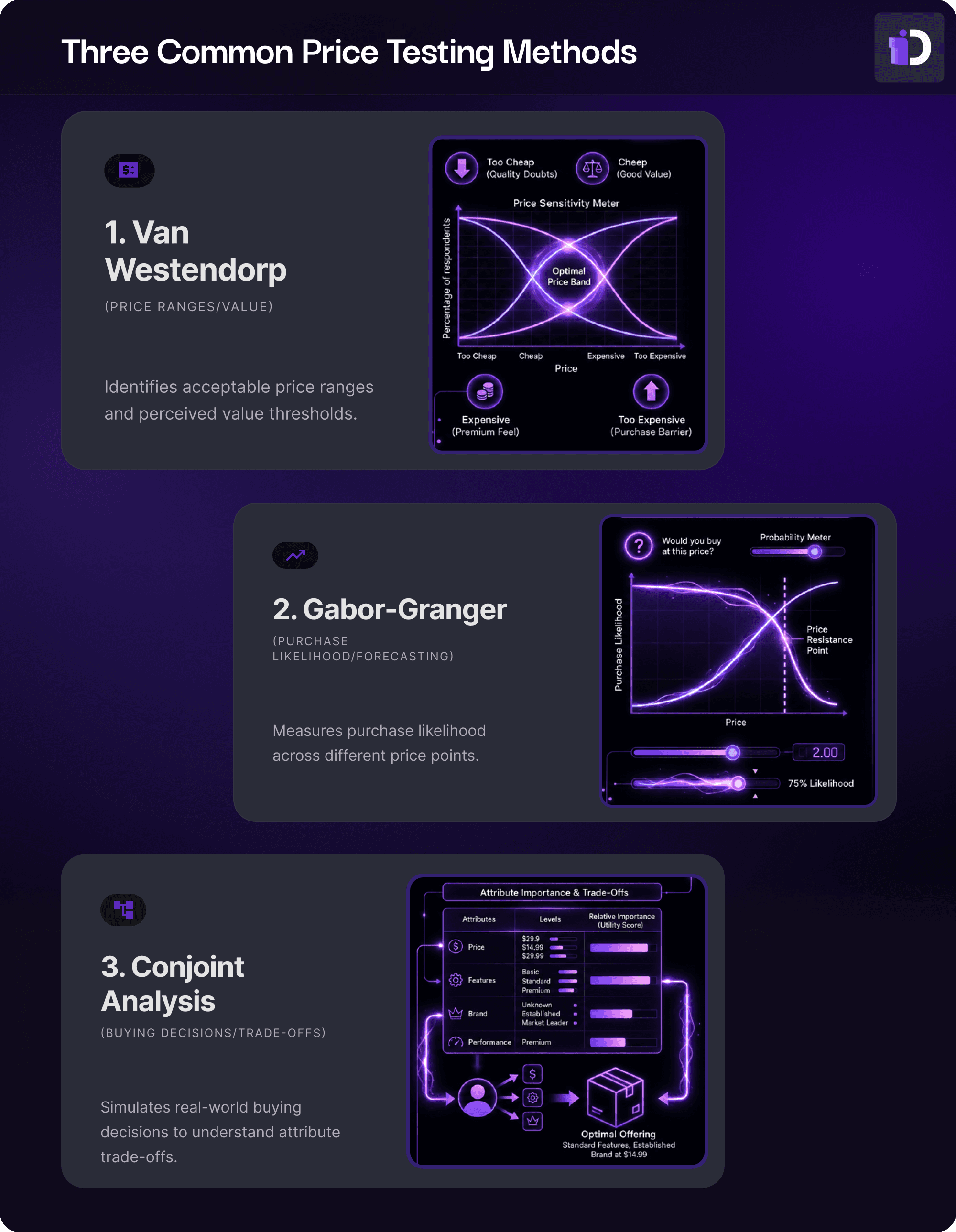
Van Westendorp Price Sensitivity Analysis
The Van Westendorp Price Sensitivity Meter is one of the most widely used pricing research methods.
Participants answer four key questions:
At what price is the product too cheap?
At what price is the product cheap?
At what price is the product expensive?
At what price is the product too expensive?
Researchers use these responses to identify acceptable pricing ranges and optimal price points.
Best for:
New product launches
Early-stage pricing exploration
Identifying perceived value thresholds
Gabor-Granger Pricing
The Gabor-Granger method evaluates purchase intent across multiple price points.
Consumers are shown different prices and asked how likely they would be to purchase at each level.
This allows researchers to estimate:
Demand curves
Revenue potential
Price elasticity
Purchase likelihood
Best for:
Revenue forecasting
Pricing optimization
Existing product pricing decisions
Conjoint Analysis
Conjoint Analysis goes beyond price alone.
It helps organizations understand how consumers make trade-offs between different product attributes, including:
Price
Features
Brand
Packaging
Service levels
Rather than asking consumers directly what they prefer, conjoint analysis simulates real-world decision-making scenarios.
Best for:
Product development
Feature prioritization
Portfolio optimization
Premium pricing strategies
Price Testing vs Guessing
Many pricing decisions are still made using assumptions, executive opinions, or competitor comparisons.
The difference between guessing and research-driven pricing is significant.
Guessing | Price Testing |
Based on assumptions | Based on consumer feedback |
Higher risk | Lower risk |
Limited confidence | Data-backed decisions |
Difficult to justify | Easy to defend |
Reactive | Strategic |
The strongest pricing decisions are supported by evidence rather than intuition.
Common Pricing Mistakes Brands Make
Even successful organizations make pricing mistakes when research is overlooked.
Pricing Based on Internal Opinions
Internal teams often have strong views on pricing. However, employee perceptions rarely reflect actual customer willingness to pay.
Ignoring Consumer Value Perception
Consumers do not buy products based solely on cost. They buy based on perceived value.
When value perception is misunderstood, pricing can become disconnected from customer expectations.
Copying Competitor Prices
Competitor pricing provides context but should not dictate strategy.
Different brands, audiences, and value propositions justify different pricing approaches.
Not Testing Premium Scenarios
Many businesses underestimate what customers are willing to pay.
Without testing premium options, organizations may leave substantial revenue opportunities unexplored.
When Should You Conduct Price Testing?
Price testing is valuable whenever pricing decisions carry meaningful business risk.
Common situations include:
New product launches
Product redesigns
Market expansion initiatives
Subscription pricing changes
Packaging updates
Feature introductions
Portfolio optimization projects
Brand repositioning efforts
The earlier pricing research happens, the more flexibility organizations have to make informed decisions.
How Modern Research Teams Approach Pricing Decisions
Today's pricing decisions are rarely based on a single survey question.
Leading research teams combine advanced quantitative research methods with broader consumer insights to understand not only what customers are willing to pay, but why.
Modern consumer insights platforms such as Decode by Entropik support pricing research through methodologies such as Conjoint Analysis, pricing studies, and advanced quantitative surveys. Combined with AI-powered reporting and analytics, these approaches help teams make faster, more confident pricing decisions while reducing reliance on assumptions.
Final Thoughts
Price testing is not about finding the cheapest possible price.
It's about identifying the price consumers are willing to pay while supporting business growth, profitability, and market positioning.
The most successful brands understand that pricing is too important to be left to instinct.
Instead of guessing, they use pricing research to understand consumer value perception, measure willingness to pay, and make decisions backed by evidence.
Because when pricing decisions are informed by research, businesses launch with greater confidence and a stronger chance of success.
Frequently Asked Questions
What is price testing?
Price testing is a research methodology used to determine how consumers respond to different price points and identify the optimal pricing strategy for a product or service.
Why is price testing important?
Price testing helps brands understand willingness to pay, reduce pricing risk, improve revenue performance, and make more confident pricing decisions.
What is willingness to pay?
Willingness to pay refers to the maximum amount a consumer is prepared to spend on a product or service based on its perceived value.
What is the Van Westendorp pricing model?
The Van Westendorp pricing model measures consumer perceptions of whether a product is too cheap, cheap, expensive, or too expensive to identify acceptable pricing ranges.
What is the difference between Gabor-Granger and Van Westendorp?
Van Westendorp identifies acceptable pricing ranges and value perceptions, while Gabor-Granger estimates purchase likelihood and demand at specific price points.
When should companies conduct price testing?
Organizations should conduct price testing before launching products, changing pricing strategies, introducing new features, entering new markets, or repositioning existing offerings.
Related Topic: