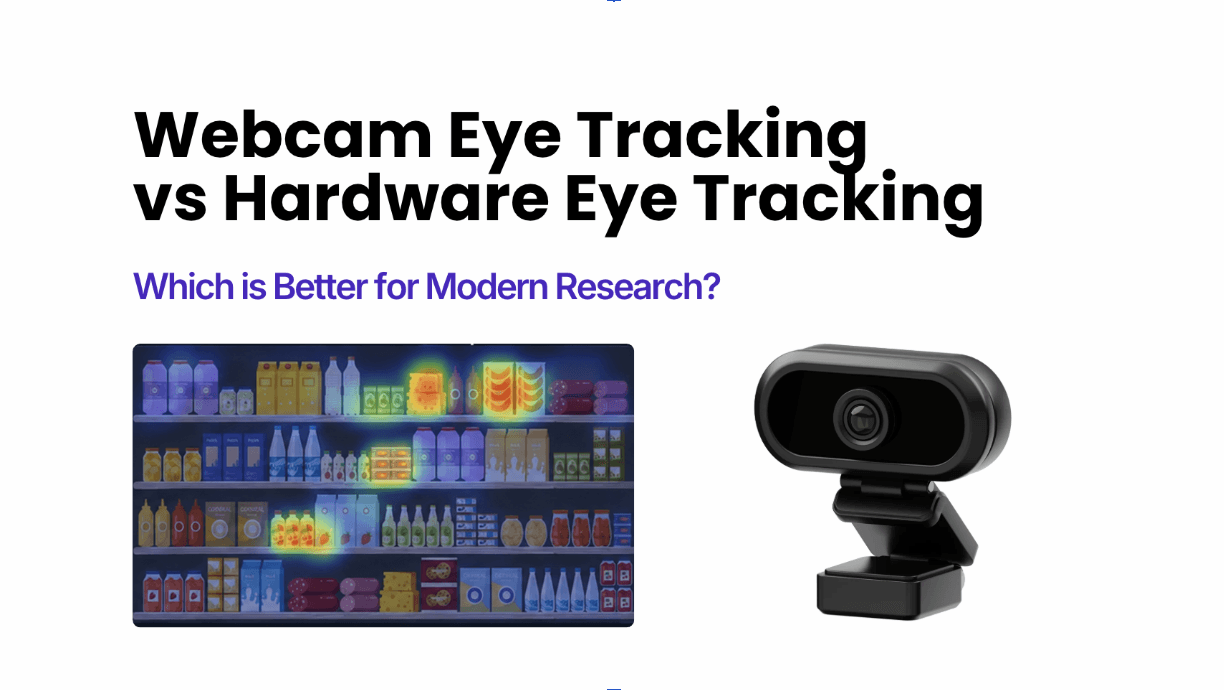
Webcam eye tracking uses a standard laptop or device camera to estimate gaze direction, making it accessible, scalable, and remote-friendly for large studies, while hardware eye tracking uses dedicated infrared sensors for higher precision, typically in a lab setting. Webcam-based tracking trades some accuracy for cost-effectiveness and reach, making it well suited to large-sample studies where directional insight matters more than pixel-level precision.
Eye tracking has transformed how researchers understand human attention.
For decades, organizations relied on specialized eye-tracking hardware to measure where people look and how they interact with products, advertisements, packaging, and digital experiences. While these systems delivered valuable insights, they often required expensive equipment, laboratory environments, and significant operational effort.
Today, advances in AI and computer vision have made webcam eye tracking a practical alternative. Researchers can now measure visual attention remotely using standard webcams, making eye tracking more accessible, scalable, and cost-effective than ever before.
So how does webcam eye tracking compare to traditional hardware eye tracking? And which approach is right for your research goals?
What Is Eye Tracking?
Eye tracking is a research methodology used to measure where people look, what captures their attention, and how they visually navigate content.
By understanding gaze patterns, researchers can uncover how individuals interact with:
Advertisements
Websites and mobile apps
Retail environments
Digital experiences
Marketing campaigns
Eye tracking provides objective behavioral data that helps organizations optimize design, communication, and customer experiences.
What Is Hardware Eye Tracking?
Hardware eye tracking uses dedicated infrared cameras and specialized sensors to measure eye movements with high precision.
These systems are commonly used in research laboratories, academic institutions, and highly controlled testing environments.
How It Works
Infrared light is projected toward the participant's eyes. Specialized sensors then track pupil movements and corneal reflections to calculate gaze direction and fixation points.
Common hardware eye-tracking providers include:
Tobii
EyeLink
Gazepoint
Laboratory-based eye-tracking systems
Advantages of Hardware Eye Tracking
Extremely high precision
Detailed gaze measurements
Suitable for controlled laboratory studies
Ideal for scientific and clinical applications
Limitations of Hardware Eye Tracking
High equipment costs
Dedicated laboratory setup requirements
Small participant sample sizes
Limited geographic reach
Dependence on trained operators
For many commercial research teams, these constraints can make large-scale eye tracking difficult to implement.
What Is Webcam Eye Tracking?
Webcam eye tracking uses a standard laptop or desktop webcam combined with AI-powered computer vision algorithms to estimate where participants are looking on a screen.
Unlike traditional systems, no specialized hardware is required.
How It Works
Modern eye-tracking software analyzes facial landmarks, eye position, head movement, and gaze direction through a participant's webcam. Machine learning models then estimate visual attention patterns and fixation locations.
Advantages of Webcam Eye Tracking
Remote participant testing
Lower research costs
Faster deployment
Larger sample sizes
Global audience access
No specialized equipment
Limitations of Webcam Eye Tracking
Slightly lower precision than dedicated hardware
Dependent on webcam quality
Influenced by lighting conditions and participant setup
However, advances in AI have significantly improved the reliability of webcam-based eye tracking over the past decade.
Webcam Eye Tracking vs Hardware Eye Tracking

While hardware systems remain the benchmark for maximum precision, webcam eye tracking offers greater flexibility and accessibility for most commercial research applications.
How Accurate Is Webcam Eye Tracking?
Accuracy is often the first question researchers ask when evaluating webcam eye-tracking technology.
Historically, webcam-based systems faced skepticism due to limitations in camera quality and computer vision capabilities. Early solutions struggled to achieve the consistency required for research-grade applications.
Today, the landscape is very different.
Advances in machine learning, gaze estimation algorithms, and facial landmark detection have significantly improved performance. Modern webcam eye-tracking platforms can achieve accuracy levels suitable for most commercial research use cases, including:
Packaging research
UX research
Website optimization
Creative evaluation
Decode by Entropik's webcam-based eye-tracking technology, enable reliable attention measurement across a wide range of digital experiences. This allows research teams to measure attention across advertisements, websites, packaging, and digital experiences without requiring specialized eye-tracking hardware. Insights generated from webcam eye tracking support attention heatmaps, gaze paths, Areas of Interest (AOI) analysis, and visual attention metrics.
For studies focused on understanding attention patterns rather than precise physiological measurements, webcam eye tracking often provides the right balance between accuracy and scalability.
When Should You Use Hardware Eye Tracking?
Hardware eye tracking remains the preferred option when maximum precision is required.
It is particularly well suited for:
Academic neuroscience research
Clinical and medical studies
Cognitive science experiments
Human factors testing
Laboratory-based behavioral studies
In these environments, small improvements in measurement precision can be critical to research outcomes.
When Should You Use Webcam Eye Tracking?
Webcam eye tracking is often the better choice when scale, speed, and accessibility are priorities.
It is commonly used for:
Consumer research
Creative testing
Packaging evaluations
Website usability testing
UX research
Shopper behavior analysis
Global market studies
Unified Insights platforms such as Decode by Entropik combine webcam-based eye tracking with Facial Coding and Voice AI to help researchers understand not only where people look, but also how they engage, respond, and make decisions throughout digital experiences.
Why Research Teams Are Moving Toward Webcam Eye Tracking
The shift toward webcam eye tracking is being driven by four major factors.
Speed
Studies can be launched quickly without laboratory scheduling or equipment setup.
Scale
Researchers can collect data from hundreds of participants across multiple markets and demographics.
Cost Efficiency
Organizations eliminate hardware investments, facility costs, and many operational expenses associated with traditional eye tracking.
Real-World Context
Participants can be tested in natural environments using their own devices, often producing insights that better reflect real-world behavior.
As organizations seek faster and more agile research approaches, webcam eye tracking continues to gain adoption across industries.
The Future of Eye Tracking Research
Eye tracking is evolving beyond measurement alone.
The next generation of attention research combines eye tracking with AI-powered analytics, predictive modeling, and multimodal behavioral data. Researchers are increasingly integrating attention metrics with emotional, verbal, and behavioral signals to build a more complete picture of customer experiences.
Predictive Eye Tracking represents another significant advancement in attention research. Solutions such as Decode use AI-trained attention models to predict likely gaze behavior, helping teams evaluate creative performance faster and at greater scale before investing in large research studies. Decode's Predictive Eye Tracking technology has demonstrated 95±2% spatial accuracy and enables attention analysis without participant recruitment or dedicated eye-tracking hardware.
As AI continues to advance, eye tracking will become faster, more accessible, and more deeply integrated into modern research workflows.
Frequently Asked Questions
What is webcam eye tracking?
Webcam eye tracking uses standard webcams and AI-powered computer vision to estimate where users are looking on a screen without requiring dedicated eye-tracking hardware.
Is webcam eye tracking accurate?
Modern webcam eye-tracking systems provide sufficient accuracy for most commercial research applications, including advertising, UX research, packaging testing, and shopper insights.
What is hardware eye tracking?
Hardware eye tracking uses dedicated infrared cameras and sensors to measure eye movements with high precision in controlled environments.
Which is more accurate: webcam eye tracking or hardware eye tracking?
Hardware eye tracking generally provides higher precision. However, webcam eye tracking offers a strong balance of accuracy, speed, scalability, and cost-effectiveness for most market research and UX applications.
Is webcam eye tracking suitable for UX research?
Yes. Webcam eye tracking is widely used for usability testing, prototype evaluation, website optimization, and digital experience research.
Why are companies adopting webcam eye tracking?
Organizations increasingly adopt webcam eye tracking because it lowers research costs, enables remote participation, supports larger sample sizes, and accelerates time-to-insight.
Related Topic: