Leveraging AI moderators and multimodal analytics to bridge the “say vs feel” gap in consumer research.
Company
Global Beverage Company
Date
Content
Entropik Team
In the highly competitive FMCG and alcoholic beverages category, understanding consumer preferences for RTD (ready-to-drink) beverages requires going beyond surface-level feedback. A leading global beverage brand set out to evaluate multiple RTD variants across six key Asian markets, with the goal of identifying what truly drives product preference, emotional engagement, and repeat consumption behavior.
To achieve this, the brand needed a research approach that could capture not just what consumers say, but also how they feel during the experience—across diverse cultures and languages.
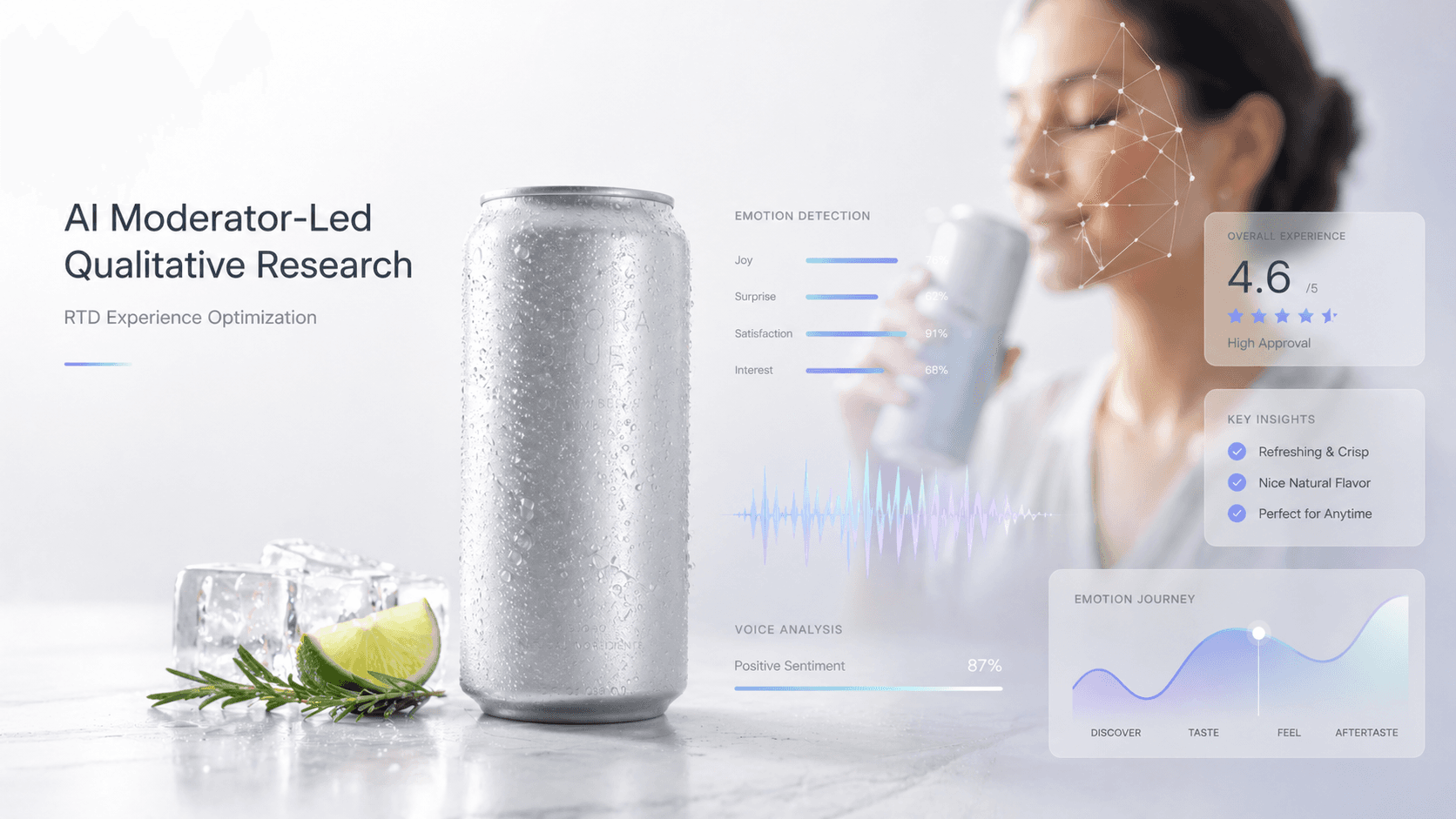
Using Decode AI Moderator, the team conducted 120+ qualitative interviews at scale, using AI-led moderation. This approach enabled the brand to deeply explore consumer reactions to packaging, taste, sensory cues, and real-life consumption occasions, while maintaining consistency across markets.
Problem Statement
Despite the importance of qualitative research in shaping product strategy, traditional approaches presented several limitations when applied across multiple geographies and product variants.
Moderator Dependency
The quality of qualitative interviews often depends heavily on the moderator. In this case, inconsistent probing styles and questioning techniques led to variability in the depth and richness of insights. This made it difficult to compare findings across markets or draw unified conclusions.
Multi-language Barrier
Conducting research across six Asian markets introduced significant linguistic and cultural complexity. Ensuring consistency in how questions were asked—and how responses were interpreted—was a persistent challenge, often leading to fragmented insights.
Emotional Blind Spots
Traditional qualitative methods rely primarily on verbal responses. However, consumers don’t always articulate their true feelings. Subtle cues such as hesitation, tone shifts, or facial expressions were often missed, creating blind spots in understanding genuine emotional reactions to RTD products.
Panel Quality & Availability
Sourcing relevant and high-quality participants across multiple markets proved difficult and time-consuming. This limited the scalability of research and slowed down the overall process.
Here’s how we helped them
To overcome these challenges, the brand adopted a next-generation AI-powered qualitative research approach, powered by Decode.
Decode AI Moderator
At the core of the solution was an AI-powered qualitative interview platform capable of adaptive moderation. The AI Moderator ensured consistent probing across interviews, reduced human bias, and enabled seamless execution across multiple languages and markets—without compromising depth.
Multi-modal AI Analytics
The platform leveraged multi-modal AI capabilities, combining:
Facial emotion recognition
Voice tonality analysis
Advanced text analytics
This allowed the brand to move beyond stated responses and uncover true consumer sentiment, emotional triggers, and subconscious reactions to different RTD beverage variants.
Centralized Repository & AI Copilot
All interviews, transcripts, and insights were stored in a centralized repository, making it easy for teams to access and analyze data in one place. The integrated AI Copilot enabled quick querying, synthesis, and insight discovery—significantly reducing manual effort and analysis time.
Automated Insight Generation
Instead of manually sifting through hours of interview footage, the platform automatically generated:
Structured summaries
Thematic clusters
Key insight highlights
Shareable video clips
This automation ensured faster and more consistent insight generation across all markets.
The Impact Experienced
By adopting AI-led qualitative research, the brand was able to transform both the scale and quality of insights.
Qualitative Interviews at Scale
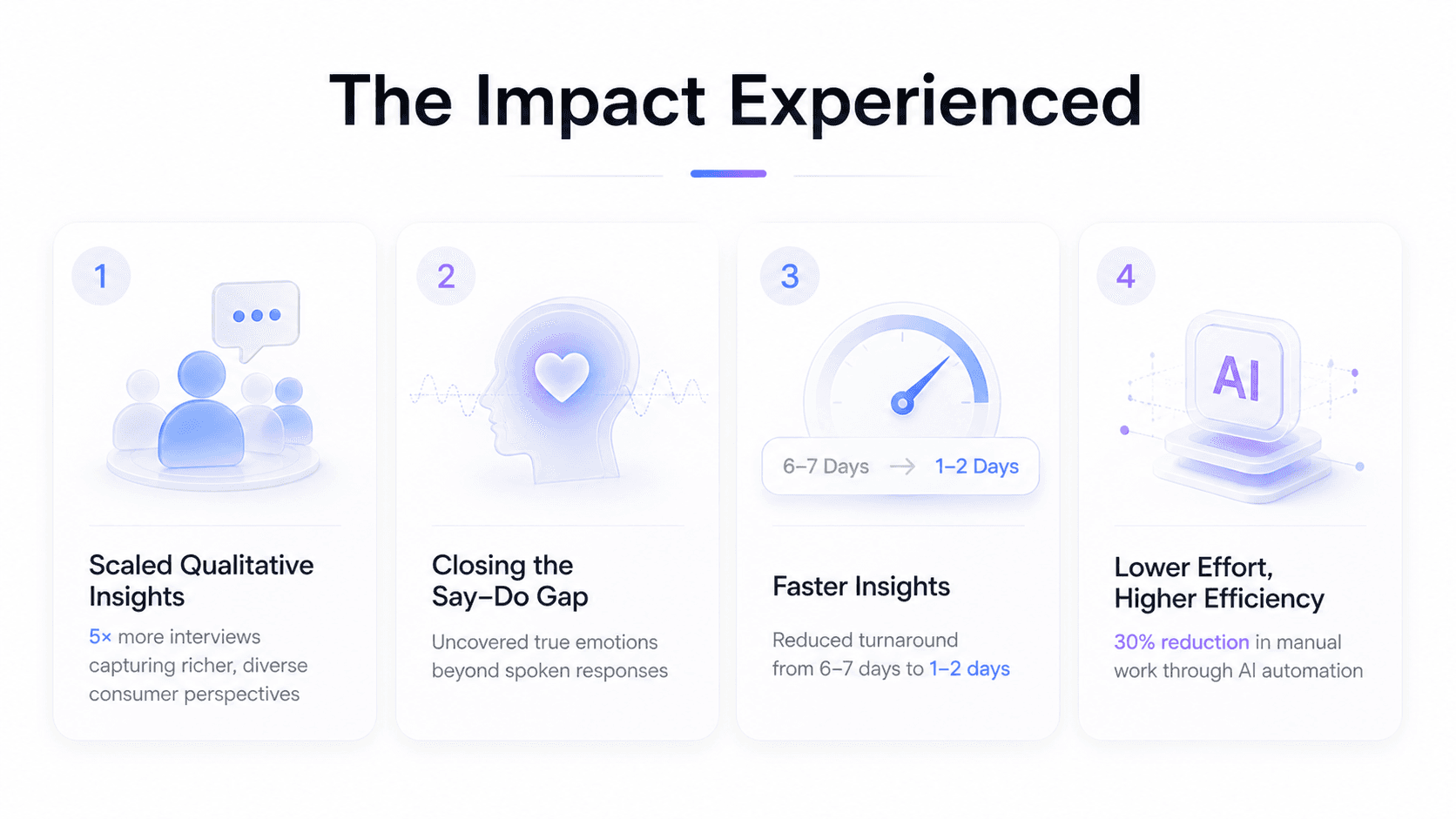
The study achieved a 5x increase in interview scale, enabling the brand to gather richer and more diverse consumer perspectives—without compromising consistency.
Bridging the Say–Do Gap
One of the most valuable outcomes was the ability to bridge the gap between what consumers say and what they actually feel. By capturing emotional signals alongside verbal responses, the brand gained a more accurate understanding of product experience.
Accelerated Time to Insights
The turnaround time for insights was reduced dramatically—from 6–7 days to just 1–2 days—allowing teams to make faster, data-driven decisions in a competitive market.
Reduced Cost & Operational Effort
Automation and AI-driven workflows led to a 30% reduction in manual moderation and analysis effort, improving operational efficiency while maintaining high research quality.
Conclusion
This case study highlights how AI-led qualitative research is redefining how FMCG and beverage brands understand consumers. By combining scalability, consistency, and deep emotional intelligence, Decode enabled the brand to unlock richer insights across markets—faster and more efficiently than traditional methods.
For brands looking to optimize RTD beverage experiences, product innovation, and go-to-market strategies, integrating AI into qualitative research is no longer optional—it’s a competitive advantage.