An effective market research survey template offers a logical question flow, from general to specific, with a mix of formats like multiple choice, rating scales, and open-ended questions. A pre-built, customizable template speeds up survey creation while letting researchers tailor questions to their objectives.

What is a Market Research Test?
A Market Research Test is designed to gather meaningful insights about a market, product, or service. A quantitative test typically includes designing structured surveys or experiments with closed-ended questions to gather measurable data. This data can then be analyzed to identify patterns and opportunities and gather data on competitors to drive smarter decision-making.
When Should I Use This Market Research Test?
A market research test is done at different stages of a product or service lifecycle- pre and post-launch. It should ideally be a continuous process to regularly analyze competitors and understand ever-evolving market dynamics to ensure they align with market expectations and preferences.
Depending on how complex a task is, it is also a good idea to follow it up with qualitative questions to get a more comprehensive understanding of the market and the consumer since it adds numerical validation, more context, and human perspective to the data.
Why Use a Market Research test?
Let us look at some of the key reasons Market Research tests are conducted:
Understanding Consumers: Market research helps identify customer preferences, needs, and expectations. This enables brands to tailor their offerings to meet those demands.
Market Segmentation: This test enables brands to identify and segment their target audience based on demographics, psychographics, and behavior. This segmentation allows brands to take a more strategic approach within the target group and provide more consumer personalization.
Competitor Analysis: Understand your strengths, weaknesses, and opportunities by understanding market dynamics through market research. You can leverage that information to develop strategies that can help you gain a competitive edge.
Product Development: Before investing in a product or service, market research tests validate the viability and acceptance of new ideas or features. This minimizes the risk of launching products and features that may not resonate with the target market.
How to Use This Market Research Template?
Follow the steps below to conduct a Market Research test on Decode platform:
Step 1: Log in to the Decode platform to access the dashboard homepage.
Step 2: Go to the left panel and select the Research button to get predefined template options for Qualitative and Quantitative research.
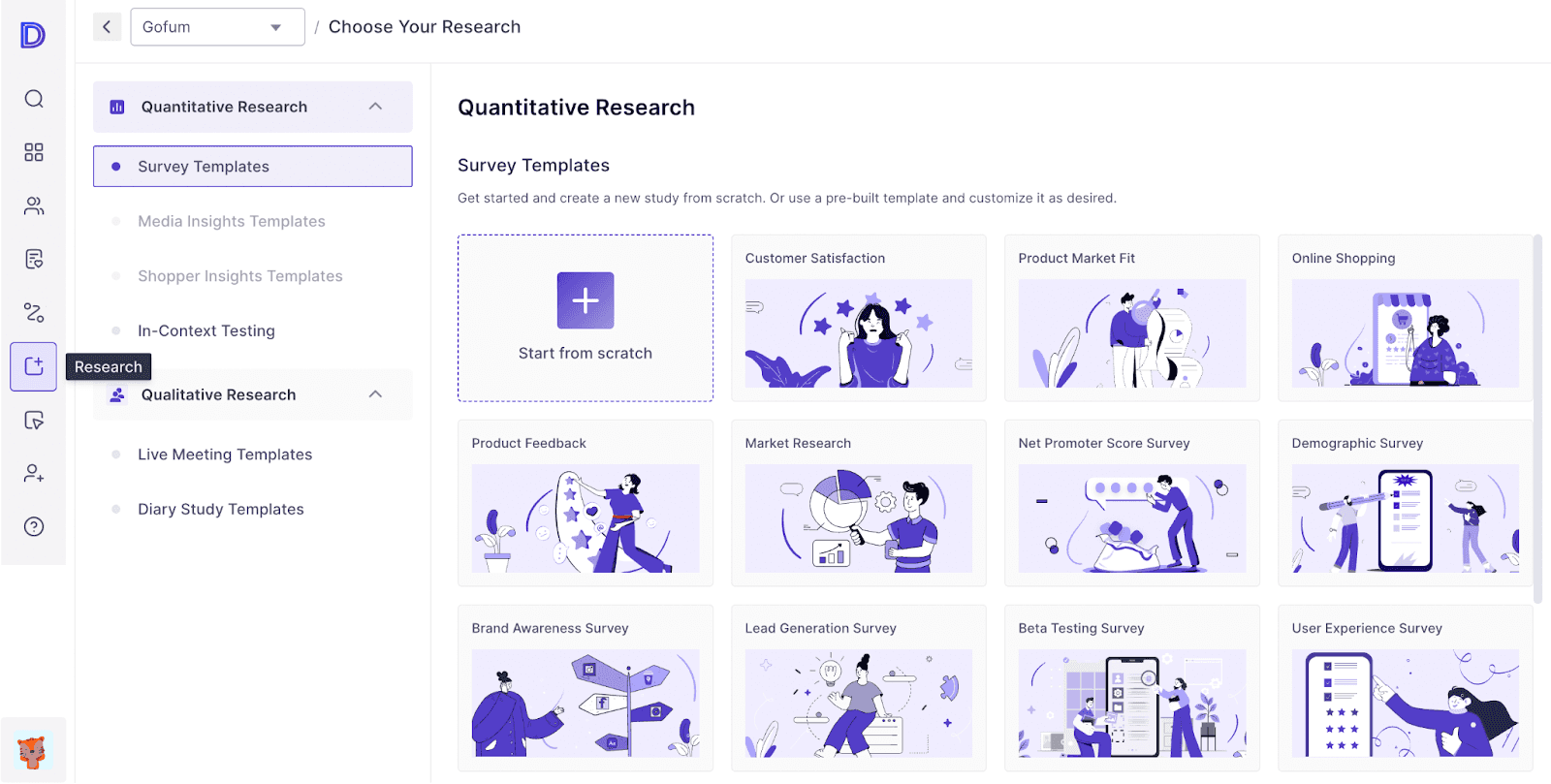
Step 3: Under Survey template options, select the Market Research block.
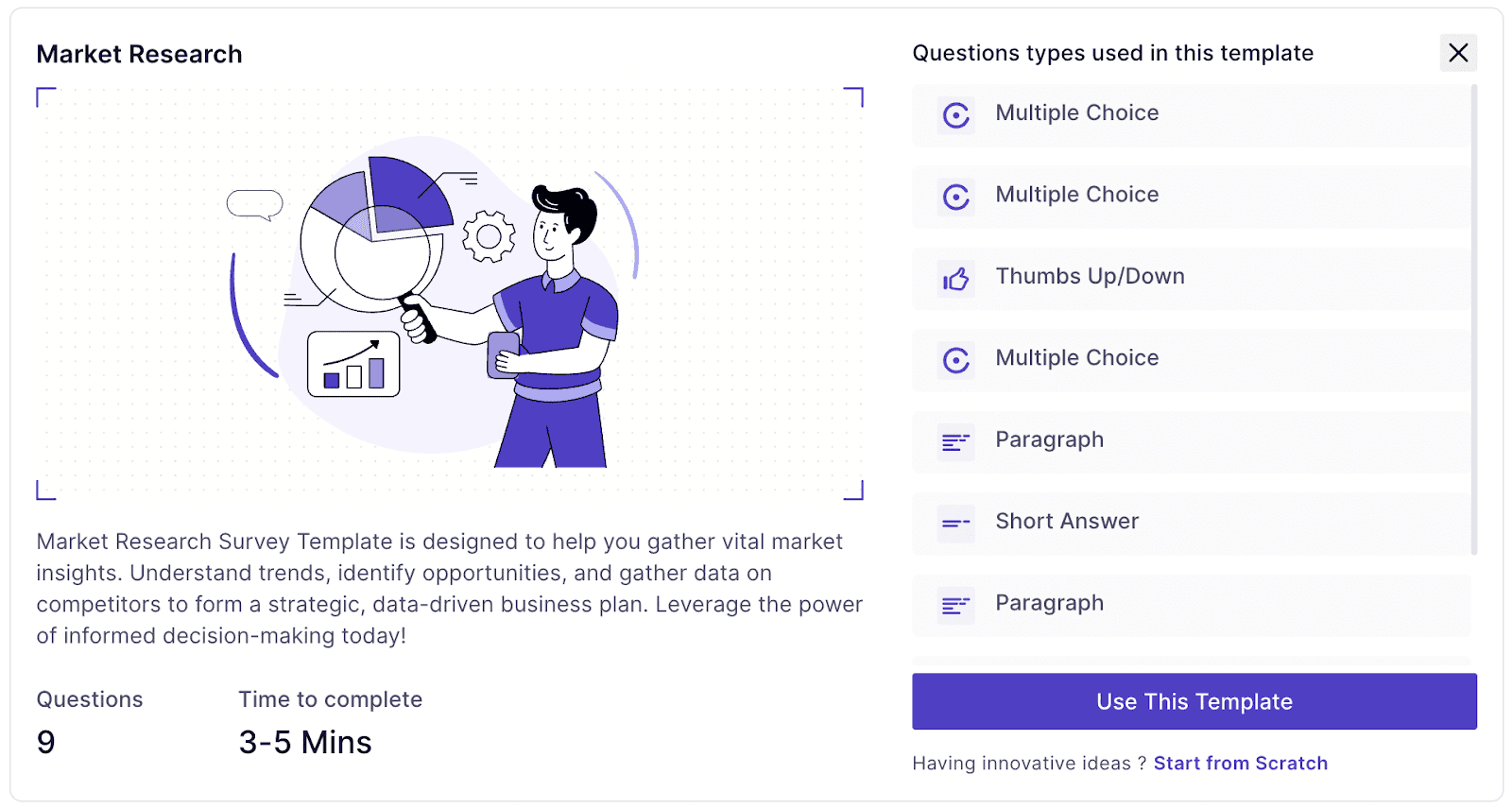
Step 4: Upon selecting, a dialog box will pop up. Click on the Use This Template button to get started.
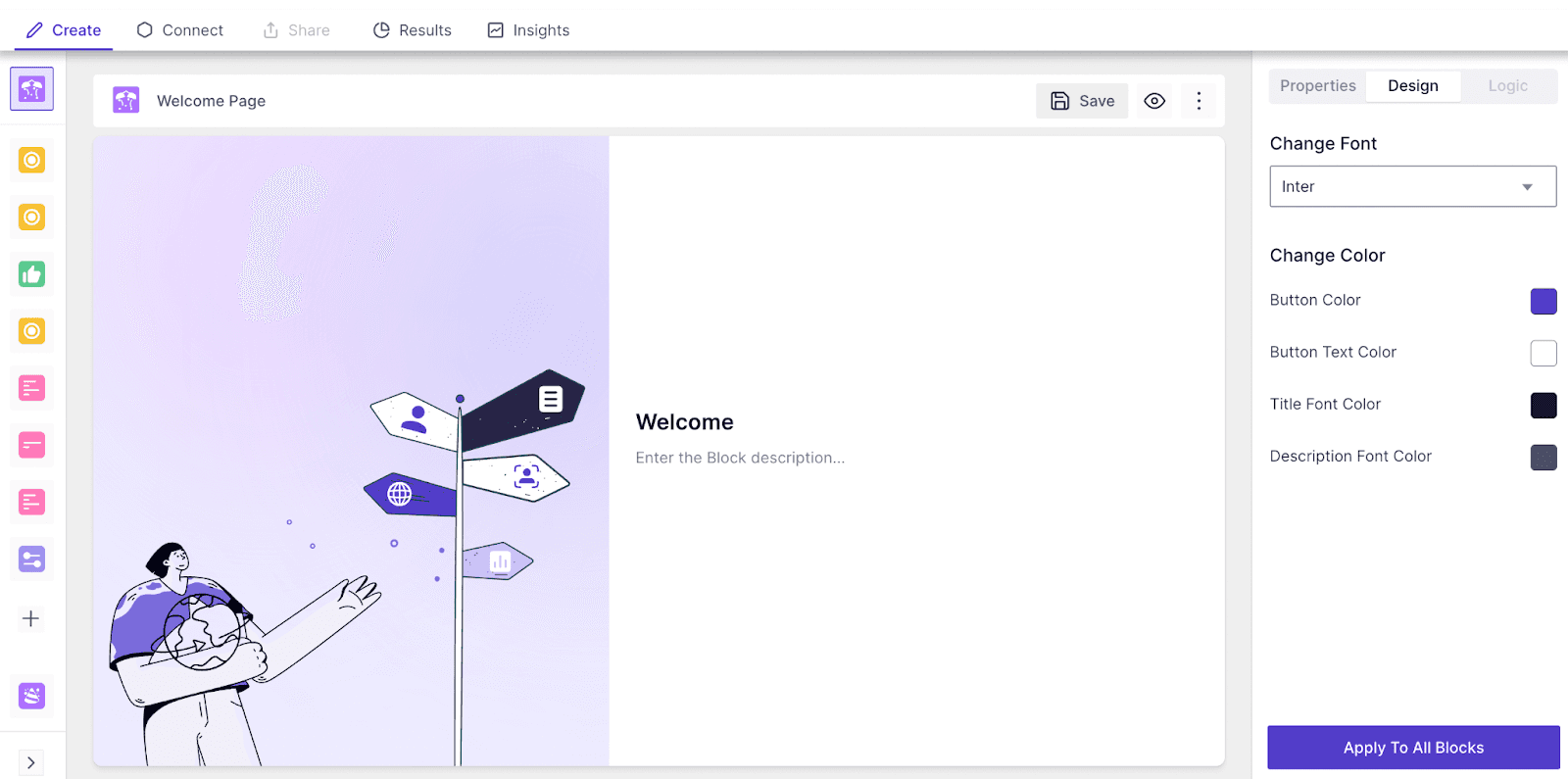
Step 4: A draft version of the study with a Welcome Page is now in front of you. You can add a test description on the page for the users. On the top left, type in the name.
Step 5: The left panel includes different block options for the survey. It can also be customized further by adding, deleting, and rearranging blocks. The right panel includes properties, design, and logic options for changing layouts, colors, etc. For example, you can replace the existing image on the welcome page and add a more relevant one.
Step 6: Click on blocks like Multiple Choice, Paragraph, Linear scale, etc., on the left to add your questions and answers, or add predefined sample survey questions as available on the template. Since the template is entirely customizable, add, delete, and change blocks and questions as required.
Once a test is set up, you can preview and publish the test with buttons available on the top right of the page. This can be shared with internal or external respondents through a test link or QR code.
Best Practices for Market Research Test
1. Define Clear Objectives: Be clear about the goals and objectives of your market research test. What kind of information are you looking for? Have a well-defined purpose to ensure your research efforts are focused and results-oriented.
2. Use Mixed-Method Research: To comprehensively understand consumers, combine qualitative and quantitative research methods. While quantitative data provides numerical insights, qualitative methods offer depth and context. Together, both approaches enhance the result of your findings.
3. Maintain Objectivity and Avoid Biases: Surveys and questionnaires should be designed objectively. Combining new-age technologies like Facial Coding and Eye tracking in your research process eliminates bias to a large degree. It ensures that your findings accurately reflect the true sentiments and behaviors of your test respondents.
4. Update Research Methods: As market dynamics change, so should your research methods. Regularly review and update your research approaches by embracing innovative tools and technologies that can enhance the efficiency and accuracy of your data collection and analysis to stay relevant.
5. Ethical Practices: Adhere to ethical standards in your research, respecting the privacy and confidentiality of participants. Obtain informed consent and handle data with integrity. Ethical research practices uphold professional standards and foster trust with participants and stakeholders.
Frequently asked questions
1. What are the key components of a market research plan or template?
Key components include research objectives, target audience definition, chosen methodology, timeline, and a plan for how findings will be analyzed and applied.
2. What types of market research methods are commonly used?
Common methods include surveys, focus groups, in-depth interviews, competitive analysis, and secondary research using existing industry data.
3. How should businesses choose the right market research methodology?
The right methodology depends on the specific research question qualitative methods suit exploring motivations, while quantitative methods suit measuring prevalence or testing hypotheses at scale.
4. Why is defining clear objectives important before starting market research?
Clear objectives ensure the research design, questions, and analysis stay focused and produce genuinely useful, actionable findings rather than unfocused data collection.
5. How often should businesses conduct market research?
Frequency depends on the industry's pace of change, but many businesses combine ongoing tracking research with targeted studies before major strategic decisions.
Related Topic: