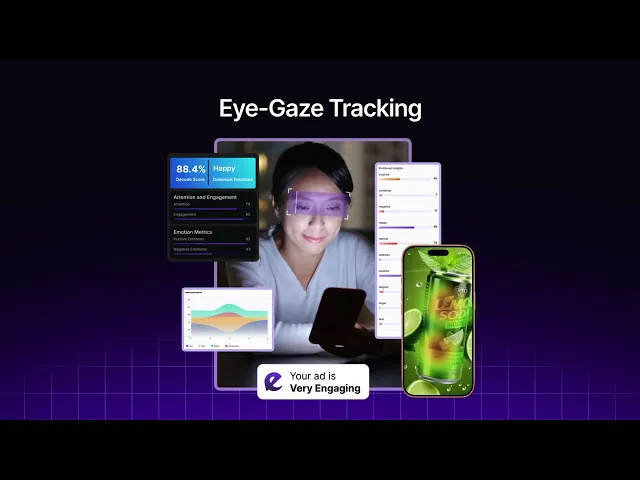
Eye gaze tracking measures exactly where a person looks on a screen or visual stimulus, using camera input and machine learning to map gaze coordinates and reveal what captures attention. Unlike click tracking, which shows only what users act on, gaze tracking reveals pre-click behavior, showing what people notice and overlook before taking any action at all.
In a digital environment filled with competing visuals, understanding attention has become essential.
Before users click, scroll, or convert, they look.
Eye gaze tracking technology helps organizations understand where users focus their attention, how long they engage with specific elements, and which parts of a screen are ignored. For product teams, marketers, and UX researchers, this insight supports better design, stronger creative performance, and improved user experience.
This guide explains what eye gaze tracking is, how it works, and how it supports usability research and media testing.
What Is Eye Gaze Tracking?
Eye gaze tracking is a technology that measures where a person looks on a screen or visual stimulus.
It captures:
Visual focus points
Attention duration
Discovery speed
Engagement over time
Attention distribution across elements
Unlike click tracking or scroll depth analytics, gaze tracking analyzes pre-click behavior. It reveals what users notice before they take action.
Modern webcam-based eye gaze tracking solutions use computer vision and AI to estimate gaze direction remotely, making visual attention analysis more accessible and scalable.
How Eye Gaze Tracking Works
Eye gaze tracking systems use camera input and machine learning models to detect eye position and orientation. The system maps gaze coordinates onto the screen to determine which elements attract attention.
The data is then aggregated into visual outputs and attention metrics that help researchers interpret user behavior.
Today, remote eye tracking allows researchers to conduct studies outside of lab environments, enabling live website testing and media evaluation at scale.
Eye Gaze Tracking for User Research and Live Website Testing
In usability and experience research, eye tracking helps evaluate how users navigate through a website or product flow.
It provides clarity on whether users notice important elements such as:
Navigation menus
Calls to action
Product images
Pricing information
Key messaging
Key Metrics in Live Website Testing
Time Spent
The total time users spend viewing a specific section or element. This helps identify which areas hold attention and which are overlooked.
Average Time to First Fixation
How long it takes users to first notice a particular element. This indicates visibility and placement effectiveness.
Average Fixation Duration
How long users continue looking at an element after noticing it. Longer fixation often signals deeper processing or interest.
Second-wise Analysis for Live Testing
For live website and experience testing, advanced eye tracking platforms provide second-wise insights:
Second-wise Engagement
Shows how engagement levels change over time during a session.
Second-wise Attention
Tracks visual focus frame by frame, helping identify moments where attention increases or drops.
These time-based insights are especially useful for understanding user flow and identifying friction points within digital journeys.
Eye Gaze Tracking for Media and Creative Testing
For media testing, advertising creatives, and visual content evaluation, eye gaze tracking reveals what captures attention and what gets ignored.
This is particularly useful for:
Display ads
Video advertisements
Social media creatives
Product packaging
Brand messaging visuals
Key Visualizations
Heatmap
A visual overlay that shows where users looked the most. High-attention areas appear in warm colors, allowing teams to quickly identify visual hotspots.
Transparency Map
Highlights what participants actually noticed. Areas that received attention remain visible, while ignored areas appear darkened. This makes it easy to see which creative elements fail to attract attention.
Areas of Interest (AOI)
Specific regions such as logos, headlines, product images, or call-to-action buttons can be defined for detailed attention analysis. AOI metrics allow precise comparison across creative elements.
Key Metrics for Media Testing
Time to Discover
The time taken for users to first notice a specific element.
Earned Attention
Measures how much attention a particular element receives compared to others on the screen.
Creative Score (Video Only)
A performance score indicating how effectively a video captures and maintains viewer attention.
Second-wise Analysis for Media
Provides second-by-second insights into how attention and engagement change throughout a video or experience. This helps identify exact moments where interest drops or peaks.
These metrics help marketing and insights teams refine creative strategy with data-driven clarity.
Why Eye Gaze Tracking Matters
Understanding visual attention improves decision-making across:
UX design optimization
Conversion rate improvement
Advertising effectiveness analysis
Packaging and retail design research
Content hierarchy validation
Eye gaze tracking provides objective insight into how visual communication performs in real environments.
Instead of assuming what users see, teams gain measurable attention data.
Eye Gaze Tracking with Entropik
Entropik’s Eye Gaze Tracking technology, available at https://www.entropik.io/technology/eye-gaze-tracking, supports both live website testing and media evaluation.

Through webcam-based eye tracking integrated with behavioral intelligence frameworks, Entropik enables teams to:
Conduct remote visual attention studies
Analyze heatmaps and transparency maps
Define Areas of Interest for detailed evaluation
Track second-wise attention and engagement
Measure earned attention and creative effectiveness
By combining gaze tracking with broader behavioral and emotional analytics, teams gain deeper understanding of user experience and creative performance.
Final Thoughts
In digital environments where attention drives outcomes, eye gaze tracking provides valuable insight into what users truly notice.
From live website usability research to media testing and creative optimization, visual attention analysis supports more informed design and marketing decisions.
For growing teams and startups, scalable webcam-based eye gaze tracking offers a practical way to understand user behavior without complex lab setups.
Understanding attention is the first step toward improving experience.
Frequently asked questions
1. What is eye gaze tracking?
Eye gaze tracking is a research technique that measures where and how long a person looks at different areas of a screen, image, or physical space, revealing visual attention patterns.
2. How is eye gaze tracking used in market research?
It's used to understand which elements of an ad, package, or webpage capture the most visual attention, helping optimize design for better engagement.
3. What is the difference between eye gaze tracking and eye tracking in usability testing?
They use similar underlying technology, but gaze tracking in market research often focuses on attention to ads or packaging, while usability testing focuses on task-based interface navigation.
4. Does eye gaze tracking require specialized hardware?
Traditional studies use dedicated eye-tracking hardware, though many modern tools now offer webcam-based gaze tracking for more accessible, remote research.
5. What insights can eye gaze tracking provide that surveys can't?
It reveals objective, unconscious visual attention patterns that participants often can't accurately self-report, since they may not consciously remember what they looked at.
Related Topic: