Testing AI features with real users means measuring whether people understand, appropriately trust, and correctly rely on an AI feature, not just whether they can complete a task. A practical framework combines self-reported trust, behavioral trust metrics, and trust calibration analysis to reveal whether user reliance matches the AI's actual reliability.
Summary:
|
When teams put an AI feature through its paces they usually end up with two figures: one relating to task success and the other with regard to customer satisfaction. The feature might still be failing quietly even though both these figures appear to be very good.
AI features have introduced a kind of failure that traditional usability testing was not designed to identify. A user might carry out the task, give a high rating to the experience, and yet be wrong, since they accepted a wrong output without verifying it. In another case, a user can rate the feature very poorly and completely ignore it, even if it had worked every single time.
Neither of them appears to be a usability issue; both are trust issues, and trust can be measured.
The framework explains how it is to be done; it takes for granted that the fundamental methods have already been put in place—namely, goal-based tasks, think-aloud protocols, and moderated sessions—and what comes next is the additional layer.
What It Means to Test AI Features With Real Users
To test AI features on real users you have to find out whether people understand what the AI is doing, whether they trust it to the extent that it is actually reliable, and whether they depend on it correctly as a result.
Standard user experience testing can only tell us whether or not someone is able to use the feature; it fails to address two questions which determine whether an AI feature is a success after it has been launched.
Do users understand what the AI is doing? Not its architecture, but a mental model that it has of how it works—namely, what it bases its responses on, what it is good at, and where it is likely to go wrong.
Do they place trust in it in the correct amount? No, they do not place maximum trust, but rather a suitable amount considering how often it is correct.
The feature comes second, following general AI usability testing; you first have to make sure that people can use it, and then assess whether their reliance on it is justified.
Why Trust Calibration Is the Core Problem to Test For
There are two ways in which things can fail, and these act in opposite directions.
Over-trust is acting on incorrect AI output without checking. The user has more confidence in the system than its accuracy warrants, so errors pass straight through into their work.
Under-trust is ignoring or redoing output from a feature that is reliably correct. The system works and delivers nothing, because nobody uses it.
The aim is not to increase trust as much as it is to adjust it in line with actual reliability; if a team treats trust like a figure that should be raised as high as possible, it will release a feature that is excessively trusted and then regard the launch as a success.
Keep two terms separate. Trust is the user's belief about the system. Trustworthiness is the system's actual accuracy. The gap between them is what you are testing, and the clinical literature shows how wide that gap can be. In a controlled study, 27 radiologists reading 50 mammograms with a purported AI assistant scored around 80 percent accuracy when the AI was correct, but between 20 and 46 percent when it was wrong, depending on experience level. These were trained experts on their own subject matter, and incorrect AI advice still pulled them off correct judgments.
The gap exists at population scale too. In a study of more than 48,000 people across 47 countries, 66 percent reported using AI regularly while only 46 percent were willing to trust it. Use and trust have separated, which means usage metrics are not telling you what you think they are.
The scale of the exposure is growing. Gartner forecasts that AI agents will augment or automate half of business decisions by 2027, while noting these systems are neither a panacea nor infallible. Every one of those decisions runs through a person deciding how much to believe an output.
Three Layers of Measuring Trust in AI Features
No single metric captures trust. Three layers together produce something actionable.
Self-reported trust - What users say they believe.
Behavioral trust signals - What their actions show they believe.
Calibration analysis - Whether that belief matched reality.
Single layer one is unreliable since there is a discrepancy between stated trust and demonstrated trust in both directions. A number of participants talk about having a healthy amount of skepticism yet end up accepting all the claims. Others state that they distrust the feature even as they still rely on it. This is the well-known gap between what is said and what is done, the gap being more apparent because reliance occurs quickly and is often not noticed by the person who is doing it.
Self-Reported Trust: What to Ask and When
Use a short multi-item scale rather than one trust question. Four dimensions cover most of what matters:
Reliability. How often do you expect this to be correct?
Transparency. Do you understand how it produced that?
Reliance willingness. Would you act on this without checking?
Error-detection confidence. Would you notice if it were wrong?
The fourth item is the most diagnostic and the most often skipped. High reliance willingness plus low error-detection confidence is the profile of a user about to make an expensive mistake.
Give the scale three administrations: one at the baseline, one after each task, and one at the end. Trust does change during a session, especially following an error, and if you only take one measurement at the end of the session then that tends to average out the trust changes so that the result does not reflect any particular individual. The patterns from these usability testing questions translate easily into trust items.
Behavioral Trust Signals to Track
Four signals do most of the work:
Acceptance rate. How often the user takes the AI output as-is.
Verification rate. How often they check it against another source before acting.
Override rate. How often they discard or replace the output.
Edit distance. How much they change the output before using it, which sits between acceptance and rejection and is usually the most informative of the four.
These diverge from self-report regularly, and when they do, believe the behavior. Capturing them means instrumenting the session rather than relying on recall, where established click tracking practice carries over directly.
Watch post-error behavior specifically. After a visible AI error, users split three ways: those who verify more, those who abandon the feature, and those who carry on exactly as before. The third group is the one to worry about.
Calculating the Calibration Gap
The calculation is straightforward once you have both halves. For each interaction, compare the user's trust, stated or behavioral, against whether the AI output was actually correct.
That produces four states:
Well-calibrated. High trust when correct, low trust when wrong. The target.
Over-calibrated. High trust regardless of accuracy. Errors flow straight through.
Under-calibrated. Low trust regardless of accuracy. The feature delivers no value.
Inversely calibrated. Confidence is highest precisely when the system is wrong. The highest-risk pattern, and the one worth designing an entire release around fixing.
Inverse calibration usually traces back to presentation. Confident phrasing, a clean interface, or a plausible explanation makes wrong answers feel more credible than right ones. A randomized trial with 111 medical students found that misleading AI explanations significantly degraded diagnostic accuracy, while correct explanations gave no significant benefit over no explanation at all. The explanation hurt when it was wrong and did nothing when it was right, which is inverse calibration in miniature.
This analysis requires one thing many teams have not prepared: knowing the AI's actual accuracy for each session. Establish ground truth before testing, or you have trust scores with nothing to calibrate them against.
Testing AI Feature Comprehension
Comprehension testing checks whether a user's mental model of the AI matches how it actually works.
The investigation is straightforward: once some output has appeared, ask the participant to give their own explanation for why they believe the AI produced it. Don't accept as an answer "because it's AI"; keep pressing for a mechanism, no matter how crude it may be.
The responses are typically one of four types: the system has carried out a search, it has recalled something from my history, it has performed a calculation, or it has made an educated guess. The type of model in question is the one that decides what gets checked. A person who thinks that the feature searches live sources will not verify facts, while someone who believes it guesses will check everything.
Comprehension gaps explain most calibration failures. People cannot calibrate trust in a system they do not understand, so they fall back on surface cues: fluency, formatting, tone. Those cues are uncorrelated with accuracy, which is how inverse calibration develops. The broader catalogue of cognitive biases in user research is worth reviewing here, since several of them describe how users substitute an easy judgment for a hard one.
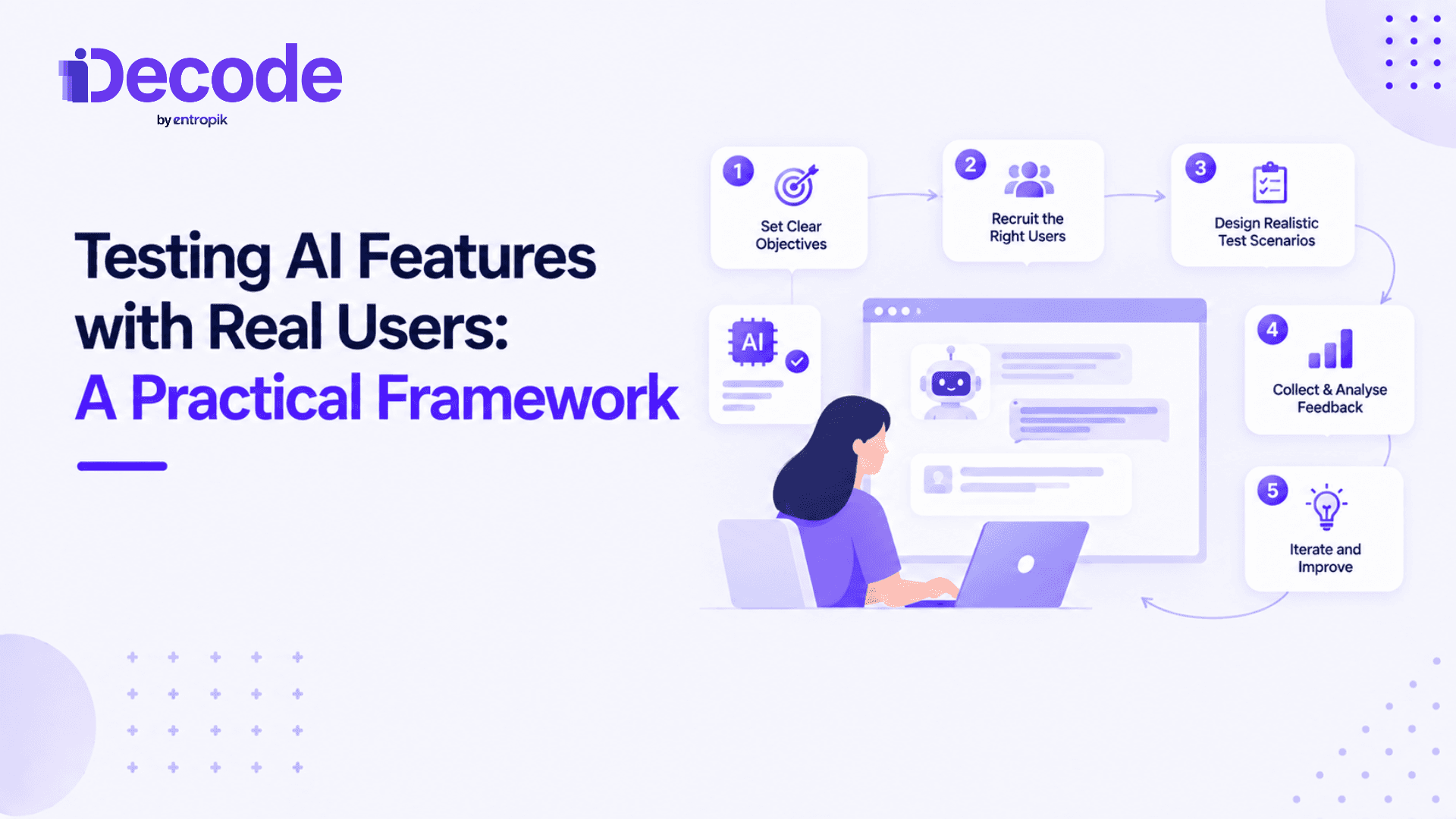
Designing a Human-AI Interaction Test Protocol
A session that produces all three layers runs in this order:
1. Baseline trust survey: Before any exposure. Captures priors, and lets you separate general AI attitude from a reaction to your specific feature.
2. Moderated task session with think-aloud: Goal-based tasks, real work, minimal scaffolding. The mechanics of running these are covered in this guide to conducting usability testing, with trust probes layered on top.
3. Behavioral observation: Record acceptance, verification, override, and editing as they happen. Do not reconstruct them afterward from memory or recording review alone.
4. A seeded error: The step that makes the protocol work. Include at least one realistic AI error per session, plausible enough that it does not announce itself, since an obviously wrong answer measures nothing. Asking hypothetically what someone would do if the AI were wrong produces a confident, useless answer. Watching what they do produces the finding.
5. Post-task comprehension and trust check: The explanation probe plus the four-item scale, immediately after each task rather than at the end.
Seeding errors needs an ethics note. Tell participants during debrief that some outputs were manipulated, and keep the practice away from live production accounts with real consequences. The principles in these strategies for managing AI risk apply to test design as much as to deployment.
Teams running this at volume often use AI moderated usability testing for the task portion, since the protocol is structured enough to hold up under consistent automated probing while the researcher focuses on calibration.
Building an Ongoing Trust Measurement Program
Trust is not a launch checkpoint. It moves with every model update.
Baseline at or before launch. Full protocol, all three layers, ground truth established. This is the reference point everything later gets compared against.
Active tracking through the first 90 days. Trust changes fastest early, as users move from novelty to habit. Lighter sessions at 30, 60, and 90 days catch that drift while it is still cheap to fix.
Quarterly monitoring after that. Enough to catch slow movement without becoming a research tax.
Re-run calibration after every meaningful model update. Retraining, a prompt change, or a new retrieval source can shift accuracy without changing anything a user sees. Your last calibration analysis described a system that no longer exists.
Two post-update signals deserve specific attention:
Trust scores drop while behavior stays stable. Users noticed something and are concerned, but habit is carrying them. This is an early warning with time to act.
Behavior shifts while trust scores stay flat. Users are relying differently without having consciously registered why. This is the more dangerous pattern, because nobody can articulate the problem and it will not surface in feedback.
Comparison across quarters only works if earlier data is findable and consistently structured, which is the case for keeping this in a research repository rather than a series of decks. Calibration is a longitudinal measure, and longitudinal measures die in slide folders.
Common Pitfalls When Testing Trust in AI Features
Relying on a single metric. A CSAT score cannot distinguish a well-calibrated user from an over-trusting one. Trust is multi-dimensional and needs to be measured that way, alongside the standard usability metrics you already track.
Measuring only self-report. Skipping behavioral data removes the gap that matters most, which is the distance between stated and demonstrated trust.
Treating trust as something to maximize. Rising trust scores can indicate a growing over-trust problem. Without accuracy data alongside them, you cannot tell which.
Skipping the seeded error. Hypothetical questions about AI mistakes produce hypothetical answers.
Testing once. A calibration result has a shelf life measured in model updates, not months.
Not establishing ground truth. Without knowing whether each output was correct, you have trust scores and no calibration.
Where Behavioral Signal Capture Strengthens Human-AI Interaction Testing
Some of the most useful trust signals are neither clicks nor words.
A participant reads an AI output, pauses slightly, then accepts it. Click data records acceptance. Self-report records satisfaction. The hesitation, which was the finding, is recorded nowhere.
Effort quietly shapes reliance too. The International AI Safety Report describes a randomized experiment with 2,784 participants who were less likely to correct erroneous AI suggestions when correcting them required extra effort. Users do not decide to over-trust. They decide checking is not worth it, in the moment, without narrating the decision, and that shows in behavior long before it appears in an interview.
Behavioral measurement adds a non-verbal layer to the signals above. Facial coding captures reaction at the moment an output appears, and eye tracking in usability testing shows whether attention landed on a confidence indicator, citation, or caveat before the user accepted the answer. That last point matters, because most trust interventions are things teams add to the interface and never verify anyone reads.
Decode's emotion AI technology reads 62 facial expressions at 90 plus percent accuracy, and eye gaze tracking runs at 96 percent accuracy, across a platform used by 150 plus global brands with 17 patents behind the underlying technology and support for 70 plus languages. Sessions run in the same structure as standard task-based research, so the trust layer sits on top of an existing protocol rather than replacing it. Teams comparing options can start with this roundup of user experience testing platforms, asking specifically what each one captures between the output appearing and the user acting on it.
Frequently Asked Questions
1. What is trust calibration in AI feature testing?
The alignment between how much a user trusts an AI feature and how reliable that feature actually is. Well-calibrated users trust correct outputs and question incorrect ones.
2. How is testing AI features with real users different from standard usability testing?
Standard usability testing measures whether people can complete a task. This framework measures whether they understood the AI, trusted it appropriately, and relied on it correctly, which are separate outcomes that a completed task can hide.
3. What's the difference between over-trust and under-trust?
Over-trust means acting on incorrect output without verifying it. Under-trust means ignoring a feature that is reliably correct. Both waste the investment, but over-trust also introduces errors into real work.
4. How do you measure whether users understand an AI feature?
Ask them to explain in their own words why the AI produced a given output. The mental model they describe predicts what they will and will not check.
5. What behavioral signals indicate trust problems with an AI feature?
Very high acceptance with near-zero verification suggests over-trust. High override rates on correct outputs suggest under-trust. Unchanged behavior immediately after a visible AI error is the strongest warning sign.
6. How often should you re-test trust after a model update?
Re-run the calibration analysis after any meaningful update, since retraining or prompt changes alter accuracy without changing the interface. Between updates, quarterly monitoring is usually enough.
7. Can you measure AI trust without running a full research study?
Partly. Acceptance, override, and edit-distance data can come from product analytics. Calibration needs ground truth on accuracy and comprehension needs a conversation, so a light session cadence still beats analytics alone.
The Practical Takeaway
The question worth answering about an AI feature is not whether people can use it. It is whether their reliance on it is justified.
That takes three things a standard test does not produce: a trust measure separate from satisfaction, behavioral data on what users did with the output, and ground truth on whether the AI was right. Together they give a calibration picture that tells you what to fix, usually presentation and comprehension rather than model accuracy.
Then re-run it after the next model update, because by then you are measuring a different system. Teams treating this as a standing program rather than a launch gate notice trust drifting while it is still a design problem, which is the discipline behind building user trust through AI-driven UX research more broadly.
Want to see the signals that sit between an AI output appearing and a user acting on it?