A mystery shopper is a hired individual who poses as a regular customer to evaluate aspects of the user experience, like website usability, customer service, and product selection, providing businesses with unbiased, real-world feedback. Unlike a typical research respondent who answers specific questions, a mystery shopper actively assesses the entire experience end-to-end, often uncovering issues a standard survey would miss.

If you are running a business, it would involve having competitors all around. You must know their strategies, strengths, and weaknesses to get an edge over them. Imagine having a secret shopper who visits your competitor's websites and can report to you with information about how they conduct business and connect with customers. You might even find a weakness that would enable you to gain a competitive advantage. That is how mystery shopping works. This article will dive into the significance of mystery shoppers in user research and how it has evolved into a crucial tool for understanding user experiences.
Who is a Mystery Shopper?
In user research, a mystery shopper is a person who is hired to assess various aspects of online behavior, such as website usability, product selection, customer service responsiveness, and the overall online shopping process. If you work in market research, you have probably heard of this term before. Think about them as undercover agents selected based on specific criteria that can find your organisation's strengths and weaknesses.
For any business, the target market is broadly divided into one of three categories: demographic, geographic, and behavioral segmentations. A mystery shopper echoes the sentiment of this diverse customer base and ensures you get real-world perspectives on users interacting with your business. As a representative to users of a product in user research, mystery shoppers are expected to provide companies with an understanding of their strengths and areas that require improvement.
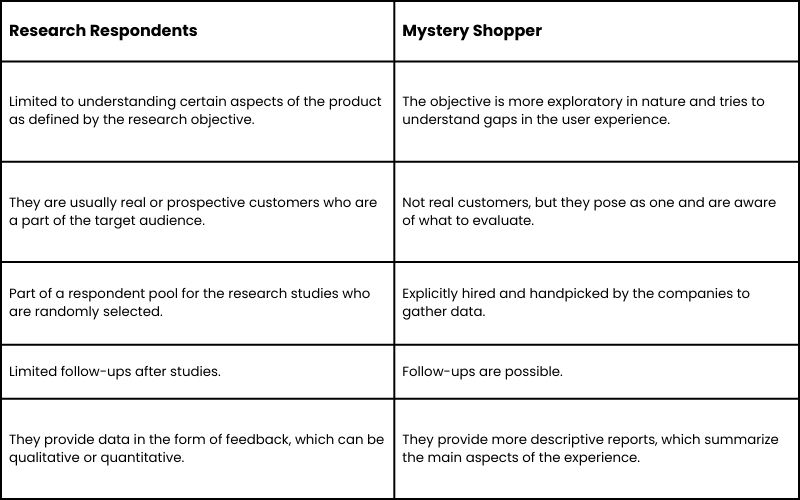
Mystery Shopper vs Research Respondents
While reading this article, you might be little confused about mystery shoppers and how different they are from regular anonymous respondents. Look at the table below to understand the key differences between the two:
{{cta-trial}}
Mystery Shopping- How It Works
A first-time user would have a different approach to your product compared to a regular customer. Mystery shoppers mold themselves into the shoes of a user based on research objectives and take that approach. They work to find underlying challenges that may impact users. The idea is to work backward to find pain points and enhance the overall business processes.
For any user research study, there is a set of steps to follow. This is how mystery shopping typically works:
Assignment: Mystery shoppers are assigned specific tasks or scenarios by a brand or a mystery shopping company. These tasks can include purchasing a product, asking specific questions, or evaluating the overall customer experience.
Evaluation: Mystery shoppers then take the test and interact with employees or use the products as regular customers would. During this process, they carefully observe and evaluate various factors.
Reporting: Mystery shoppers provide detailed feedback on their experiences after the visit. This feedback usually includes information about several things as required, like the product's usability, how easy or difficult it is to find specific elements and interact with them, and other relevant details.
Analysis: The collected data is then analyzed by the mystery shopping company or the brand to identify key strengths, weaknesses, and areas for improvement in the business's operations.
Feedback and Improvement: The business can use the feedback to make informed decisions about improving the product or other aspects of the research process.
Businesses often collaborate with specialized agencies based on specific criteria to handpick mystery shoppers. These providers evaluate and recruit mystery shoppers based on strict verification processes. The meticulous selection process ensures you can work with a diverse participant pool and have a reliable data source.
Advantages and Disadvantages of Mystery Shopping
According to a survey conducted by a leading user research institute, 75% of customers believe that mystery shopping provides more authentic insights into their experience than traditional surveys. Understanding the elements contributing to a successful mystery shopping mission is key to obtaining actionable insights.
While mystery shopping has a lot of value, it is essential to acknowledge both the pros and cons.
Advantages:
Unbiased Insights: It offers businesses genuine, real-world perspectives that extend beyond conventional surveys. Such evaluations capture the essence of customer experiences, offering a depth of understanding that surveys alone may not achieve.
Save on expensive redesigns: Understanding users before a product launch helps brands prevent expensive redesign costs at a later point.
Disadvantages:
Subjective perspectives: Choosing the right mystery shopper is important since personal biases might creep in, influencing evaluations, and the point of the study might be negated. It is better to use individuals who are not very close to the brand or the person conducting the study.
Ethical Dilemma: Mystery shoppers usually play the role of users and are meant to represent a target audience. Hence, it is imperative to ensure objectivity and discretion during the study.
Conclusion
In a dynamic field like user research, the market and the users evolve constantly. With AI technologies revolutionizing user research, mystery shoppers are at the front seat to witness this changing landscape. A mystery shopper in user research should be able to adapt to these shifts and have a keen understanding of emerging trends and technologies.
Product building and improvement is no longer a one-time process. It needs to evolve and change according to user expectations, and for that, continuous improvement is key. Ongoing customer engagement with mystery shoppers can establish customer feedback loops that can enable users to provide feedback sustainably.
Mystery shopping bridges a significant gap between a business and its users. It is a crucial piece of the puzzle that helps in building and completing a truly seamless experience by aligning a product according to user needs. Applying insights received from mystery shopping can help businesses apply the right decisions to remove roadblocks and promote positive changes to a product. These, in turn, improve user satisfaction and promote customer loyalty.
{{cta-trial}}
Frequently asked questions
1. What is mystery shopping in user research?
Mystery shopping involves researchers posing as regular customers to evaluate a business's service, environment, or product experience firsthand, without staff knowing they're being observed.
2. Why is mystery shopping valuable for research?
It captures authentic, unfiltered insight into the real customer experience, since staff behave naturally without knowing they're being evaluated.
3. What industries commonly use mystery shopping?
Retail, hospitality, banking, and restaurant industries commonly use mystery shopping to evaluate service quality and consistency across locations.
4. What should a mystery shopping evaluation typically measure?
Evaluations often measure service quality, staff friendliness, adherence to brand standards, and overall customer experience during the visit.
5. How does mystery shopping complement other user research methods?
It provides real-world, in-context observational data that complements more structured methods like surveys or interviews, adding authenticity to findings.
Related Topic: