Voice AI analyzes vocal cues like tone, pitch, and pace to detect emotions such as hesitation or confidence directly from speech, while sentiment analysis interprets the words and language people use, typically in text, to classify feedback as positive, negative, or neutral. Voice AI captures how something is said; sentiment analysis captures what is said, and combining both gives a fuller read on customer emotion.
Introduction
Understanding customer feedback has never been easier. Understanding customer emotions is a different challenge altogether.
Most organizations today use sentiment analysis to categorize customer feedback as positive, negative, or neutral. While useful, sentiment analysis focuses primarily on the words people use. It often misses the emotional signals hidden beneath those words.
This is where Voice AI introduces a new dimension to customer understanding.
By analyzing tone, pitch, pace, pauses, and vocal energy, Voice AI uncovers emotional reactions that text alone cannot capture. For researchers, marketers, and customer experience teams, this can reveal insights that would otherwise remain hidden.
In this article, we'll explore the differences between Voice AI and sentiment analysis, where each technology excels, and why modern research teams are increasingly using both approaches to better understand consumer behavior.
What Is Sentiment Analysis?
Sentiment analysis uses Natural Language Processing (NLP) to analyze written or spoken text and classify it as:
Positive
Negative
Neutral
For example:
"The product is fine."
Most sentiment analysis systems would classify this statement as neutral.
Similarly:
"The app works well."
Would likely be classified as positive.
The technology is valuable because it can process thousands of responses quickly, helping organizations identify broad trends across surveys, reviews, social media conversations, and customer support interactions.
Common Use Cases
Customer feedback analysis
Survey open-end analysis
Social media monitoring
Brand sentiment tracking
Support ticket categorization
However, sentiment analysis only evaluates the content of what was said, not how it was said.
What Is Voice AI?
Voice AI goes beyond language and analyzes the emotional signals embedded within speech itself.
Instead of focusing solely on words, Voice AI evaluates acoustic characteristics such as:
Pitch variation
Speaking speed
Voice intensity
Pauses and hesitation
Vocal energy
Frequency patterns
Tone fluctuations
These signals are processed using machine learning models trained to identify emotional states and emotional intensity. Modern Voice AI systems can analyze more than 30 acoustic parameters and detect emotions independent of language by focusing on vocal characteristics rather than word meaning.
Common Use Cases
Customer experience research
Media testing
Consumer behavior research
Emotion measurement
The Biggest Difference: Words vs Emotions
Consider this interview response:
"Yeah, I guess the experience was okay."
A sentiment analysis engine might classify this as neutral or mildly positive.
But Voice AI may detect:
Hesitation before answering
Reduced vocal energy
Slower speech rate
Subtle frustration in tone
The emotional signal tells a completely different story.
This distinction is critical because people often struggle to accurately articulate their emotions. In many cases, the emotional truth is revealed through vocal patterns long before it appears in their words.
Why This Matters in Consumer Research
Traditional research methods have largely depended on stated responses.
The challenge is that consumers do not always communicate exactly what they think or feel. Sometimes they struggle to explain emotions. Sometimes they rationalize decisions after the fact. Sometimes they simply don't realize what influenced them.
This is one reason why modern consumer research platforms such as Decode by Entropik increasingly combine conversational data with behavioral and emotional signals to build a more complete picture of consumer decision-making.
Rather than relying solely on what participants say, researchers can also understand how they react emotionally throughout a conversation.
Where Sentiment Analysis Falls Short
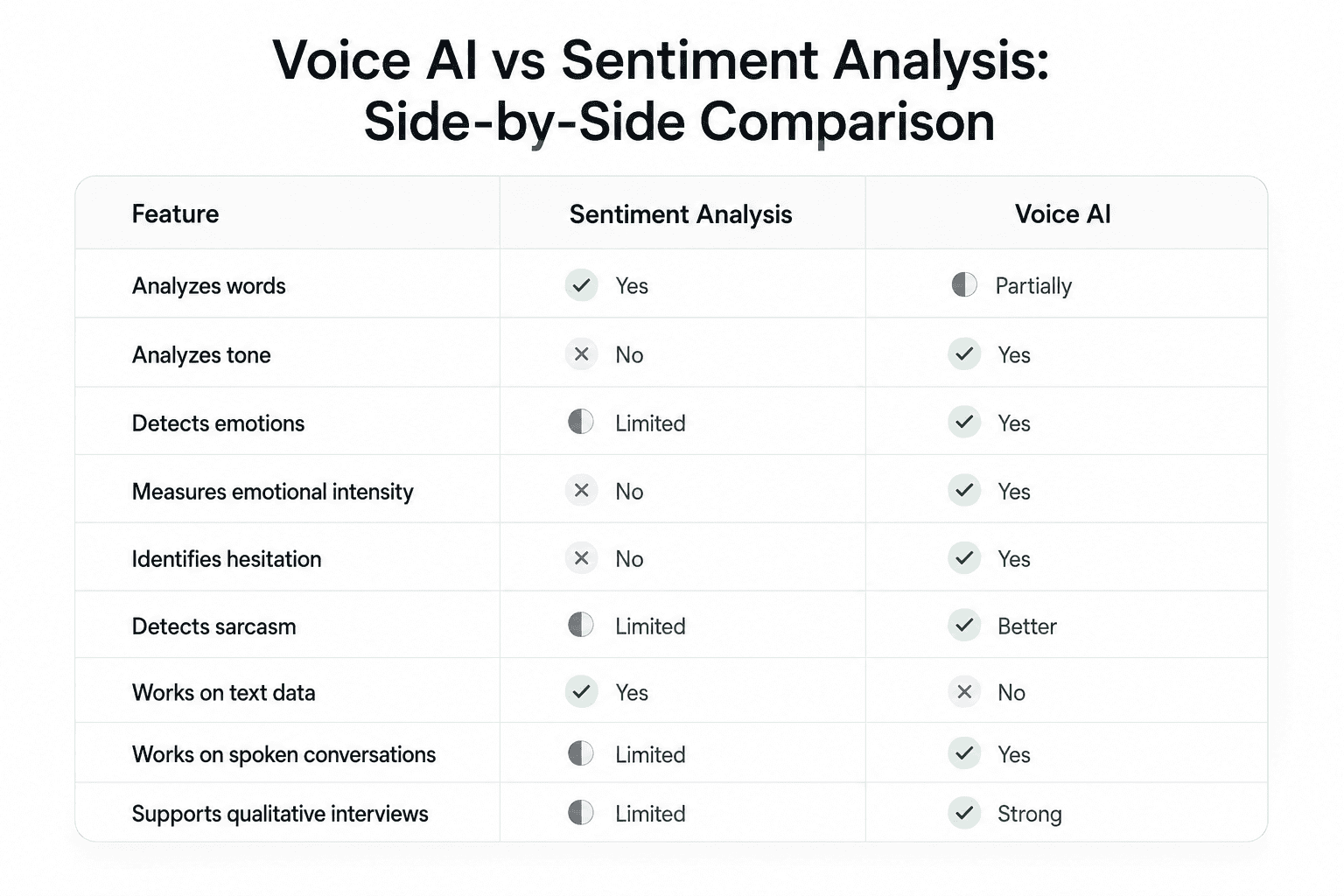
1. It Misses Emotional Intensity
Two people may say:
"I liked the advertisement."
One may sound genuinely excited.
Another may sound indifferent.
Sentiment analysis sees the same positive statement.
Voice AI recognizes the difference.
2. It Cannot Detect Hesitation
Hesitation often signals uncertainty, confusion, or discomfort.
These signals appear through:
Long pauses
Speech interruptions
Changes in speaking pace
Voice AI can identify these patterns, while traditional sentiment models cannot.
3. It Struggles With Sarcasm
A statement like:
"Well, that was amazing."
Can mean completely different things depending on tone.
Without vocal context, sentiment analysis frequently misclassifies sarcasm.
How Voice AI Helps Researchers Understand the Say–Do Gap
One of the biggest challenges in research is understanding the gap between what consumers say and what they genuinely feel.
A participant may claim to love a product concept, yet show uncertainty through vocal hesitation.
They may describe an advertisement positively while exhibiting low emotional engagement.
They may express confidence in a purchase decision while their tone suggests doubt.
Voice AI helps researchers identify these moments.
Platforms like Decode use Voice AI alongside qualitative interviews to analyze emotional signals across conversations, helping researchers uncover moments of excitement, frustration, uncertainty, and confidence that may not be evident in transcripts alone.
This creates a richer layer of understanding that complements traditional qualitative analysis.
Learn how Decode combines Voice AI with behavioral and emotional analytics to uncover deeper insights.
Voice AI vs Sentiment Analysis: Side-by-Side Comparison
The Best Approach: Combining Both
This is not a case of Voice AI replacing sentiment analysis.
The strongest insights come from combining both approaches.
Sentiment analysis helps organizations understand:
What people are talking about
Topics and themes
Positive and negative language
Common discussion patterns
Voice AI helps organizations understand:
How people feel
Emotional intensity
Confidence and hesitation
Hidden emotional reactions
Moments of engagement and disengagement
Together, they provide a far more complete understanding of customer experiences and consumer decision-making.
The Future of Customer Understanding
As research moves beyond surveys and traditional feedback collection, understanding emotion is becoming just as important as understanding opinions.
Customers may tell you what they think.
Their voice often reveals how they truly feel.
Voice AI enables researchers to capture these emotional signals at scale, helping bridge the gap between stated responses and real human reactions.
For organizations conducting qualitative interviews, customer experience studies, concept testing, or consumer research, the future is not simply analyzing words.
It is understanding the emotion behind them.
Frequently asked questions
1. What is the difference between Voice AI and sentiment analysis?
Voice AI analyzes vocal characteristics like tone, pitch, and pace to detect emotion, while sentiment analysis typically analyzes the words used in text or transcribed speech to gauge positive or negative feeling.
2. Which method better captures genuine customer emotion?
Voice AI can capture emotional cues independent of the words spoken, such as hesitation or frustration in tone, offering insight sentiment analysis alone might miss.
3. Can Voice AI and sentiment analysis be used together?
Yes, combining both provides a fuller picture sentiment analysis captures what customers say, while voice AI captures how they say it.
4. Can Voice AI detect emotions in real time during a call?
Yes, many Voice AI tools are designed to analyze tone and vocal patterns in real time, flagging emotional shifts like frustration as a conversation happens.
5. Does sentiment analysis work on non-English languages?
Many sentiment analysis tools support multiple languages, though accuracy can vary based on the availability of high-quality training data for a given language.
Related Topic: