Microexpressions are brief, involuntary facial expressions that flash across a person's face for a fraction of a second, often revealing a genuine emotional reaction before it can be consciously suppressed or masked. Because they happen faster than a person can control, researchers use facial coding technology to detect microexpressions during ad or product testing, capturing authentic emotional responses that stated feedback alone would miss.
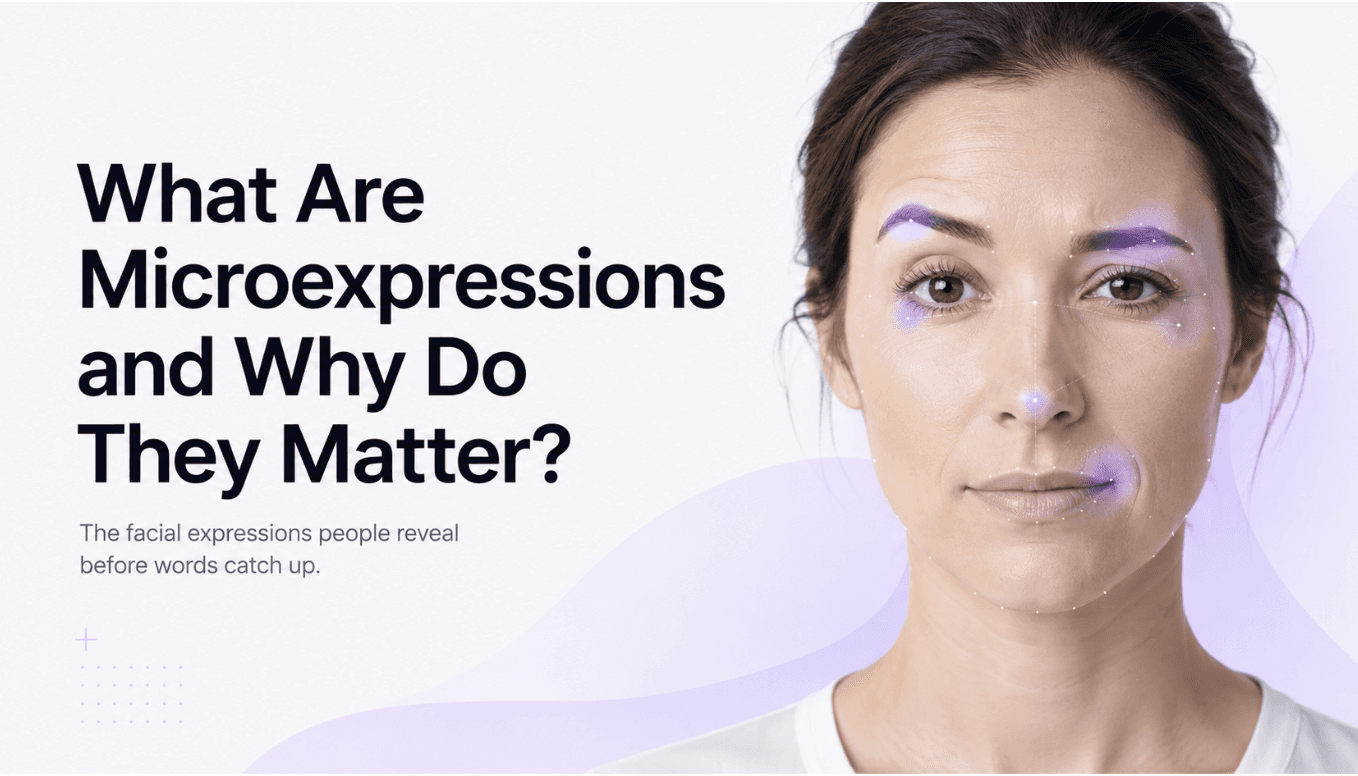
People don't always say what they truly feel.
A customer may claim they love a new product while showing a fleeting look of hesitation. A participant in a research interview may express enthusiasm for an advertisement, yet briefly display confusion or uncertainty. These subtle facial cues can reveal insights that words alone often miss.
So, what are microexpressions exactly?
Microexpressions are brief, involuntary facial movements that can reveal genuine emotional states before a person consciously controls their expression. Although they last only fractions of a second, they offer a unique window into how people truly respond to experiences, products, and messages.
What Are Microexpressions?
Microexpressions are extremely brief facial expressions that occur automatically and often last less than half a second. They appear when someone experiences an emotion before consciously regulating or masking their facial response.
Unlike regular facial expressions, which can be deliberate and sustained, microexpressions happen almost instantaneously and are difficult to suppress.
Because they occur involuntarily, psychologists and behavioral researchers often view them as valuable indicators of authentic feelings and subconscious responses.
Why Do Microexpressions Happen?
Human emotions are processed far more quickly than conscious thought.
When a person encounters a stimulus, whether it's an advertisement, product, conversation, or experience, the brain often triggers an immediate response before conscious control takes over. This can result in a fleeting facial movement that briefly reveals what someone is feeling in that moment.
This phenomenon is often referred to as emotional leakage.
For example:
A shopper may briefly display disappointment before verbally saying they like a product.
An interview participant may show surprise before explaining their opinion.
A customer may exhibit confusion when viewing new packaging, even if they struggle to articulate what feels unclear.
These subtle signals can provide context that traditional feedback methods may overlook.
Common Types of Microexpressions

What Do Microexpressions Reveal?
Microexpressions can provide valuable insight into:
Authentic emotional states
Internal conflict between thoughts and words
Confidence and uncertainty
Positive and negative engagement
Immediate reactions to experiences
Consider a product concept test. A participant may rate a concept positively, yet display a brief look of confusion when first encountering it. That moment may indicate issues with messaging, design clarity, or comprehension.
Similarly, advertisers often examine emotional signals during specific moments of a campaign to understand which scenes resonate most strongly with audiences and which fail to capture interest.
Why Microexpressions Matter in Consumer Research
People are not always aware of the factors influencing their decisions.
While surveys and interviews capture conscious opinions, many responses occur automatically and are difficult to verbalize. This is especially important because purchasing decisions are influenced by both rational thinking and emotion.
Traditional research methods help uncover what participants say, but behavioral signals help reveal how they respond in real time.
By combining both perspectives, research teams can develop a more complete understanding of customer behavior, engagement, and decision-making.
Modern consumer research increasingly incorporates facial expression analysis to uncover reactions that may never appear in survey responses or interview transcripts.
Can Humans Reliably Detect Microexpressions?
Detecting microexpressions is challenging.
Because they often last only a fraction of a second, even trained observers can miss them. Interpretation can also vary based on personal experience, context, and observer bias.
What one person interprets as uncertainty, another may perceive as surprise.
This makes consistent analysis difficult, particularly when evaluating hundreds or thousands of participants across multiple studies.
As a result, many organizations are turning to technology-driven approaches to measure emotional and behavioral signals more objectively.
How Facial Coding and AI Analyze Microexpressions
Advances in Facial Coding, facial expression analysis, and Emotion AI have made it possible to detect subtle facial movements at scale.
These systems use computer vision and machine learning to:
Identify facial landmarks
Track muscle movements
Detect emotional cues
Measure engagement patterns over time
Analyze responses consistently across large participant groups
Rather than relying solely on human observation, AI can process thousands of facial responses with speed and consistency.
Platforms like Decode by Entropik use facial expression analysis and behavioral AI to evaluate subtle facial movements during interviews, concept tests, media evaluations, and consumer research studies. This helps researchers identify moments of engagement, confusion, surprise, or hesitation as they occur.
Microexpressions vs Self-Reported Feedback
Self-Reported Feedback | Microexpressions |
Conscious responses | Subconscious responses |
Subject to bias | Observable behavior |
What people say | What they may genuinely feel |
Reflective | Immediate |
Requires articulation | Occurs naturally |
Neither approach is inherently better than the other.
The strongest insights often emerge when stated feedback is combined with behavioral evidence, providing a fuller picture of the customer experience.
The Future of Emotion Measurement
As organizations seek deeper customer understanding, emotion measurement is evolving beyond traditional surveys and interviews.
The future of behavioral research is increasingly multimodal, bringing together surveys, qualitative conversations, attention analytics, facial expression measurement, voice-based signals, and AI-powered analysis to create a richer understanding of how people think, feel, and make decisions.
This approach helps researchers move beyond assumptions and uncover the drivers behind customer preferences, engagement, and behavior.
Microexpressions may last only milliseconds, but the insights they reveal can influence product design, advertising effectiveness, customer experiences, and business decisions for years to come.
Frequently Asked Questions
What are microexpressions?
Microexpressions are brief, involuntary facial expressions that reveal genuine emotions. They typically last less than half a second and occur before a person consciously controls their expression.
Why are microexpressions important?
Microexpressions provide insight into authentic emotional responses that may not be communicated verbally. Researchers use them to better understand engagement, decision-making, and customer behavior.
How long do microexpressions last?
Most microexpressions last between 1/25th and 1/2 of a second, making them difficult to detect without training or technology.
Can microexpressions reveal true emotions?
Microexpressions often reflect genuine emotional states because they occur automatically before conscious control can alter facial expressions.
What is the difference between microexpressions and regular facial expressions?
Regular facial expressions can be deliberate and sustained. Microexpressions are involuntary, extremely brief, and more likely to reveal immediate emotional responses.
How are microexpressions used in market research?
Researchers use Facial Coding and Emotion AI to analyze facial responses during interviews, advertisements, product tests, and consumer studies to better understand audience reactions and engagement.
Related Topic: