Overall Score
80 / 100
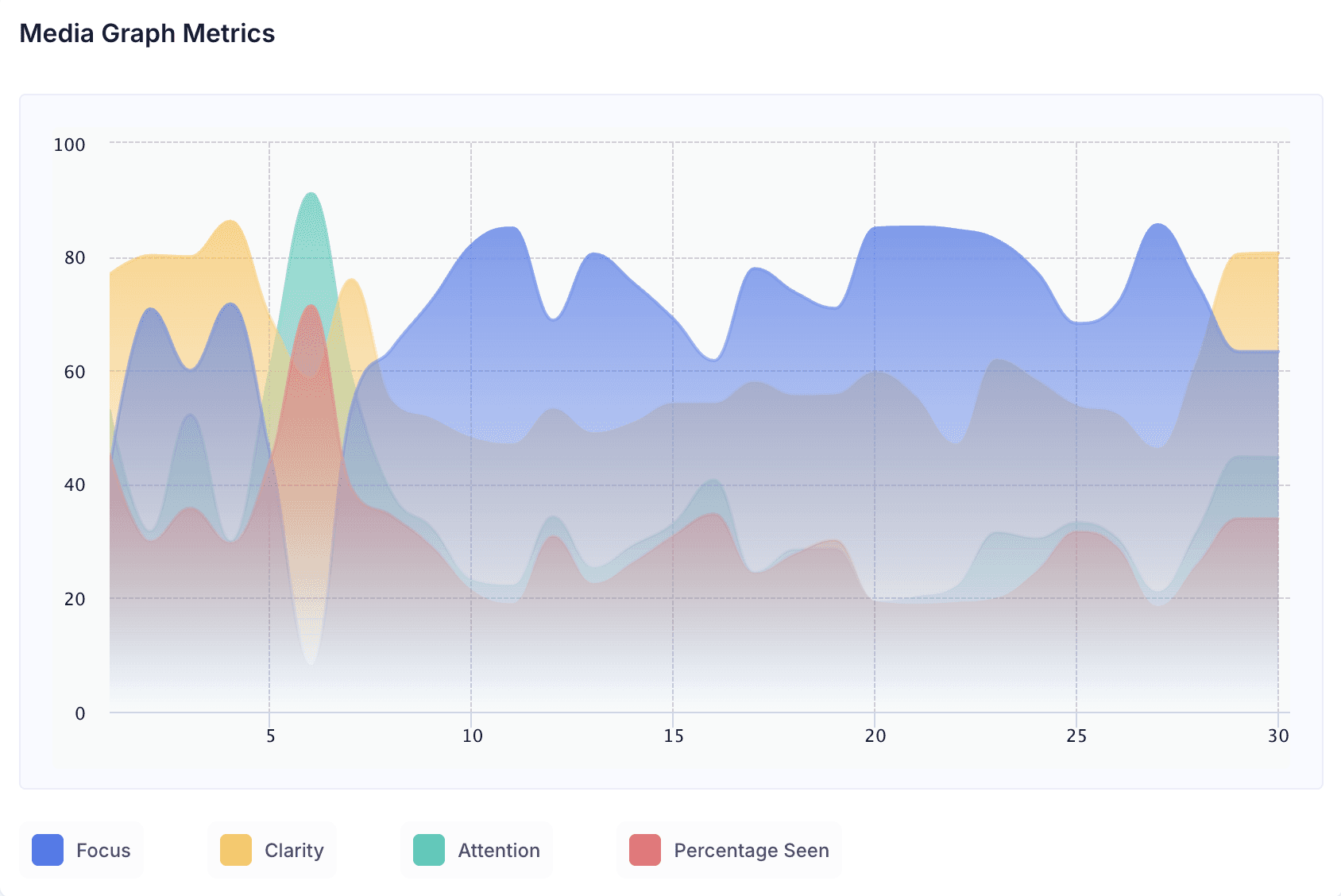
Highest Focus
85 at 0:20
This timestamp falls inside the customer reaction shot, the close-up where the joke's twist has just registered on her face. It's the moment the setup (Shaq installed inside Carvana's own vending tower, cast as an employee rather than a spokesperson) resolves into a punchline. Focus peaking here suggests viewers are mentally following the joke through to its payoff rather than just watching images pass by. That's a good sign for comprehension of the comedic idea, even if, as the next section shows, it isn't the most visually active moment in the film.
Lowest Focus
8 at 0:06
This sits inside the vehicle tower/mechanism shot, the establishing visual of cars stacked inside Carvana's glass structure. This isn't a weak scene in the sense of being wrong for the ad. It's a necessary orientation beat, the shot that tells the viewer what kind of building this is before the joke can work. But structurally it's exposition, not narrative, and that likely explains why focus dips here even as the eye is drawn in (see HA below). The scene is doing setup work, not story work.
Highest Clarity
86 at 0:04
This lands during the customer's close-up and gesture toward the tower, with CARVANA signage clearly in frame. What's clearest at this point isn't the joke, it's the category and the brand: viewers immediately understand they're looking at a Carvana ad about buying a car from this tower. That's the branding and context doing their job early, before the comedic premise has even been introduced.
Lowest Clarity
47 at 0:22
This corresponds to the financing graphic: monthly payment, down payment, APR and vehicle price for the 2025 Honda CR-V Hybrid, all appearing together over the executive's desk. Four separate numbers land in a short window, and that's a clarity problem distinct from an attention problem. The ad hasn't lost the viewer's eye here (this is well after the joke has already earned engagement), it's asking the viewer to process a dense information block quickly, which is a different cognitive task than following a story.
Highest Attention
91 at 0:06
The same moment that produced the lowest focus score produces the highest attention score. That split is the most telling pair of numbers in this report. The vehicle tower and stacked cars are visually unlike anything in conventional automotive advertising, so the eye locks onto it immediately. But because the shot is pure spectacle at this point, with no character or story attached yet, it captures the eye without yet capturing the mind. Attention here is a function of visual novelty, not narrative interest.
Lowest Attention
19 at 0:20
This is the same window that produced the highest focus score. The customer's reaction close-up is a simple, static shot: one face, minimal movement, no new visual information. Attention drops because there's nothing novel left to look at, but focus is at its peak because that's exactly where the joke pays off. This is the clearest evidence in the data that Attention and Focus are measuring different things here: one tracks visual pull, the other tracks narrative involvement, and at 0:20 they move in opposite directions.
Summary
Carvana turns Shaq’s celebrity persona into a literal job placement inside its own machinery. Most celebrity-endorsement advertising keeps the star on the outside of the product, admiring it, using it, vouching for it. This spot puts Shaq to work inside Carvana’s vending tower, as staff rather than spectator, and builds the entire joke around the mismatch between his size and reputation and the confined, corporate role he’s been given.
The insight the ad leans on is Shaq’s own documented fascination with Carvana’s car vending machines, which is what turned last year’s “Shaqvana” partnership into this follow-up. Rather than restate that fascination in dialogue, the ad dramatizes it: if Shaq loves the tower that much, the joke goes, of course he’d eventually just move in. The film opens on the tower itself as the hook (heavily distinctive, immediately recognizable as Carvana’s signature retail format), before cutting to the “office” reveal and the customer’s reaction once she discovers who, or what, is actually running the operation.
The product enters late but concretely. Once the joke has landed, the ad pivots to specific financing terms for a 2025 Honda CR-V Hybrid, tying the entertainment back to an actual, shoppable offer rather than leaving the spot purely as a celebrity bit. What the audience is meant to walk away with is twofold: Carvana’s tower is memorable enough to build a joke around, and Shaq is now functionally part of how that tower operates in the brand’s world.
Emotional Insights
Positive (78) and Happy (72) dominate, consistent with the visual tone described in the AI summary: smiling faces, bright lighting, a celebratory showroom feel. Surprise (44) is the second most notable signal, and it's doing real work here rather than sitting as background noise. A comedic premise built on an unexpected reveal (a celebrity found working inside a vending tower) should produce exactly this kind of moderate surprise spike alongside high positivity, rather than surprise paired with negative emotion, which would suggest confusion or shock instead of amusement.
Negative emotion overall is low (6), and none of its sub-components (contempt 1, sadness 1.5, fear 1.5, anger 2, disgust 1) rise high enough to suggest genuine discomfort. Neutral sits at 34, a meaningful share, which likely reflects the stretches of dialogue and financing information where the viewer is processing rather than reacting. Taken together, the emotional profile supports the creative's comedic intent: this reads as an ad people find amusing and pleasant rather than one relying on tension or discomfort to hold attention.
The Commercial
Heatmap Video
Fogmap Video
Suggestion for Improvement
Sustain attention through the mid-section. Attention runs well below benchmark overall (36 vs 61), and the one strong spike is concentrated at the 6-second establishing shot. Once the film moves into dialogue-heavy executive and reaction scenes, attention has nothing comparably novel to hold onto. More visual movement or cutting pace through the office scenes could keep attention closer to benchmark without disrupting the joke's pacing.
Stagger the financing information. Clarity drops to 47 at 0:22, precisely where four numbers (monthly payment, down payment, APR, price) appear together. Introducing the figures sequentially, or pairing them with a spoken callout rather than a single dense graphic, would likely reduce the cognitive load at this specific point without lengthening the ad.
Give the establishing shot more to do. The 0:06 tower shot pulls the highest attention in the film but the lowest focus. That gap suggests the shot is captivating the eye without yet giving the viewer anything to engage with narratively. A small addition, a hint of the joke's premise, or Shaq's presence teased earlier, could start converting that attention into focus sooner.
Decode Takeaway
The ad's core mechanic works exactly as designed, a visually distinctive hook earns attention early, and a well-structured reveal earns focus once the joke lands, with Focus finishing well above benchmark as a result. Where the ad underperforms is in sustaining visual interest through its middle and in compressing too much financial information into a single beat near the end. The data points to a spot that people follow and enjoy once they're in it, but one that could pull viewers in more consistently before the reveal and communicate its offer more legibly after it.