Overall Score
81 / 100
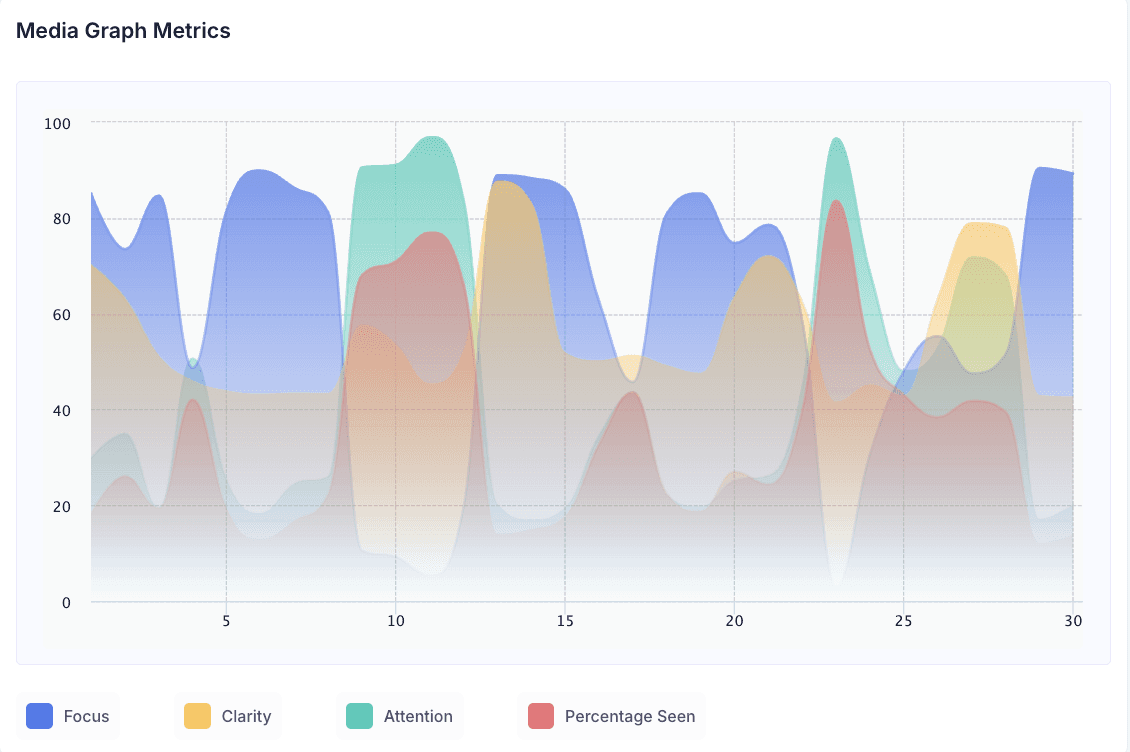
Highest Focus
89 at 0:06
This lands squarely inside the "growing up in the greenhouse" reveal, where the grower is shown sitting among the lettuce rows reading a children's book about the crop. This is the moment the ad's structural joke fully lands: a grown man treating lettuce like a child he is raising. Focus measures whether the viewer stays mentally locked onto the content, and an anthropomorphic gag this specific forces the brain to keep processing what it's seeing rather than checking out. The premise is odd enough that it demands resolution, and that cognitive itch is what likely drives the peak.
Lowest Focus
45 at 0:17
This falls inside the wooden growth-chart sequence, where the grower is shown writing markings like "FIRST SPROUT" on a board. It is a quieter, more explanatory beat sandwiched between the louder comedic hook earlier and the distribution/retail payoff later. This isn't necessarily a flaw in the ad. Every film needs connective tissue between its hook and its resolution, and this scene is doing legitimate narrative work by extending the "raising the lettuce like a child" metaphor into something more literal (growth milestones). The dip in Focus likely reflects a natural mid-film lull rather than a scene that shouldn't exist.
Highest Clarity
87 at 0:13
This sits inside the water-droplet macro shot, part of the cinematic greenhouse montage between the book reveal and the growth-chart sequence. At first glance a close-up water droplet seems like an odd place for peak clarity, but it functions as a visual explainer: it silently communicates "controlled, cared-for growing conditions" without needing dialogue to carry the point. Clarity here isn't about a punchline landing, it's about the viewer instantly understanding what kind of environment they're looking at. The image does the explaining that the campaign's broader story (climate-controlled, real sunlight, recycled rainwater) needs the viewer to absorb.
Lowest Clarity
41 at 0:23
This is the same window in which the wall of packaged Little Leaf Farms product is first revealed, immediately following the delivery truck. On paper this should be a clarity high point, since it's the first unambiguous full-brand, full-product shot in the film. Instead it's the low point. That's a meaningful signal. Attention (see below) actually spikes at this same timestamp, so the moment is grabbing eyes without the message landing as cleanly. A plausible read: after nearly 20 seconds of a personified, narrative story about lettuce "growing up," the sudden hard cut into a packaged-product wall is a tonal and informational jump the viewer hasn't been fully prepared for. The eye catches it, but the brain hasn't caught up yet.
Highest Attention
96 at 0:23
Same timestamp as the lowest Clarity score, and that pairing is the most interesting data point in the whole set. The packaged-product wall is visually novel, colorful, and represents a hard scene change after a long unbroken narrative stretch in the greenhouse. Attention responds to stimulus, not comprehension, and a sudden shift from soft, sunlit greenhouse photography to a densely packed retail wall is exactly the kind of visual jolt that spikes it. What the data shows is a viewer whose eyes snap toward the moment before their understanding of it fully forms, a classic visual-stimulation-before-narrative-absorption pattern.
Lowest Attention
17 at 0:14
This falls right at the boundary between the water-droplet macro and the grower picking up the wooden growth board, a transition point between two quieter, process-oriented beats. There's no character close-up, no punchline, no reveal happening here, just handoff footage bridging one explanatory scene into another. A dip like this is common at transition points and doesn't necessarily indicate a problem with the creative; it reflects reduced visual novelty in a stretch built for pacing rather than payoff.
Summary
Little Leaf Farms turns the story of how lettuce is grown into the story of how a child is raised, using a single sustained anthropomorphic device to make an otherwise dry agricultural process feel personal.
Most category advertising for packaged greens sells the eating moment: the salad, the crunch, the plate. Most Loved Lettuce almost entirely skips that and instead sells the growing moment. The film opens on the crop itself rather than a supermarket or a bowl, then introduces a grower reading a book titled “Growing Up in the Greenhouse” while sitting among the lettuce rows, as if he’s tucking in a child rather than tending a crop. That’s an unusual choice for a lettuce commercial, and it’s a deliberate one: the category insight, made explicit in the campaign’s own positioning, is that “the better you care for lettuce, the better the lettuce can be.” Rather than argue that point, the ad dramatizes it through parental behavior.
From there the film does something structurally smart: it doesn’t stay inside the joke. It expands outward into a visible supply chain, moving the viewer from greenhouse to delivery truck to retail shelf to a shopper’s hand, before landing on the “Most Loved Lettuce in the World” end card. That chain matters strategically because it answers a question the anthropomorphic device raises but doesn’t resolve on its own: what happens to this thing you’ve clearly cared for? The ad shows its own supply chain as proof, not as filler footage. Then, rather than end on the pack shot, which is the category default, it cuts back to the grower reading his book one more time. That’s a memory-structure decision, not just a stylistic flourish. It closes on a person and a joke instead of a product shot, which is precisely the move that Decode’s Focus data (peaking on that same character device) supports as the emotionally stickiest part of the film.
What the audience is ultimately meant to remember isn’t a nutritional claim or a taste attribute. It’s a feeling: that this lettuce was raised, not just grown. Given that the campaign was built ahead of a multistate lettuce-safety scare tied to field-grown produce, that emotional groundwork now carries more real-world weight than it did when it was conceived, even though the film itself never references the issue directly.
Emotional Insights
Positive: 78 | Happy: 67.5 | Surprise: 29 | Neutral: 32 | Negative: 5 | Sadness: 2 | Fear: 1.5 | Disgust: 1 | Anger: 1.5 | Contempt: 1
The emotional profile is almost entirely clean and supports the tone the film is going for: warm, whimsical, low-stakes. Positive and happy scores dominate, which fits a story built around care and affection rather than tension or conflict. The near-absence of negative, fear, and disgust confirms there’s no functional discomfort anywhere in the creative, unsurprising given the subject matter, but worth confirming since low-stakes humor can sometimes misfire into unease if the anthropomorphism reads as strange rather than charming. Here it doesn’t.
The more interesting number is Surprise at 29, sitting well above the negative-emotion cluster but below positive and happy. That’s consistent with a film whose hook depends on an unexpected premise (a man reading a bedtime story to lettuce) rather than a twist ending. Surprise is doing setup work early, not payoff work late.
Neutral at 32 is worth flagging alongside the Clarity dip at the product-wall moment. A meaningfully high neutral score alongside a comprehension dip suggests some portion of the audience is processing that stretch of film cognitively rather than emotionally, consistent with the idea that the hard cut into packaged product asks the viewer to shift gears faster than the rest of the film does.
The Commercial
Heatmap Video
Fogmap Video
Suggestion for Improvement
Smooth the transition into the product-wall reveal. LC (41) and HA (96) land on the exact same timestamp, meaning the moment that grabs the most attention is also the least clearly understood. The cut from the greenhouse narrative into the packaged-product wall is sudden relative to the pacing that precedes it. A brief bridging beat, even half a second of visual connective tissue between the truck and the shelf, could let attention and clarity rise together rather than working against each other at the same moment.
Reinforce the care-to-benefit link during the growth-chart sequence. LF (45) falls during the wooden board/"FIRST SPROUT" scene, which is functionally important but currently the quietest stretch of the film. Since this is the section doing the most literal work to justify the "growing up" metaphor, sharpening what's written on the board or adding a beat of on-screen text could give viewers something concrete to hold onto here rather than relying on Focus recovering later.
Consider whether Clarity overall needs a stronger anchor statement. Clarity (56) sits 25 points below benchmark despite Engagement and Focus performing close to or above benchmark. That combination suggests viewers are staying with the film emotionally without always being sure what the specific product claim is. A single, plainly stated line, spoken or on-screen, tying the greenhouse-growing story directly to a consumer-facing benefit (freshness, taste, safety) could close that gap without disrupting the tone.
Decode Takeaway
Decode Takeaway: This ad wins on cognitive grip rather than visual spectacle. Its Focus score, 30 points above benchmark, shows that casting a recognizable, trust-coded persona in the technician role does real work: viewers stay narratively engaged well past where a generic service ad would lose them. But the Attention shortfall reveals that the ad's most story-critical moments are also its quietest ones visually, which caps how much sensory pull the creative generates even while it holds attention cognitively. The strategic lesson is that persona-driven trust and visual dynamism are not the same lever, and this execution has fully pulled the first without yet pulling the second.