Overall Score
81 / 100
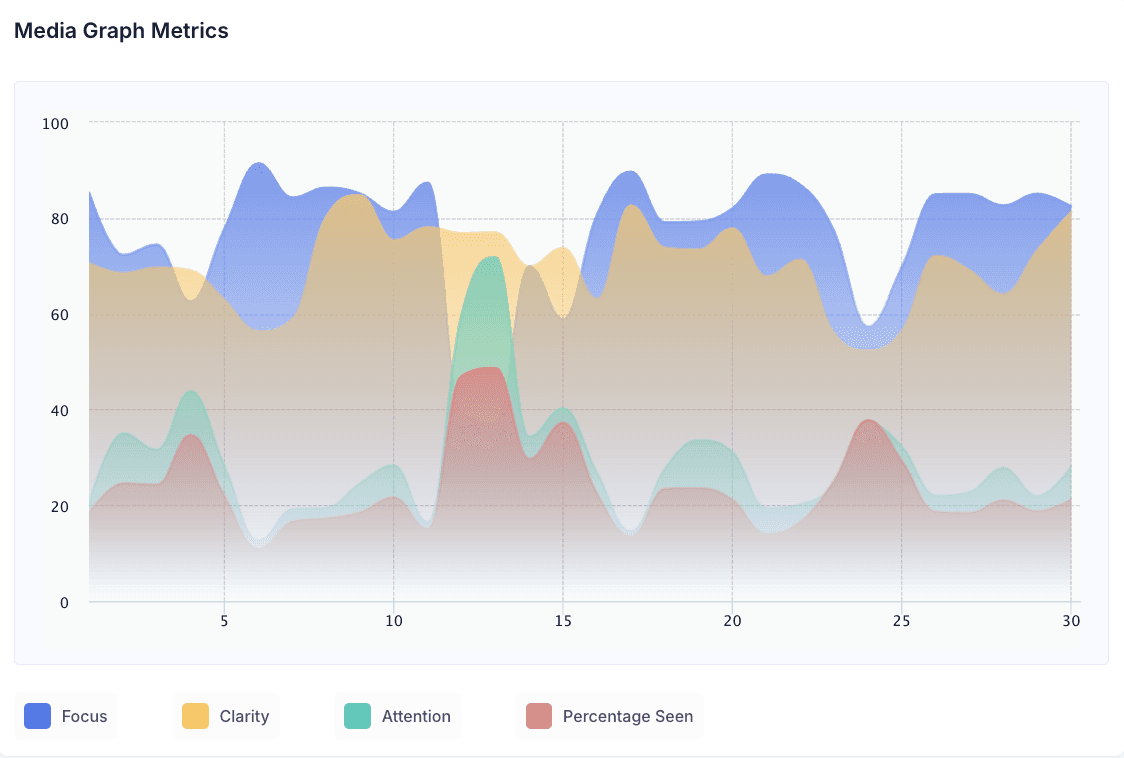
Highest Focus
89 | Timestamp: 0:17
At 17 seconds, William Zabka's technician delivers a comedic gesture (a finger near the mouth) that transitions into the customer/technician exchange at the counter, with "Lifetime" signage visible behind them. This is a quieter, character-driven beat rather than an action-heavy one, yet it produces the single strongest Focus response in the ad.
That's a meaningful signal. The moment doesn't rely on movement or spectacle to hold the viewer. It relies on the payoff of a character the audience has been tracking since the dramatic garage entrance. The gesture lands because Zabka's screen presence, precise, controlled, faintly self-aware, has already been established as the thing worth watching. Focus peaks when the joke resolves, not when the tires are being serviced.
Lowest Focus
37 | Timestamp: 0:13
At 13 seconds, the ad is mid-way through the tire-service montage: tools, wet tire spray, mechanical close-ups. This isn't a failure so much as a structural cost. Service montages are functionally necessary. They demonstrate the work being done and justify the guarantee that follows. But process footage without dialogue or character stakes is where narrative tension naturally slackens, and the data confirms it.
This shouldn't be read as a weakness to cut. It's the ad paying a small, predictable Focus tax to earn credibility for the reveal later.
Highest Clarity
84 | Timestamp: 0:09
At 9 seconds, the close-up of Zabka in Midas workwear beside the tire delivers the clearest single moment in the ad. This is where the audience understands, without any ambiguity, who the expert is and what role he's playing. It's a character-establishing shot rather than a message-establishing one, and Clarity peaks on it because that's the information the ad most needs the viewer to register early: this technician is the embodiment of Midas expertise.
Lowest Clarity
52 | Timestamp: 0:24
At 24 seconds, the ad cuts to a man in a vintage red car wearing sunglasses, a scene introduced with no prior setup. Clarity dips here, and that tracks. The viewer has to work to place this new character in relation to the story they were just following. It's worth noting this is a Clarity dip, not a Focus or Attention dip; the ad hasn't lost the viewer's mental engagement, it has simply introduced a beat that takes an extra moment to parse. Comedy often trades short-term clarity for a bigger payoff, and the sequence resolves quickly into the guarantee reveal that follows.
Highest Attention
71 | Timestamp: 0:13
Notably, the Attention peak lands at the exact same timestamp as the Focus trough. During the tire-service montage, the wet-spray close-up and dynamic motion blur pull the eye even as the narrative itself goes quiet. This is the clearest evidence in the dataset that Attention and Focus are measuring different things here: Attention responds to visual movement and sensory novelty, while Focus responds to story stakes. The service montage is attention-grabbing precisely because it's visually kinetic, even though it isn't narratively gripping.
Lowest Attention
14 | Timestamp: 0:17
This is the inverse of the HA finding, and arguably the most interesting data point in the report. At 17 seconds, the same moment that produces the ad's highest Focus score produces its lowest Attention score. The gesture-and-signage beat holds the viewer's mind completely while offering almost nothing in the way of visual dynamism: no motion blur, no cut, no spectacle, just a static two-shot and a small gesture. The takeaway isn't that the moment underperforms. It's that Decode is picking up a genuine mode-switch in the viewer, from being visually stimulated to being narratively absorbed. The ad achieves its strongest cognitive grip through stillness, not motion.
Summary
Midas turns a returning "Karate Kid" antagonist into a tire technician, using William Zabka's built-in reputation for precision and discipline to make expertise legible on sight.
This is the second chapter of Midas' "Midas is the Best" campaign with Where Eagles Dare, and the mechanism is simple but not obvious: rather than building trust through a generic mechanic character, the brand borrows a persona the audience already has decades of context for. Zabka's Johnny Lawrence, later Cobra Kai's flawed-but-disciplined mentor, carries a cultural shorthand for competitive precision. The ad doesn't need to explain that its technician is skilled. The casting does that work before a single tire is touched.
The story follows a familiar service arc: dashboard warning, drive to Midas, exaggerated technician entrance, service montage, comedic beats with the customer and a passing vintage-car cameo, then a hard proof point, a service document showing "LIFETIME" and a $0 invoice total, before the guarantee is spelled out on a branded end card. What makes the structure work is where the ad places its evidence. It doesn't ask the viewer to take the guarantee on faith. It shows a real invoice line before the tagline ever appears.
Most tire-service advertising leans on either fear (something might go wrong) or price (this is cheap). This ad leans on persona transfer: if Zabka is meticulous enough to be trusted, the technician he's playing is too. The product enters the story not as a sales pitch but as the natural consequence of the character's competence, and the audience is left to remember one thing: Midas' guarantee is backed by the kind of precision this actor has spent a career being known for.
Emotional Insights
Positive: 78 | Happy: 74 | Surprise: 28 | Neutral: 32 | Negative: 8 | Sadness: 6 | Fear: 6 | Disgust: 3 | Anger: 4 | Contempt: 3
Positive and Happy dominate by a wide margin, which fits a service-recovery narrative built on comedy rather than genuine risk. Surprise sits at a healthy 28, likely reflecting the technician's exaggerated entrance and the vintage-car cameo, both pattern interrupts rather than plot twists. Negative emotion is low at 8, and what negative signal exists is almost certainly functional: the dashboard warning light and the customer's initial "worried expression" mentioned in the visual cues are meant to register as mild inconvenience, not real distress, before the tone flips to relief and laughter.
The Neutral score of 32 is worth flagging alongside the Focus data. A moderate neutral reading during a comedic ad usually points to viewers processing the joke's mechanics (who is this character, what's the gesture for) rather than reacting purely emotionally, which lines up with the HF/LA finding at 17 seconds: that moment is cognitively busy, not emotionally loud. Overall, the emotional profile supports the creative idea cleanly. There's no tension that needs resolving, no negative emotion doing double duty as suspense, just a straightforward concern-to-reassurance arc that the humor is built to deliver.
The Commercial
Heatmap Video
Fogmap Video
Suggestion for Improvement
Address the Attention gap directly. At 29 against a benchmark of 61, this is the ad's clearest underperformance, and the HA/LA data points to why: the moments with the strongest visual dynamism (the service montage) aren't the moments carrying the story, and the moments carrying the story (the gesture/signage beat at 17s) are visually static. A version of this ad that folds a touch more visual movement into the narrative beats, rather than reserving it for the mechanical process shots, could lift Attention without sacrificing the Focus the story currently earns.
Reinforce the guarantee mechanics, not just the headline. Clarity dips at the vintage-car cameo (24s) and sits only in line with benchmark overall. The invoice/signage proof point works well as evidence, but the small print noted in the breakdown is not legible on screen. A slightly longer or larger treatment of the guarantee terms, even briefly, would help convert the strong emotional payoff into a more functionally clear takeaway about what "Limited Lifetime Tire Guarantee" actually covers.
Consider trimming the vintage-car cameo, or tying it more explicitly to the technician's story. It's the ad's one moment where Clarity dips without a corresponding Focus or Attention gain to justify the trade. If the cameo doesn't serve a callback later in the campaign, tightening this beat could remove the one point of friction in an otherwise clean arc.
Decode Takeaway
Decode Takeaway: This ad wins on cognitive grip rather than visual spectacle. Its Focus score, 30 points above benchmark, shows that casting a recognizable, trust-coded persona in the technician role does real work: viewers stay narratively engaged well past where a generic service ad would lose them. But the Attention shortfall reveals that the ad's most story-critical moments are also its quietest ones visually, which caps how much sensory pull the creative generates even while it holds attention cognitively. The strategic lesson is that persona-driven trust and visual dynamism are not the same lever, and this execution has fully pulled the first without yet pulling the second.