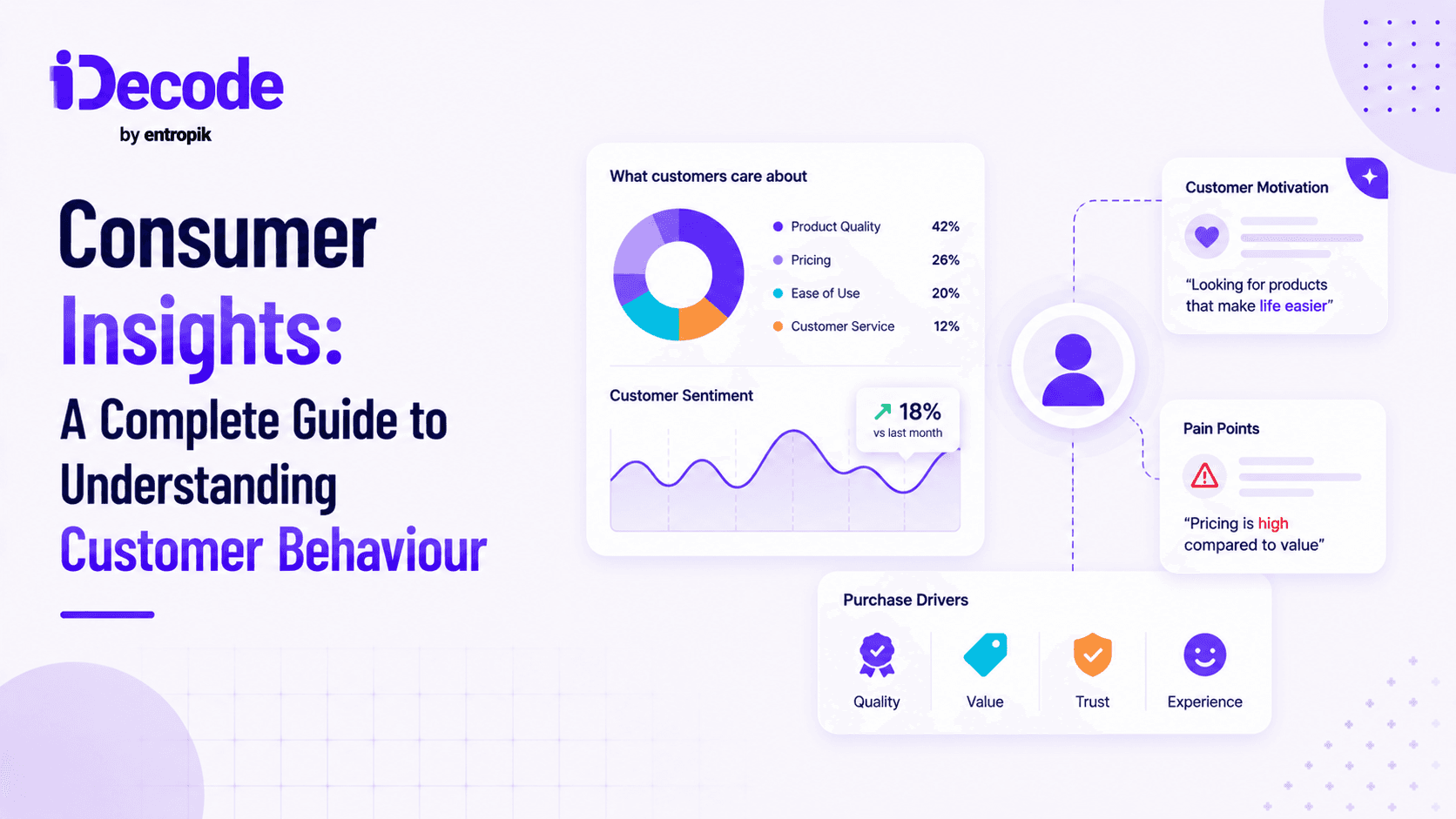
Consumer insights are what separate brands that truly understand their customers from those that are guessing. This guide explains what consumer insights are, why they differ from market research, how to collect them across stated, behavioral, and emotional signal layers — and how to build a research program that translates evidence into decisions that actually stick.
Summary
|
Consumer insights are one of the most strategically valuable assets a brand can build — yet most organizations collect only a fraction of the signal they actually have access to.
This guide explains what consumer insights are, how they differ from market research, why behavioral and emotional signals change what you find, and how modern consumer research platforms make deep, scalable insight gathering achievable across teams of any size.
What are consumer insights?
Consumer insights are actionable interpretations of customer data that explain why people behave, choose, and buy the way they do.
That definition matters because the word "actionable" is doing real work. A piece of consumer data tells you what happened. A consumer insight tells you why it happened — and what you should do about it. Without that interpretive step, even large datasets produce little more than interesting-sounding numbers that nobody can act on.
Every insight is ultimately built from one or more of three signal layers:
What consumers SAY — stated preferences, survey responses, interview answers, reviews.
What consumers DO — purchase behavior, click paths, product usage, conversion data.
What consumers FEEL — emotional reactions captured through facial coding, voice AI, eye tracking, and biometric measurement.
Most research programs cover the SAY layer extensively. Fewer add robust DO-layer behavioral analytics. Almost none systematically capture the FEEL layer — which is precisely where the gap between stated preference and actual behavior lives.
One-line takeaway: Consumer insights turn raw customer data into strategic decisions by answering the one question data alone cannot: why.
Consumer insights vs raw data
It's easy to confuse the two. Here's the practical distinction:
Raw data point | Consumer insight derived from it |
|---|---|
"60% of visitors leave the pricing page within 15 seconds" (illustrative) | "Users don't find a clear anchor offer — the page leads with feature lists instead of outcomes, so high-intent visitors disengage before reaching the CTA" |
"Net Promoter Score dropped 8 points this quarter" | "Customers who used the new onboarding flow gave significantly lower scores — the redesign removed a key setup step they relied on" |
"Add-to-cart rate is 3.2% on mobile" (illustrative) | "Mobile shoppers abandon because product images don't load fast enough on 4G connections in Tier 2 cities — not price sensitivity as previously assumed" |
Data describes. Insight explains. The leap from one to the other requires combining multiple signal layers and applying interpretive rigor — which is why method selection matters so much.
Consumer insights vs market research: what's the difference?
These two disciplines are frequently conflated, but they answer different questions and serve different purposes.
Market research describes the market around your brand — its size, growth trajectory, competitive landscape, and macro trends. It answers the question: What is happening out there?
Consumer insights interpret individual and collective customer behavior — motivations, emotional responses, decision-making patterns, and friction points. It answers the question: Why do our customers do what they do?
They are complementary, not competing. A product team launching in a new category needs both: market research to size the opportunity and understand competitive positioning; consumer insights to know whether their specific value proposition resonates, how the target segment makes decisions, and what emotional barriers might block adoption.
Dimension | Market research | Consumer insights |
|---|---|---|
Core question | What is happening in the market? | Why do customers behave this way? |
Typical outputs | Market size reports, trend analysis, competitive benchmarks | Behavioral patterns, motivational maps, emotional response profiles |
Typical methods | Desk research, surveys, industry data, competitive intelligence | Qualitative interviews, behavioral analytics, emotion AI, ethnography |
Who uses it | Strategy, business development, executive team | Product, UX, marketing, CX, brand |
Time horizon | Medium-to-long term strategic planning | Current product, campaign, or experience decisions |
When a team needs both: Ideally, market research frames the strategic landscape and consumer insights fill in the behavioral detail required to act within it. A CPG brand launching a new product line, for instance, needs market sizing and category trend data (market research) and shopper emotional response to the pack design (consumer insights) before committing to launch.
Why consumer insights matter for business growth
Organizations that invest in rigorous consumer insights programs consistently outperform those that rely on instinct or stated-preference data alone. Here's why the investment pays off:
1. Personalization that actually works
McKinsey's "Next in Personalization" research found that 71% of consumers expect personalized interactions, and 76% report frustration when they don't receive them. But personalization only works when it's grounded in real behavioral data — not demographic assumptions. Gartner's 2025 personalization research found that poorly executed personalization created negative experiences for more than 50% of buyers surveyed. The quality of the insight determines whether personalization helps or harms.
2. Faster, more confident product decisions
When product teams have clear insight into why users abandon a flow, which features drive retention, and what emotional response a prototype triggers, they can prioritize confidently instead of debating assumptions. Decision cycles get shorter because the evidence base is stronger. Microsoft research has associated systematic use of customer behavioral data with meaningful outperformance versus peers — a directional finding consistent across multiple independent analyst studies.
3. Reduced rework costs
Design and marketing rework triggered by insights discovered post-launch costs significantly more than research conducted before launch. Catching a messaging misfire, packaging confusion, or UX friction point in a pre-launch study eliminates downstream spend on fixes, rebranding, or campaign pivots.
4. Sharper competitive positioning
Consumer insights reveal not just what your customers want, but where current alternatives fall short. Behavioral and emotional research surfaces frustrations with competing products that customers rarely articulate directly in surveys — creating clear, defensible positioning space.
5. More effective advertising and content
Ad pre-testing grounded in emotional response data (facial coding, attention tracking) predicts in-market performance more accurately than survey-based recall or stated preference. Organizations that measure emotional engagement in creative testing can iterate before spend, not after.
The 6 dimensions of consumer understanding
Consumer insights don't live in one data type. A complete understanding of any customer segment requires combining multiple dimensions:
Dimension | Question it answers | Example data sources |
|---|---|---|
Identity | Who are they? | Demographics, psychographics, segmentation models |
Behaviour | What do they do? | Purchase history, digital analytics, heatmaps, eye tracking |
Motivation | Why do they do it? | Jobs-to-be-done interviews, focus groups, ethnographic research |
Emotions | How do they feel? | Facial coding, voice emotion AI, galvanic skin response |
Journey | When and where? | Customer journey mapping, touchpoint analytics, session recordings |
Pain points | What frustrates them? | Qualitative research, support ticket analysis, NPS verbatims |
Identity — who they are
Identity insights describe the demographic and psychographic composition of a customer segment. Age, income, geography, and life stage are table stakes. More useful are psychographic dimensions: values, lifestyle preferences, risk tolerance, and self-concept. Identity data provides the "who" that gives behavioral data context — the same purchase behavior can mean very different things in different segments.
Behaviour — what they do
Behavioral insights are grounded in observed actions, not stated intentions. Digital analytics, heatmaps, session recordings, click-path analysis, purchase data, and product usage logs all surface what customers actually do. The critical limitation: behavior data shows what happened but rarely explains why. That's why DO-layer data needs to be combined with qualitative and emotional signals to produce genuine insight.
Motivation — why they do it
Motivational insights get at the underlying job the customer is trying to accomplish — the problem they're hiring a product or service to solve. Jobs-to-be-done frameworks, qualitative interviews, and AI-moderated research are the primary methods here. Motivation is the hardest dimension to capture at scale because it requires nuance, probing, and an environment in which participants feel comfortable being honest.
Emotions — how they feel
Emotional insights represent the newest and most differentiated dimension of consumer understanding. Facial coding, voice emotion AI, and eye tracking reveal how customers actually feel about a product, ad, or experience — moment by moment — regardless of what they say in response to direct questions. This is where the most commercially significant gaps between stated preference and actual behavior are found.
Journey — when and where
Journey insights map when, in what sequence, and through what channels customers interact with a brand. Customer journey mapping combined with touchpoint analytics identifies where experience is strong, where it breaks down, and where emotional peaks and troughs occur. Journey analysis is particularly valuable for CX programs trying to reduce churn, improve onboarding, or increase lifetime value.
Pain points — what frustrates them
Pain point insights emerge from what customers complain about, struggle with, or abandon silently. Qualitative research — especially interviews and focus groups — surfaces articulated frustrations. But many pain points are never verbalized: customers simply stop using a product, choose a competitor, or disengage from a flow without explaining why. Behavioral analytics and emotional response data are critical for capturing these silent frictions.
How to gather consumer insights: the major methods
No single method covers all six dimensions above. Strong insight programs combine multiple methods, each mapped to the questions they answer best.
Surveys and questionnaires
Surveys offer scale and quantifiable results. They're effective for measuring stated attitudes, tracking sentiment over time (NPS, CSAT, brand health trackers), and gathering demographic data at volume. Their core limitation: they capture only what consumers are willing to say and able to articulate — which means stated preferences frequently diverge from actual behavior. Social desirability bias, question framing effects, and simple post-hoc rationalization all constrain survey validity.
Qualitative interviews and focus groups
One-on-one interviews and focus groups unlock depth that surveys cannot reach — motivations, mental models, emotional narratives, and the contextual reasoning behind decisions. The traditional constraints are time and scale: a skilled human moderator can run only a limited number of sessions, and analysis is labor-intensive. Focus groups introduce additional social dynamics that can suppress honest responses, particularly when participants anticipate judgment from peers.
AI moderated interviews
AI moderated interviews combine the depth of qualitative research with the scale of quantitative methods. An AI moderator conducts live, adaptive interviews with hundreds of participants simultaneously — asking follow-up questions in real time based on participant responses, detecting emotional cues, and generating structured insights without manual analysis overhead.
For consumer insights programs that need both scale and behavioral nuance, this approach represents a significant methodological advance over either surveys or traditional qualitative research used in isolation.
Behavioral analytics and digital tracking
Behavioral analytics tools — session recordings, click-path analysis, conversion funnels, cohort analysis — capture what customers actually do in digital environments. They're non-reactive: participants aren't asked to describe their behavior, so social desirability and recall bias don't apply. The limitation: digital behavioral data captures that something happened, not why. A drop-off in a checkout flow is visible; whether it was caused by price confusion, trust concerns, or UX friction requires additional signal to diagnose.
Emotion AI and biometric research
Facial coding, eye tracking, and voice emotion AI capture real-time emotional and attentional responses that participants cannot self-report accurately — because they often don't consciously experience them in a form they can describe. This is the FEEL layer of the SAY/DO/FEEL framework.
Facial coding uses computer vision to detect micro-expressions mapped to emotional states (joy, confusion, disgust, surprise, disengagement). At 90%+ accuracy, it captures moment-by-moment responses to ads, pack designs, prototypes, and interview stimuli. Decode's platform tracks 62 distinct facial expressions, surfacing nuances that coarser tools miss.
Eye tracking reveals where attention actually goes — which elements are noticed, in what order, and for how long. At 96% accuracy, it identifies visual hierarchy failures, missed CTAs, and competing stimuli before creative is finalized.
Voice emotion AI analyzes prosody, tone, and micro-vocal patterns to detect emotional states that may not surface in facial expression — particularly relevant for remote and phone-based research contexts.
Social listening and community research
Social listening tools monitor brand mentions, category conversations, and competitor sentiment across social platforms, forums, review sites, and communities. They offer unsolicited signal — what customers say about a brand or category when they're not in a research context — which can surface emergent trends, unmet needs, and genuine frustrations that formal research programs miss.
The say-do gap: why consumer insights need behavioral signals
The say-do gap is one of the most well-documented problems in consumer research: the difference between what consumers say they will do and what they actually do.
In concept testing, for example, a consumer may rate a new product concept "very likely to buy" on a 5-point scale — then fail to purchase it when it launches. In usability research, a participant may describe a flow as "clear and easy to follow" — while eye tracking shows they completely missed the key instruction that made it work. In ad testing, stated recall scores may look strong — while facial coding shows consistent confusion or disengagement at the critical moment the brand message lands.
The gap exists for several reasons:
Social desirability: Consumers answer questions in ways they believe are expected or socially acceptable, not ways that accurately reflect their likely behavior.
Poor introspective access: Much of decision-making happens below the level of conscious awareness. Consumers can't accurately report on emotional reactions they didn't consciously register.
Context collapse: Research environments rarely replicate the conditions under which real decisions are made — time pressure, competing options, ambient distraction.
Self-presentation: Participants in research settings often present an aspirational version of themselves, not an accurate one.
Closing the say-do gap requires moving beyond purely stated-preference data to include DO-layer behavioral signals and FEEL-layer emotional measurement. The combination of what someone says, what they actually do, and how they emotionally respond across the journey produces insights that are far more predictive of real-world behavior than any single layer alone.
Consumer insights across industries
Consumer insights programs look different depending on the industry — different questions, different methods, different outputs. Here's how the discipline applies across major verticals:
CPG and FMCG
Pack testing, advertising pre-testing, concept validation, and shopper research are the core use cases. CPG insights teams need to understand not just whether consumers say they like a product, but whether the packaging communicates the right message at shelf (eye tracking), whether the ad creative triggers the intended emotional response (facial coding), and whether the product concept drives genuine purchase intent rather than just stated interest.
Financial services
Banks, insurers, and fintech companies use consumer insights to improve digital onboarding experiences, test new product concepts, understand customer churn drivers, and map CX across multi-channel journeys. Trust, anxiety, and confusion are emotionally loaded dimensions in financial services — which makes emotion AI particularly valuable for uncovering friction that survey data misses.
Tech and SaaS
Product and UX teams use consumer insights to validate feature decisions, identify usability issues before launch, understand activation and retention drivers, and prioritize development roadmaps. AI-moderated interviews at scale allow SaaS teams to run continuous discovery without the operational overhead of traditional qualitative research programs.
Retail and e-commerce
Shopper insights, conversion optimization, and customer journey mapping are central. Behavioral analytics combined with emotional response measurement help retail teams understand why high-intent visitors abandon carts, which product presentation triggers the highest engagement, and where the online-to-offline journey creates friction.
Healthcare and pharma
Patient experience research, healthcare professional (HCP) insights, and digital health UX all require specialized consumer insights approaches. Sensitivity, compliance requirements, and the complexity of patient decision-making demand research designs that capture both stated and unstated experience.
How to turn consumer insights into action: a 5-step process
Collecting data is the starting point, not the finish line. Most organizations struggle not with gathering consumer signals but with converting them into decisions that stick. A structured process closes that gap.
Step 1: Define the decision the insight must inform
Insights without a clear decision to support are expensive-sounding observations. Before launching any research, specify the exact business question: "Which packaging design drives stronger purchase intent on shelf?" is actionable. "Tell us what customers think of our brand" is not. The question anchors every subsequent choice — what to measure, which methods to use, and what success looks like.
Step 2: Collect data across all three layers
Map your methods to the SAY/DO/FEEL signal spectrum deliberately. Surveys and interviews capture stated preferences. Behavioral analytics and purchase data reveal what customers actually do. Facial coding, eye tracking, and voice emotion AI surface how they feel in the moment. Single-layer research is faster but more prone to the say-do gap; triangulating across layers produces insights with significantly higher predictive validity.
Step 3: Synthesize patterns — don't just report findings
Synthesis is where data becomes insight. Group observations by theme and look for patterns that hold across multiple signal types. A behavioral drop-off that aligns with a negative emotional response and stated confusion in qualitative interviews is a strong, cross-validated signal. Where signal layers contradict each other, that contradiction is itself an insight worth surfacing. A useful framing for every insight: observation + underlying motivation + business implication.
Step 4: Prioritize insights by business impact
Not all insights are equally actionable. Rate each by the size of the decision it can improve, the confidence of the evidence base, and the cost of acting on it. High-impact, high-confidence insights that require low implementation effort should be activated first. Lower-confidence signals warrant further research before committing resources.
Step 5: Share, act, and close the loop
An insight that stays inside a research report changes nothing. Insights must be translated into a specific recommendation — a product change, a messaging revision, a UX fix — and assigned to a decision-maker. Centralized insight repositories (shared across teams, searchable by topic) prevent the same finding from being re-discovered every quarter. Tracking whether insight-driven changes produced expected outcomes creates a feedback loop that improves the quality of future research programs over time.
One-line takeaway: The gap between "interesting finding" and "decision made" is closed by structure — clear questions, triangulated signals, prioritized evidence, and a recommendation assigned to someone who can act on it.
Common challenges in using consumer insights (and how to solve them)
Even well-resourced insights programs run into predictable obstacles. Recognizing them early reduces wasted research spend and increases the rate at which insights actually change decisions.
Challenge 1: Data overload without interpretation
The volume of available consumer data has grown faster than most organizations' capacity to interpret it. Behavioral analytics dashboards, survey responses, social listening streams, and CRM exports all generate data — but data isn't insight until someone synthesizes it into something a decision-maker can act on.
Solution: Impose a strict insight-statement format — observation + motivation + implication — for every finding delivered to stakeholders. If a finding can't be expressed in that structure, it isn't an insight yet; it's still data. Limit deliverables to the top five to seven actionable insights per research project, regardless of how much data was collected.
Challenge 2: Siloed insights across teams
Research findings frequently live in one team's shared drive, inaccessible to colleagues who face the same question six months later. The result: duplicated research spend and decisions made without awareness of relevant prior evidence.
Solution: A centralized insights repository — searchable, tagged by topic, product area, and methodology — prevents institutional knowledge from evaporating. The investment pays off most in organizations running multiple research programs simultaneously across product, marketing, and CX functions. Even a well-structured shared folder outperforms no repository at all.
Challenge 3: The speed-versus-depth tradeoff
Product and marketing teams frequently need answers in days, not weeks. Traditional qualitative research — recruiting, scheduling, moderation, analysis — takes too long to fit inside most decision cycles.
Solution: AI-moderated research has materially reduced this tradeoff. Platforms that run adaptive qualitative interviews at scale can deliver structured synthesis within hours rather than weeks, without sacrificing the depth that behavioral decisions require. For quantitative signals, real-time behavioral analytics can surface preliminary patterns quickly, with deeper qualitative investigation reserved for the most consequential decisions.
Challenge 4: Over-reliance on stated preferences (the say-do gap)
Surveys and interviews capture what consumers are willing and able to articulate. They systematically miss the emotional reactions, implicit associations, and contextual behaviors that drive real decisions. Heavy reliance on self-reported data produces insights that sound confident but predict behavior poorly.
Solution: Treat stated-preference data as one signal layer, not the complete picture. Pair survey findings with behavioral analytics (what customers actually did) and emotional measurement (how they actually felt) wherever the decision is consequential. The say-do gap is widest in high-stakes categories — financial services, healthcare, luxury, CPG — where social desirability and aspirational self-presentation most heavily distort what people say.
Challenge 5: Collecting insights but not acting on them
Organizations that lack a clear process for translating research into recommendations frequently produce well-funded insight programs that have no measurable impact on business decisions. Research becomes a quarterly ritual rather than a decision-making input.
Solution: Every research project should conclude with a decision matrix: which insights recommend action, who owns the decision, and what the next step looks like. Insights without an owner and a timeline rarely change anything. Building a post-research review cadence — reviewing whether insight-driven changes produced the expected outcomes — creates accountability and improves the return on research investment over time.
One-line takeaway: The most common failure mode in consumer insights isn't poor data collection — it's the absence of a system for converting evidence into decisions.
The future of consumer insights: AI, real-time, and predictive research
The consumer insights discipline is changing more quickly than at any point in its history. Several trajectories are converging in ways that will materially alter how research programs operate — and what insights teams are expected to deliver.
AI-moderated interviews at scale
Traditional qualitative research is constrained by the supply of skilled human moderators and the logistics of scheduling. AI moderation removes both constraints: platforms like Decode's Mira can conduct hundreds of adaptive interviews simultaneously, probing follow-up questions in real time across 70+ languages without scheduling overhead. The implication is not the elimination of human moderators — experienced researchers still design the study, interpret the synthesis, and make the judgment calls that distinguish insight from pattern — but a fundamental shift in what's achievable at a given budget and timeline.
Real-time behavioral signals
The shift from periodic research studies to continuous behavioral monitoring is already underway. Behavioral analytics, session recording, and conversion data provide a real-time signal stream that research teams can monitor between formal study cycles. Organizations that integrate real-time behavioral signals with periodic qualitative investigation can identify emerging friction or opportunity much earlier than those running quarterly research programs alone.
Emotion AI closing the say-do gap
Facial coding, voice emotion analysis, and eye tracking have historically required controlled lab environments with specialist hardware. Webcam-based emotion AI — where Decode's platform operates at 90%+ facial coding accuracy and 96% eye tracking accuracy, tracking 62 distinct facial expressions — is bringing emotional measurement to remote qualitative research at scale. This means the FEEL layer of the SAY/DO/FEEL framework is becoming accessible for any research program with a standard webcam, not just for those with dedicated research labs.
Predictive models and synthetic data
A growing set of research vendors offers predictive models that project consumer behavior from existing datasets, reducing the need for primary research in scenarios where behavioral patterns are well-established. Synthetic data generation is also emerging as a complement to primary research — not a replacement. The industry consensus is cautious: predictive and synthetic approaches are most useful for generating hypotheses and narrowing the research agenda, not for replacing direct behavioral measurement in high-stakes decisions.
The role of the human insights professional
AI acceleration raises an important question about the evolving role of consumer insights professionals. The answer is consistent across most serious practitioners: AI handles volume, pattern recognition, and synthesis speed. Human researchers handle judgment, ethical design, stakeholder translation, and the contextual interpretation that turns a pattern into a strategically meaningful recommendation. The premium on deep methodological expertise — knowing which methods to use when, how to triangulate across signal layers, and how to interpret signal disagreements — is increasing, not decreasing, as data volume grows.
One-line takeaway: AI doesn't replace the consumer insights function — it raises the volume of signal that function must be equipped to interpret. The organizations that invest in both the technology and the expertise to use it will see the largest returns.
How Decode by Entropik powers consumer insights
Decode by Entropik is the only unified human insights platform that covers all three signal layers — SAY, DO, and FEEL — within a single research environment.
Most platforms stop at the SAY layer (surveys, interviews, stated preferences). Some extend to DO (behavioral analytics, click tracking). Very few capture FEEL at the systematic, scalable level that consumer insights programs need to close the say-do gap.
The Consumer Insights platform brings together survey-based stated preference research, behavioral analytics, and emotion AI measurement — including facial coding (90%+ accuracy), eye tracking (96% accuracy), and voice emotion AI — into a unified workflow. Research teams can run concept tests, ad pre-tests, pack tests, and shopper studies with full behavioral and emotional signal capture, without stitching together multiple disconnected tools.
Mira, the AI Moderator, adds qualitative depth at scale. Mira conducts live, adaptive interviews probing on emotional cues, adjusting question paths in real time, and delivering structured insights without manual moderation overhead. For consumer insights teams that need to move fast without sacrificing the depth that behavioral decisions require, Mira removes the traditional trade-off between scale and rigor.
Decode's platform is used by 150+ global brands across CPG, FMCG, BFSI, tech, retail, and healthcare — backed by 17 patents in emotion AI, support for 70+ languages, and $25M Series B funding from Bessemer Venture Partners and SIG.
Frequently asked questions
1. What are consumer insights?
Consumer insights are actionable interpretations of customer data that explain why people behave, choose, and buy the way they do. They go beyond raw data — which describes what happened — to explain the motivations, emotions, and contextual factors that drive customer behavior.
2. What is the difference between consumer insights and market research?
Market research describes the external market landscape — size, trends, competition. Consumer insights interpret individual and collective customer behavior — motivations, emotional responses, and decision patterns. Both are valuable; they answer different questions and serve different business decisions.
3. Why are consumer insights important?
Consumer insights enable more effective personalization, faster product decisions, reduced rework costs, sharper competitive positioning, and more accurate advertising performance. McKinsey research indicates that 76% of consumers report frustration when interactions are not personalized — and personalization only works when grounded in accurate behavioral insight.
4. What are the types of consumer insights?
Consumer insights can be organized across six dimensions: identity (who customers are), behaviour (what they do), motivation (why they do it), emotions (how they feel), journey (when and where they engage), and pain points (what frustrates them). Strong insight programs combine multiple dimensions rather than relying on a single data type.
5. How do you collect consumer insights?
Common methods include surveys and questionnaires, qualitative interviews and focus groups, AI-moderated interviews, behavioral analytics and digital tracking, emotion AI and biometric research (facial coding, eye tracking, voice AI), and social listening. The most predictive insight programs combine methods across the SAY/DO/FEEL signal spectrum.
6. What is the say-do gap in consumer insights?
The say-do gap is the difference between what consumers say they will do and what they actually do. It occurs because of social desirability bias, limited introspective access to unconscious decision-making, and context collapse in research environments. Closing it requires adding behavioral and emotional signal layers to stated-preference data.
7. What tools are used for consumer insights research?
Consumer insights tools range from survey platforms (Qualtrics, SurveyMonkey) and behavioral analytics tools (Mixpanel, Hotjar) to emotion AI platforms like Decode by Entropik — which covers facial coding, eye tracking, voice AI, and AI-moderated interviews in a single environment. See the best consumer insights platforms for 2026 for a full comparison.
Related Topic: