An AI moderated interview is a qualitative research method in which an AI system conducts a structured or semi-structured conversation with a participant via text, voice, or video asking follow-up questions in real time based on each response, without a human moderator present. The result is a scalable, consistent alternative to live 1:1 interviews that still captures depth, nuance, and open-ended insight.

Summary
|
Research teams are under more pressure than ever to move faster. Product cycles have compressed. Consumer behavior shifts quarterly, not annually. And the old trade-off — rich qualitative insights or speed at scale — is starting to break down.
AI moderated interviews are one of the technologies driving that shift. What used to require a trained human moderator, a scheduling coordinator, a transcription vendor, and two weeks of synthesis time can now happen in days — and at a scale that was previously unthinkable for qualitative methods.
According to the GRIT Report, AI-assisted research methods have seen their fastest adoption rate in the history of the study, with qualitative AI tools gaining traction in particular. Sample sizes for qual programs are growing as a direct result — research buyers who once ran eight IDIs are now running thirty without changing their budget.
This guide covers everything you need to know about AI moderated interviews: what they are, how they work, when to use them, what the research actually says, and how to run your first study.
What are AI moderated interviews?
An AI moderated interview is a qualitative research conversation facilitated by an AI system rather than a human moderator. The AI follows a structured discussion guide, asks probing follow-up questions when a participant gives a shallow or incomplete answer, and captures responses in real time.
They sit between two familiar methods: richer than a survey (because the conversation adapts to each participant's answers), and more scalable than live 1:1 interviews (because they run in parallel, asynchronously, without scheduling overhead).
Dimension | AI moderated interviews | Traditional moderated interviews |
|---|---|---|
Speed | Hours to days for 30+ respondents | Weeks for 10–12 respondents |
Scale | Dozens to hundreds simultaneously | Limited by moderator availability |
Cost per interview | Significantly lower | Higher (moderator time + incentives) |
Probing depth | Consistent, rule-based laddering | Flexible, human judgment-driven |
Adaptability | Within pre-set guide parameters | Fully flexible in real time |
How AI moderated interviews differ from surveys and unmoderated tests
AI moderated interviews occupy a distinct position in the research toolkit. They are not surveys, and they are not the same as unmoderated usability tests, even though all three methods involve participants working without a live researcher present.
Dimension | Surveys | Unmoderated tests | AI moderated interviews |
|---|---|---|---|
Depth | Low — fixed response options | Medium — task-based observation | High — open-ended, probed responses |
Scale | Very high | High | High (for qual) |
Cost | Low | Low to medium | Medium |
Speed | Very fast | Fast | Fast |
Adaptability | None | Low | Medium (within guide) |
Best for | Quantifying known variables | Task flow and usability | Why and how questions at scale |
Nielsen Norman Group characterizes unmoderated tests as best suited for evaluating whether participants can complete tasks, not for understanding the reasoning behind their behavior — see Nielsen Norman Group. AI moderated interviews close that gap by probing the why, not just recording the what.
How do AI moderated interviews work?
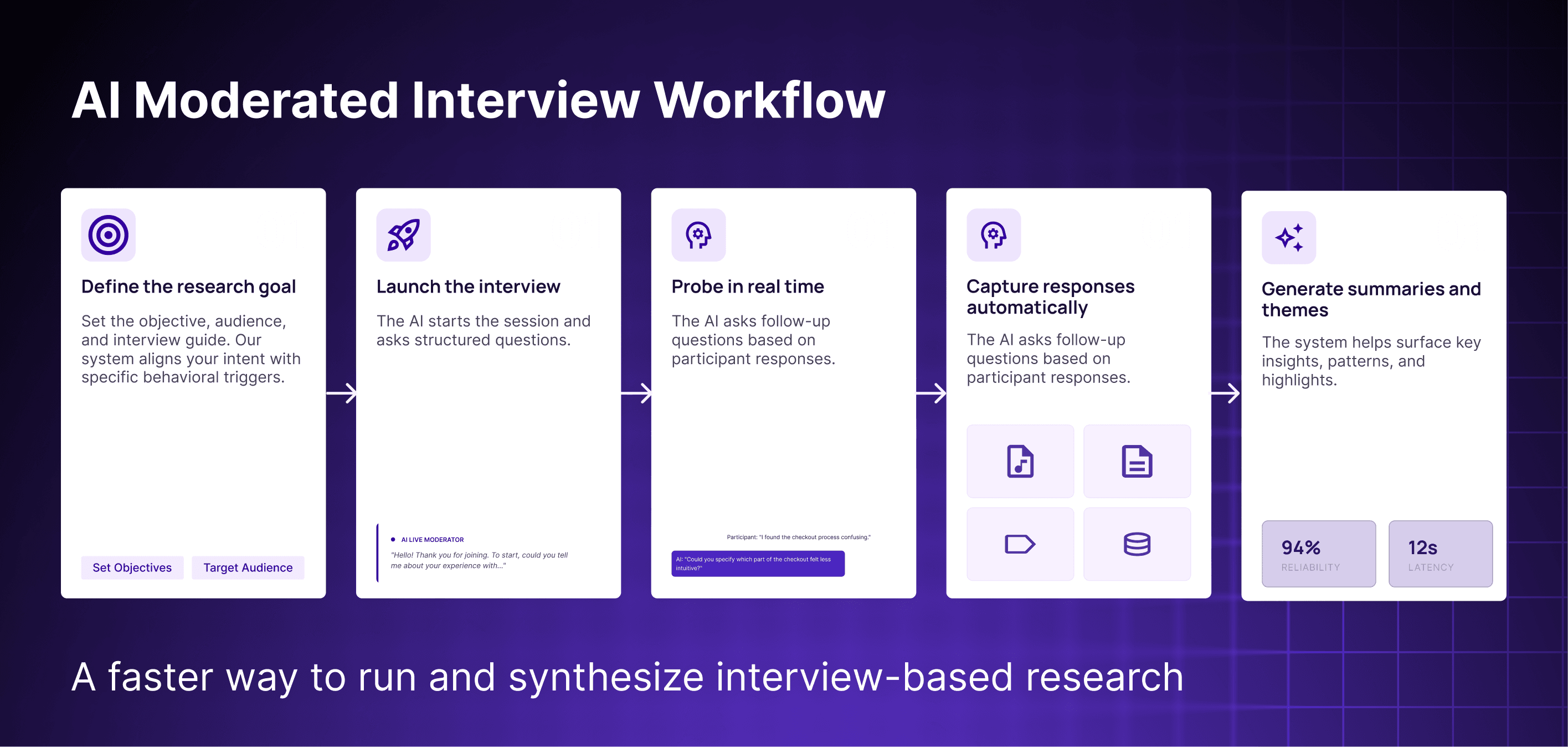
An AI moderated interview follows a structured workflow: a researcher designs the discussion guide, the AI facilitates the conversation with each participant, real-time probing keeps responses from staying surface-level, and outputs — transcripts, themes, summaries — are generated automatically. Here's each stage in detail.
The research team sets up the study
Before a single participant enters the session, the research team defines the conversation structure. This is the single most important success factor in any AI moderated study.
The guide typically includes an introduction (context-setting and informed consent), a set of core questions, and a probing rule for each question — specifying when and how the AI should push deeper ("You mentioned X — can you say more about what you meant by that?"). The quality of the guide directly determines the quality of the insights. An AI can only probe what the guide tells it to explore.
Best practice: treat each question as having two layers — the surface question the participant sees, and the ladder of probing questions the AI uses when the first response is vague or brief.
The AI conducts the conversation
Once the study is live, participants join the session at any time that works for them — no scheduling required. Depending on the platform, the conversation can happen via text chat, voice, or video. Each modality offers different trade-offs: text is the most accessible and works across the widest range of devices; voice adds prosodic signals (pace, tone, hesitation); video adds facial expression and gaze data.
Multilingual capability is a significant advantage here. Platforms supporting 70+ languages allow research programs to run simultaneously across markets without translation delays.
The AI probes and follows up
The defining trait of an AI moderated interview — the characteristic that separates it from a survey — is live, adaptive follow-up questioning.
When a participant gives a vague or thin answer ("It was fine, I guess"), the AI recognizes the low-depth signal and probes: "What would have made it more than fine?" or "You said 'fine' — what specifically felt okay versus not quite right?" This technique, known as laddering, helps researchers surface the underlying motivations and values behind surface-level responses.
The depth of probing is configurable. Some platforms cap probing at two levels to avoid pressuring participants; others allow up to four. Discussion guide designers typically set probing intensity per question — shallow for demographic or context-setting questions, deep for attitude and motivation questions.
Responses are captured and structured
Every response is recorded and transcribed in real time. Modern AI moderated interview platforms produce timestamped transcripts for each session, flag emotionally significant moments, and — depending on the platform's capabilities — apply sentiment tagging and theme detection as sessions complete.
Researchers no longer need to re-watch hours of recordings to find the single quote that captures the insight. The structure is built in from the start.
The AI helps generate outputs
At the end of a study, AI moderated interview platforms typically offer automated synthesis tools: theme clustering across all transcripts, representative quotes surfaced per theme, sentiment breakdowns by question, and draft summary reports.
These outputs are starting points, not final deliverables. Researchers still need to validate AI-generated themes, check for misclassifications, and apply human judgment about what the patterns mean. The AI saves the mechanical synthesis work; the researcher's expertise shapes the interpretation.
What the research says about AI moderated interviews
Academic and industry evidence on AI moderated interviews has grown substantially in the past two years. The picture is nuanced — the method works well for certain research objectives and less well for others — but the overall signal is positive.
Nielsen Norman Group conducted hands-on testing of AI interviewing tools and found that AI interviewers collect structured input effectively at scale and produce consistent probing behavior across sessions. Their analysis noted that the method works best when discussion guides are carefully designed and when the research objective is exploratory rather than requiring deep interpersonal rapport.
Forrester Wave: Experience Research Platforms, Q1 2026 — Forrester highlights that language coverage and asynchronous flexibility are the primary reasons enterprise research teams are adopting AI moderated tools — particularly for global programs where traditional in-person or synchronous moderation was cost-prohibitive.
Harvard Business Review, April 2026 — HBR reported that AI-facilitated interviews enable adaptive conversational structures with significant compression of the research timeline — reducing the gap between question formulation and insight delivery from weeks to days for many standard research programs.
GRIT Report / Greenbook 2025 data shows AI adoption in qualitative research has accelerated sharply, with a growing share of practitioners using AI at the data collection stage rather than only at the analysis stage.
It is worth acknowledging the skepticism as well. Some qualitative researchers raise valid concerns about the rigor of AI moderation for sensitive or emotionally complex research topics, and about the risk that AI-generated summaries can flatten or misrepresent participant voice. These are real limitations — we address them in the limitations section below — and awareness of them makes AI moderated interview programs stronger, not weaker.
Where are AI moderated interviews used?
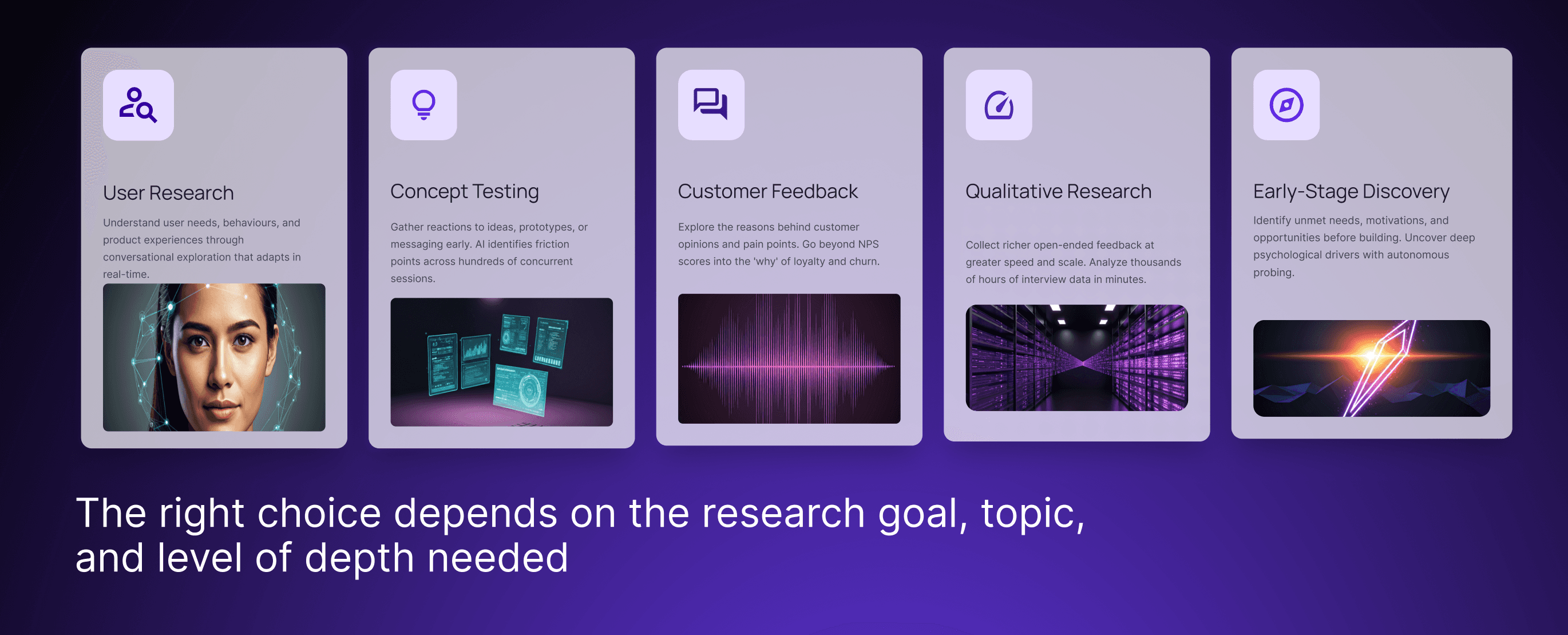
User research and product development
Product teams use AI moderated interviews to validate features, test prototypes, and understand the mental models users bring to a new interface. Because studies can scale to 30 or 50 respondents without the scheduling burden of live IDIs, teams can run qual validation at sprint cadence rather than once per quarter. For prototype testing, the combination of behavioral observation (via User Research tools) and conversational probing creates a richer picture than either method alone.
Consumer insights and market research
For consumer insights teams, AI moderated interviews are increasingly the go-to method for concept testing, pack testing, and ad pre-testing across multiple markets simultaneously. A CPG brand can field a 60-respondent study across Singapore, Indonesia, and Brazil in the time it previously took to field 12 respondents in one market.
Customer experience and retention research
Win/loss research and churn interviews are a natural fit for AI moderation. Participants can share candid feedback about why they left or chose a competitor without the social pressure of talking to a company representative. Studies suggest some participants disclose more honestly to an AI interviewer than to a human, which is particularly valuable in sensitive customer experience contexts.
ICP and market segmentation research
B2B companies use AI moderated interviews to build richer ICP profiles by interviewing large samples of buyers, non-buyers, and churned customers simultaneously — a type of research that was previously too expensive to run at meaningful scale.
Multi-market and multilingual studies
Platforms supporting 70+ languages enable synchronized research across markets. A study that previously required in-country moderators in six markets can now run from a single discussion guide, with the AI handling language localization and cultural framing at the session level.
Continuous discovery and always-on research
Rather than running discrete research programs every quarter, some product and CX teams are moving toward always-on AI moderated interview pipelines — recruiting a small cohort of participants each week and maintaining a rolling view of how user needs and attitudes are shifting. This model requires robust infrastructure but produces the kind of longitudinal signal that one-off studies cannot.
A realistic scenario: A product manager needs to validate three roadmap priorities before a quarterly planning meeting in 96 hours. Using an AI moderated interview platform, she writes a 45-minute discussion guide covering all three features, recruits 30 participants from a panel, and launches the study on Monday evening. By Wednesday morning, she has 30 complete transcripts, an automated theme summary per feature, and representative quotes. She spends four hours on interpretation and synthesis, presents findings on Thursday, and the team makes a data-backed prioritization decision — in under four days, for a fraction of what a traditional qual program would have cost.
Benefits of AI moderated interviews
Speed. Time-to-insight for AI moderated studies is measured in days, not weeks. GRIT Report and ESOMAR benchmarks consistently show AI-assisted qual programs completing synthesis in 30–50% of the time required by traditional methods.
Scale. AI moderators run sessions in parallel. There is no scheduling bottleneck, no moderator fatigue, no capacity ceiling. A 100-participant study runs at the same speed as a 10-participant study.
Cost. Traditional moderated research for a 30-participant project can cost $40,000–$80,000 when you factor in moderator fees, facility costs, incentives, transcription, and analysis time AI moderated platforms reduce per-session costs substantially by automating the most time-intensive steps. The cost of a 30-participant AI moderated study is typically a fraction of that range.
Consistency. Every participant hears the same questions, in the same order, with the same probing logic applied at the same trigger points. There is no moderator variation — the subtle bias introduced by a moderator's tone, body language, or enthusiasm for particular topics — across sessions.
Easier synthesis. Automated transcripts, theme detection, and quote extraction mean researchers spend their cognitive energy on interpretation, not mechanical data processing.
Participant candor. Research suggests that some participants are more willing to share honest, self-critical, or socially sensitive information with an AI than with a human interviewer. This is particularly relevant for topics involving embarrassment, brand disloyalty, or health behavior.
Limitations of AI moderated interviews
A rigorous guide to AI moderated interviews must acknowledge what the method cannot do well.
Nuance and non-verbal cue blindness in text-only AI. Text-based AI moderated interviews capture what participants say, not how they say it. Hesitation, micro-expressions, emotional contradictions between verbal and non-verbal signals — these are invisible to a text-only system. Platforms that add video with facial coding and voice emotion analysis close part of this gap (Decode's AI Moderator addresses this with multi-modal signal capture, including 90%+ accurate facial coding).
Script adherence. The AI probes only what the discussion guide tells it to probe. An experienced human moderator might pick up on an unexpected thread and follow it intuitively. An AI will stay within the parameters its guide defines.
Voice-only AI discomfort. Some participant demographics — older adults, participants in certain cultural contexts, or people who are less comfortable with technology — find voice-only AI interfaces alienating. Text interfaces tend to have broader accessibility.
Data quality and fraud risk. At scale, AI moderated studies using open panels are exposed to the same participant quality risks as any large-scale online research: inattentive respondents, professional survey takers, and fraudulent completions. Validation layers and attention checks are essential.
Discussion guide dependency. The output quality is only as good as the input quality. A poorly designed discussion guide produces poor insights regardless of how sophisticated the AI moderator is.
Unsuitable for emotionally sensitive or vulnerable populations. AI moderated interviews should not be used for research involving grief, trauma, clinical populations, or children. These contexts require trained human moderators who can respond dynamically to distress, offer referrals, and exercise professional judgment in ways no AI system currently can.
AI moderated vs. human-moderated interviews: How to choose
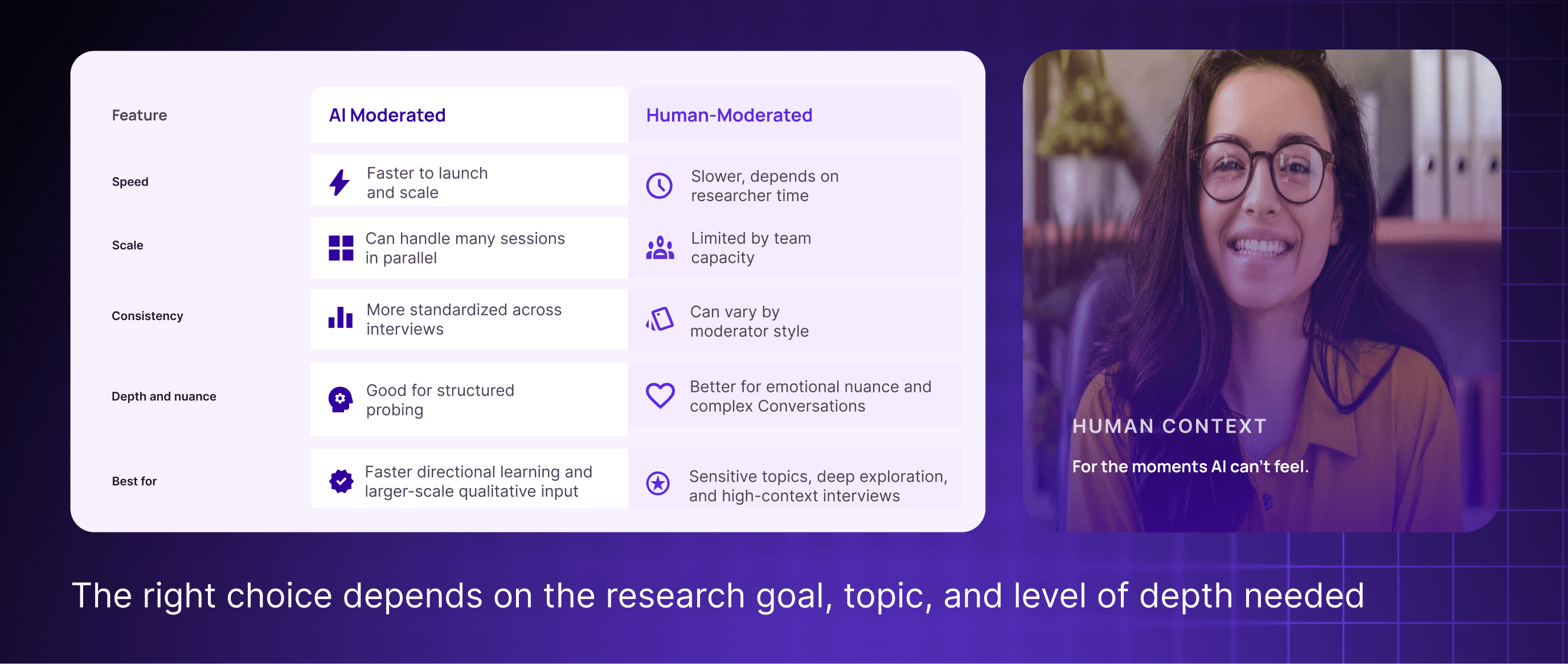
The right moderation approach depends on your research objective, timeline, budget, and the nature of the insights you need. There is no universally correct choice. Here is a practical decision framework.
As a starting rule: choose AI moderated for studies with 20 or more respondents where consistency and speed matter; choose human moderated for 6–10 deep dives requiring maximum probing flexibility and rapport; choose hybrid (AI for scale, human for validation) for sequential programs where breadth is followed by depth.
Dimension | AI moderated | Human moderated | Hybrid |
|---|---|---|---|
Volume | 20–500+ respondents | 6–20 respondents | Any |
Speed | Days | Weeks | Weeks (human phase gates speed) |
Cost | Lower | Higher | Medium |
Probing depth | Consistent, guide-constrained | Flexible, intuition-driven | Both |
Non-verbal signals | Video + emotion AI platforms only | Full | Full (human phase) |
Sensitive topics | Not recommended | Yes, with trained moderator | Human moderation required |
Best for | Scalable exploration, continuous discovery, multi-market | High-stakes decisions, sensitive topics, deep empathy research | Large programs with phased depth requirements |
How much do AI moderated interviews cost?
Traditional moderated research benchmark. A standard qualitative study using human moderators — covering 30 participants across two or three markets — typically costs $40,000–$80,000 all-in, including moderator fees, facility rental, participant incentives, transcription, and analysis. Multi-market programs with in-country moderation can exceed $100,000.
AI moderated research. AI moderated platforms significantly reduce per-session costs by automating moderation, transcription, and initial synthesis. Pricing models vary:
Subscription-based: A flat annual fee covering a defined number of studies and respondents per month, typically suited for teams running continuous discovery.
Per-study pricing: A fixed cost per research project, regardless of respondent count — common for mid-market platforms.
Usage-based: Cost scales with the number of sessions completed, respondent minutes, or features activated — most flexible for teams with variable research cadences.
For a typical 30-participant study, AI moderated platforms deliver comparable qualitative depth to traditional approaches at a fraction of the cost. The savings are largest for multi-market programs where traditional approaches would require in-country moderators in each geography.
How to set up your first AI moderated interview study
Step 1: Define your research question.
Start with one specific question your study must answer. Not "understand our users" — something like "understand why users with active accounts stopped using the workflow automation feature after their first 30 days." The more specific your research question, the better your discussion guide will be.
Step 2: Write the discussion guide.
Budget 30 minutes for this. For each question, write the surface question and at least two probing follow-ups the AI should use if the initial response is shallow. Include emotional checkpoints — questions that ask participants to describe how they felt at a particular moment, not just what they did. These probes are where the richest data tends to live.
Step 3: Define participant criteria and recruit.
Write a screener that ensures your participants genuinely have the experience you are researching. If you are studying lapsed users, define "lapsed" precisely. For panel recruitment, be explicit about relevant behaviors, not just demographics.
Step 4: Configure the AI moderator.
Set session length (typically 20–45 minutes for AI moderated formats), probing depth per question, language settings, and consent disclosures. Most platforms offer preview modes that let you walk through the session as a participant would.
Step 5: Run a test session on yourself first.
Complete the study as a participant before it goes live. You will immediately spot confusing questions, probing rules that trigger too aggressively or not enough, and technical issues. A 20-minute self-test prevents hours of bad data.
Step 6: Launch and monitor the behavioral signal dashboard in real time.
Once the study is live, monitor completion rates, session lengths, and — on platforms with real-time emotion AI — the behavioral signal dashboard. High drop-off at a specific question often signals that the question is confusing or uncomfortable. Early monitoring allows you to intervene before a majority of sessions complete.
Participant experience, ethics, and data privacy
Do participants know they're talking to AI? Best practice — and increasingly, regulatory expectation — is full informed consent. Participants should be told clearly before the session begins that they are interacting with an AI system, not a human researcher. Research on disclosure rates suggests this transparency does not meaningfully reduce participation or honesty, and in some cases, participants are more forthcoming when they know there is no human on the other side.
Data privacy. AI moderated interview platforms operating in enterprise contexts are expected to comply with GDPR for European participants, maintain SOC 2 Type II certification, and provide configurable data retention periods. Research buyers should verify these credentials before deploying at scale.
Unsuitable research contexts. AI moderated interviews should not be used for research involving bereavement or grief, trauma or mental health, clinical populations, or participants under 18 years old. These contexts require the adaptive professional judgment of a trained human moderator, and using AI in these situations creates genuine risk of participant harm.
The next frontier: beyond what participants say
Every AI moderated interview, at its foundation, captures what participants say.
Layer 1 of consumer signal — verbal data, survey-style responses, open-ended answers. It is enormously valuable. And it is not the whole picture.
Research consistently shows that what people say and what they actually do or feel are often different things. This is the Say-Do Gap — the divergence between stated preference and actual behavior that undermines so many market research programs.
Layer 2: what they do. Behavioral signals — where participants look, what draws their attention, where their eyes linger on a stimulus — reveal the automatic, pre-conscious dimension of consumer behavior that verbal responses rarely capture. Eye tracking and attention measurement bring this layer into view.
Layer 3: what they feel. Emotional signals — the micro-expressions that flash across a face before the participant forms a verbal response, the tension in a voice that contradicts the words — are the most predictive layer for intent, recall, and behavior. Facial coding and voice emotion AI make this layer legible.
The most complete picture of consumer truth requires all three. Decode's AI Moderator is one of the few platforms designed to capture all three signal layers simultaneously in a single research session — because understanding what consumers say is only the beginning.
Final thoughts
AI moderated interviews are a workflow option, not a replacement for research craft. Strong objectives, careful discussion guide design, and human judgment in interpretation remain decisive — the AI handles facilitation at scale, not the strategic thinking that makes research worth doing.
The teams getting the most out of AI moderated interviews use them for what they are genuinely good at: running 30 to 100 qualitative conversations in days rather than weeks, scaling across languages and markets without local moderator logistics, and maintaining consistent probing logic across every session. They still rely on human moderators for sensitive topics, high-stakes discoveries, and research requiring the kind of rapport and improvisation that AI systems cannot replicate.
Used at the right stage for the right research question, AI moderated interviews remove the scale and cost barriers that have historically rationed access to qualitative insight — without sacrificing the depth that makes qualitative research worth doing.
How Decode helps
Decode by Entropik builds the AI Moderator known as Mira — an AI moderated interview platform with full Say/Do/Feel signal capture. Where most AI interview tools stop at verbal analysis, Mira adds facial coding (90%+ accuracy), eye tracking (96% accuracy), and voice emotion AI in the same session, across 70+ languages.
Backed by 17 patents in emotion AI and trusted by 150+ global brands, Mira is built for research teams that need depth at scale — without choosing between the two.
FAQs
1. What are AI moderated interviews?
AI moderated interviews are research conversations led by an AI system rather than a human moderator. The AI asks questions, probes responses, captures answers, and often helps summarize the results.
2. How do AI moderated interviews work?
A researcher sets up the study and discussion guide, then the AI runs the interview, asks follow-up questions, records responses, and helps organize the data into summaries or themes.
3. When should you use AI moderated interviews?
They are useful when teams need faster turnaround, more scale, and structured interview-based feedback, especially in user research, concept testing, and early-stage discovery.
4. Can AI moderated interviews replace human moderators?
Not fully. They can support many workflows, but human moderators are still better for sensitive, complex, or deeply nuanced conversations.
5. What are the benefits of AI moderated interviews?
The main benefits are speed, scale, consistency, easier synthesis, and the ability to run interview-based research without requiring a human moderator in every session.
Related Topic: