Creative effectiveness is whether a piece of creative actually achieves the outcome it was designed to influence, whether that's awareness, recall, persuasion, or action, rather than just how it behaves in-market through clicks or views. Brands typically measure it through a mix of signals like attention, emotional response, and message clarity, since no single metric tells the full story.

Why Creative Effectiveness Matters
Brands usually know when a campaign is live. What is harder to know is whether the creative itself is truly working.
An ad can generate impressions, spend budget, and even attract engagement without delivering the outcome the brand actually wants. It may get noticed but not remembered. It may look strong but fail to communicate clearly. It may capture attention without building interest, recall, or intent.
That is why creative effectiveness matters. It helps brands move beyond surface delivery and ask a more useful question: is this creative actually doing its job?
This matters both before and after launch. Before launch, teams want to know whether the creative has the right ingredients to perform. After launch, they want to understand what is driving response, what is underperforming, and what should improve next.
What Creative Effectiveness Actually Means
Creative effectiveness is about whether a piece of creative achieves the outcome it was designed to influence.
That outcome can vary. Sometimes the goal is awareness. Sometimes it is recall, interest, consideration, or intent. In other cases, the creative needs to communicate clearly, stand out in a crowded environment, or motivate action.
So creative effectiveness is not just about whether an ad exists or gets seen. It is about whether the creative helps move the audience in the intended direction.
That is where creative performance enters the conversation. Performance helps show how the creative behaves in the real world, but effectiveness asks a deeper question: is the creative contributing meaningfully to the result the brand wants?
A creative can be visually polished and still be ineffective. It can also appear simple yet work extremely well because it captures attention, communicates clearly, and leaves the right impression.
Why Creative Effectiveness Is Easy to Misread
Creative is often one of the biggest drivers of campaign outcome, yet it is also one of the easiest things to misread.
Teams sometimes assume weak results come mainly from targeting, channel mix, or budget. Those factors matter. But weak creative can quietly limit performance even when the rest of the campaign setup is solid. Media spend can amplify reach, but it cannot fully rescue weak messaging or poor execution.
That is why advertising effectiveness is not only a media question. It is also a creative question.
When brands understand creative effectiveness better, they can:
make stronger pre-launch decisions
identify what is driving results
avoid scaling weak creative
optimize with more confidence
connect creative choices to business outcomes
In short, better creative decisions usually start with a clearer view of creative impact.
How Brands Measure Creative Effectiveness
Brands rarely measure creative effectiveness through one signal alone. A stronger approach looks at a mix of responses that show whether the creative is being noticed, understood, remembered, and acted on.
This is where creative measurement becomes important.
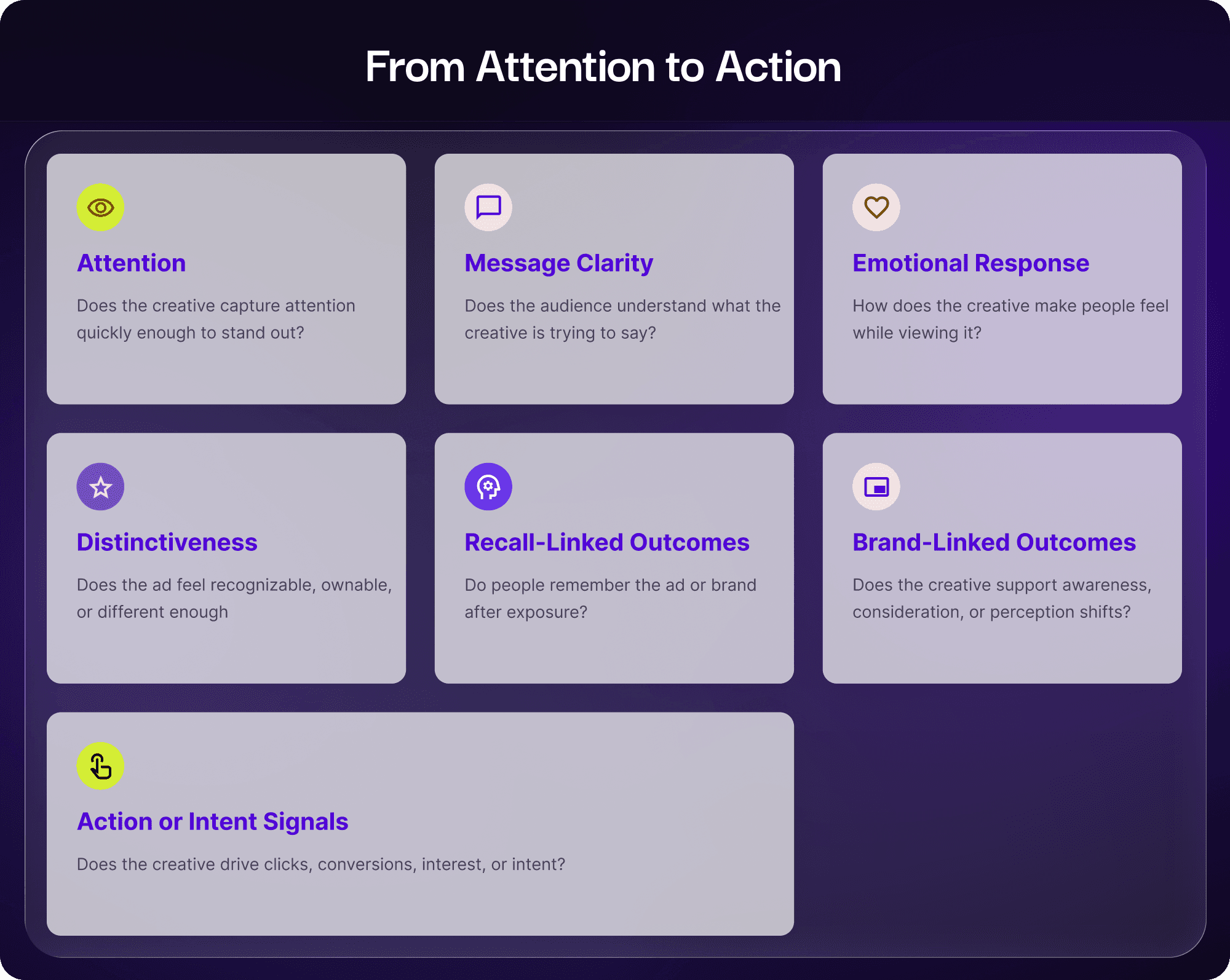
A useful approach may include:
Attention
Does the creative capture attention quickly enough to stand out? If the audience never really notices it, the rest of the message has less chance to work.
Message clarity
Does the audience understand what the creative is trying to say? A creative that is seen but misunderstood is not truly effective.
Emotional response
How does the creative make people feel? Emotional reaction can shape memory, engagement, and overall response.
Distinctiveness
Does the ad feel recognizable, ownable, or different enough to stand out from surrounding noise?
Recall-linked outcomes
Does the audience remember the ad or the brand later? Signals like ad recall can help indicate whether the creative leaves a lasting impression.
Brand-linked outcomes
Some teams also look at broader signals such as brand lift to understand whether the creative is contributing to awareness, consideration, or perception shifts.
Action or intent signals
Depending on the objective, brands may also measure whether the creative supports clicks, conversions, interest, or other lower-funnel outcomes.
The goal is not to overload evaluation with too many ad effectiveness metrics. It is to choose the signals that best reflect what the creative is supposed to do.
Which Signals Matter Most
Not every campaign needs the same measurement lens. The most useful signals depend on the role the creative is meant to play.
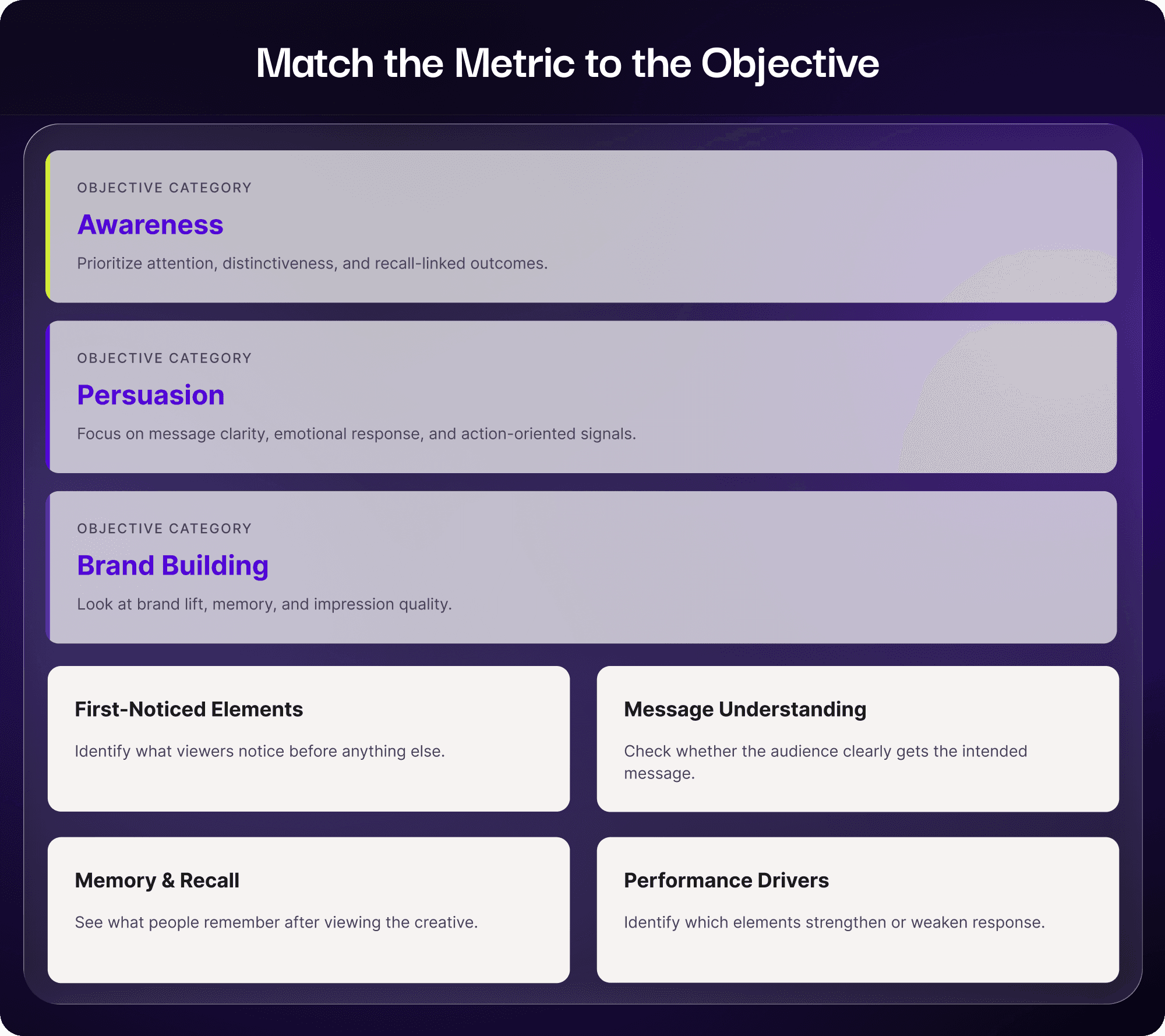
If the goal is awareness, then attention, distinctiveness, and recall-linked outcomes may matter more. If the goal is persuasion, then clarity, emotional response, and action-oriented signals may carry more weight. If the goal is brand building, then brand lift, memory, and impression quality may matter more than immediate clicks.
A few signal types tend to matter often:
what people notice first
what they remember later
how clearly they understand the message
how they feel while viewing it
which elements are strengthening or weakening response
These are the kinds of creative signals that help teams move from guesswork to diagnosis. They reveal the likely performance drivers behind strong or weak results instead of forcing teams to rely only on top-level outcomes.
This is especially useful when brands want to understand more than whether an ad worked. They want to understand why.
Creative Effectiveness vs Creative Performance
These terms are closely related, but they are not the same.
Creative performance often refers to how the creative behaves in-market. That may include CTR, view-through behavior, engagement, conversion efficiency, or similar signals.
Creative effectiveness is broader. It asks whether the creative is achieving its intended purpose.
A creative can perform well in delivery terms and still not be especially effective. It may attract clicks but communicate the wrong message. It may generate views but fail to leave a brand impression. It may gain attention without driving the intended response.
The reverse can also be true. A creative may show strong signs of potential before full in-market results are visible, especially in pre-launch analysis where brands are trying to evaluate effectiveness before scaling spend.
That is why performance matters, but it should not be treated as the whole story.
What Creative Effectiveness Does Not Mean
Creative effectiveness should not be confused with a single metric.
It is not just:
high CTR
strong view count
one memorable visual
internal team approval
aesthetic appeal alone
A creative can look beautiful and still fail to communicate clearly. It can drive clicks and still weaken the brand impression. It can get attention and still underperform on the real business objective.
That is why a balanced view matters. Strong evaluation should connect the creative to the role it is supposed to play, rather than assuming one positive metric tells the full story.
How Decode by Entropik Helps
For brands trying to understand what is really driving creative effectiveness, Decode by Entropik can help make that evaluation clearer.
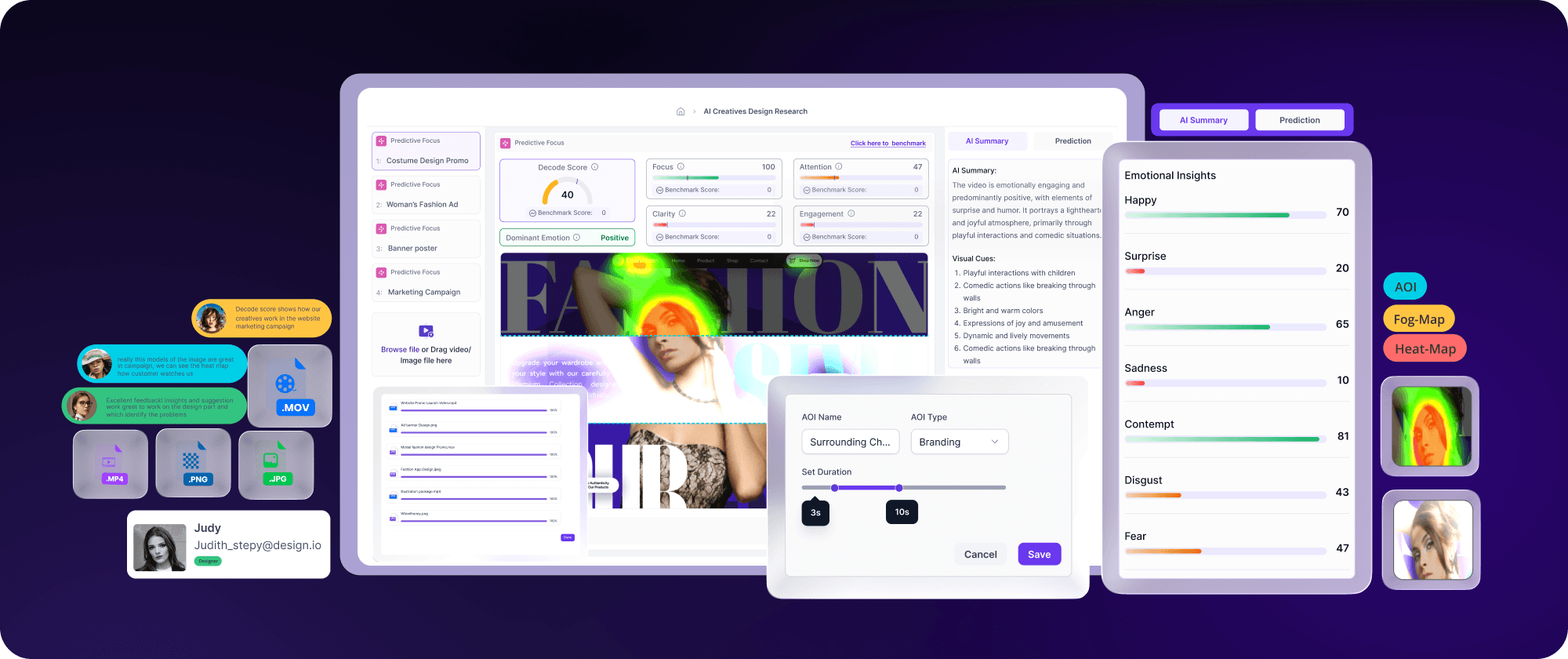
With Decode AI Creative Insights, teams can:
understand which creative elements are driving attention
evaluate emotional response alongside other effectiveness signals
identify what is helping or weakening recall-linked outcomes
compare creative routes and variations more meaningfully
surface creative diagnostics that support stronger optimization decisions
move from raw response to more actionable improvement paths
That makes Decode useful for teams that want to measure more than surface engagement and better understand what is shaping creative effectiveness before and after launch.
Final Thoughts
Creative effectiveness is about whether creative is actually doing its job.
That means brands need a broader view than impressions, clicks, or aesthetics alone. They need to understand whether the creative is being noticed, understood, remembered, and connected to the intended outcome.
That is why creative effectiveness matters. It helps brands evaluate not just whether a creative is live, but whether it is working in the way it needs to. And when teams measure that more clearly, they make better creative decisions, stronger optimization decisions, and ultimately better campaign decisions.
Frequently asked questions
1. What is creative effectiveness?
Creative effectiveness measures how well an ad or piece of creative content achieves its intended marketing goals, such as driving attention, emotional engagement, recall, or purchase intent.
2. How do brands measure creative effectiveness?
Brands use tools like attention tracking, emotion AI, brand recall testing, and post-campaign performance data to assess how creative content performs against objectives.
3. Why is measuring creative effectiveness important before a campaign launches?
Pre-testing creative effectiveness helps brands avoid wasting media spend on underperforming assets and allows them to optimize messaging and visuals before a full rollout.
4. What is the difference between creative effectiveness and creative testing?
Creative testing is the process used to evaluate an ad, while creative effectiveness is the outcome or result measured how well that ad actually achieves its goals.
5. Can creative effectiveness be measured after a campaign has launched?
Yes, post-campaign measurement using sales lift, brand tracking, and engagement metrics complements pre-launch testing to fully assess creative effectiveness.
Related Topic: