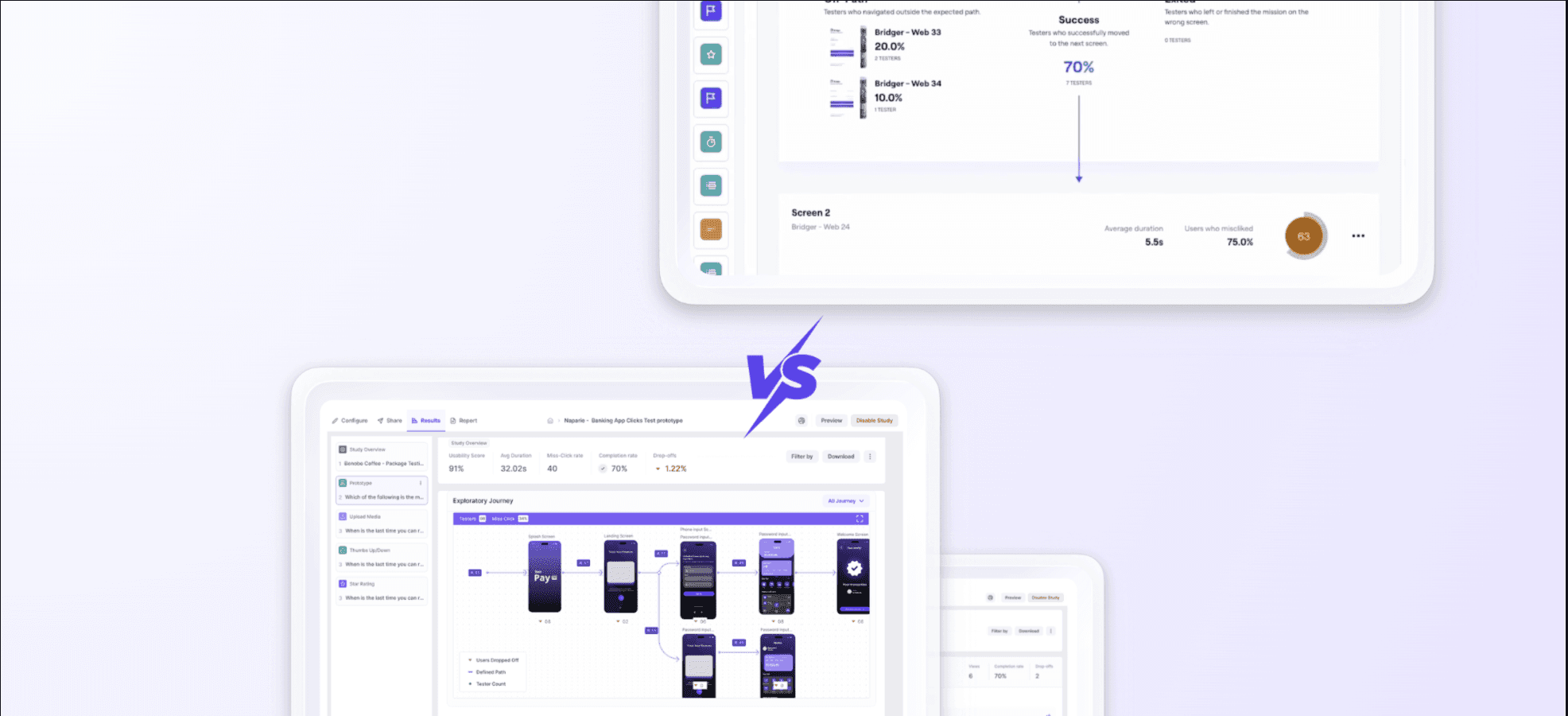
Decode vs Maze: Which User Research Platform Delivers Deeper Insights?
User research has evolved far beyond task completion rates and survey responses.
Today's teams need to understand not only where users struggle, but also what drives their decisions, how they react throughout an experience, and how those insights can be applied across future studies.
Both Decode and Maze help teams gather user feedback, but they are designed for different levels of research maturity. Maze focuses on product discovery and usability validation, while Decode takes a broader approach by combining research workflows, AI-powered analysis, behavioral intelligence, and insight management in a single platform.
This comparison explores where each platform fits and what organizations should consider when evaluating user research software.
Decode vs Maze at a Glance
Category | Decode | Maze |
|---|---|---|
Primary Focus | AI-powered user research platform | Product discovery and usability testing |
Research Methods | Qualitative, quantitative, moderated, unmoderated, diary studies | Prototype testing, surveys, usability testing |
AI Capabilities | AI Copilot, AI Moderator, automated synthesis | AI-assisted analysis and interview moderation |
Behavioral Intelligence | Emotion, attention, sentiment, engagement analytics | Limited behavioral signals |
Research Repository | Centralized insights hub | Study-level storage |
Participant Access | 100M+ global participants and BYOP | Recruitment options vary by project |
Ideal Teams | ResearchOps, UX, Product, CX | Product and design teams |
Understanding the Difference
Maze was built to help teams validate ideas quickly. It enables researchers, designers, and product managers to test prototypes, measure usability, and collect feedback before launch.
Decode supports these same workflows while extending research beyond validation. Interviews, usability studies, behavioral signals, participant management, analysis, and knowledge retention are connected within a single ecosystem.
The result is a research process that scales more effectively as study volume, stakeholders, and research complexity grow.
Research Capabilities
Prototype and Usability Testing
Both platforms support prototype testing and usability evaluation.
Maze focuses on task success, navigation flows, survey responses, and usability metrics that help teams identify friction within digital experiences.
Decode combines usability testing with behavioral analysis, helping teams understand not only where friction occurs but also how users respond throughout the experience.
Moderated and Unmoderated Research
Modern research programs rarely rely on a single methodology.
Decode supports moderated interviews, unmoderated studies, diary research, and usability testing within the same platform. This flexibility allows teams to move from exploration to validation without introducing additional tools or workflows.
Maze remains primarily focused on usability and product discovery studies.
Participant Recruitment
Participant quality often determines research quality.
Decode provides access to more than 100 million participants globally while supporting Bring Your Own Participants (BYOP) workflows. This enables organizations to recruit niche audiences, existing customers, or large-scale consumer panels from a single environment.
AI-Powered Research Workflows
One of the biggest differences between the platforms is how research is analyzed.
As study volumes increase, manual synthesis becomes one of the most resource-intensive parts of the research process. Reviewing recordings, identifying themes, creating summaries, and preparing reports can consume significantly more time than data collection itself.
Decode addresses this challenge through AI Copilot, which automatically surfaces themes, generates summaries, highlights key moments, and organizes findings across studies.
This allows teams to spend less time processing data and more time acting on insights.
Moving Beyond Individual Studies
Many organizations accumulate hundreds of interviews, usability sessions, and surveys over time. Yet valuable findings often remain scattered across projects, teams, and repositories.
This creates a common problem: the same questions get researched repeatedly.
Decode approaches research as a long-term organizational asset. Findings, clips, reports, themes, and study outputs are stored within a centralized repository that supports search, reuse, and cross-study analysis.
For growing research teams, knowledge management can be as important as data collection itself.
AI Moderator Comparison
Both platforms offer AI-driven interviewing capabilities, but their approaches differ.
Maze AI Moderator automates interviews and generates summaries based on participant responses.
Decode AI Moderator combines automated interviewing with sentiment analysis, attention measurement, engagement tracking, and AI-powered synthesis. Researchers receive both conversational feedback and behavioral context within the same workflow.
This creates a richer view of participant responses without increasing research effort.
Enterprise Readiness
As research programs expand, priorities shift from executing individual studies to managing research operations at scale.
Organizations often require:
Centralized governance
Cross-functional collaboration
Consistent research standards
Knowledge retention
Global participant access
Automated analysis
While Maze is well-suited for rapid product validation, Decode is designed to support continuous research programs that span multiple teams, business units, and markets.
Final Thoughts
Maze has established itself as a strong platform for usability testing and product discovery. Teams looking to validate designs, test workflows, and gather feedback quickly will find a focused set of capabilities built around those use cases.
Decode takes a broader view of user research. By combining behavioral intelligence, AI-powered synthesis, participant access, moderated and unmoderated research, and a centralized insights repository, it helps organizations build a research practice that scales beyond individual studies.
For teams investing in long-term research operations, the conversation increasingly extends beyond usability testing alone. The ability to connect findings, automate analysis, and preserve institutional knowledge is becoming just as important as collecting feedback in the first place.