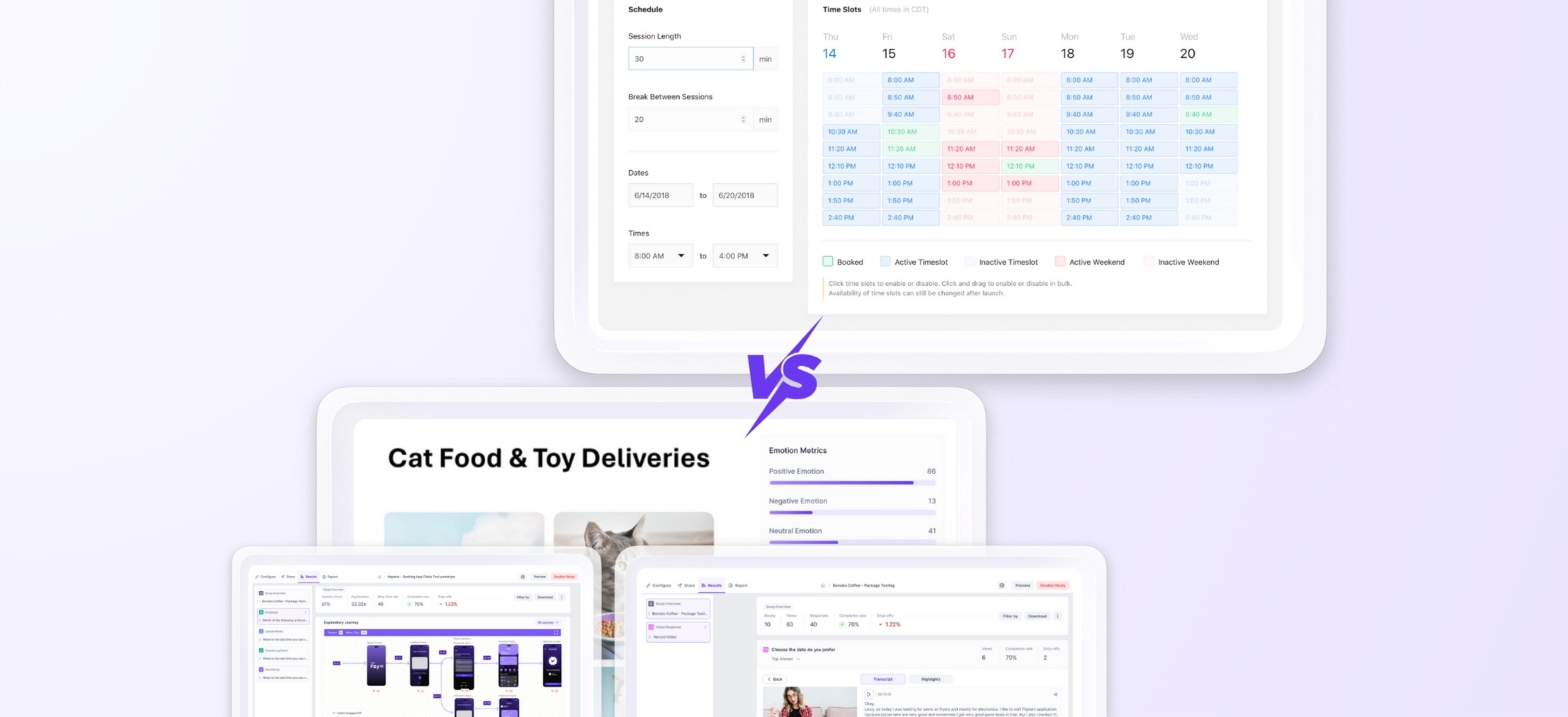
Decode vs Dscout: A Complete Guide to Behavioural Intelligence vs Diary-Based Research
User research today needs to go deeper than qualitative feedback. As digital products become more complex, teams require emotional understanding, behavioural visibility, and automated insight generation—far beyond what diaries and interviews alone can offer.
While Dscout is widely known for its diary studies and mission-based qualitative research, Decode by Entropik is built for a different era: one where Emotion AI, Attention AI, and behavioural analytics work together to reveal the true reasons behind user actions.
This blog provides a clear, structured comparison between Decode and Dscout, helping UX, Product, and ResearchOps teams choose the platform that best serves their research needs.
Decode vs Dscout: High-Level Comparison
Dscout focuses on qualitative missions.
Decode unifies behavioural, emotional, and usability intelligence.
Dscout | Decode (Entropik) |
|---|---|
Diary-based qualitative research platform | Unified human-insights platform with emotion, attention & behavioural analytics |
Interviews, diary studies, field research, surveys | End-to-end research: prototypes, live sites, apps, concepts & behavioural insights |
Used by qualitative UX & research teams | Designed for ResearchOps, UX, CX & Product teams in enterprises |
Decode expands research from observing behaviour to understanding it.
Research Approach: The Fundamental Difference
Dscout = Qualitative Stories
Dscout captures users’ experiences through diary entries, video submissions, and missions—great for understanding long-term behaviours but limited for digital experience testing.
Decode = Behavioural + Emotional Intelligence
Decode incorporates:
Emotion AI to measure facial expressions & sentiment
Attention AI to track gaze, focus & engagement
Usability analytics across prototypes, websites & apps
AI-assisted synthesis to automate manual review
A unified repository to preserve insights across studies
Decode gives a holistic understanding of interactions in real time—not just what users say, but how they feel and behave.
Decode vs Dscout: Strengths & Gaps
Decode’s Strengths | Dscout’s Limitations |
|---|---|
Emotion, attention & usability analytics in one platform | Focuses solely on qualitative diary & interview data |
AI Copilot automates transcription & summaries | Manual coding and tagging |
Unified repository connects & reuses insights | Insights remain within individual missions |
Multi-method research (prototype, web, app, concept testing) | Geared toward field & diary research only |
Scales for enterprise global teams | Designed primarily for qualitative teams |
Decode unifies behavioural analytics and automation.
Dscout centers on qualitative storytelling.
Feature Comparison: Decode vs Dscout
Research Methods Coverage
Capability | Decode | Dscout |
|---|---|---|
Emotion & Attention Analytics | Tracks facial emotion, voice tone, gaze & behavioural cues | Self-reported video/text responses only |
AI Assistance | AI Copilot automates summaries & insight generation | Manual tagging & coding |
Repository & Reuse | Centralised repository linking all studies | Project-level storage; no continuity |
Testing Environments | Prototypes, live websites, apps, concepts | Diary studies, interviews, field research |
Participant Access | Global panel + BYOP flexibility | Dscout’s “Scout” community only |
Decode offers broader coverage across digital experiences.
Dscout excels in ethnographic and longitudinal studies.
Key Differences: What Truly Sets Decode Apart
Area | Decode | Dscout |
|---|---|---|
Scope | Multi-method research across prototypes, web, apps | Qualitative diary & mission-based studies |
Behavioural Depth | Emotion + attention analytics reveal engagement & sentiment | Self-reported qualitative feedback |
Automation | AI-based transcription, tagging & summarisation | Manual analysis |
Continuity | Unified repository prevents duplication | Missions remain standalone |
Research Coverage | End-to-end digital experience testing | Qualitative field & diary work |
Decode bridges qualitative and behavioural research—Dscout does not.
Research Coverage & Practical Use Cases
Where Decode Excels
Prototype testing with friction detection
Website and app behavioural analytics
Concept & creative validation
Moderated & unmoderated UX research
Centralised insight reuse for ResearchOps at scale
Where Dscout Excels
Longitudinal diary studies
Ethnographic field research
Qualitative missions and story-driven insights
Both platforms support video-based input and cross-device participation, but only Decode adds actionable behavioural intelligence.
Why Leading Teams Choose Decode
Smarter Analysis
AI Copilot automates analysis, eliminating time-consuming manual workflows.
Faster Research Cycles
Insights delivered up to 10× faster than traditional qualitative review.
Continuous Insight Reuse
Repository keeps knowledge connected across teams, projects & markets.
Deeper Understanding
Emotion & Attention AI uncover subconscious reactions—data Dscout cannot capture.
Broader Reach
Global and BYOP participant options ensure scalable and diverse research.
Decode moves teams beyond usability into true behavioural intelligence.
Final Takeaway
Dscout helps you gather qualitative stories.
Decode helps you understand behavioural truth.
If your research requires emotional depth, behavioural insights, AI automation, and enterprise readiness, Decode offers a more powerful and future-proof solution.