Decode and Outset are AI-moderated research platforms that help teams conduct qualitative research at scale. While both automate interviews and insight generation, they differ in research methodologies, AI moderation capabilities, analysis depth, and enterprise features. Comparing Decode vs Outset helps organizations identify the platform that best supports their research workflows, teams, and decision-making needs.
Summary
|
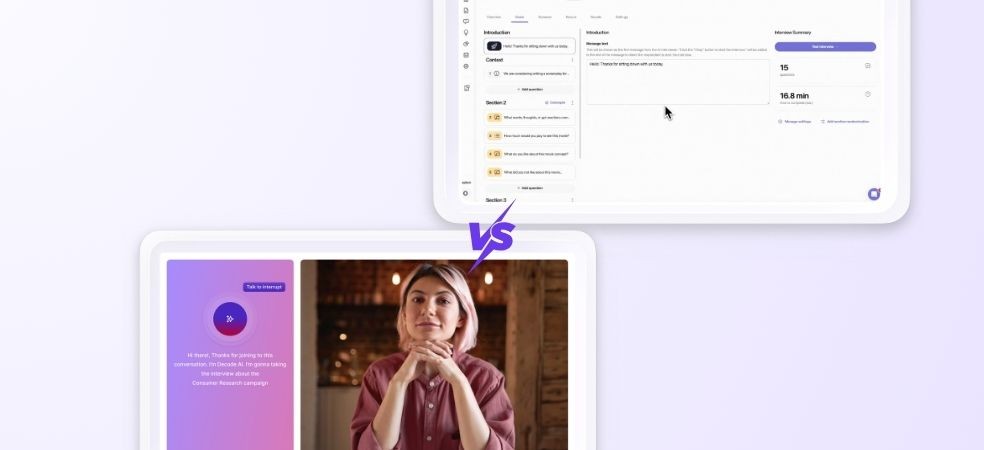
Decode and Outset both run AI moderated interviews at scale, but they capture different evidence. Outset focuses on conversational depth, multimodal interviewing and automated synthesis, with Visual Intelligence so the AI moderator can see on-screen stimuli. Decode adds behavioral measurement to every interview, using facial coding, eye gaze tracking and voice emotion analysis alongside the transcript.
Decode vs Outset at a glance
Outset is optimized for deep, high-volume AI-moderated conversational interviews with strong stimulus handling and synthesis. Decode captures measured emotion, attention, and gaze in the same interview session, across a platform that extends beyond interviews into creative testing, concept research, and usability.
| Decode by Entropik | Outset |
AI moderated interviews | ✅ | ✅ |
Interview modalities | Text, voice, video | Text, voice, video, voice-to-voice |
Visual Intelligence (AI sees stimulus) | N/A | ✅ |
Facial coding | ✅ 90%+ accuracy, 62 expressions | ❌ |
Eye gaze tracking | ✅ 96% accuracy | ❌ |
Voice emotion AI | ✅ | ✅ (tone and vocal analysis) |
Creative and ad testing | ✅ AI Creative Insights | ❌ |
Automated synthesis and themes | ✅ | ✅ Explore, highlight reels, auto-tagging |
Research repository | ✅ Insights Hub | ✅ cross-study knowledge base |
Languages | 70+ | 40+ |
Pricing | Custom / enterprise | Custom / enterprise |
Outset is a strong standalone AI interview product. The decision comes down to whether your research needs behavioral signal capture alongside conversational depth.
What are AI moderated interviews?
An AI moderated interview is a research session in which an AI interviewer asks questions, adapts follow-ups based on what the participant says, and runs across many participants simultaneously — combining the depth of a qualitative interview with the scale of a survey.
The workflow in four steps: study design and discussion guide, participant recruitment or upload, AI-led interview execution across text, voice, or video, and automated synthesis and reporting.
The standard implementation captures what participants say and how they say it — the verbal and para-verbal layer. Signal capture beyond the transcript — where participants look, how their face responds at the moment of exposure — has become the next differentiator in the category as platforms compete beyond transcription quality.
According to the 2025 GRIT Business & Innovation Report, AI-assisted qualitative methods are the fastest-growing segment in market research. Significant venture capital followed that growth: the AI-moderated interview category saw major funding rounds in 2024 and 2025 as enterprise buyers moved from pilots to production deployments.
What is Outset?
Outset is an AI-moderated research platform founded in 2022 and headquartered in San Francisco. It is operated by Parnassus Labs and led by co-founder and CEO Aaron Cannon.
In December 2025, Outset closed a $30M Series B led by Radical Ventures with participation from M12, Y Combinator, 8VC, and Adverb Ventures, bringing total funding to $51M. The company has stated it is extending AI-moderated research toward an AI-native customer experience management category.
Product surface: AI Moderated Interviews, AI-Driven Synthesis, Recruit, Multilingual, Fraud Detection, Visual Intelligence, Explore mode, chat-with-your-data, highlight reels, auto-tagged themes, and exports to CSV, PPT, PDF, and video. Voice-to-voice modality enables natural conversation-style sessions without typing.
Publicly referenced customers include Microsoft, HubSpot, Uber, Nestlé, Glassdoor, Away, and WeightWatchers.
Typical buyer: UX researchers, market researchers, consumer insights teams, agencies, and cross-functional product teams prioritizing interview speed and conversational depth.
What is Decode by Entropik?
Decode is Entropik's Emotion AI and human insights platform. Its AI Moderator, Mira, runs conversational interviews while Emotion AI captures facial, gaze, and voice signals in the same session — so teams analyze what participants say alongside how they reacted.
Core technology stack:
Platform modules include Consumer Insights, AI Creative Insights, User Research, Insights Hub, and AI Moderator.
Verified figures: 90%+ facial coding accuracy, 96% eye tracking accuracy, 62 facial expressions, 70+ languages supported, 17 patents, 150+ global brands.
Typical use cases: creative and ad diagnostics, packaging and concept testing, usability and UX research, brand research, and multi-market qualitative programs.
Decode vs Outset: feature-by-feature
Interview modalities and adaptive probing
Outset supports text, voice, video, and voice-to-voice responses, with custom moderator training, white-labeling, and custom interviewer branding. Voice-to-voice enables natural conversation-style sessions that reduce friction for participants less comfortable typing.
Decode's AI Moderator (Mira) runs text, voice, and video sessions with adaptive probing across 70+ languages. A relevant industry caveat applies to both platforms: Nielsen Norman Group's evaluation of AI interview tools found that current AI moderators have measurable limits in real-time adaptivity compared to skilled human moderators — they perform better on structured research questions than on deeply exploratory conversations that require improvisation. Both platforms are subject to this constraint.
Visual Intelligence vs eye tracking
Outset's Visual Intelligence is a genuine advance in AI-moderated concept and screen testing: the AI moderator can see images and on-screen content the participant is viewing, so probing can reference what is actually on screen. For screen-based stimuli, this improves the relevance and context-specificity of follow-up questions.
Decode's eye gaze tracking measures where the participant actually looked — in what order, for how long, and with what fixation pattern. The distinction matters for the research outcome:
Visual Intelligence = the AI sees the stimulus and can ask questions about it.
Eye tracking = the research records whether and how the participant attended to each element of the stimulus.
Both are useful. They answer different questions. Visual Intelligence improves interview quality on screen-based stimuli. Eye tracking reveals gaze data — the attention signal that tells you which claim was read, which pack element was noticed first, and what the participant never looked at at all.
Behavioral and emotional signal capture
This is the decisive difference between the platforms.
Facial coding analyzes micro-expressions — brief, involuntary facial muscle movements mapped to emotional states. Decode's Facial Emotion AI tracks 62 distinct expressions at 90%+ accuracy.
Eye gaze tracking captures where attention lands, in what sequence, and for how long. Decode's system runs at 96% accuracy.
Voice Emotion AI analyzes tone, pitch, and pacing for markers of hesitation, confidence, frustration, or delight.
The research rationale: transcripts capture articulated, post-rationalized responses — what a participant consciously decided to say after processing the question. Behavioral signals capture the immediate, non-conscious layer, including hesitation, confusion, and emotional response that participants rarely name aloud.
Research published by NCSolutions found that creative quality drives approximately 49% of advertising's incremental sales impact — more than targeting, reach, or recency. Measuring creative quality at that level requires knowing how attention and emotion responded to the stimulus, not only what participants said about it afterward.
Outset analyzes what participants say and applies tone-based analysis. It does not offer facial coding or eye gaze tracking as native capabilities, and it does not position itself as a behavioral measurement platform.
Recruitment, panel access, and participant quality
Outset supports custom screeners and quotas, bring-your-own-panel and customer lists, shareable recruitment links, and panel sourcing through its network on higher tiers. It relies on partner networks and BYO participants rather than a large proprietary panel — which adds sourcing, screening, and incentive costs outside the platform price.
Decode supports bring-your-own-participant research alongside access to 103M+ profiled participants via Cint and Dynata across 120 countries. Teams that maintain owned customer panels or want a combination of owned and external recruitment operate flexibly within the same platform.
Both platforms apply fraud tagging, incomplete response detection, and duplicate controls. Behavioral signal data adds an engagement validity layer: facial and gaze signals reveal disengaged or distracted participants that transcript-level quality checks cannot reliably identify.
Language coverage and global research
Outset supports 40+ languages with live translation. Decode supports 70+ languages for AI-moderated interviews with behavioral signal capture across supported languages.
The practical gap matters for global research programs: teams running studies in APAC, the Middle East, Latin America, or emerging markets will encounter language boundaries with Outset that don't exist on Decode. Behavioral signals are also language-independent — gaze and facial data are directly comparable across markets without translation loss, which is a genuine methodological advantage for cross-market studies.
Synthesis, reporting, and the insights layer
Outset's synthesis surface is deep: auto-tagged themes and transcripts, Explore mode for cross-study search, chat with your data, highlight reels, custom reports, and exports to CSV, PPT, PDF, and video. The ability to upload researcher-led interviews for analysis extends the value beyond Outset-fielded studies.
Decode's synthesis layer applies emotion and attention data alongside transcript analysis, with Insights Hub as a centralized repository that stores quantitative, qualitative, and behavioral findings in one searchable archive. The repository compounds value over time — past studies become searchable not only by theme but by emotional pattern and attention signal.
Outset has signaled expansion toward continuous customer experience feedback, so the scope comparison between platforms may narrow over time.
Pricing
Neither vendor publishes list pricing. Both sell custom subscriptions based on team size, research volume, and support needs.
Outset's pricing model involves annual enterprise commitments without a self-serve or per-study entry point. Buyers report usage-based billing tied to research volume and add-ons for expert services, recruitment management, and advanced research design. Attribute these to buyer-reported sources and verify directly with Outset.
The relevant comparison is total cost of the research stack: platform licence, participant sourcing, sessions, synthesis tools, creative testing tools, and repository. A platform focused on interviews may cost more per insight once the full research workflow is included.
Where Outset is the stronger choice
Teams whose only requirement is AI-moderated interviewing run at high volume, with no need for quantitative, creative, or behavioral modules
Screen and stimulus-heavy research where the moderator needs to reference exactly what the participant is viewing (Visual Intelligence)
US and North America-focused teams working primarily in English and major European languages
Teams already invested in separate quantitative, repository, and creative testing tools they don't intend to consolidate
Organizations that want a focused, fast-moving interview product with deep expert services
Where Decode is the stronger choice
Research where the decision depends on non-verbal evidence: creative diagnostics, packaging and shelf research, concept reveals where reaction precedes rationalization
CPG, FMCG, and consumer research programs where purchase behavior is driven by fast, emotional responses
Multi-market and non-English research programs requiring 70+ languages
UX and usability research where attention paths and frustration signals explain drop-off that participants can't articulate
Teams consolidating qualitative, quantitative, creative testing, and repository into one platform
Why teams look for Outset alternatives
Based on publicly available buyer reviews and third-party competitive analysis:
No large proprietary panel — recruitment relies on partner networks or team-provided participants
Custom annual pricing with no self-serve or per-study entry — constrains low-volume and experimental use
Point-solution scope — quantitative research, creative testing, and the repository sit outside the platform
Language coverage — 40+ languages limits teams running APAC, Middle East, or LatAm programs
No behavioral or biometric signal capture — transcript-only measurement for teams that need attention and emotion data
Fair counterpoint: Outset's rapid funding, enterprise customer base, and product velocity indicate a platform with real traction, and several of these gaps are roadmap items rather than permanent constraints.
Other Outset competitors worth evaluating
Platform | Best for | Key strength | Main limitation |
Decode by Entropik | Behavioral + multi-method research | Emotion AI, eye tracking, full research stack | Enterprise pricing |
ListenLabs | Large-scale qualitative with panel | 30M+ panel, sub-24hr turnaround | No eye tracking |
Conveo | Enterprise qual with EU data hosting | Video-first, strong compliance | Interview-focused |
Strella | Consumer research, fast qual | Speed and simplicity | Limited platform breadth |
Maze | Design and prototype testing | Tight design tool integrations | Not for consumer insights |
dscout | Longitudinal and diary studies | Mobile-first, contextual depth | Different methodology |
How to evaluate an AI moderated research platform
Eight questions to ask in every vendor call:
What evidence would change the decision this research needs to support?
Do we need what participants say, or also how they reacted?
Which markets and languages must be covered in the next 18 months?
Who supplies participants, and what is the fully loaded cost per completed interview?
What fraud and engagement controls exist, and how are they verified?
What certifications and data governance terms does procurement require?
Which other tools would this replace, and which would it sit alongside?
How will findings be searchable and reusable in twelve months?
Run a paid pilot on a live business question — the same discussion guide on both platforms — and compare not just speed but whether the outputs changed a decision.
How Decode helps
The say-do gap — the distance between what participants tell you and what their behavior and emotions reveal — is the central problem that behavioral research exists to close.
Decode's AI Moderator (Mira) captures the verbal layer across 70+ languages. Facial Emotion AI, Eye Gaze Tracking, and Voice Emotion AI instrument the behavioral and emotional layers in the same session. AI Creative Insights applies the same measurement to creative pre-testing. Insights Hub stores every finding — verbal, behavioral, and attitudinal — in one searchable archive that compounds in value over time.
For teams whose research questions go beyond what participants tell you, that combination is what Decode is built for.
Frequently asked questions
1. Is Decode a good Outset alternative?
Yes, for teams that need measured behavioral and emotional signal data (facial coding, eye tracking, attention measurement) alongside AI-moderated interviews. Decode also covers creative testing and concept research that Outset doesn't. For teams whose primary need is fast, high-volume AI interviews with Visual Intelligence, Outset is a strong option.
2. What is Visual Intelligence in AI moderated research?
Visual Intelligence (Outset's term) allows the AI moderator to see images and on-screen content the participant is viewing, enabling probing that references the actual stimulus. It is different from eye tracking: Visual Intelligence improves interview relevance; eye tracking measures where the participant's gaze actually went.
3. Does Outset have emotion detection or facial coding?
Outset analyzes voice tone and applies vocal analysis to interviews. It does not offer dedicated facial coding or eye gaze tracking as native capabilities. Decode provides both — facial coding at 90%+ accuracy tracking 62 expressions, and eye tracking at 96% accuracy.
4. How much does Outset cost?
Outset does not publish pricing. Enterprise commitments are annual, custom-priced, and include research design services. Verify current pricing directly with Outset.
5. Which is better for large-scale interview studies?
Outset's voice-to-voice sessions, Visual Intelligence, and rapid synthesis are strong for high-volume interview programs. For programs that also need behavioral diagnostics, creative testing, or multi-market coverage above 40 languages, Decode's platform is the stronger fit.
6. Can Decode replace Outset entirely?
For most research programs, yes. Decode's AI Moderator covers AI-moderated interviews and adds behavioral measurement, broader language coverage, and a full research stack. The areas where Outset has specific advantages are voice-to-voice sessions and Visual Intelligence for screen-based stimuli.
The bottom line
Both platforms scale qualitative research with AI moderation. The difference is whether your decisions depend on what participants say, or also on where their attention went and what they felt before they spoke.
Choose Outset if the requirement is a focused, high-volume AI interview product with stimulus-aware moderation, in primarily English-speaking markets. Choose Decode if your decisions depend on measured behavioral and emotional evidence, broader language coverage, or consolidating a fragmented research stack.