Decode and UserTesting are research platforms designed to help teams gather user and customer insights. While both support research workflows, they differ in areas such as participant engagement, AI-powered analysis, qualitative research capabilities, and scalability. Comparing Decode vs UserTesting helps modern research teams determine which platform best aligns with their research goals, processes, and organizational needs.
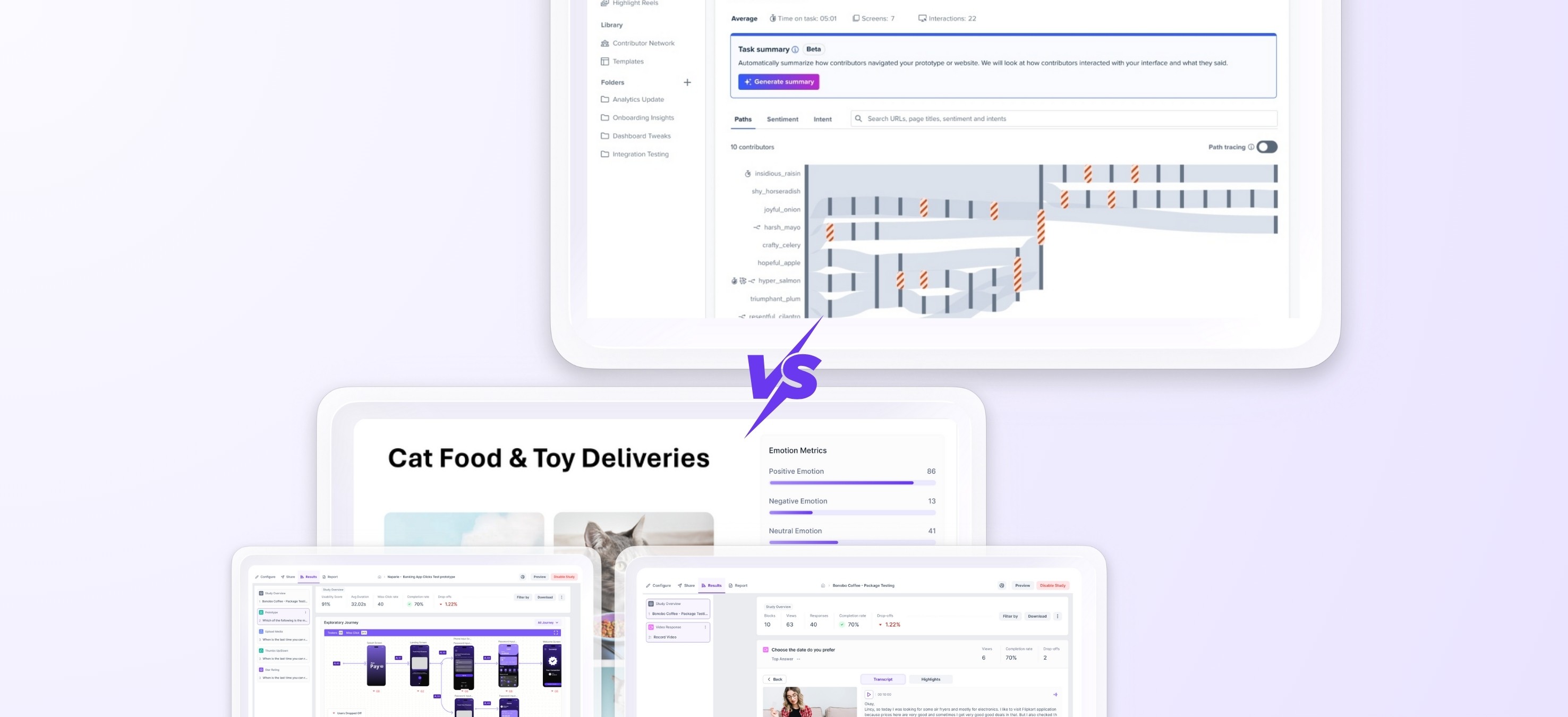
Summary:
|
UserTesting captures what users do and say during a research session. Decode adds the why — measuring facial emotion, gaze, and voice signals alongside the session — in a platform that covers usability, surveys, interviews, and creative testing without switching tools.
Decode vs UserTesting at a glance
UserTesting is best known for fast, high-volume video feedback and consumer usability research with a large global Contributor Network. Decode is a behavioral research platform that adds emotion, attention, and voice measurement to usability and qualitative research in a unified stack.
| Decode by Entropik | UserTesting |
Primary use case | Behavioral + multi-method research | Usability testing + video feedback |
Facial coding / emotion AI | ✅ 90%+ accuracy, 62 expressions | ❌ |
Eye tracking / attention | ✅ 96% accuracy | ❌ |
AI moderated interviews | ✅ AI Moderator (Mira) | Limited |
AI synthesis | ✅ AI Copilot | ✅ AI Insight Summary, Smart Tags |
Surveys and quant | ✅ | Via integrations |
Creative and concept testing | ✅ AI Creative Insights | Limited |
Research repository | ✅ Insights Hub | ✅ Insights Hub |
Panel / participants | 103M+ via Cint/Dynata + BYO | Large global Contributor Network |
Pricing model | Custom / enterprise | Credit-based, quote-only |
The core distinction: UserTesting shows you what users do. Decode also measures why — through emotion, attention, and behavioral signals in the same session.
What is UserTesting?
UserTesting is an experience research platform for moderated and unmoderated usability testing and video feedback, founded in 2007. It built the consumer usability testing category and maintains one of the largest global Contributor Networks for on-demand research participants.
Core strengths: fast qualitative feedback at volume, a large global Contributor Network for consumer usability, AI Insight Summary for automated insight generation, Smart Tags, and Insights Discovery. Strong fit for consumer brands and product teams running high-volume usability at scale.
Typical buyer: enterprise consumer brands and product teams with dedicated research operations needing fast, large-volume usability feedback.
What is Decode by Entropik?
Decode is a unified human insights platform that combines usability research, AI-moderated qualitative interviews, surveys, behavioral analytics, and creative testing in one platform without the fragmented tool stack.
Core technology:
Modules include Consumer Insights, User Research, AI Creative Insights, Insights Hub, and AI Moderator.
Verified figures: 90%+ facial coding accuracy, 96% eye tracking accuracy, 62 facial expressions, 70+ languages supported, 17 patents, 150+ global brands.
Typical buyer: UX research, Product, ResearchOps, and CX teams seeking behavioral depth, mixed-method coverage, and a governed research repository.
Decode vs UserTesting: feature-by-feature
Research methods and coverage
UserTesting is strongest in task-based usability testing and video feedback. For other research types — surveys, card sorts, concept testing, AI-moderated qualitative interviews, creative pre-testing — teams typically add separate tools.
Decode covers usability research, AI-moderated qualitative interviews, surveys, concept and creative testing, and packaging research in one platform. Teams that currently run UserTesting alongside separate survey, repository, and creative testing tools can consolidate into Decode's unified stack.
Emotion, attention, and behavioral depth
UserTesting captures what users say via think-aloud narration and video recording, and what they do via task completion paths and click behavior. It does not offer facial emotion measurement or eye gaze tracking.
Decode measures these directly in the same session. Facial coding at 90%+ accuracy tracks 62 discrete expressions. Eye gaze tracking at 96% accuracy captures exactly where attention lands during a task — which CTA was noticed, which navigation element caused hesitation, what participants looked at before abandoning. Voice Emotion AI analyzes tone, pacing, and hesitation patterns.
The practical difference: a participant who says "that was easy" while gaze data shows three attempts to find the primary CTA has given you contradictory signals. Task completion rate says success. Eye tracking says friction. UserTesting shows you the completion. Decode shows you both.
AI and automation
UserTesting's AI Insight Summary, Smart Tags, and Insights Discovery provide automated theme extraction and session summaries. These are genuine time-savers for research teams processing high volumes of video.
Decode's AI Copilot and AI Moderator automate study design, session execution, synthesis, and emotion scoring. The AI layer operates across behavioral signal data alongside transcripts — so AI-generated themes can be cross-referenced with attention and emotion patterns, not only text.
Participant panel and recruitment
UserTesting's global Contributor Network is one of its clearest competitive advantages, particularly for rapid consumer usability research in English-speaking markets.
Decode connects to 103M+ profiled participants via Cint and Dynata across 120 countries, plus full support for bringing your own participant lists. Teams running international research or working with owned customer panels have flexible options on both sides — but Decode's panel reach is broader for non-English and emerging market programs.
Research repository and knowledge reuse
Both platforms offer an Insights Hub for storing and searching findings. Decode's repository stores quantitative, qualitative, and behavioral signal data — emotion scores, gaze patterns, and attention findings alongside transcripts and survey results. The addition of behavioral data means the archive gets richer with every study.
Pricing
UserTesting pricing is quote-only and not publicly listed. Based on third-party buyer reports, teams report credit-based annual commitments with expiring credits, per-seat licensing that limits how many people can view research, and additional cost for observer seats. These are buyer-reported figures — verify current pricing directly with UserTesting.
The recurring pain points teams cite when evaluating alternatives: credits that expire before they can be used, per-seat licensing that prevents broader stakeholder access to research, and the need to purchase additional tools for surveys, card sorts, and repository functionality.
The meaningful comparison is total cost of the research stack — not a single invoice. Teams running UserTesting alongside separate survey tools, card sorting tools, and a repository tool should compare what a unified platform would cost against their current fragmented stack.
When to choose UserTesting vs when to choose Decode
One framing before the comparison: UserTesting competes with Decode's User Research module — one of five Decode products. Teams choosing Decode gain not only usability research with behavioral signals, but also AI-moderated qualitative interviews (AI Moderator), consumer and brand research (Consumer Insights), creative and ad testing (AI Creative Insights), and a cross-study research repository (Insights Hub). Teams currently running UserTesting alongside separate survey, interview, creative testing, and repository tools should factor that consolidation into the total cost comparison.
Choose UserTesting when:
High-volume consumer usability testing with the Contributor Network is the primary requirement
Your team already has an enterprise UserTesting contract and existing workflows
Fast video-based feedback at scale is the priority and additional tools handle other research types
Choose Decode when:
You need emotional and attention depth in usability research — not only task completion and think-aloud
Mixed-method research in one platform matters: usability alongside interviews, surveys, concept testing, and creative pre-testing
Per-seat licensing or expiring credits are limiting how many people can access research
Your team is looking to consolidate a fragmented research tool stack
How Decode helps
Fragmented tools create fragmented insight. When usability research sits in one platform, surveys in another, qualitative interviews in a third, and creative testing in a fourth, findings don't connect — and the emotional and attentional signals that explain why users behave as they do never get measured at all.
Decode's User Research solution handles task-based usability with Facial Emotion AI and Eye Gaze Tracking running in the same session. AI Moderator (Mira) runs AI-moderated qualitative interviews at scale. Insights Hub stores every finding — behavioral and verbal — in a searchable, shareable repository. AI Creative Insights applies attention measurement to creative and concept research.
For teams whose research needs to go deeper than what users tell you, that is what Decode is built for.
Frequently asked questions
1. Is Decode a good UserTesting alternative?
Yes, particularly for teams that need emotion measurement, eye tracking, and a unified research stack. Decode covers usability, qualitative interviews, surveys, and creative testing without adding separate tools. For teams whose primary need is fast, high-volume video usability with the UserTesting Contributor Network, UserTesting remains strong.
2. What is the main difference between Decode and UserTesting?
UserTesting captures what users do (task paths, video narration) and say (think-aloud). Decode adds measured emotion (facial coding at 90%+ accuracy), gaze (eye tracking at 96% accuracy), and voice emotion — plus a broader research stack covering AI-moderated interviews, surveys, and concept testing.
3. Does UserTesting measure emotion or attention?
No. UserTesting captures video feedback, think-aloud narration, and behavioral click paths. It does not offer facial emotion measurement or eye gaze tracking. Decode provides both as core research technology.
4. How much does UserTesting cost?
UserTesting pricing is quote-only. Based on third-party buyer reports, pricing involves annual credit-based commitments, per-seat licensing, and paid observer seats. Verify current pricing directly with UserTesting.
5. Which is better for enterprise user research?
Both serve enterprise teams. UserTesting's Contributor Network and AI Insight Summary make it strong for high-volume consumer usability. Decode is stronger for teams that need behavioral depth, mixed-method research in one platform, and broader language coverage for non-English programs.
6. Can Decode replace UserTesting entirely?
For most research programs, yes. Decode's User Research module covers task-based usability, and adds emotion, gaze, and voice measurement that UserTesting doesn't provide. The area where UserTesting has a specific advantage is its large US and English-market Contributor Network for on-demand consumer panels.
The bottom line
UserTesting is a strong, category-defining platform for consumer usability and video feedback. Choose it if speed and the Contributor Network are the priority.
Choose Decode if your research decisions depend on emotional and attention evidence — and if you're ready to consolidate a fragmented research stack into one platform.