Whitepaper
SECTION 01 /06
Why Emotion Matters
Human decisions are largely driven by subconscious emotions, yet most measurement approaches fail to capture them accurately. Understanding emotional response is critical to evaluating how people engage with content, products, and experiences.
Facial expressions are spontaneous and closely linked to neural activity, making them a reliable indicator of genuine emotional states.
SECTION 02 /06
The Limits of Traditional Measurement
Conventional research methods rely heavily on self-reported feedback, which often does not reflect true emotional reactions.
Responses are influenced by bias and rationalization
Emotional engagement is inferred rather than measured
Critical signals such as attention and instinctive reactions are missed
This gap leads to incomplete insights and less informed decision-making.
SECTION 03 /06
Capturing Emotion in Real Time
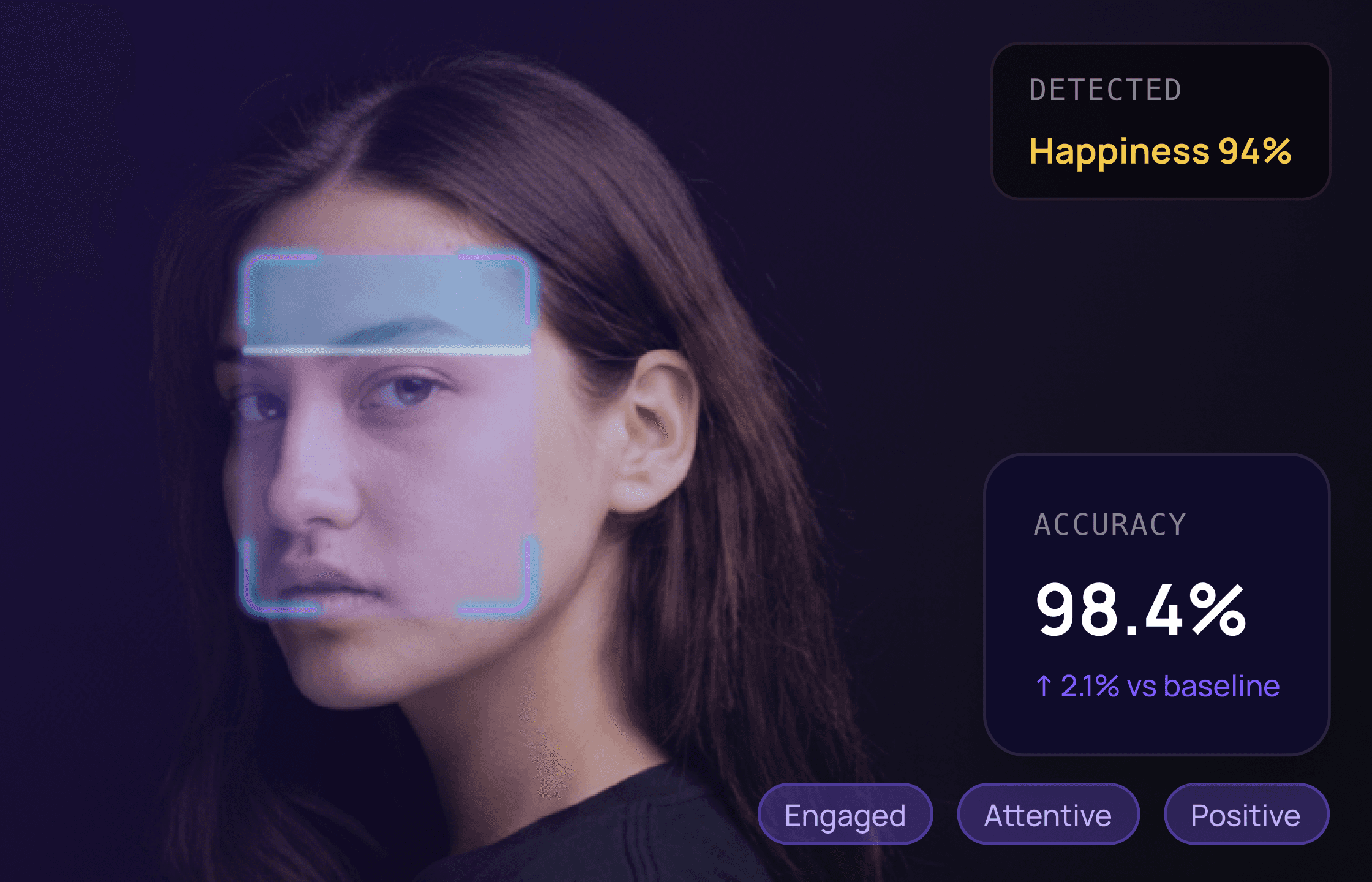
Facial coding uses artificial intelligence and computer vision to analyze facial expressions and translate them into measurable emotional signals.
How it works
/01
Individuals interact with content in a natural environment
/02
Facial responses are captured via webcam with consent
/03
Each frame is processed and classified into emotional states
/04
Insights are aggregated and visualized in real time
This approach enables continuous, objective measurement without disrupting the experience.
SECTION 04 /06
Built on Proven Behavioral Frameworks
Facial coding is grounded in established research, particularly Paul Ekman’s Facial Action Coding System (FACS), which links facial muscle movements to specific emotions.
Detects microexpressions occurring within fractions of a second
Uses defined facial action units to classify emotions
Applies advanced machine learning models for accuracy
Key takeaway:
Because these expressions are difficult to consciously control, they provide a dependable signal of underlying emotional response.
SECTION 05 /06
From Insight to Action
Facial coding enables organizations to measure and improve how people respond across a wide range of contexts:
Content & Media
Evaluate emotional engagement and effectiveness
Digital Experiences
Identify friction points and optimize user journeys
Consumer Research
Capture authentic, in-the-moment reactions
Product Testing
Improve usability and experience design
The methodology is supported by large-scale datasets with millions of annotated facial frames across diverse populations, enabling scalable and consistent insights.
SECTION 06 /06
FAQ's
What is Voice AI?
Voice AI is a technology that analyzes speech to detect emotions, behavioral signals, and communication patterns.
What type of data is analyzed?
It analyzes audio signals from spoken interactions, focusing on tone, pitch, rhythm, and other acoustic features.
What emotions can be detected?
Common emotional states such as happiness, sadness, fear, calmness, anger, surprise, disgust, and neutrality.
Can it measure confidence?
Yes. Confidence is derived from vocal patterns and variations in speech delivery.
Is it dependent on language?
No. Voice AI focuses on nonverbal vocal features, making it applicable across languages.
What kind of insights does it provide?
It provides emotional trends, confidence levels, speaker behavior, and overall conversation dynamics.
Entropik
Understand how people truly feel by analyzing real-time facial expressions with AI-driven precision.