Agentic voice of customer uses AI agents to continuously collect, analyze, prioritize, and act on customer feedback across support tickets and other CX channels. Unlike traditional VoC analysis that primarily reports themes and sentiment, agentic systems can route issues, assign owners, trigger workflows, monitor outcomes, and feed resolved problems back into the customer insight process.
Summary:
|
What Is Agentic Voice of Customer?
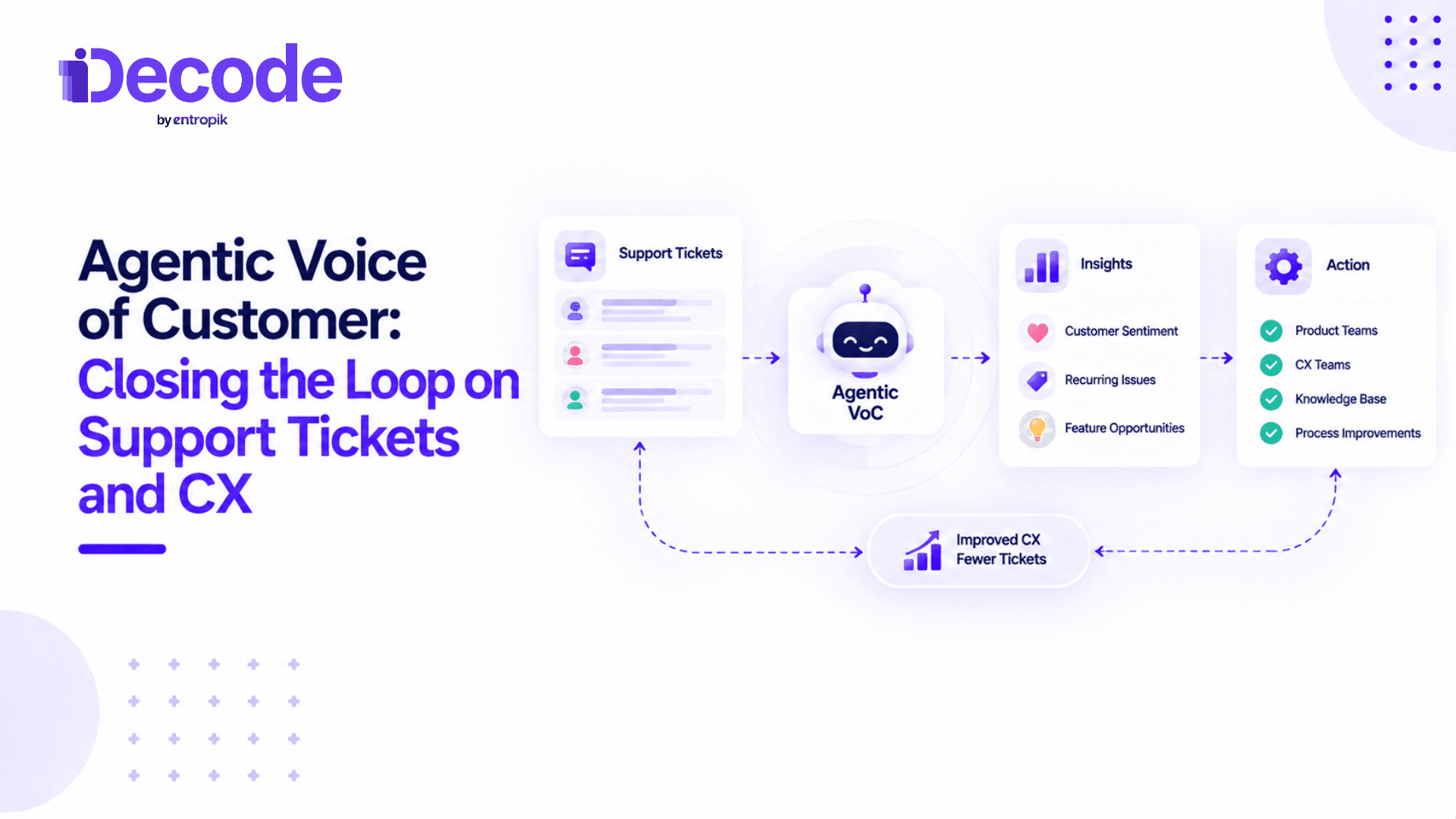
Agentic voice of customer (VoC) uses AI agents to continuously interpret customer feedback and coordinate actions based on what they find. Instead of a dashboard that waits for someone to look at it, an agentic system analyzes, routes, triggers, monitors, and learns.
It extends traditional VoC rather than replacing it. Surveys, interviews, and structured feedback programs still matter, and a well-designed voice of the customer survey remains a core input. Agentic VoC adds the layer that turns what customers say into work that gets done.
The shift is already underway in service organizations. Gartner predicts that agentic AI will autonomously resolve 80% of common customer service issues by 2029, with a 30% reduction in operational costs. If service teams are heading toward autonomous action, VoC programs need a matching way to act on what customers tell them.
How Agentic VoC Differs From Traditional Voice of Customer Programs
Traditional VoC collects, categorizes, analyzes, and reports feedback for human teams to interpret. That reporting is useful, but it often ends with a slide deck and a list of themes.
Agentic workflows connect insight to action. They can escalate a ticket, open a product investigation, or trigger a customer follow-up. The contrast:
Periodic reporting vs continuous detection: monthly summaries give way to ongoing monitoring.
Themes vs owners: every insight is tied to a team or workflow.
Dashboards vs outcomes: the system tracks whether the problem actually went away.
For a deeper look at how autonomous agents behave in research settings, see this overview of AI agents in consumer research.
Why Support Tickets Are a High-Value Source of Customer Research
Support conversations contain unsolicited evidence. Customers describe product friction, failed tasks, recurring questions, and unmet needs in their own words, at the moment they hit a problem. Surveys rarely capture that moment of difficulty.
Tickets should not stand alone, though. Analyze them alongside surveys, interviews, reviews, and behavioral data, the way any serious consumer insights practice combines sources. A support queue shows who complained, not who quietly left.
Pairing ticket evidence with customer sentiment analysis across other channels gives a fuller picture of how customers feel.
The Agentic VoC Loop: Listen, Understand, Act, and Learn
The workflow has six working stages: signal ingestion, interpretation, prioritization, action, resolution tracking, and feedback. Each insight connects to an owner or downstream workflow rather than ending in a report. Outcomes then flow back into the system so recurring issues and unresolved root causes stay visible.
This is a practical form of a classic feedback loop, with agents handling the sorting and routing and people handling judgment.
Listen: Ingest Feedback Across Customer Channels
Combine support tickets, chat logs, calls, surveys, reviews, and other feedback sources. Normalize channel-specific data into consistent customer, issue, and experience signals.
Preserve source metadata throughout. Every finding should trace back to the original interaction, so a reviewer can check what the customer actually said.
Understand: Detect Themes, Intent, and Sentiment
Classify intent, recurring topics, sentiment, urgency, and product area. Cluster related issues even when customers describe the same problem in different words, such as "can't pay," "card keeps failing," and "checkout error."
Link each theme to representative tickets. Modern approaches to AI thematic analysis show how themes become stronger when they are grounded in behavioral evidence, not text alone.
Act: Route Insights to the Teams That Can Resolve Them
Assign issues to support, product, engineering, UX, or CX owners based on the underlying cause, not the ticket label. Trigger alerts, investigations, or follow-up tasks when predefined thresholds are met.
Require human approval for consequential or ambiguous actions. This is where the line between helpful automation and risky autonomy gets drawn.
Learn: Measure Whether the Problem Was Actually Fixed
Track whether ticket volume, complaints, sentiment, or related friction changes after an intervention. Closing a single ticket is not the same as removing the cause that produced it.
McKinsey's 2026 survey offers a useful warning about confusing activity with results. While 44% of organizations report scaling AI across the enterprise, only 37% attribute any EBIT impact to AI, essentially unchanged from the year before. Processing more feedback is not the same as improving the business, so feed resolution outcomes back into prioritization.
How AI Support Ticket Analysis Works
AI support ticket analysis ingests ticket text and metadata, identifies themes, extracts entities, classifies intent, and assesses sentiment. Its real value is aggregation. It finds patterns across thousands of tickets that no individual agent would see.
The output should be evidence-backed issue clusters that researchers and CX teams can inspect. Traceability matters because generated summaries can sound more certain than they are. A Stanford study of generative search engines found that only 51.5% of generated sentences were fully supported by their citations, a reminder to keep a visible link between every theme and its source tickets.
Automated Ticket Categorization
Classify tickets by topic, journey stage, product area, customer intent, and issue type. Let emerging topics surface instead of relying only on predefined tags, and keep one consistent taxonomy across support and other feedback channels.
Sentiment and Emotion Detection
Detect sentiment shifts within a conversation and across issue categories. Connect negative sentiment to specific topics instead of reporting one overall score.
Treat model-detected sentiment as a signal, not a verdict. Nuanced interactions, including sarcasm and polite frustration, may need validation.
Emerging Issue Detection
Watch for sudden increases in new complaints, failure patterns, or support requests. Compare current themes with historical baselines to surface unusual change, and escalate emerging issues before they become large recurring support drivers.
Move From Ticket Categories to Root Causes
A category describes the symptom. A root cause explains why it keeps happening. Separate what the ticket says from the product, service, or process failure underneath it, and combine related themes to find common upstream causes.
Link recurring contact reasons to journeys, features, policies, or operational breakdowns. Following a step-by-step journey mapping process shows where in the experience a recurring complaint begins.
To see how customers actually move through those steps, Decode's customer journey research adds emotional and behavioral context.
Symptom vs Root Cause
"Checkout failed" is a symptom. The cause might be a payment error, a confusing form, or an unclear policy. High-volume labels are not complete explanations, so avoid treating them as one.
Validate inferred causes with product, behavioral, operational, or qualitative evidence. Inference is not proof, and the difference between correlation and causation applies to ticket data as much as to any research.
Prioritize VoC Issues by Impact, Not Volume Alone
The most frequent complaint is not always the most consequential. Combine frequency with severity, affected segment, journey importance, recurrence, and business impact. Preserve low-frequency but severe problems, such as a rare security concern, for specialist review.
Teams working through this tradeoff can borrow from guidance on how to prioritize research findings when everything feels important.
Signals for Prioritizing Customer Issues
Evaluate these signals together:
Frequency and recurrence
Severity and sentiment
Customer effort, including repeat contacts
Churn risk and revenue impact
Strategic importance
Compare trends across products, segments, markets, and time periods. Require evidence before an agent elevates an issue into a strategic priority.
Route Customer Insights to Product, UX, Support, and CX Teams
Send product defects, usability friction, policy complaints, support gaps, and service failures to the owner who can fix them. Include supporting tickets, themes, affected segments, and evidence with every routed insight, so the receiving team does not start from scratch.
Then track acknowledgement and resolution. Routing is not the end of the workflow.
Closing the Loop With Individual Customers
Trigger follow-up when a complaint, escalation, or research response needs a direct reply. Give human agents the context of the original problem and what changed since, so customers do not repeat themselves.
Avoid automated outreach when a situation is sensitive, ambiguous, or needs judgment. Gartner found that 87% of customers say it is essential to be able to reach a human agent when companies use GenAI for customer service, even though 50% say AI makes their interactions easier. Automation should open the door to a person, not close it.
Closing the Structural Loop on Recurring CX Problems
Individual follow-up fixes one customer's day. Structural loop closure fixes the cause. Track a recurring issue from first signal through investigation, ownership, intervention, and outcome.
Measure whether corrective changes reduce future friction, not just whether the ticket queue shrank. Keep unresolved issues visible, especially the ones that keep generating support demand.
Use VoC Insights as Continuous User Research
Support data is a continuous qualitative stream that complements planned studies. It surfaces hypotheses about unmet needs, confusing experiences, and recurring usability barriers. Use those patterns to decide where deeper interviews, usability tests, or behavioral research are worth the investment.
When a theme needs depth, AI moderated interviews can probe the "why" behind it with a larger sample than a handful of manual calls.
Turning Support Themes Into Research Questions
Translate recurring ticket themes into questions about goals, behaviors, expectations, and friction. "Customers keep asking how to cancel" becomes: what do customers expect cancellation to look like, and where does the current flow break that expectation?
Decide which hypotheses existing evidence can answer and which need new primary research. Digital issues can be tested with live website testing on real user behavior. Feed validated findings back into product and CX prioritization.
Connect Support Tickets With Other Voice of Customer Sources
Combine tickets with surveys, reviews, calls, interviews, and other feedback under a common taxonomy. Check whether an issue appears in both solicited and unsolicited feedback. If customers complain in tickets but score the experience well in surveys, that gap is itself a finding.
Keep channel context intact instead of flattening everything into one score. A single source of truth for conversational data makes this easier, because teams work from the same evidence instead of competing exports.
Human Oversight in Agentic VoC Workflows
Keep people responsible for high-impact prioritization, sensitive customer interactions, and consequential decisions. Set approval thresholds for autonomous routing, remediation, and outreach. Use human review to correct classification, interpretation, and root-cause errors, and feed those corrections back to improve the system.
Teams already rely on human-in-the-loop oversight for AI-moderated studies, and agentic VoC deserves the same discipline.
Avoiding False Confidence in AI-Generated Customer Insights
Agents can misclassify sarcasm, ambiguous language, complex causes, and sparse signals. Automated themes should keep links to underlying evidence for researcher review. Separate directly observed patterns from inferred causes and recommendations.
Even specialized retrieval tools make mistakes. Stanford researchers found that purpose-built legal research tools produced incorrect information more than 17% of the time in their benchmark. A VoC agent working from messy ticket text will not be error-free either, so build in sampling and review.
Privacy and Governance for Customer Support Data
Support tickets contain personal and account details. Define controls for personally identifiable information, sensitive conversations, and retention. Restrict agent access by role and workflow, and keep audit trails for analysis, routing, automated actions, and customer communication.
How to Measure an Agentic Voice of Customer Program
Track insight-to-action time, recurring issue reduction, resolution rates, research coverage, and human review effort. Measure whether causes were resolved, not only how many feedback items were processed. Compare customer and operational outcomes before and after each intervention.
Budget pressure makes this more urgent. A Gartner survey of 199 service and support leaders found that AI spending rose 38% while overall service and support budgets grew only 2%. When AI absorbs a growing share of a flat budget, programs need clear evidence that they reduce friction.
Customer Experience Metrics
Monitor CSAT, CES, sentiment, escalation rates, and repeat contacts. Analyze them at the theme and journey level, not only as aggregate scores. A rising customer effort score on one journey tells you more than a flat company-wide average. Link metric changes to specific interventions only where the evidence supports attribution.
Operational Metrics
Time from signal detection to ownership, decision, and resolution
Recurring ticket volume tied to identified causes
Share of agent-generated insights that reviewers accept, correct, or reject
When Should VoC Automation Trigger an Agentic Action?
Automate low-risk, repeatable actions when confidence is high and business rules are clear, such as tagging, routing a known issue type, or alerting an owner. Use approval gates when an action affects customers, policies, product priorities, or money. Escalate cases with uncertainty, conflicting signals, or sensitive content to a person.
A Practical Agentic VoC Workflow for Support Tickets
Run the workflow in this order:
Ingest tickets and metadata.
Classify intent, topic, and sentiment.
Detect themes and clusters.
Analyze root causes.
Prioritize by impact.
Route to an owner with evidence.
Act through approved workflows.
Monitor outcomes and feed them back.
Require source evidence and a named owner at each major handoff. Resolved and unresolved issues should both update the system, so recurring problems never disappear from view.
From Voice of Customer Reporting to Continuous CX Action
The direction is clear: from AI that summarizes feedback toward agents that coordinate workflows and take controlled actions. Customer service automation, VoC intelligence, and operational systems are converging. Governance and measurable CX outcomes need to stay central as autonomy grows.
Teams planning this shift can read how agentic AI is changing research teams.
When comparing tools, review the leading consumer research platforms to see which fit an evidence-first workflow.
Support-derived pain points tell you what is going wrong. Behavioral research shows how customers respond to the experience itself. Decode, a consumer insights platform, adds that layer for products, concepts, and digital journeys:
Facial coding with 90%+ accuracy across 62 facial expressions
Eye tracking with 96% accuracy
Support for 70+ languages, 17 patents, and 150+ global brands
Use it to validate how customers react to the fixes your VoC program recommends. Explore Decode's consumer research software today.
Frequently Asked Questions (FAQs)
1. What is agentic voice of customer?
It is the use of AI agents to continuously collect, analyze, prioritize, and act on customer feedback, including routing issues, assigning owners, and tracking outcomes.
2. How does AI support ticket analysis work?
It ingests ticket text and metadata, classifies intent, extracts entities, assesses sentiment, and clusters similar issues into evidence-backed themes.
3. How is agentic VoC different from traditional voice of customer software?
Traditional tools report themes and sentiment for people to interpret. Agentic VoC also routes issues, triggers workflows, and monitors whether problems were resolved.
4. Can AI automatically identify root causes from support tickets?
It can suggest likely causes by combining related themes, but those causes are inferences. Validate them with product, behavioral, or qualitative evidence.
5. How can support tickets be used for continuous user research?
Treat them as an ongoing qualitative stream. Turn recurring themes into hypotheses, then use interviews, usability tests, or behavioral research to verify them.
6. What does closing the loop mean in a VoC program?
It has two parts: following up with individual customers, and fixing the recurring root cause so the problem stops generating contacts.
7. How should companies prioritize insights found in customer support tickets?
Weigh frequency alongside severity, affected segment, journey importance, recurrence, effort, churn risk, and business impact, not volume alone.
8. Where should humans remain involved in agentic VoC workflows?
In high-impact prioritization, sensitive customer interactions, ambiguous cases, and any action that affects customers, policies, or money.