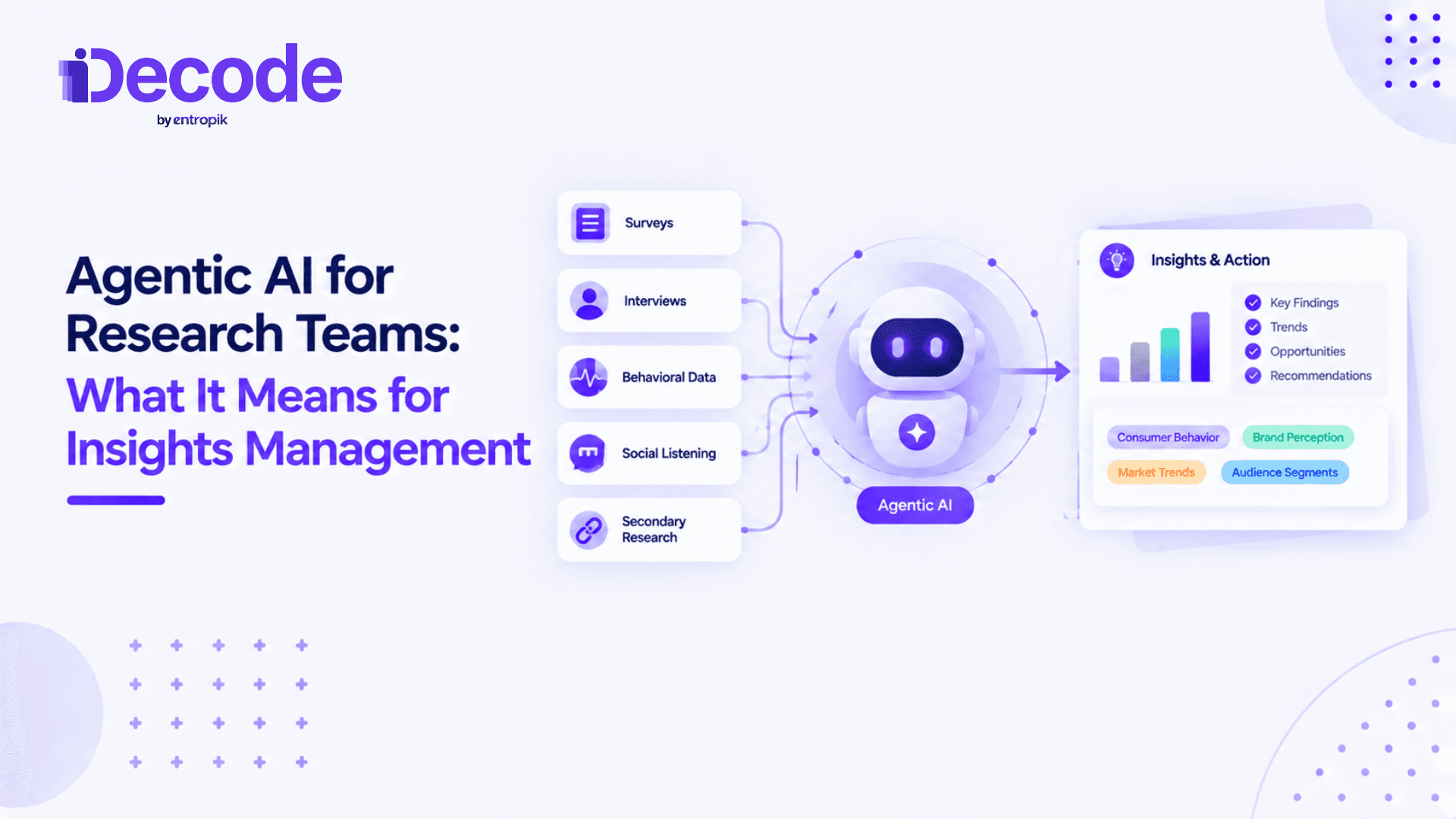
Agentic AI for research teams refers to autonomous and semi-autonomous systems that plan, execute, and coordinate research tasks across the insights workflow, from study design through synthesis. For insights management, it means restructuring team roles around governing and validating AI-driven workflows rather than only running them manually, with humans focused on judgment, interpretation, and stakeholder decisions.
Summary:
|
The majority of the discussion concerning agentic AI in the context of research focuses on tools, while the more meaningful conversation revolves around organizational charts.
When a system is able to plan and carry out a sequence of research steps, the issue ceases to be about which vendor to buy and instead becomes one of what the team does, who examines the output, and what takes place when it is certainly wrong at 4 p.m. before the stakeholder readout.
It is an insights management problem, and this guide addresses the changes that are needed in the operating model, the roles that have to appear, the kind of governance that is required before scaling, and how to carry out a first pilot so that you gain some knowledge from it.
What Agentic AI Means for Research Teams
Agentic AI refers to systems that plan and coordinate a multi-step process in order to achieve a goal by deciding on their next action according to what they have already produced.
This is a change on from earlier research automation. In the case of survey scripting, automated dashboards, and scheduled reporting, a fixed sequence is carried out by someone who had previously defined it. If an agent is given the task of 'identifying the main barriers to adoption in this dataset' then it has to work out its own sequence: which segments to look at, which analysis to carry out first, and whether the first pass revealed anything worth pursuing.
They also require different kinds of management: rule-based automation calls for maintenance, while agentic systems require oversight since the course taken differs from run to run and the quality of the output also varies.
The change is first one of organization rather than of technique. Once the work is carried out by means of systems, the researcher's daily routine shifts from carrying out the various steps to defining what good looks like, checking what the results are, and then deciding what they mean. The section on the background of categories is included in this general overview of agentic AI in market research, and the more general introduction to AI in market research serves as a good starting point for teams that are new to the terminology.
How Agentic AI Changes the Operating Model
The main change is that researchers go from carrying out each step of the workflow to overseeing systems that carry out the steps automatically.
Currently, agents are situated in five places.
Study design support: Drafting screeners, checking a design against methodology standards, suggesting sample structures. The structured part of research planning is assistable. The part that requires knowing why the business is asking is not.
Fielding: Recruitment matching, quota monitoring, and quality screening as responses arrive.
Moderation: Conducting interviews and adapting follow-ups in real time based on what a participant actually says.
Coding and analysis: Applying frameworks consistently at volume, as covered in this guide to AI for qualitative data coding and in thematic analysis with behavioral data.
Synthesis and stakeholder output: Drafting summaries and assembling evidence for a claim.
Most teams adopt these as task-specific agents chained together by people rather than one orchestrated system, which matches the wider picture. McKinsey's global survey found 23 percent of organizations scaling an agentic AI system somewhere in the enterprise and another 39 percent experimenting, with no more than 10 percent scaling agents in any single business function. Full multi-agent orchestration is still maturing, so planning team structure around it now would be premature.
New Roles and Skills Insights Leaders Need to Plan For
Three responsibilities appear that did not exist in most insights teams three years ago.
Agent output validation.
Checking what came back against a defined standard, not a general sense of whether it reads well. This is a different skill from doing the analysis, and harder than it sounds, because plausible output is easy to approve.
Workflow and prompt design.
Specifying how an agent should probe, code, or summarize is methodology work in another form. The people best at it are usually experienced researchers, not the most technical people on the team.
Confidence-threshold setting.
Deciding what an agent may complete unsupervised, what needs review, and what it must escalate. Make this decision explicitly, or the default becomes whatever the tool shipped with.
The junior position is the one that changes the most; the kind of work that previously involved carrying out tasks, coding open-ended questions, and doing the first analysis and drafting summaries now consists of reviewing and correcting the output of the AI. There is a risk to the development of skills since people have in the past learned the methodology by carrying out those tasks, and teams which want to develop researchers need to deliberately reconstruct that kind of learning.
The other gap is translation. Raw agent output is not a recommendation, and the distance between a synthesis and a business decision is where insights functions earn their standing. Deloitte's survey of 3,235 leaders across 24 countries found the AI skills gap to be the biggest barrier to integration, with just 34 percent of organizations truly reimagining how they work. The constraint is rarely the model.
Team Structure for AI-Driven Workflows
A workable structure has three layers.
Specialist agents handle bounded tasks: moderation, coding, screening, summarization. Each owns one job with a defined output.
Human leads coordinate the sequence and review at handoffs. Most teams underbuild this layer, and it is where errors get caught before they compound.
Senior researchers set standards, define thresholds, and interpret findings for stakeholders. Their work becomes more strategic, not less necessary.
One principle matters more than the layout: organize around where risk is highest, not around the old org chart. A stakeholder-facing finding informing a launch decision deserves more review than an internal exploratory summary, even if an agent produced both that afternoon with equal confidence.
Blended human-AI teams are becoming the norm rather than a transitional arrangement. Deloitte found that 74 percent of surveyed leaders expect their organizations to be using AI agents at least moderately by 2027, with 23 percent expecting extensive use. Planning for a temporary hybrid phase underestimates how durable this arrangement is.
Where Human Oversight Remains Non-Negotiable
There are certain things which never get passed on to agents at any stage of maturity.
Research involving distressing, sensitive, and vulnerable populations must be carried out by a human moderator who is able to detect when people are uncomfortable and can therefore stop the interview. The processes of obtaining informed consent, handling any escalations, and the final interpretation remain the researcher's responsibility, and someone who is accountable has to approve the conclusions of a study since a machine cannot take on professional responsibility for a recommendation.
The practical boundaries are worked through in this guidance on when to use and when not to use AI-moderated research, and the oversight design in this piece on human-in-the-loop AI moderated research.
Governance and Trust: What Insights Managers Must Put in Place
Governance is where most agentic adoption either works or quietly fails.
Validation checkpoints before high-stakes decisions.
Define which decisions require human-verified evidence and make the checkpoint a named step someone owns. If skipping it takes a decision rather than an oversight, it happens less often.
Systems that flag uncertainty instead of masking it.
The dangerous failure mode is not an agent saying it does not know. It is one filling a gap with something plausible. Ask vendors how the system behaves when evidence is thin, and treat a platform that always produces an answer as a risk rather than a feature.
Provenance labeling.
Every output should carry a marker showing what produced it and whether a human verified it. Six months later nobody reconstructs that from memory.
The gap here is well documented. In Deloitte's research, only 21 percent of companies reported a mature model for agent governance, even as 85 percent expect to customize agents for their own needs. Adoption is running ahead of the guardrails, and insights functions are unusually exposed, because their output feeds decisions rather than sitting in a system log.
The reasoning in these strategies for managing AI risk applies directly, as does the discipline behind keeping a single source of truth so that verified and unverified findings do not blend into one undifferentiated pile.
Benefits for Insights Management
Faster turnaround from question to deliverable: The bottleneck is rarely fieldwork. It is the coordination and analysis around it, the layer agents compress, which is the argument behind running faster consumer research without compromising quality.
Research access that scales without proportional headcount: More teams can run studies without the function growing at the same rate, provided methodology standards live in the tooling rather than in people's heads.
More consistent methodology at volume: A well-configured agent applies the same quality checks and coding framework to every study, where human coders vary under deadline pressure. The same consistency argument underpins reducing bias with AI-led behavioral research.
Common Risks and Change-Management Pitfalls
Agent washing: Gartner estimates that of thousands of vendors claiming agentic AI, only around 130 are genuinely building it, and predicts over 40 percent of agentic AI projects will be canceled by the end of 2027 on cost, unclear value, or inadequate risk controls. Ask what the system does across multiple steps without human input, and price a single automated task as a single automated task.
Role ambiguity: Teams resist workflow change when nobody has told them what their job becomes. That resistance is usually rational and it is a communication failure, not a technology one. Define the new responsibilities before the tool lands.
The translation gap: Output nobody can convert into a business recommendation delivers no value. If the team's constraint is turning findings into decisions, more agent capacity may make it worse by increasing the volume awaiting interpretation.
Skipping the boring governance work: Provenance, thresholds, and checkpoints are unglamorous, and they are what make the rest safe to scale.
Building a Roadmap: How to Prepare Your Research Team
Audit workflow bottlenecks first: Where does time actually go? Usually coding, scheduling, and drafting rather than where people assume.
Pilot one bounded, well-understood task: Something high-friction the team can evaluate confidently, since you need to be able to tell whether the output is good.
Define validation checkpoints before scaling: Retrofitting governance onto a running workflow rarely happens.
Set success metrics up front: Turnaround time and first-pass approval rate are the two most useful. First-pass approval, meaning the share of agent output accepted without rework, tells you whether the system is genuinely saving effort or relocating it.
Expand scope only when the checkpoints hold: If reviewers are rubber-stamping, you have automation with a review theater attached.
Decode's guide on how to evaluate AI research tools covers the vendor diligence side, and this roundup of consumer research platforms is a reasonable starting comparison across the category.
The Future of Insights Management With Agentic AI
Three directions look reasonably clear.
From isolated features to always-on intelligence.
AI capabilities sit as separate features in separate tools today. The direction is a connected layer where past research informs new research automatically, which is why the research intelligence platform category is consolidating around repositories.
The researcher's strategic role grows.
Gartner expects AI agents to augment or automate half of business decisions by 2027, while noting these systems are neither a panacea nor infallible. More automated decisions means more demand for people who can judge which ones deserve scrutiny.
Blended teams become structural.
Not a transitional phase to be managed through, but the shape of the function.
Piloting Agentic Capability Inside an Insights Team
The least risky way to get started is by using a single agent workflow for one specific task, with researchers maintaining control over both the design and the interpretation.
Adaptive interview moderation is a suitable option since the system is genuinely agentic (it plans, listens, and then decides what to probe next) and because the results are easy to assess; by reading over the transcript you can tell within a few minutes whether the probing was effective, which is exactly what is needed for a pilot.
Decode's AI Moderator runs AI moderated interviews with real, consented participants across 70 plus languages. For teams building toward multi-signal research, facial coding reads 62 facial expressions with 90 plus percent accuracy and eye gaze tracking runs at 96 percent accuracy, extending a moderation agent's output beyond text. Findings then sit alongside the rest of the team's work in a consumer insights hub rather than a separate system. For compliance, data handling, or security questions, ask for verified Entropik documentation.
Run it on one study type, measure first-pass approval, and expand only if the number holds. Teams doing consumer insights research at scale usually find one bounded pilot teaches them more about their governance gaps than a year of vendor evaluation.
Frequently Asked Questions
1. What is agentic AI in market research?
Systems that plan and coordinate multi-step research tasks toward a goal, deciding the next step based on prior output, rather than executing a fixed sequence someone defined in advance.
2. How is agentic AI different from traditional research automation?
Traditional automation runs the same workflow the same way every time. Agentic systems plan dynamically, which makes them better with messy inputs and harder to audit.
3. What new roles do research teams need for agentic AI?
Agent output validation, workflow and prompt design, and confidence-threshold setting. All three are methodology skills rather than technical ones.
4. How should insights teams structure themselves around AI agents?
Specialist agents on bounded tasks, human leads coordinating and reviewing at handoffs, senior researchers setting standards and interpreting findings. Concentrate review where the output carries the most risk.
5. What are the risks of adopting agentic AI in research?
Rebranded automation sold as autonomy, confidently wrong output reaching decisions unchecked, role ambiguity stalling adoption, and a widening gap between output volume and the team's ability to interpret it.
6. Will agentic AI replace market researchers?
No. Agents execute bounded tasks. Setting standards, judging quality, and translating findings into business decisions stay human, and grow in relative importance.
7. How do you build a governance framework for AI agents in research?
Define which decisions require human-verified evidence, name the checkpoint owner, require uncertainty flagging from any tool you adopt, and label the provenance of every output.
8. Where should a research team start when piloting agentic AI?
One bounded, high-friction, well-understood task the team can evaluate confidently, with success metrics defined before the pilot begins.
The Practical Takeaway
Agentic AI has a smaller impact on the insights function by moving rather than replacing researchers.The work is transferred,but the judgment is not and the judgment was always the most important part.
The teams that deal with this effectively make three decisions at an early stage: they decide which tasks an agent is allowed to carry out, determine who will check the output and according to what standard, and establish which decisions always need to be backed by human-verified evidence. All the rest consists of tooling, and the tooling is the simpler aspect.
Start with one workflow and measure whether the output gets approved without rework. That number tells you more about readiness than any maturity model, and the broader shift toward AI-led consumer insights rewards teams that build the checkpoints before they need them.
Want to test one bounded agentic workflow rather than overhaul a platform?