Experimental research is a systematic and scientific approach to research that tests cause-and-effect relationships. Researchers deliberately manipulate an independent variable, measure its effect on a dependent variable, and control other factors that could influence the outcome. True experiments typically use random assignment and comparison groups to strengthen causal conclusions
Summary:
|
Experimental research is a systematic and scientific approach to research that tests cause-and-effect relationships. Researchers deliberately manipulate an independent variable, measure its effect on a dependent variable, and control other factors that could influence the outcome. True experiments typically use random assignment and comparison groups to strengthen causal conclusions.
Most business questions are really causal questions. Will a new headline lift sign-ups? Does a lower price grow demand? Teams that rely on consumer insights every day eventually hit the same wall: observing behavior tells you what happened, but not why it happened or what would happen if you changed something.
That is the gap experimental research fills. This guide covers the meaning of experimental research, how it works, the main design types, practical examples, and when to use it.
What Is Experimental Research?
Experimental research is a method in which a researcher intentionally changes one or more factors (independent variables) and measures the effect on an outcome (the dependent variable), while holding other conditions steady. Its primary purpose is to test hypotheses and determine whether one thing truly causes another.
Four ideas anchor the definition:
Manipulation: the researcher actively changes something rather than just observing it.
Control: other influences are held constant or accounted for.
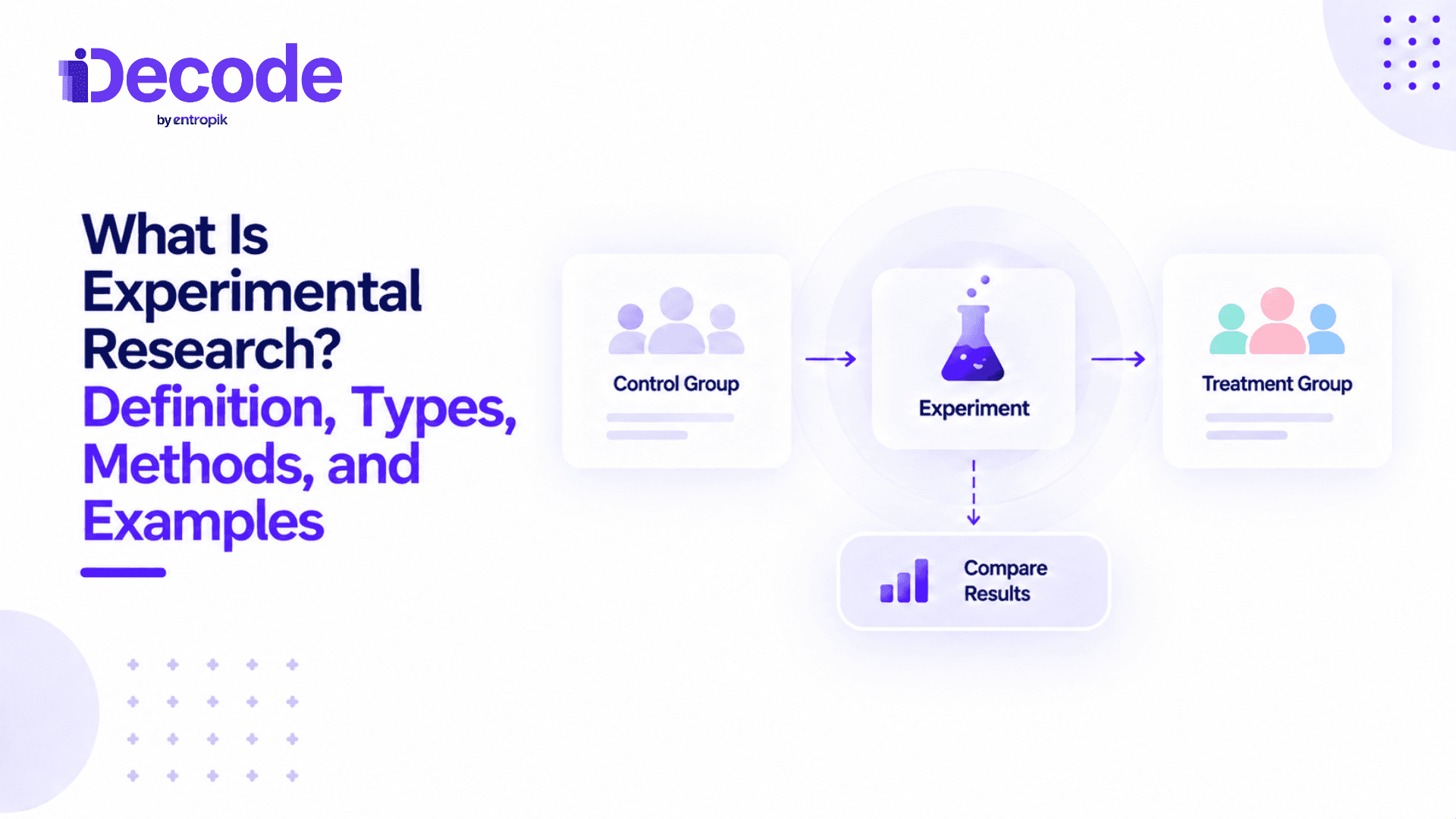
Comparison: outcomes are compared across conditions, such as treatment and control groups.
Measurement: the outcome is captured with consistent measures.
Every experiment begins with a testable prediction. A well-formed research hypothesis states which variable you expect to change, in which direction, and how you will measure the result. Without that clarity, even a well-run experiment produces data that is hard to read.
Why Is Experimental Research a Systematic and Scientific Approach?
Experimental research is a systematic and scientific approach to research because every step is defined before data collection begins. The hypothesis, variables, procedures, measurements, and analysis plan are all set in advance. That discipline prevents researchers from quietly adjusting the question after seeing the results.
Systematic control lets you isolate the effect of the thing you are testing. If two groups are treated identically except for one change, any meaningful difference can be traced back to that change.
The business world has embraced this logic at scale. A widely cited Harvard Business Review article describes how a small ad headline idea at Bing sat on the shelf for months until an engineer ran an online controlled experiment. The test showed a 12% revenue increase, worth more than $100 million a year in the United States alone. Even experts struggle to predict which ideas matter, and a structured test settles the question with evidence.
Key Characteristics of Experimental Research
Rigorous experiments share a handful of features. Together they separate real experimental research from casual testing.
Manipulation of Variables
The researcher intentionally changes an independent variable, such as ad creative, price, or interface layout. The experiment then measures whether this manipulation produces a change in the dependent variable, such as purchase intent, click-through rate, or task completion time.
If you only record which customers happened to see which version, you are observing, not experimenting.
Control of Extraneous Variables
Uncontrolled factors provide alternative explanations for results. Imagine you test two product pages, but one runs during a holiday sale. A difference in conversions could come from the page or from the sale.
Researchers reduce this risk through standardization, comparison groups, and consistent procedures. Outside factors are called extraneous variables, and those that systematically distort results are confounding variables.
Random Assignment
In a true experiment, participants are assigned to conditions by chance. Random assignment spreads differences such as age, mood, or brand loyalty evenly across groups, so they are unlikely to explain the outcome.
Random assignment is not the same as random sampling. Sampling decides who is selected for the study. Assignment decides which condition each selected person experiences. When groups are built from volunteers or convenient segments instead, selection bias can quietly undermine the comparison.
Replicability and Standardized Procedures
Rigorous experiments document their procedures well enough that another team could repeat them, which makes results easier to verify.
Independent, Dependent, and Control Variables in Experimental Research
Variables are the building blocks of every experiment. A single consistent example makes them easier to see. Suppose a retailer wants to know whether free shipping messaging increases checkout rates.
Independent variable: the factor the researcher deliberately changes. Here, whether the product page displays a free shipping banner.
Dependent variable: the outcome measured in response. Here, the percentage of visitors who complete checkout.
Control variables: factors kept constant so they do not interfere, such as page layout, product selection, traffic source, and time of day.
Extraneous variables: other influences that could blur the result, such as a competitor promotion or a site outage during the test.
If you cannot name your independent and dependent variables in one sentence each, the study is not ready to run.
How Does Experimental Research Work?
Experiments follow a repeatable sequence. The steps below apply whether you are testing an advertisement, a medication, or a teaching method.
1. Define the Research Question and Hypothesis
Start with a testable causal question, such as "Does adding customer reviews to the product page increase purchases?" Then turn it into a measurable hypothesis: "Pages with reviews will produce a higher checkout rate than pages without."
2. Identify the Variables
Specify what you will manipulate and what you will measure. List the extraneous variables most likely to interfere, and decide how each will be controlled.
3. Select Participants and Experimental Conditions
The experimental group receives the intervention, while the control group receives the standard experience or a placebo. Where feasible, randomly assign participants so the groups start out comparable.
4. Conduct the Experiment
Apply the intervention consistently to everyone in the experimental condition, and keep procedures equivalent across groups apart from the manipulated variable. Small slips, like different instructions, can introduce new confounds.
5. Measure and Analyze the Results
Compare outcomes between conditions using measures chosen in advance. Statistical hypothesis testing then shows whether differences are larger than chance would explain.
Before treating a surprising result as broadly applicable, replicate it with new participants or in a new setting. Replication is the strongest protection against false conclusions.
Types of Experimental Research Designs
Experimental research is usually grouped into three design categories: pre-experimental, true experimental, and quasi-experimental. They differ in how much control and random assignment they include, and therefore in how strongly they support causal claims.
Structures such as factorial or repeated-measures designs are configurations within these categories, not separate top-level types. For a wider view, explore types of quantitative research designs.
Pre-Experimental Research Design
Pre-experimental designs have limited control. They often lack random assignment or a strong comparison group, so they offer only preliminary evidence. Two common forms are:
One-shot case study: a single group receives a treatment and is measured afterward, with no baseline and no comparison.
One-group pretest-posttest: a single group is measured before and after a treatment, but nothing rules out other explanations, such as seasonality.
These designs are quick and inexpensive, which suits early exploration, but they should not be used to claim causation.
True Experimental Research Design
True experimental designs combine manipulation, a control or comparison condition, and random assignment. They provide the strongest causal evidence. Common forms include:
Randomized controlled trial (RCT): participants are randomly assigned to treatment or control and compared on the outcome.
Pretest-posttest control group design: both groups are measured before and after, so researchers can see how much each group changed.
Posttest-only control group design: groups are measured only after the intervention, which avoids the pretest influencing participants.
Quasi-Experimental Research Design
Quasi-experimental designs study an intervention without full random assignment, which is common when a policy applies to an entire region.
Non-equivalent groups design: compares an intervention group with a similar but non-randomized comparison group.
Interrupted time series: tracks an outcome repeatedly before and after an intervention to see whether the trend changes.
True Experimental vs Quasi-Experimental vs Pre-Experimental Research
The table below compares the three categories on the features that matter most.
Feature | Pre-experimental | Quasi-experimental | True experimental |
Manipulates a variable | Yes | Yes | Yes |
Comparison group | Often absent or weak | Usually present | Always present |
Random assignment | No | No | Yes |
Strength of causal inference | Low | Moderate | High |
True experiments generally provide stronger internal validity because random assignment removes many competing explanations. Even so, practical or ethical constraints sometimes force teams toward quasi-experimental or preliminary designs. Choose the strongest design your situation allows and be honest about its limits.
Other Common Experimental Design Structures
Beyond the three main categories, researchers choose from several structures depending on the question.
Factorial Design
A factorial design manipulates two or more independent variables at the same time. This lets researchers study main effects (the separate impact of each variable) and interaction effects (how variables combine). For example, a brand could test two headlines and two images together and learn that one headline only works with one image, something two separate tests would miss.
Between-Subjects vs Within-Subjects Design
In a between-subjects design, different participants experience different conditions. In a within-subjects design, the same participants experience every condition.
Between-subjects designs avoid order effects but need more participants. Within-subjects designs need fewer participants and control for person-to-person variation, but they require careful counterbalancing of condition order.
Experimental Research Examples
Strong examples share a pattern: a clear independent variable, a measurable dependent variable, an experimental condition, and a comparison condition.
A/B Testing Example
A subscription company wants to know whether a shorter sign-up form increases registrations.
Independent variable: form length (short vs long).
Dependent variable: completed sign-up rate.
Experimental condition: visitors who see the short form.
Comparison condition: visitors who see the long form.
Visitors are randomly split between versions at the same time, so seasonality affects both equally. Digital teams run this kind of A/B testing constantly because it is fast, cheap, and directly tied to business outcomes.
For more on running these tests, see how A/B testing can boost user experience and engagement.
Product Testing Example
A beverage brand wants to know which of two package designs shoppers prefer.
Independent variable: package design (A vs B).
Dependent variable: purchase intent and attention to the product.
Experimental condition: participants who see design B.
Comparison condition: participants who see design A.
Researchers keep everything else the same, including price and shelf context, so differences can be attributed to the design. Teams often run package testing this way before committing to a print run.
Clinical Trial Example
Clinical trials are the classic illustration of why random assignment matters. In the Women's Health Initiative, 16,608 postmenopausal women were randomly assigned to receive either estrogen plus progestin or a placebo. The randomized controlled trial was stopped early, after an average of 5.2 years, because the health risks exceeded the benefits.
Much of the earlier evidence had been observational. The randomized comparison exposed the risks, a reminder that careful experiments can overturn comfortable assumptions.
Experimental Research in Business Research Methods
Businesses use controlled experiments to test decisions before rolling them out widely. Instead of debating opinions or leaning on correlations, they expose a small, randomly selected group to a change and compare the outcome to a control. Marketing, pricing, product development, customer experience, and digital optimization all rely on the method.
Marketing and Advertising Experiments
Marketers test advertisements, messages, offers, layouts, and channels. Outcomes can include attention, recall, clicks, conversions, or purchase intent. Combining these with behavioral signals helps explain why a version wins, which is the focus of behavioral research for ad testing.
Teams can use dedicated ad testing to compare variations on attention and emotional response before launch.
Pricing Experiments
Pricing experiments compare consumer responses to controlled price or offer variations, measuring conversion, willingness to buy, or demand. The stakes are high. McKinsey's analysis of typical S&P 1500 economics found that a 1% price increase, with stable volume, would lift operating profit by about 8%, and that volumes would need to rise 18.7% to offset a 5% price cut. Those numbers explain why guessing at the power of pricing is risky.
Brands that want a structured way to run these studies can follow this guide to price testing before launch.
Product and Concept Testing
Teams test alternative concepts, features, designs, or experiences, then compare how people respond across conditions. The strongest studies compare stated and behavioral responses, since what people say and do often differ. The workflow is covered in behavioral research for concept testing.
For early-stage ideas, concept testing lets teams validate directions before investing in development.
Customer Experience Experiments
Customer experience teams test changes to checkout flows, interfaces, service scripts, or customer journeys. They compare measurable outcomes, such as completion rate and satisfaction, before a wider rollout. A small controlled pilot is often far cheaper than a failed full launch.
Experimental Research vs Observational Research
Experimental research actively manipulates a variable. Observational research watches naturally occurring variables without intervening.
Observational studies are excellent at spotting patterns, but they usually provide weaker evidence of causation because many hidden factors differ between the groups being compared. If customers who read reviews buy more, is it the reviews, or are motivated buyers simply more likely to read them?
Observation is still the right choice when manipulation would be impractical or unethical. You cannot ethically assign people to smoke for twenty years, for instance.
Experimental Research vs Correlational Research
Correlational research measures an existing relationship between variables. Experimental research deliberately changes one variable to see what happens to another. The difference matters because correlation does not by itself establish causation.
Consider a retailer that notices stores with more staff have higher sales. A correlational study would report the link. But busy, high-traffic stores may simply hire more staff, so sales could be driving staffing instead of the reverse. To test causation, the retailer could randomly add staff to some stores and not others, then compare results.
The same trap appears in digital products, and this explanation of correlation vs causation in UX research shows how teams avoid it.
Advantages of Experimental Research
Tests cause and effect: no other common method comes as close to isolating what drives an outcome.
Greater control: researchers can limit the influence of confounding factors.
Standardized and repeatable: documented procedures make replication possible.
Evidence over opinion: experiments give teams a neutral way to settle disagreements.
Limitations of Experimental Research
Experimental research is powerful, but it has real constraints.
Cost and time: well-controlled studies can be expensive and slow.
Ethical restrictions: many variables cannot be manipulated responsibly.
Participant reactivity: people who know they are studied may behave differently.
Limited real-world control: it is hard to control every variable outside the lab.
Feasibility: random assignment is not always possible.
Good ideas also fail often. Harvard Business School professor Stefan Thomke notes that for every online experiment that succeeds, nearly 10 do not, even at firms like Booking.com that run roughly 25,000 tests a year. His analysis of building a culture of experimentation argues that failed tests are not waste, because they stop teams from shipping changes that would have hurt.
Highly controlled laboratory settings can also reduce how well findings carry over to everyday life, which leads to the question of validity.
Internal and External Validity in Experimental Research
Internal validity is the confidence that the manipulation caused the observed outcome rather than something else. External validity is the extent to which findings generalize beyond the experimental setting, to other people, places, and times.
There is often a trade-off. Tight control raises internal validity but can make the setting feel artificial, lowering external validity. A field experiment in a real store is more realistic but harder to control. This overview of validity in research explains how to evaluate both.
Generalizing too quickly carries real risk. The Open Science Collaboration attempted to replicate 100 published psychology studies. While 97% of the original studies reported significant results, only 36% of the replications did, according to their reproducibility study in Science. The takeaway for business researchers is to replicate important findings before betting heavily on them.
Ethical Considerations in Experimental Research
Experiments involve real people, so ethics belong in the design from the start. Core principles include:
Informed consent: participants understand what the study involves.
Voluntary participation: people can withdraw at any time.
Confidentiality: personal data is protected.
Risk minimization: potential harm is kept as low as possible.
Debriefing: participants learn the study's purpose afterward.
Some variables cannot ethically be manipulated, and studies involving vulnerable groups require extra safeguards. This overview of responsible and ethical research practices can help teams build these protections into their process.
When Should You Use Experimental Research?
Choose experimental research when your question asks whether one variable causes a change in another and you can ethically and practically manipulate it. Good signals are questions like "Does X increase Y?" or "Which version performs better?"
Prefer other methods when your question is about description, exploration, or naturally occurring relationships. If you are still working out what matters, interviews or surveys will serve you better. Once you have a hypothesis worth testing, an experiment confirms it.
Many teams run these studies on a single consumer research platform so that survey, behavioral, and experimental data stay connected instead of scattered across tools.
Applying Behavioral Measurement to Consumer Experiments
In consumer experiments, the winning variation is only half the story. Survey answers tell you what people say they prefer, but they miss attention and emotion, which often drive actual choices. Behavioral and emotional measures complement self-reported data.
This is where Decode by Entropik fits. Decode adds behavioral and emotional measurement to controlled consumer studies, so teams can see not just which variation performs better but how people respond to each one. Its verified capabilities include:
Facial coding with 90%+ accuracy across 62 facial expressions.
Eye tracking with 96% accuracy.
Support for 70+ languages.
17 patents and a client base of 150+ global brands.
Facial coding relies on facial emotion AI to read how viewers react moment by moment.
Meanwhile, eye gaze tracking shows where attention actually lands on an ad, pack, or screen.
For creative work specifically, it helps to understand how AI-powered attention analysis works and what it can predict.
To compare tools for this work, see this roundup of the best consumer research platforms is a useful starting point.
Frequently Asked Questions
1. What is experimental research?
Experimental research is a systematic and scientific approach in which a researcher manipulates one or more independent variables, measures the effect on a dependent variable, and controls other factors. Its goal is to test hypotheses and establish cause-and-effect relationships.
2. What is the meaning of experimental research?
It means testing whether a deliberate change produces a measurable effect. Instead of only observing what happens naturally, the researcher creates the conditions, compares groups, and measures the outcome.
3. What is an example of experimental research?
A common example is an A/B test in which half of website visitors see a shorter sign-up form and half see the original. Another is a clinical trial comparing a treatment group with a placebo group.
4. What are the three main types of experimental research?
The three main types are pre-experimental, true experimental, and quasi-experimental designs. Pre-experimental designs have little control, true experimental designs use random assignment and comparison groups, and quasi-experimental designs study interventions without full random assignment.
5. Why is experimental research considered a systematic and scientific approach?
It follows predefined hypotheses, variables, procedures, and analysis plans, and it controls outside influences so the effect of one factor can be isolated.
6. What is experimental research in business research methods?
It means running controlled tests on marketing, pricing, products, customer experiences, or digital interfaces to see which choice performs better before a wide rollout.
7. What is the difference between experimental and quasi-experimental research?
True experimental research randomly assigns participants to conditions, while quasi-experimental research does not. The former gives stronger causal evidence, while the latter is used when randomization is impractical or unethical.
8. What are the advantages and limitations of experimental research?
Advantages include strong causal evidence, tight control, and repeatable procedures. Limitations include cost, time, ethical restrictions, participant reactivity, and reduced realism in highly controlled settings.
9. Run Controlled Consumer Experiments with Behavioral Insight
Controlled experiments tell you which variation performs better. Behavioral and emotional measures tell you why.
Related Topic: