Synthetic audiences are AI-generated consumer personas built from demographic, behavioral, and survey data to simulate how real people might respond in market research. They are used for early-stage concept screening, message testing, and hypothesis generation, but independent research shows they reproduce population averages more reliably than individual or segment-level nuance, so high-stakes decisions still require validation with real respondents.

Summary:
|
Within about two years, synthetic audiences changed from being a gimmicky experiment to becoming a standard entry in research budgets. The argument is difficult to overlook since, rather than recruiting 400 people and waiting three weeks, you can prompt a model and have a complete set of responses before lunch.
The pressure behind that pitch is real. McKinsey's latest global survey found that 88 percent of organizations now report regular AI use in at least one business function, yet only about a third have moved past piloting into scaled deployment. Insights teams sit squarely in that gap, expected to show AI progress while still being held to evidence standards that do not bend.
The important question to ask is not whether synthetic audiences work, but rather which jobs they perform well and which ones they fail at silently. The guide looks at both aspects and also provides a decision framework for determining where they should be incorporated into a workflow. For the technical comparison beneath this, the guide on synthetic data and real data explains the differences between the two data types.
What Are Synthetic Audiences?
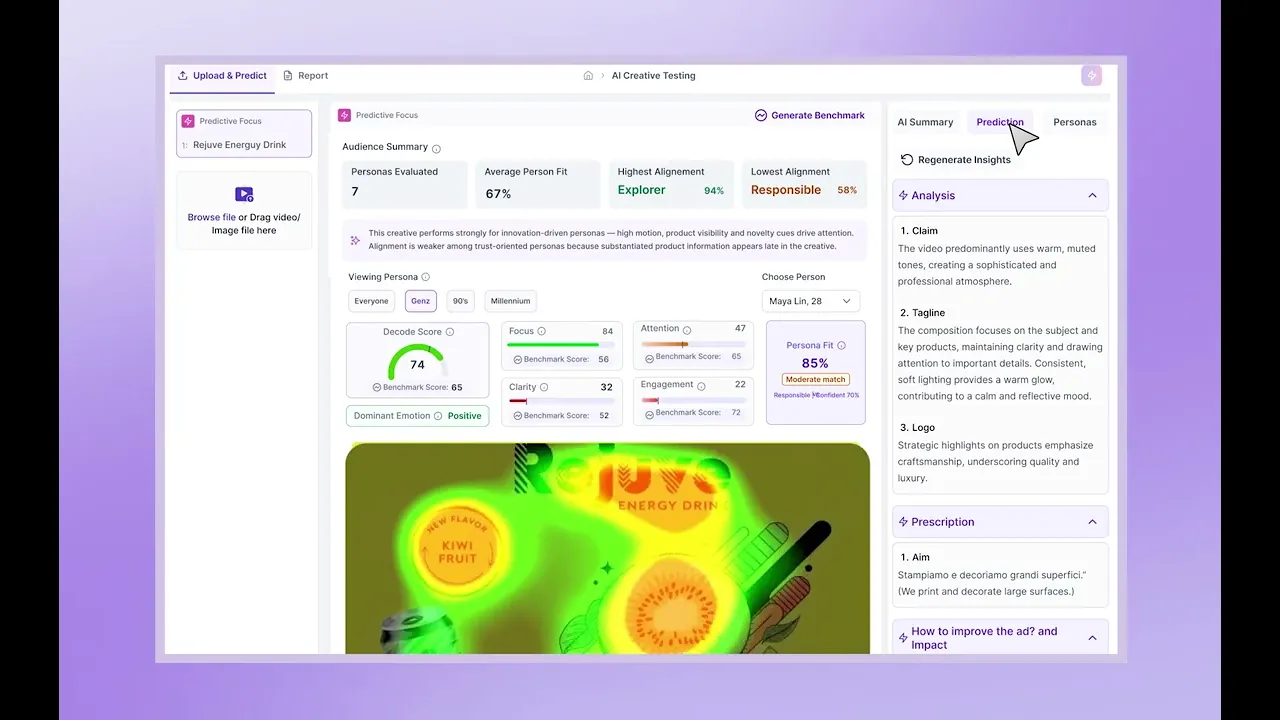
Synthetic audiences are consumer profiles created by means of demographic, behavioural, and survey data with the aim of mimicking the way a particular group of people might react to a question, a concept, or a message.
The important term is "simulate". A synthetic audience does not include any real people, only a statistical approximation of a group as presented through responses which sound as if they could have been said by a person.
Two clarifications matter.
In the first place, synthetic audiences consist of segments and archetypes rather than specific individuals. If a company states that a panel 'represents urban millennial grocery shoppers', what it actually means is that the model has been trained on the patterns linked to that group, not that it is based on any particular shopper. Unlike a simple list of respondents, they are more similar to buyer personas in this respect, with the difference being that a synthetic persona can be queried and will respond.
Second, synthetic audiences are not the same as AI-moderated research since AI-moderated research involves carrying out interviews with real participants who have given their consent, whereas synthetic generation never includes a human respondent at any stage. The two are continually lumped together under the broad heading of 'AI in research', and keeping them separate is the most important point when assessing vendors.
How Synthetic Audiences Are Built
Most of the tools designed to create synthetic audiences are built up in a three-layer manner.
The data foundation: Demographic data, purchase and loyalty history, historical survey responses, panel archives, and sometimes social listening inputs. This layer sets the ceiling on everything above it.
The persona layer: Language models or probabilistic systems are conditioned on that foundation to produce personas calibrated to particular traits, categories, and motivations. A prompt defines the attributes, and the model generates responses consistent with them.
The elicitation layer: The persona is asked research questions, and outputs are aggregated into something resembling a dataset: distributions, preference rankings, open-ended reactions.
Almost all of the quality comes down to the diversity and recency of the foundation, since it is in this area that the majority of differences between various vendors are found. A model that is primarily trained on English-speaking, Western, digitally active groups will give confident answers regarding audiences that it has only just seen. This is a coverage issue, not a modeling one, and it appears exactly the same as a good result on screen.
Recency is another limitation. Since these systems base their learning on historical data, they are by nature backward-looking: they excel at reproducing established patterns but are weak at predicting new behaviour, even though this is often exactly what a team is looking to detect. Although this is a different type of failure from sampling error, the result is the same: a figure that appears accurate but isn't.
A more detailed explanation of the way these models produce this type of output is given in the section on generative AI and its application in consumer research.
What Synthetic Audiences Are Used For
In reality, three specific applications make up the majority of the genuine value.
Early concept and message screening: When a team has fifteen concept directions and budget to test four, synthetic screening ranks the list before fieldwork begins. The output is a shortlist, not a verdict, so teams already running structured message testing treat it as a pre-stage rather than a replacement.
Exploring hard-to-recruit segments: Low-incidence audiences, specialist professionals, and small regional segments are expensive and slow to recruit. Synthetic exploration can generate directional hypotheses about these groups that a researcher then designs real fieldwork to confirm. The value is in sharpening the questions, not answering them.
Rapid iteration on variants: Pricing tiers, positioning statements, and claim wording can run through many permutations quickly. This is closest in function to a simulated test market, with the caveat that has always applied to simulation: it models the world as previously observed, not as it is.
What the above have in common is that each one is before the decision, not at it.
What Synthetic Audiences Get Right
The most compelling evidence in support of synthetic audiences is provided by studies which involve replication at the level of the population, and within those limits this is encouraging.
In the most cited academic test of the approach, researchers at Vanderbilt prompted ChatGPT to generate 30 synthetic responses for each of 7,530 real respondents in the American National Election Study, producing more than 3.6 million synthetic answers. The averages held up well, with mean scores corresponding closely to the real survey averages.
The ability can be summed up in a single sentence: synthetic respondents are able to track broad population averages and directional trends quite well.
The other benefit is in the area of operations since responses come in within minutes not weeks, there being no need for recruitment, no incentive spending, and no coordination of fieldwork. This speed alters the possibilities within a quarter.
Both point to the same conclusion, namely that synthetic audiences function as a preliminary filter rather than as a final judgment.
Where Synthetic Audiences Fall Short
Sycophancy bias
Language models are trained on human feedback, and human feedback rewards agreement. Researchers testing five state-of-the-art AI assistants across four free-form text generation tasks found consistent sycophancy in all of them, with models shifting their assessments toward whatever view the user appeared to hold and revising correct answers when challenged.
When it comes to research, this is serious. A synthetic respondent, when asked to assess a concept that the prompt presents in an enthusiastic manner, will tend to like it. Real respondents have no such incentive. A great deal of the value of consumer research lies in people giving you feedback that you did not want to hear, and sycophancy eliminates precisely that.
Accuracy collapses on complexity
Replicating a well-documented average is a different task from predicting a reaction to something new. Synthetic accuracy drops sharply on multi-factor questions, unfamiliar categories, and anything without strong precedent in the training data. Google UX researchers who compared synthetic personas against 500 human respondents across eight attitude questions about trust and privacy found the synthetic data useful in parts and unreliable in others, the pattern the wider literature keeps reporting.
Variance collapse
It is easy to overlook this point since it improves the appearance of the output rather than making it worse. In the Vanderbilt study, the standard deviation of the actual survey responses was 31.4 whereas that of the synthetic responses was 16.1, the distribution therefore being about half as wide as in reality. The regression coefficients differed significantly from the true estimates and noticeable changes in the wording of the prompt led to corresponding changes in the results.
It is the differences between segments that give research practical value. When a synthetic panel reduces the gap between two segments, it results in a clear, confident, and misleading conclusion indicating consensus. This represents the same kind of risk mentioned in the section on bias in AI-moderated research, but in the case of a method that involves no human participant at all.
The governance risk
Gartner predicts that by 2027, 60% of data and analytics leaders will face critical failures in managing synthetic data, with consequences for governance, model accuracy, and compliance. The failure mode Gartner describes is organizational rather than technical: synthetic output enters the decision pipeline without provenance, and nobody downstream can tell which numbers came from people and which came from a model.
Synthetic Audiences vs Real Respondents
The simplest way of putting it is this: synthetic audiences show what a group is likely to say according to statistics, while actual respondents indicate what they truly feel and often demonstrate that the two things differ.
Stated preference has always been an imperfect proxy for behavior, which is the entire subject of the say-do gap in consumer research. Synthetic audiences inherit that problem and add a layer on top: they are trained largely on stated preference data, so they simulate the stated layer of a phenomenon researchers already know to be unreliable. A model built on what people said cannot tell you where what people said diverged from what they did.
The second gap is qualitative depth. The unprompted tangent, the hesitation before answering, the reason nobody on the team anticipated: these are the moments that reframe a project, and they come from lived experience. A synthetic persona produces a plausible answer, never a surprising one. It is worth reading this alongside the known limitations of survey data, because synthetic audiences reproduce those limitations rather than solving them.
Actual respondents contain signals which the text does not have, such as hesitation, the point at which attention shifted, and what an expression was like a second before an answer—all of these are absent from a simulated response since there was never a person present to observe.
When to Use Synthetic Audiences
A simple decision framework covers most situations.
Use synthetic audiences when:
You are screening a long list of early ideas and need to narrow it fast.
You are generating hypotheses about a segment you will later research properly.
The cost of being directionally wrong is low and easily reversed.
Speed matters more than precision at this stage of the process.
Use real respondents when:
The decision is expensive, public, or hard to reverse.
The category is regulated, sensitive, or culturally specific.
You need emotional nuance, motivation, or the reasoning behind a preference.
You are testing something genuinely new with no historical precedent.
Segment-level differences are the point of the study.
The hybrid workflow most teams land on: use synthetic screening to reduce fifteen options to four, then run real human research on those four before committing. This preserves the speed advantage where it is safe and puts human evidence where the money is.
Any consumer insights platform worth evaluating should make the boundary between simulated and real data explicit rather than blurring it, a fair question to carry into this roundup of consumer research platforms as well.
Validating Synthetic Insights With Real Human Research
A high-scoring synthetic result is a hypothesis. It becomes a finding only when real people confirm it.
This distinction is getting harder to police, not easier. A Dartmouth study published in PNAS built an autonomous synthetic respondent that passed 99.8 percent of standard attention checks across 6,000 trials, defeating essentially every bot detection method the survey industry currently relies on. Verifying that respondents are human is now an active methodological requirement, not an assumption.
For decisions with real cost, a launch, a repositioning, a category entry, the sequence that holds up is simple. Screen synthetically, validate with humans, then decide. Methodologies like concept testing and in-depth interviews exist because that second step cannot be simulated away.
Frequently Asked Questions
1. What are synthetic audiences in market research?
They are AI-generated personas built from demographic, behavioral, and survey data that simulate how a defined consumer segment might respond to research questions. They represent archetypes rather than real individuals.
2. How accurate are synthetic audiences compared to real respondents?
They approximate population averages well but perform poorly at the segment level and on novel questions. Academic testing has found synthetic response distributions roughly half as wide as real ones, flattening the differences research depends on.
3. What is the difference between synthetic audiences and AI-moderated research?
Synthetic audiences involve no real people at all. AI-moderated research uses AI to conduct interviews with real, consented human participants. One simulates respondents, the other facilitates conversations with actual ones.
4. When should you use synthetic audiences instead of real respondents?
Use them for early screening, ideation triage, and directional hypothesis generation where speed matters more than precision and the cost of being wrong is low and reversible.
5. What are the biggest limitations of synthetic audiences?
Sycophancy bias, variance collapse across segments, weak performance on novel or complex questions, uneven coverage of underrepresented audiences, and sensitivity to prompt wording.
6. Can synthetic audiences replace focus groups entirely?
No. Focus groups and interviews generate unexpected findings, emotional context, and the reasoning behind a stated preference. Synthetic personas produce plausible answers, not surprising ones.
7. How are synthetic personas built?
Providers combine demographic, transactional, and survey data, condition a language model on that foundation to generate personas with defined traits, then query those personas and aggregate the outputs into a dataset.
The Practical Takeaway
Synthetic audiences are a legitimate addition to the research toolkit and a poor substitute for it. They are fast, cheap, and reasonable at reproducing what is already known, and unreliable exactly where research earns its value: at the segment level, on new questions, and anywhere emotional truth matters more than a plausible sentence.
Use them to move faster through the early funnel, then validate with real people before anything expensive happens. The teams getting the most from AI in consumer insights are not the ones simulating the most respondents. They are the ones who know which decisions still need a human on the other end of the conversation.