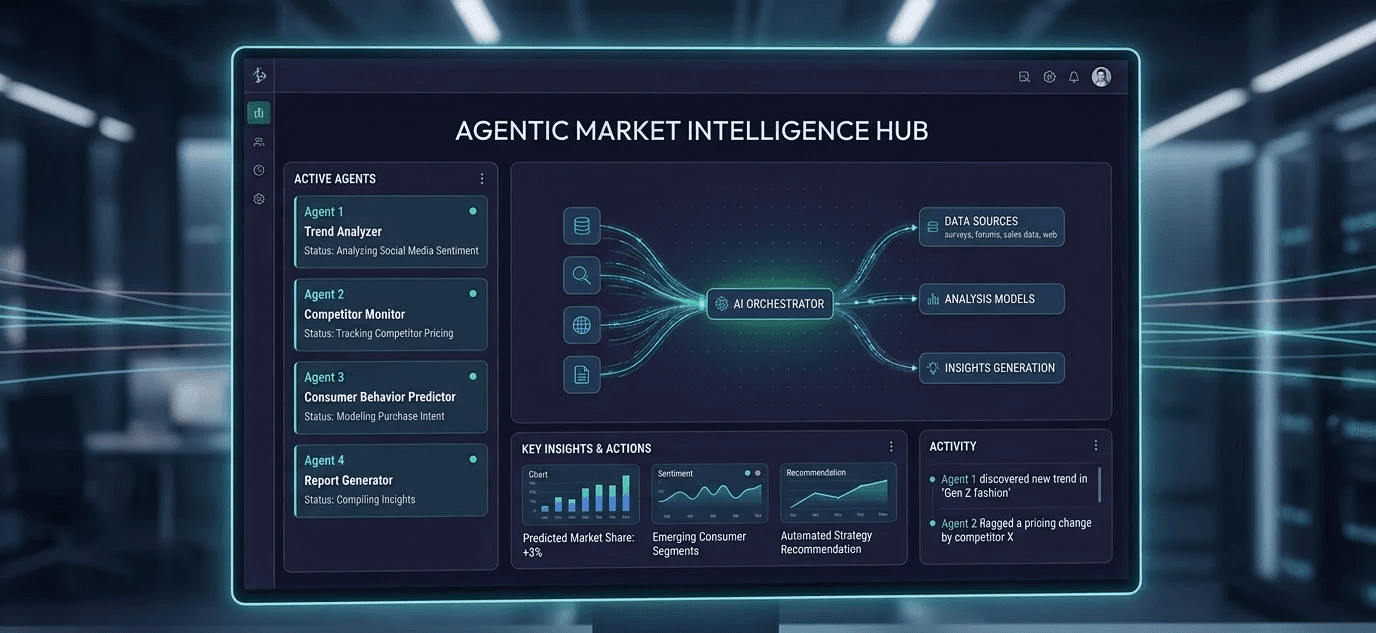
Agentic AI refers to systems that act autonomously toward a goal across multiple steps, like planning a research workflow or probing deeper during an interview, rather than completing one task per prompt. In market research, this makes AI more of a workflow partner that structures data and surfaces insights with less manual input, though human judgment still shapes what matters.
The Shift: From Data to Decisions to Autonomous Execution
Market research has always been about understanding people. But how we get there is changing fast.
We have moved from surveys and reports to dashboards and analytics. Now, we are entering the next phase — where AI does not just analyse data, but acts on it.
This is where agentic AI comes in.
Agentic AI represents a new generation of artificial intelligence that can plan, reason, and execute tasks with minimal supervision. Instead of waiting for instructions, it works toward a goal, adapts to context, and continuously improves.
For consumer insights teams, this shift is critical. It moves research from a passive function to an active, decision-driving system.
What Is Agentic AI in Simple Terms
Agentic AI is an AI system that can independently complete tasks by:
Understanding a goal
Breaking it into steps
Making decisions along the way
Executing actions
Learning from outcomes
It does not just respond. It acts with intent.
In a market research context, this means AI can move beyond generating insights to actually helping teams take action based on those insights.
Generative AI vs AI Agents vs Agentic AI
To understand agentic AI clearly, it helps to differentiate it from other AI systems.
Generative AI
Generative AI focuses on creating content.
Generates text, images, or code
Works based on training data
Responds to prompts
Does not take real-world actions
Example: Writing a report or summarising research findings.
AI Agents
AI agents are designed to perform specific tasks.
Operate within defined rules
Can connect to tools or APIs
Execute predefined actions
Limited adaptability
Example: Pulling survey data, tagging responses, or generating reports automatically.
Agentic AI
Agentic AI goes a step further.
Understands goals, not just tasks
Plans multi-step workflows
Coordinates multiple agents and tools
Adapts based on context and outcomes
Executes end-to-end processes
Example: Designing a research study, collecting responses, analysing behaviour, identifying insights, and recommending actions — all in one continuous workflow.
The Key Difference
Generative AI creates
AI agents execute tasks
Agentic AI orchestrates outcomes
This distinction is important because many organisations mistake task automation for true intelligence. Agentic AI operates at the workflow level, not just the task level.
Why Agentic AI Matters for Market Research
Market research today faces several challenges:
Slow turnaround times
Fragmented tools and workflows
Delayed insights
Limited scalability
Agentic AI addresses these challenges by enabling continuous, autonomous research systems.
From Static Reports to Continuous Insights
Traditional research is often project-based. Insights are generated at a single point in time.
Agentic AI enables always-on consumer insights, where data is continuously collected, analysed, and updated.
From Manual Effort to Automated Workflows
Instead of manually running surveys, analysing data, and creating reports, agentic systems can manage the entire process.
This reduces time, effort, and operational complexity.
From Insights to Action
Most organisations struggle not with generating insights, but with acting on them.
Agentic AI bridges this gap by connecting insights directly to decision-making and execution.
How Agentic AI Works in Consumer Insights
Agentic AI systems operate through a structured loop that mirrors human thinking.
Understanding the Context
The system gathers data from multiple sources such as user interactions, research inputs, and behavioural signals.
Interpreting Meaning
It processes this data to identify patterns, trends, and signals.
Defining the Objective
The AI determines what needs to be achieved based on user goals or business outcomes.
Planning the Approach
It breaks down the objective into smaller steps and identifies the best way to execute them.
Executing Actions
The system carries out tasks such as running studies, analysing responses, or generating recommendations.
Learning and Improving
It continuously refines its approach based on feedback and results.
The Role of AI Agents Within Agentic AI
AI agents are still an important part of the system.
Think of them as building blocks.
Each agent handles a specific task
Multiple agents work together
Agentic AI coordinates them
Without this orchestration layer, agents operate independently, leading to fragmented workflows.
With agentic AI, they function as a connected system working toward a common goal.
Real Impact: What Changes for Market Research Teams
Faster Research Cycles
Studies that once took weeks can now be completed in hours or days.
Better Decision Making
Insights are generated in real time, allowing teams to respond quickly to changing consumer behaviour.
Scalable Consumer Understanding
Agentic AI enables research across multiple markets, segments, and touchpoints simultaneously.
Reduced Manual Work
Teams spend less time on repetitive tasks and more time on strategy and innovation.
Where Agentic AI Creates Value in Consumer Insights
Continuous Consumer Feedback
Always-on research programmes that track behaviour, sentiment, and preferences in real time.
Creative and Campaign Testing
Testing multiple variations of ads, messaging, and experiences before launch to identify what works best.
Behavioural and Emotional Insights
Understanding not just what consumers do, but how they feel and why they act.
Journey Optimization
Identifying friction points across the customer journey and improving experiences continuously.
Challenges to Keep in Mind
Agentic AI is powerful, but it requires the right approach.
Poorly Defined Goals
If objectives are unclear, the system may optimize for the wrong outcomes.
Data Quality Issues
Insights depend on accurate and relevant data.
Over-Automation Risks
Not every workflow needs full autonomy. Some processes still require human judgment.
Trust and Transparency
Teams need visibility into how decisions are made to ensure reliability.
Why the Future of Market Research Is Agentic
The future of consumer insights is not about more dashboards or more reports.
It is about systems that think, learn, and act.
Agentic AI enables:
Outcome-driven research
Real-time decision making
Continuous learning loops
Integrated workflows across tools and teams
It shifts market research from a support function to a core driver of business strategy.
Why Human Insight Still Matters
Agentic AI can process data and automate workflows, but understanding human behaviour, emotions, and context remains essential.
The most effective systems combine:
AI-driven automation
Human expertise
Behavioural understanding
This balance ensures that insights are not only fast but also meaningful and accurate.
Final Thoughts
Agentic AI is not just another step in AI evolution. It is a shift in how work gets done.
For market research, it means moving from:
Insights to action
Projects to continuous systems
Manual processes to intelligent workflows
But the goal is not to replace human thinking.
It is to enhance it.
The most effective organizations will be those that combine:
Agentic AI for automation and scale
Consumer insights for understanding and empathy
Because in the end, even the most advanced AI needs to understand one thing clearly - People.
Frequently asked questions
1. What is agentic AI in the context of market research?
Agentic AI refers to AI systems capable of autonomously performing multi-step research tasks, such as designing studies, gathering data, and generating insights with minimal human intervention.
2. How does agentic AI differ from traditional AI tools in research?
Traditional AI tools typically assist with a single task like transcription or analysis, while agentic AI can independently chain together multiple steps toward a broader research goal.
3. What are the potential benefits of agentic AI in market research?
Benefits include significantly faster research cycles, reduced manual effort, and the ability to continuously monitor and adapt research based on real-time findings.
4. What are the risks of relying on agentic AI for autonomous decision-making?
Risks include reduced human oversight, potential for compounding errors across autonomous steps, and challenges in maintaining transparency and accountability in AI-driven decisions.
5. How should businesses approach adopting agentic AI in their research processes?
Businesses should start with lower-risk, well-defined tasks, maintain human review checkpoints, and gradually expand autonomy as trust in the system's reliability grows.
Related Topic: