An AI agent in market research is a system that can act toward a research goal across multiple steps with more autonomy than a standard AI tool, such as moderating interviews, probing follow-up questions, and organizing responses. Rather than replacing researchers, it helps teams plan, moderate, analyze, and scale their work faster.
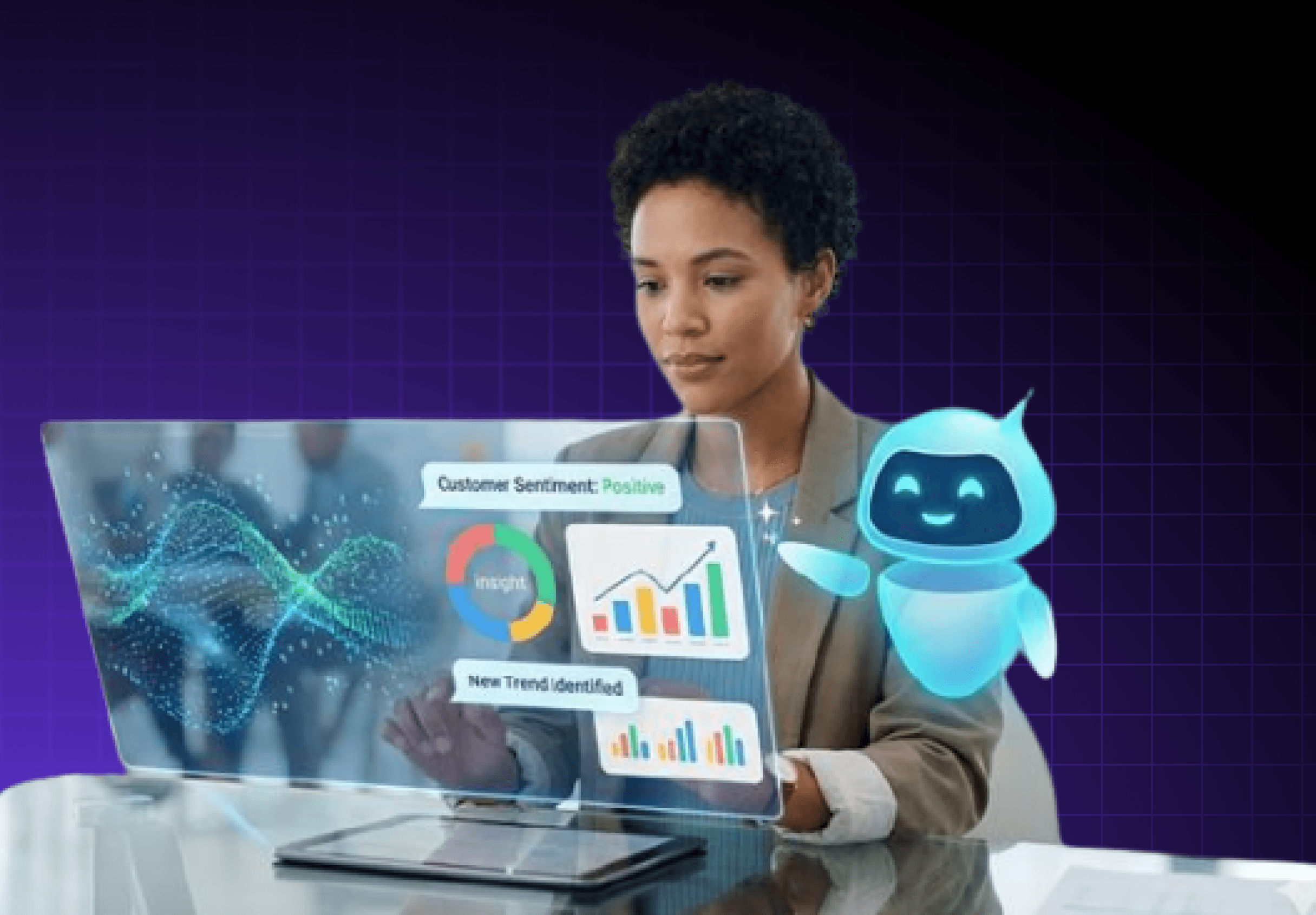
AI is changing how research teams work. It is helping them move faster through tasks that once took hours or days, from sorting open-ended responses to summarizing interviews and pulling out patterns across large datasets. But as the technology becomes more capable, a new term is showing up more often in research conversations: AI agents.
For many people, that phrase sounds more complicated than it needs to be. In simple terms, AI in market research is moving beyond basic automation and toward systems that can support parts of the research workflow more actively. Instead of only completing one task at a time, AI agents can help carry out a sequence of steps with more autonomy.
This does not mean human researchers are being replaced. It means the tools are becoming better at helping research teams plan, moderate, analyze, and scale their work. In this guide, we’ll break down what AI in market research means, what AI agents are, how they fit into research workflows, and where human researchers still matter most.
What is AI in market research?
At its core, AI in market research means using artificial intelligence to make research work faster, easier, or more scalable.
That can include helping with:
survey analysis
open-text analysis
interview summaries
tagging and organizing feedback
identifying recurring themes
spotting patterns across data
retrieving insights from older studies
drafting toplines or reports
In other words, AI helps researchers handle information more efficiently. Instead of spending all their time processing raw input, they can spend more time interpreting what it means.
It is also useful to separate the broad idea of AI from specific workflows. AI is the umbrella capability. Under that umbrella, there are many different tools and use cases. Some are simple, like summarizing a transcript. Others are more advanced, like systems that can run parts of a moderated study or organize insights automatically.
That distinction matters, because not every use of AI in research is the same. Some tools help with one isolated task. Others are starting to support wider chunks of the workflow.
How is AI used in market research today?
When people ask how is AI used in market research, the answer is usually more practical than futuristic. Most teams are not handing over the entire process to AI. They are using it to speed up specific parts of the workflow.
Here are some of the most common applications.
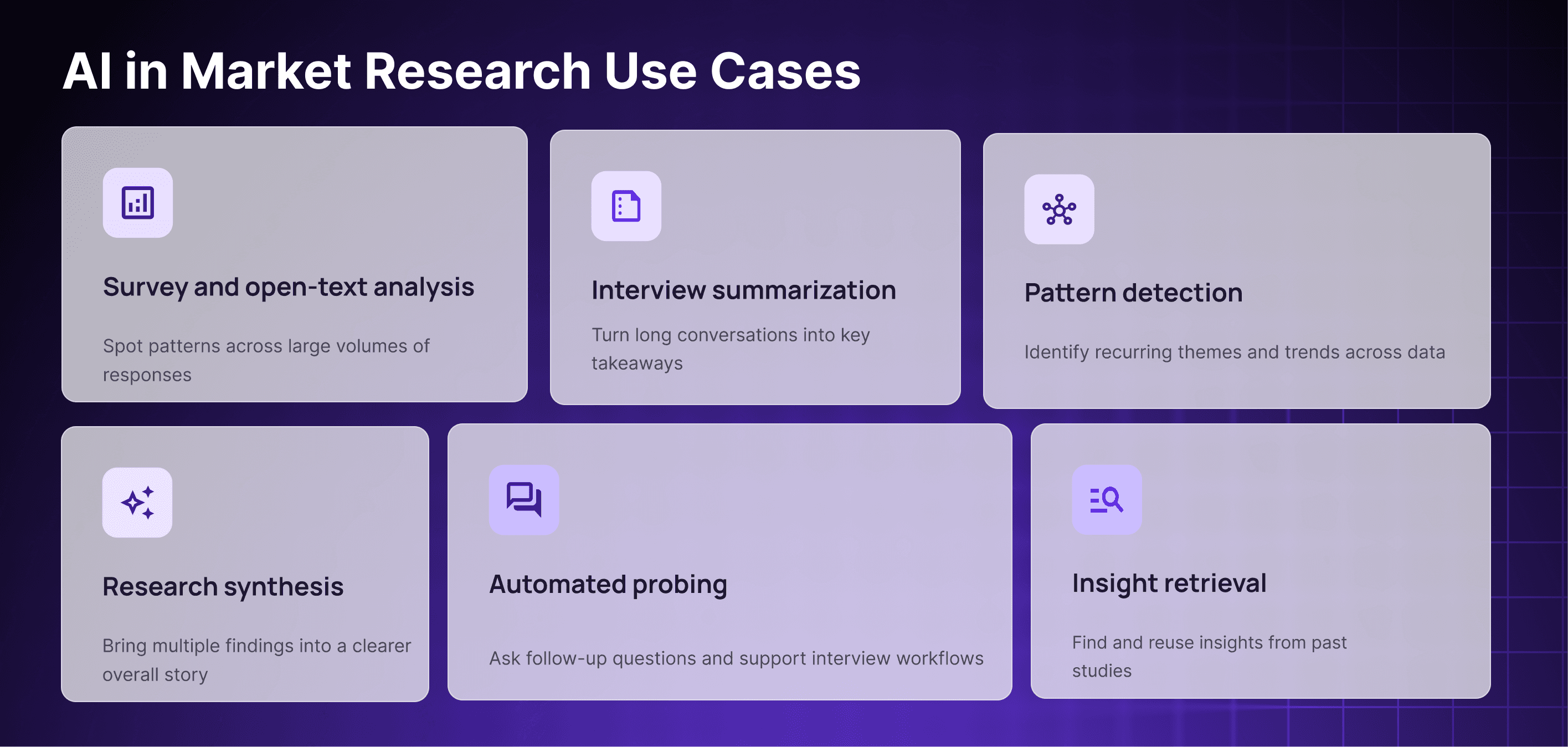
Survey and open-text analysis
Research teams often need to review hundreds or thousands of responses. AI can help group similar comments, surface patterns, and highlight recurring themes much faster than manual review alone.
Interview summarization
A single interview can generate pages of notes or transcripts. Multiply that across many sessions and synthesis becomes one of the biggest bottlenecks in research. AI helps by turning long conversations into summaries, themes, and key takeaways. This is also one of the clearest examples of generative AI in market research, especially when teams need faster ways to turn unstructured conversations into usable outputs.
Pattern detection
AI can help spot trends across large amounts of qualitative or quantitative input. This is especially useful when teams need to compare multiple segments, markets, or waves of feedback quickly.
Research synthesis
Beyond summarizing individual responses, AI can help bring multiple findings together into a clearer overall story. It can cluster insights, connect recurring signals, and give researchers a faster starting point for analysis.
Automated probing or moderation
This is where the conversation begins to overlap with AI Moderator workflows. Instead of only analyzing responses after the fact, AI can also help guide interviews or ask follow-up questions based on what a participant says.
Insight retrieval from past studies
Many organizations already have valuable research sitting in decks, docs, and past reports. AI can make those insights easier to search, retrieve, and reuse rather than leaving them buried in static files.
So when people talk about AI applications in market research, they are often describing a mix of analysis, synthesis, retrieval, and workflow support rather than one single use case.
What are AI agents in market research?
An AI tool usually completes one task after you prompt it. An AI agent goes a step further.
In simple terms, an AI agent is a system that can act toward a goal across multiple steps. It can follow instructions, adapt within a defined workflow, and help move a process forward with less manual input at each stage.
In market research, that could mean an AI system that can:
ask interview questions
respond with follow-up prompts
organize responses as they come in
identify early themes
summarize findings for review
support a researcher across more than one step of the workflow
That is what makes AI agents in market research different from simple automation.
For example:
Basic automation might send a survey link after a trigger.
A standard AI tool might summarize answers once they are collected.
An AI agent might ask questions, probe deeper, organize responses, and prepare an initial summary for the researcher.
This matters because research workflows are not made up of one isolated task. They are chains of steps. The more AI can support those chains in a useful and controlled way, the more valuable it becomes.
How AI agents fit into research workflows
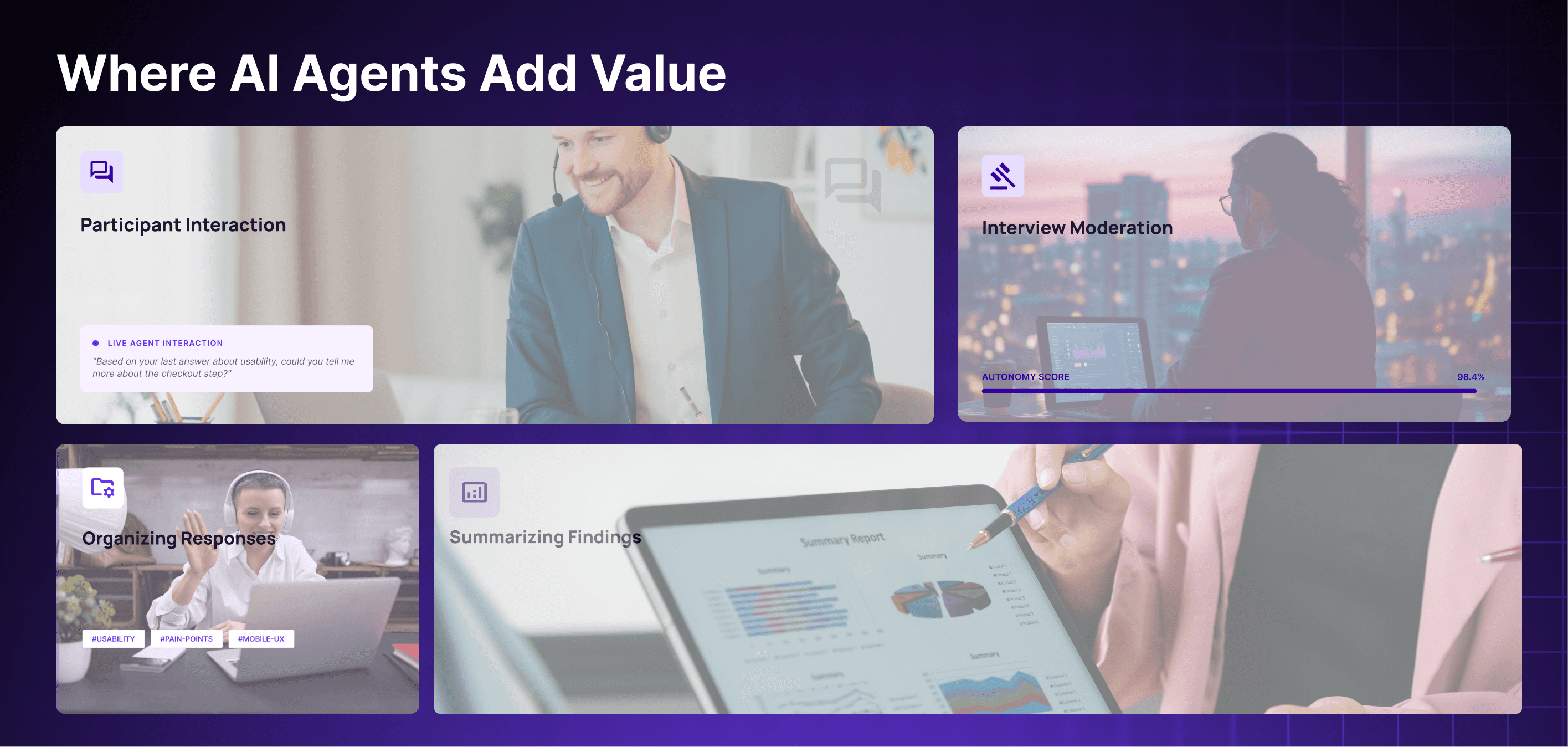
To understand where AI agents fit, it helps to break the research process into stages.
1. Participant interaction
AI agents can help engage participants through structured, conversational experiences. Instead of only collecting static answers, they can guide users through questions and adapt based on the responses they receive.
This is especially relevant in interview-style or qualitative workflows where follow-up questions are part of the value.
2. Interview moderation
One of the clearest examples of an AI agent for market research is AI-supported moderation. The system can ask prepared questions, probe when an answer needs more detail, and keep the conversation moving in a way that supports the research objective.
That does not make it equal to a skilled human moderator in every case, but it does make it useful in workflows where speed, structure, and scale matter.
3. Organizing responses
Instead of waiting until the end of a study to clean up messy data, AI agents can help structure input as it comes in. That could include tagging themes, clustering related answers, or keeping responses organized by topic.
4. Summarizing findings
After the interaction is complete, AI agents can help turn raw input into usable insights. That may include toplines, summaries, notable quotes, or early themes for researchers to review.
This is where market research AI agents become especially valuable, not just by speeding up one task, but by helping researchers move through multiple stages with less manual effort.
Benefits of using AI in market research
Interest in AI for market research keeps growing because, when used well, it can reduce friction across multiple parts of the research process.
Faster turnaround
Research teams are often expected to deliver insights quickly. AI can shorten the time between collecting input and sharing a useful summary or first draft of findings.
Better handling of large volumes of data
As studies scale across audiences, markets, or channels, the amount of input grows fast. AI helps teams handle that volume without increasing manual work at the same rate.
Consistency in repetitive tasks
Tasks like summarizing, tagging, or organizing responses are repetitive but important. AI can help make those steps more consistent.
Easier scale across markets or segments
If a team is collecting feedback across different groups, AI can help make cross-segment synthesis more manageable.
Faster synthesis and retrieval
AI makes it easier not only to summarize new research, but also to find and reuse older insights that may already answer part of the question.
For teams wondering how to use AI in market research, these are often the most practical entry points. Start with the parts of the workflow that are repetitive, time-heavy, or difficult to scale.
Limits of AI in market research
AI can help a lot, but it is not a substitute for good research judgment.
Risk of shallow interpretation
AI is good at pattern recognition, but it can miss context. It may summarize what was said without fully understanding why it matters.
Human judgment is still necessary
A research team still needs to decide what question to ask, how to frame the method, whether the sample makes sense, and how to interpret the findings in business context.
Context sensitivity matters
Some conversations require empathy, nuance, and flexibility. Sensitive subjects, emotionally complex responses, or highly strategic discussions often still need skilled human moderation and interpretation.
Bias risks
AI outputs are shaped by the data, prompts, and workflow behind them. If those inputs are weak or biased, the outputs can be too.
Quality depends on setup
Poorly designed studies do not become good studies just because AI is involved. Clear objectives, strong prompts, good questions, and thoughtful review still matter.
So while using AI in market research can improve speed and scale, it does not remove the need for quality research design.
When human researchers still matter most
One of the biggest misconceptions about AI in research is that it will remove the need for human researchers. In practice, the opposite is often true: the better the AI tools get, the more important good human judgment becomes.
Human researchers still matter most in areas like:
Complex moderation
When the discussion needs flexibility, emotional sensitivity, or real-time judgment, a human moderator is still stronger.
Nuanced interpretation
Researchers do more than summarize. They connect signals, challenge weak conclusions, spot contradictions, and understand what is strategically meaningful.
Strategic decision-making
AI can help organize evidence, but people still decide what matters, what to prioritize, and what action to take.
Research design
Good research starts before fieldwork. Human researchers define objectives, choose methods, frame questions, and decide what success looks like.
That is why the strongest use of AI in research is usually collaborative. AI helps with support, structure, speed, and scale. Human researchers bring judgment, context, and rigor.
Final thoughts on AI agents in market research
AI in market research is no longer just about speeding up one isolated task. It is becoming part of how modern research workflows are run.
AI agents are one of the clearest signs of that shift. They move the conversation from simple assistance to more active workflow support. They can help ask questions, probe deeper, organize responses, summarize findings, and reduce the time between research and action.
But they are not a replacement for strong research practice. Good research still depends on clear objectives, thoughtful design, human review, and careful interpretation.
The most useful way to think about AI agents in market research is as workflow partners. Used well, they help research teams move faster, scale more easily, and get more value from both new and existing insights.
FAQs
How is AI used in market research?
AI is used in market research for tasks like survey analysis, open-text analysis, interview summarization, pattern detection, research synthesis, automated probing, and insight retrieval from past studies.
What are AI agents in market research?
AI agents in market research are AI systems that can support multiple steps of a research workflow, such as asking questions, probing responses, organizing answers, and summarizing findings.
Can AI replace human researchers in market research?
No. AI can support many research tasks, but human researchers are still essential for research design, moderation in sensitive contexts, nuanced interpretation, and strategic decision-making.
What are the benefits of AI in market research?
The main benefits include faster turnaround, easier handling of large volumes of data, more consistency in repetitive tasks, support for scale, and quicker synthesis and retrieval of insights.
What are the limitations of AI in market research?
The main limitations include shallow interpretation, lack of context sensitivity, bias risks, dependence on good setup, and the continued need for human judgment.
See how AI Moderator helps teams run AI moderated interviews and get structured insights faster.
Related Topic: