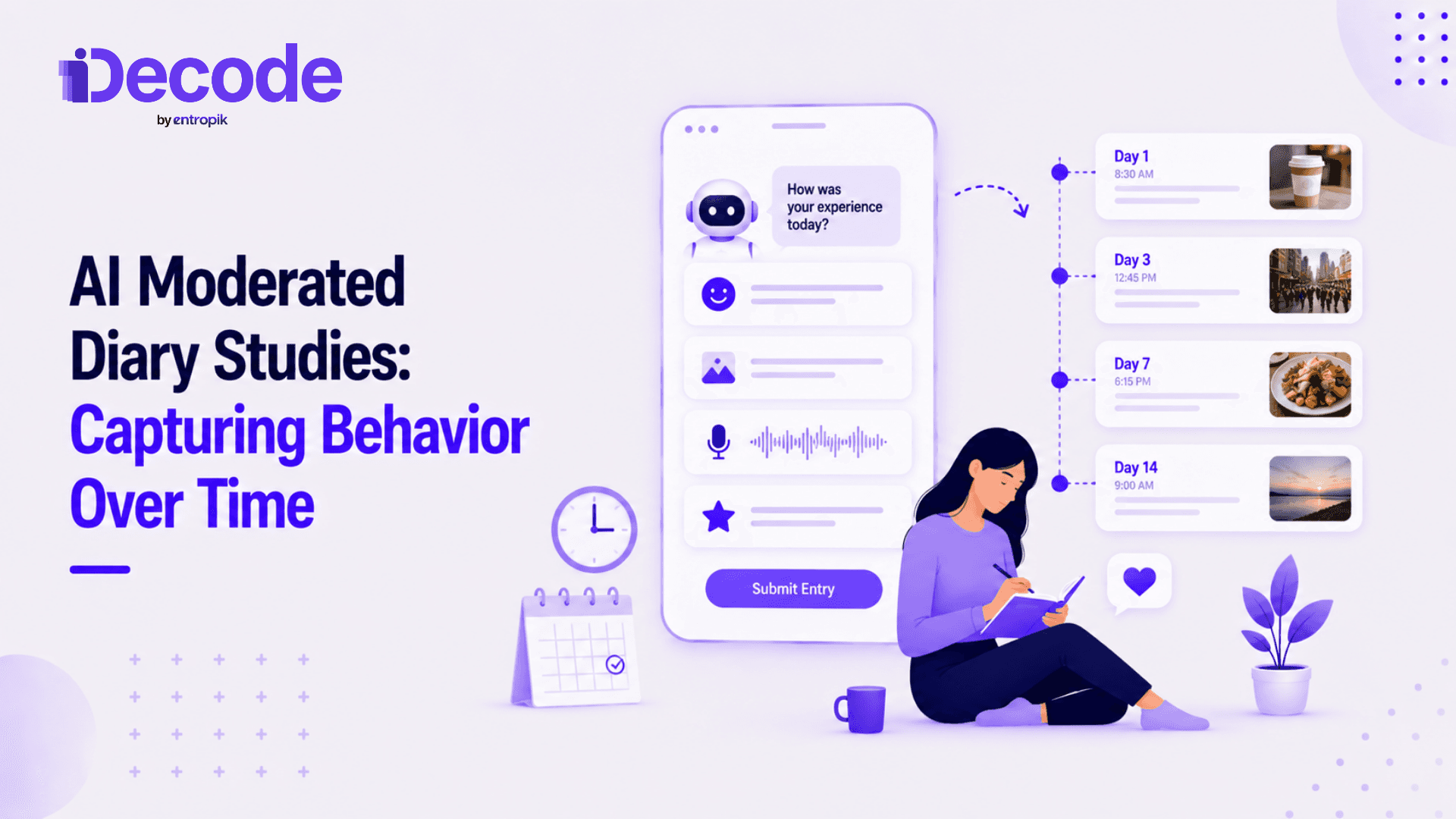
AI moderated diary studies use AI interviewers to prompt participants to log experiences as events happen, then probe the reasoning behind each entry in real time. Because entries are contemporaneous rather than recalled, they capture actual behavior over days or weeks, while the AI handles prompting, drop-off, and analysis, making longitudinal qualitative research feasible at scale.
Summary:
|
What are AI moderated diary studies?
An AI moderated diary study asks participants to record entries as events unfold, whether that is a snack eaten mid-afternoon, a moment of friction inside an app, or a decision made in a store aisle. Instead of waiting for a scheduled interview, participants log the moment while it is fresh, and an AI moderator responds to each entry with a follow-up question that digs into the why behind it.
This is a meaningfully different method from a standard qualitative research approach, because the researcher is not asking someone to reconstruct a week from memory. Entries are contemporaneous, logged close to the moment they describe, not recalled after the fact. And unlike a passive logging app that just stores what someone types, an AI moderator in a diary study both prompts the entry and interrogates it, turning a raw log into a small structured interview every time.
The distinction matters for research design. A one-off interview or survey captures a single point of view on a single day. A diary study captures an arc, a series of moments strung together over days or weeks, which is exactly what product adoption, habit formation, and shifting sentiment require to be understood properly. It sits alongside the broader discipline of user experience testing as a method built specifically for behavior that only reveals itself over time.
Why in-the-moment capture beats recall
Ask someone in an interview to describe how they used a product last month, and what you get back is a story shaped by how they see themselves, not a record of what actually happened. Recall is reconstruction. People compress, smooth over friction, and quietly edit out the parts that do not fit the narrative they are telling about themselves in the room.
This is not a minor quirk. A large body of consumer research shows that what people say they intend to do and what they actually do can diverge sharply. A widely cited Harvard Business Review analysis of sustainability purchasing found that 65% of consumers said they wanted to buy from purpose-driven, sustainable brands, yet only about 26% actually followed through with a purchase, a nearly 40-point gap between stated preference and real behavior. Diary studies close that gap by capturing the purchase, the usage, or the abandonment as it happens, rather than asking someone to summarize their intentions afterward.
The evidence holds up outside of marketing research too. A peer-reviewed study comparing retrospective surveys against experience sampling among 125 adolescents found that participants consistently overestimated their own behavior when reporting from memory, and that the two methods only reached moderate agreement, with correlations in the 0.55 to 0.65 range. Even well-intentioned, attentive participants misremember their own recent behavior, in ways that overlap with several well-documented cognitive biases in user research. This is precisely why diary studies occupy their own category in the research toolkit. They are not a cheaper substitute for a single interview; they are the only practical way to observe behavior as it actually unfolds rather than as it gets remembered.
Executives face a version of the same blind spot. A PwC survey on business trust found that 90% of executives believed their customers highly trusted their company, while only about 30% of consumers actually said they did. Self-reported confidence inside a business and self-reported behavior from a consumer both suffer from the same distortion: people describe the version of events that feels true, not necessarily the one that happened. Diary studies are built specifically to get past that gap.
Types of diary studies
There is no single "diary study" format. The right structure depends entirely on what you are trying to learn, and choosing the wrong one is a common way these studies fail before they even start, a point covered in more depth in this complete guide to diary studies. Four formats cover most research questions, and each is suited to a different kind of behavior.
Experience diaries
Experience diaries track how someone interacts with a category or product across days or weeks. Rather than asking about usage in the abstract, participants log real sessions as they happen, revealing how a product actually gets used, including the workarounds people invent and the features they quietly abandon. This format works especially well when studying product usage over time, where the gap between intended use and actual use tends to be widest.
Moment-capture diaries
Moment-capture diaries prompt an entry either on a trigger (something happens, so the participant logs it) or on a schedule (a check-in at a set time each day). This format is best suited to studying triggers and decision flows that happen outside a researcher's direct line of sight, such as what prompts someone to open a shopping app or reach for a snack.
Reflective diaries
Reflective diaries ask participants to spend a few minutes on a prescribed topic across several consecutive days. Giving someone time to sit with a question, rather than answering it live under the pressure of a single user interview, often produces more honest self-awareness than a one-off conversation ever could.
Video diaries
Video diaries preserve emotion, environment, and context that text-based entries inevitably lose. A participant filming themselves mid-commute or standing in a supermarket aisle captures tone of voice, hesitation, and body language, details that a typed log simply cannot convey. Entropik's video and audio response collection tools are built specifically to make this kind of in-context capture easy for participants on a phone.
How AI moderation changes diary studies
Diary studies have existed for decades, but they historically stayed out of commercial research because they were operationally brutal to run. Two problems killed most attempts: drop-off, where participants stop logging after a few days, and the sheer hand-work of reading and coding hundreds of entries afterward. AI moderation solves both.
Real-time probing means every entry gets a follow-up question the moment it is logged, turning a raw note into the reasoning behind the behavior. Instead of a researcher discovering three weeks later that half the entries lack any context, the AI moderator asks "what led to that" while the participant is still there. Automated prompting and reminders also mitigate drop-off directly, nudging participants back into the study without a researcher manually chasing anyone down. This kind of consistent, structured ux testing platform workflow is what makes running a multi-week study operationally realistic rather than a research team's biggest time sink.
Automatic thematic analysis handles the other half of the problem. Reading, tagging, and clustering hundreds of diary entries by hand used to take longer than the fieldwork itself. AI-assisted coding compresses that into something a researcher can review and validate rather than build from scratch, echoing the shift already underway in how AI moderated interviews actually work more broadly across qualitative research.
How to run an AI moderated diary study
Running a diary study well starts before a single participant logs an entry.
Define the behavior and window first. Decide exactly what you are trying to observe and how long it takes to show up naturally, whether that is a three-day purchase decision or a six-week onboarding arc.
Choose the format and cadence to match. An experience diary for ongoing usage needs a different prompt schedule than a moment-capture diary tied to a specific trigger.
Screen and recruit for the right behaviors and contexts. Participants need to be in a position to actually encounter what you are studying, not just fit a demographic quota.
Keep entries short. Long prompts kill completion rates fast; the entry itself should take under a minute.
Configure the AI moderator to probe consistently. Every entry should get a follow-up, and the system should synthesize themes as data accumulates rather than waiting until the study closes.
Teams already running remote usability testing will recognize a lot of this discipline; diary studies simply extend it across a longer window and a less controlled environment. And much like agile UX research, the goal is to build a repeatable rhythm rather than treat each study as a one-off event. Automation is also what makes it realistic for smaller teams to run diary studies at all, echoing the broader case for why DIY is the future of user research.
What AI moderated diary studies are used for
The method earns its place in a research toolkit because it answers questions a single session simply cannot.
Product adoption and usage over time is the most common use case, tracking how onboarding actually lands and where feature adherence quietly drops off in the weeks after launch. Habit formation research follows closely behind, capturing routines, category consumption, and media habits as they naturally recur rather than as a participant remembers them in hindsight. Shopper journeys benefit enormously too, since real-world purchase decisions happen across multiple touchpoints that a static journey map can outline but a single interview can never fully observe.
Analyzing behavior over time
Once entries start coming in, the analysis job has three layers. Thematic coding groups entries by behavior, trigger, or emotional state, a process that leans heavily on AI qualitative data analysis to turn hundreds of short logs into a structural map of what is happening across the sample. Longitudinal tracking then follows how individual participants change across the study window, the same underlying logic behind what a longitudinal study actually measures, surfacing shifts that a snapshot method would completely miss. Finally, cross-participant analysis compares that individual data against the wider cohort, revealing shared patterns and standout outliers.
This kind of layered synthesis is where a structured research repository becomes essential rather than optional. Diary studies generate far more data points per participant than a single interview, and without a system for connecting entries across time and across people, the richest part of the method, the pattern that only shows up in week three, gets lost in a folder of individual transcripts.
The scale at which this data gets collected is worth noting too. Deloitte's ConsumerSignals program, a longitudinal survey run monthly across more than a dozen countries, shows how much more reliable a repeated-measurement approach becomes compared with a single cross-sectional survey. Diary studies apply the same logic at the level of individual behavior rather than aggregate market sentiment.
AI moderated diary studies vs interviews and surveys
Interviews and surveys are snapshot methods. They capture a single point of view, filtered through memory, on a single day. Diary studies capture behavior as it unfolds, adding a temporal arc that no single-session method can reach, however well designed the interview itself is.
That does not make diary studies a universal replacement. Emotionally sensitive or clinical topics, where a participant might need real-time support or where a disclosure requires immediate human judgment, still warrant human oversight rather than pure automation. For most commercial research questions though, from adoption to habit to shopper behavior, the user experience testing platforms that anchor a research stack increasingly need a longitudinal option sitting alongside single-session testing, not as a replacement for it but as a complementary lens.
Nielsen's own work on marketing measurement makes a related point: combining behavioral data with contextual data consistently produces a more complete and more accurate picture than either source alone. Diary studies are, in effect, a way of generating that behavioral layer directly from the people you are researching, rather than inferring it from downstream signals.
Capturing emotion in video diaries at scale
Text captures what someone did. Video captures how they felt while doing it, and that distinction is often the entire point of running a diary study in the first place. Decode's AI Moderator layers emotion signals directly onto video diary entries, reading facial expressions with over 90% facial coding accuracy across 62 distinct expressions, so a participant's hesitation or delight gets recorded alongside their words rather than left for a researcher to infer from a transcript. That signal comes from Decode's underlying facial emotion measurement technology, applied here to longitudinal, self-recorded footage rather than a single moderated session.
Because the moderation is AI-driven, multi-market longitudinal waves can run in parallel across 70+ languages with consistent probing logic in every market, something that would require an enormous human moderator bench to replicate manually. That kind of scale mirrors a broader shift already visible in enterprise AI adoption: Gartner has reported that generative AI has become the most frequently deployed AI solution across organizations, a signal that automation-first workflows, including in research operations, are moving from experimental to standard practice. Decode's diary study capability has been built out with that trajectory in mind, and it is used by 150+ global brands running longitudinal and video-diary research on the Decode by Entropik platform.
Frequently Asked Questions
1. What is an AI moderated diary study?
It is a research method where participants log real experiences as they happen, and an AI moderator prompts entries, asks follow-up questions in real time, and helps synthesize the resulting data into themes.
2. How is a diary study different from an interview or survey?
Interviews and surveys capture a single, recalled snapshot. Diary studies capture entries contemporaneously, close to when the behavior actually happened, across a window of days or weeks.
3. How do diary studies reduce recall bias?
By having participants log an experience immediately rather than reconstructing it later from memory, which research consistently shows introduces distortion, especially the longer the gap between the event and the report.
4. What types of diary studies are there and when should you use each?
Experience diaries track ongoing usage, moment-capture diaries follow triggers or scheduled check-ins, reflective diaries invite considered responses over several days, and video diaries capture emotion and context that text cannot.
5. How long should a diary study run?
It depends on the behavior being studied. Short adoption windows might run one to two weeks, while habit formation or loyalty tracking often needs four to six weeks or longer to show a meaningful pattern.
6. How does AI moderation reduce diary study drop-off?
Automated prompts and reminders keep participants engaged without requiring a researcher to manually chase responses, and short, well-timed check-ins protect completion rates across the study window.
7. What can you learn from a diary study that a single session cannot show?
It reveals how behavior actually changes over time, including moments of friction, habit formation, and context-driven decisions that a single interview or survey would never surface.
8. Can AI moderated diary studies run across multiple markets and languages?
Yes. Because the moderation logic is automated, studies can run consistently across many markets and languages in parallel without needing a proportional increase in human moderators.
See what people actually do over time, in the moment, with the reasoning behind every entry, without the operational hand-work that used to make diary studies impractical.
Related Topics:
AI Moderated Ethnography
AI Moderated Research For Customer Journey
AI Moderated Interviews For Brand Research
Human In The Loop AI Moderated Research
AI Moderator Thematic Analysis