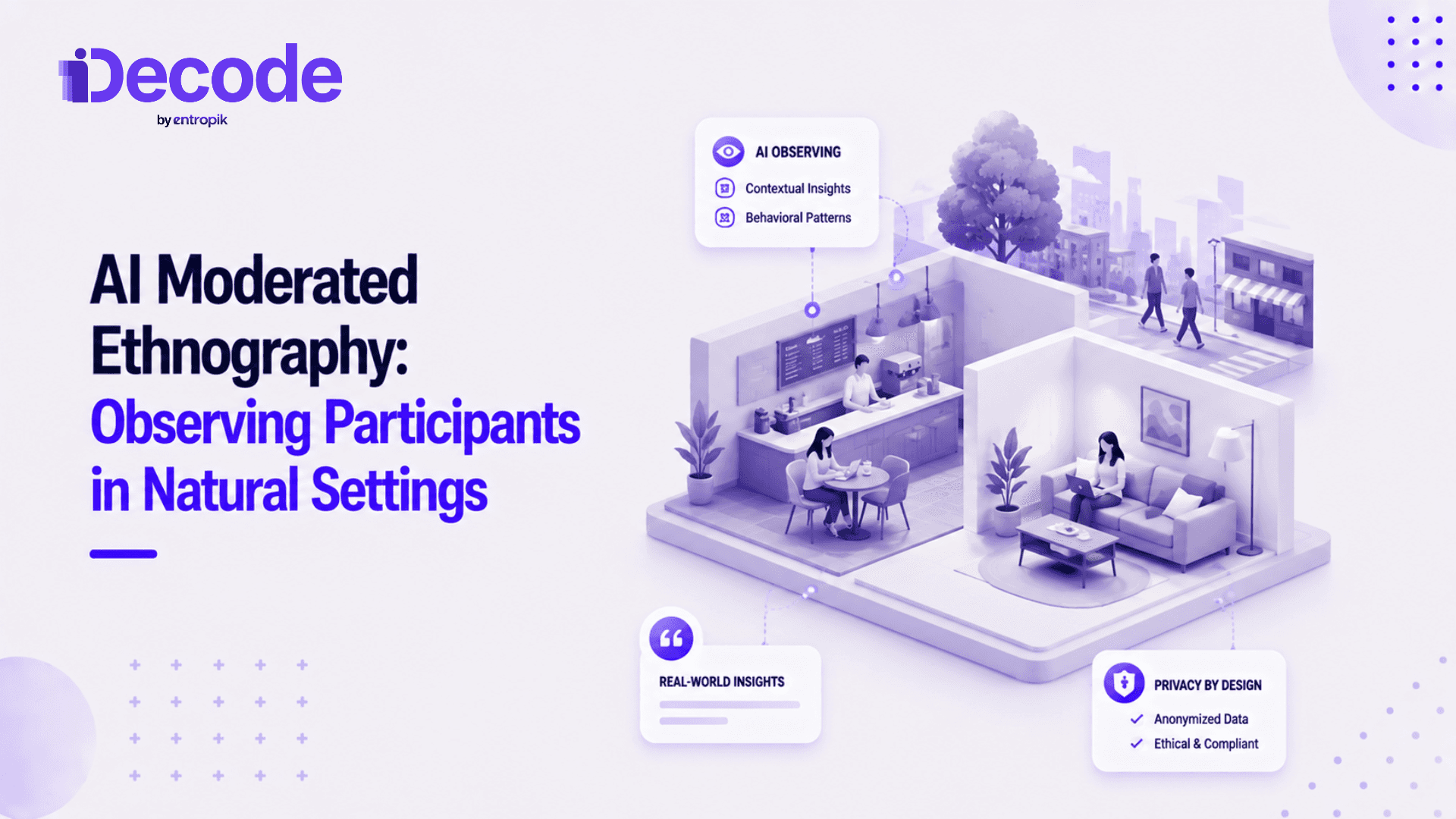
AI moderated ethnography is a contextual research method where participants capture their own behavior in natural settings, such as their home or a store, while an AI moderator asks adaptive follow-up questions in the moment and AI analyzes the video, audio, and images at scale. It aims to observe what people do in context, not only what they recall
Summary:
|
What is meant by AI moderated ethnography?
AI-mediated ethnography is a form of contextual research in which the participants record their own behaviour themselves, using video, photographs, or audio notes, within their own environment, while an AI moderator simultaneously asks questions and prompts them about what they have recorded in real time. It stems from the original purpose of ethnography, which is to understand behaviour and meaning in the situations where they naturally take place—for example, in a kitchen, in a car, or in a store aisle—rather than in an artificial setting that has been constructed for the sake of research.
The wedge that separates this from almost every other qualitative method is simple to state and easy to underestimate: it captures what people actually do in context, not only what they remember and choose to report afterward in an interview. That distinction sits at the center of the broader case for qualitative research methods generally, but ethnography pushes it further than most, since even a well-run interview still depends on a participant's memory of an event rather than the event itself. It also sits inside the wider discipline of user experience testing, which covers the full range of methods a team might reach for depending on what stage of a product or decision they are trying to inform.
How AI moderated ethnography works
The approach consists of three stages: the participants record instances in their everyday context, an AI moderator examines these recordings as they are received, and then AI analyzes the video, audio, and image data that results on a scale which no research team could possibly go through by hand. Contextual recording is just one of a number of methods that can be used in a contemporary moderated user testing procedure, the others being more structured interviews and usability sessions. It is only possible to carry out the first stage on a realistic scale because of the use of a smartphone. According to GSMA's Mobile Economy research, the number of unique mobile subscribers is approximately 70% of the world's population, meaning that the always-available recording device that this method relies on is already in the pockets of most people rather than having to be provided by the study. Since each finding can be traced back to a specific timestamped clip and quote, any theme mentioned in a summary report is no more than a click away from the actual moment it originated.
In-context capture by participants
Participants record real events as they occur by using video, photos, and audio in their own environment, thus capturing behaviour in the situation where it takes place rather than reconstructing it later in an interview setting. It is in this aspect that the method gains much of its credibility: when a participant films themselves cooking dinner, for example, they are able to show exactly which ingredient they substituted when they ran out of it, the shortcut they take without realising it, and the moment when they become frustrated with a package that is difficult to open. None of these details would be retained with the same accuracy if the behaviour were described from memory a week later. A substantial amount of research directly supports this concern. A peer-reviewed study that compared retrospective self-report with real-time experience sampling among 125 adolescents found only moderate agreement between the two methods, the correlations being in the range of 0.55 to 0.65, which means that even careful and well-intentioned participants significantly misremember their own recent behaviour. While it is helpful in general qualitative work to be aware of the cognitive biases that enter into any recalled account, in-context capture avoids the problem at its root rather than attempting to compensate for it afterwards.
AI moderated probing in the moment
An AI moderator poses adaptive follow-up questions depending on what the participant has just said or recorded, thereby turning a bare clip or note into an explanation of the behaviour instead of requiring the researcher to work it out later. The same inquisitive approach is applied in a consistent manner to all participants, and this consistency is more important than it may appear: in a study involving dozens or even hundreds of participants, such consistency is necessary if comparable results are to be obtained, just as the discipline that gives any well-conducted user interview value rather than making it amount to a loosely organised chat.
AI analysis of multimodal data at scale
The amount of unstructured video, image, audio, and text data that AI deals with enables it to generate tagged clips, identify detected themes, and carry out cross-cohort comparisons—something that a human team having to examine the footage clip by clip could never manage within a reasonable time period. It is precisely this kind of structured qualitative data analysis that allows hours of raw footage to be turned into something a researcher can actually use, and it is also what makes it possible to carry out larger and more diverse samples than had ever been possible with one-at-a-time fieldwork. All the output from such an analysis is of any use only if the team is able to find it again later, which is why a searchable research repository is just as important for ethnographic footage as it is for any other type of research.
AI moderated ethnography vs traditional ethnography
Traditional ethnography makes use of close human observation, takes detailed field notes, and depends on the cultural interpretation of a researcher who has spent a long time genuinely immersed in the environment. Advice given in academic circles usually states that contemporary applied fieldwork takes between several weeks and several months, while classical anthropological fieldwork lasts a year or longer, a duration which seldom matches the timeline of a business or marketing decision that is waiting for an answer. AI-assisted ethnography greatly enhances the collection of contextual information and considerably speeds up the analysis, thus overcoming the bottleneck in fieldwork that has prevented traditional ethnography from being widely used in commercial research.
Honesty matters here: AI augments contextual research, it does not replace the embodied presence and interpretive depth a skilled human ethnographer brings to a setting. A trained ethnographer notices things a camera does not think to point at, reads social dynamics a participant would never think to narrate, and builds the kind of trust that surfaces things a phone screen alone cannot. The gap this method closes is speed and scale, not the ceiling on interpretive depth that comes with years of embedded fieldwork. The same trade-off already shapes how teams think about diary studies relative to a single moderated session: more ground cWhen applied properly, this method eliminates actual gaps that stated-preference research always fails to address. A study by the Harvard Business Review into sustainability purchasing revealed that 65% of consumers stated they wanted to buy from brands with a purpose, but only about 26% actually did so, resulting in a nearly 40-point difference between what people say and what they do. It is a straightforward approach to narrowing that gap rather than attempting to predict it through a survey question. direct way to close that gap, rather than relying on a survey question to predict it.
The approach is able to be applied to a larger number of participants and markets without losing the contextual depth that it has, a situation which would demand a corresponding increase in the number of trained fieldworkers if the traditional method had been used, and this is part of the same wider trend discussed in the article 'Why DIY is the future of user research', in which teams are increasingly carrying out more of their own research rather than outsourcing all their studies to a fieldwork agency. It also provides results more quickly than traditional multi-session fieldwork since capture, probing and analysis take place in parallel rather than in a strict sequence. This speed becomes all the more important as automation becomes standard across research operations as a whole: Gartner's survey of marketing technology leaders showed that adoption of AI agents is now widespread, with 81% of them either piloting or having fully implemented such tools, indicating that automation-supported contextual research is arriving at the same time as automation is being introduced elsewhere in the research process. The same reasoning that explains how remote usability testing has replaced the entirely in-person approach applies in this case too: achieving greater reach and scale without sacrificing the element that made the original method so valuable. Therefore, teams evaluating user experience testing platforms for this type of work should consider the level of contextual capture when assessing them together with the more conventional usability features.
Common use cases for AI moderated ethnography
Daily routines suit the approach perfectly since activities in the morning such as carrying out rituals, preparing meals, and commuting tend to be difficult to describe accurately afterwards but easy to record as they take place. The experience of shopping also lends itself well to this method, as it involves both making decisions in stores and browsing online in a way that is closely linked to wider efforts in the area of shopper insights, since the exact moment a decision is made at a shelf or at a checkout page almost never survives being retold accurately a few days later. The other strong applications include the real-time use of products within the home, the consumption of media, and caregiving, all of which are situations in which the environment itself is an integral part of the findings and not merely the setting for them. Another approach that is related but different is in-home product testing, which is based on the same fundamental idea of observing use in the actual environment rather than in a laboratory.
Limitations and ethical considerations
AI is incapable of grasping cultural nuance or the contextual interpretation that an experienced ethnographer provides in a given situation; while a camera can record events, it doesn't understand in the same way as a trained human observer what a gesture, a pause, or an unspoken social rule signifies. The decision of when a research question should make use of AI moderation rather than a more conventional approach is one that requires serious consideration rather than relying on a one-size-fits-all solution, and it is important to take a step back and consider at an elementary level whether the research question calls for quantitative or qualitative methods before concluding that ethnography is the appropriate research method to use.
The need to consider real privacy concerns and informed consent in situations where recordings are made at home in natural settings goes beyond what is required for a study carried out in a laboratory setting; this includes people who are in the scene but who never agreed to take part, for example, a family member walking through a kitchen while a cooking demonstration is being given. There is a clear boundary that should be stated: in the case of sensitive, distressing or vulnerable populations, the process should be overseen by trained human professionals, not by AI, even if using AI to moderate the recording might otherwise be more beneficial for a less sensitive subject.
Capturing behavior and emotion in context with Decode
The AI Moderator used by Decode carries out contextual, real-time research, incorporating adaptive probing and the measurement of behaviour alongside the data that participants provide. In studies that involve the collection of video and audio responses, facial coding is able to detect emotion with over 90% accuracy for 62 different facial expressions and with 96% accuracy in eye tracking, thus adding a behavioural signal component that cannot be obtained from a transcript or a simple written field note alone. Given that such a signal is important for activities like consumer journey mapping, where a person's immediate reaction often tells a different story from what they say about it later, Decode enables this type of contextual research across more than 70 languages and is employed by over 150 global brands in studies where it is the behaviour observed in the context that actually matters, not the preferences that are stated.
Frequently Asked Questions
1. So what is AI moderated ethnography?
It is a form of contextual research in which the participants record their own behaviour in natural environments and an AI moderator then asks adaptive follow-up questions at that time, the AI analysing the video, audio, and image data that results on a large scale.
2. What is the difference between AI moderated ethnography and traditional ethnography?
Traditional ethnography involves carrying out immersive human observation over a period of weeks or months. AI moderated ethnography enables greater scaling of contextual capture and accelerates the analysis, but it enhances rather than takes the place of the interpretive depth of a skilled human ethnographer.
3. Can AI take the place of an ethnographer?
No it can't. Although AI is capable of scaling up the processes of data collection, questioning, and analysis, it is unable to match the cultural interpretation based on context and the physical presence that a qualified ethnographer has when in a real setting.
4. So what is mobile ethnography?
It is the practice of using a smartphone as the main tool for collecting data in ethnographic research, enabling the participants to record video, photos, and audio of their own behaviour wherever that behaviour occurs.
5. What kind of research questions are appropriate for AI-mediated ethnography?
For example, those concerning daily routines, shopping trips, the use of products around the home, media consumption, and other behaviours which are difficult to describe accurately from memory but which are easy to record when they occur.
6. How does AI-mediated ethnography reduce recall bias?
By getting the participants to record their behaviour as it happens rather than reconstructing it later from memory, thus avoiding the well-documented discrepancy between stated and actual behaviour.
7. What are the privacy considerations for in-home observation?
Informed consent needs to cover not just the participant but anyone else who might appear in frame, and naturalistic capture in a home setting raises privacy obligations that a lab-based study does not need to consider.
8. When should you use a human ethnographer instead of AI?
For studies requiring deep cultural interpretation, extended embedded fieldwork, or any sensitive, distressing, or vulnerable-population context that calls for trained human judgment and oversight.
Related Topics: