A diary study works by having participants log their behaviors, thoughts, and emotions over an extended period, typically through video, audio, or written entries, without a researcher present. This captures authentic, real-world experiences and context that are difficult to observe in a single interview or lab session.

Introduction
Diary studies represent one of the most powerful yet underutilized methods in qualitative user research. Unlike traditional usability tests or one-time interviews, diary studies capture authentic user experiences as they unfold in real-world contexts over days, weeks, or even months. They reveal not just what users do, but how they feel, why they make decisions, and how their perceptions evolve over time.
In an era where user experience teams are increasingly expected to move beyond surface-level insights, diary studies offer a path to deeper understanding. This comprehensive guide walks you through everything you need to know about diary studies - from fundamentals to advanced implementation.

What Are Diary Studies? Understanding the Fundamentals
A diary study is a qualitative research method in which participants self-report their interactions, emotions, and experiences over an extended period - typically days to months. Rather than relying on recall during a single interview session, participants document their behaviors and feelings as they happen in their natural environments, creating a longitudinal record of authentic user behavior.
The fundamental advantage of diary studies lies in their ability to capture behavior in context. Unlike lab-based usability testing, where artificially controlled environments never fully replicate real-world conditions, diary studies observe users in their actual environments, dealing with real interruptions, competing priorities, and the genuine emotional stakes that accompany everyday decision-making.
Consider this: when you ask someone in an interview to remember how they used a meal-delivery app last week, they rely on memory, which is inherently flawed and selective. But when that same person logs their experience immediately after using the app—capturing their frustration with navigation, their delight at a personalized recommendation, or their confusion about delivery fees—you get an unfiltered snapshot of their actual experience.
When to Use Diary Studies: Research Scenarios That Matter
Diary studies are particularly valuable for three research scenarios:
Broad Behavioral Questions: Understanding general activities, behaviors, and habits over time. Examples include how people use intelligent assistants in everyday life or what triggers fitness app engagement.
Targeted Product Usage: How users interact with a specific product and their comprehensive experience with it over time. This reveals the full customer journey from discovery through integration into daily routines.
Targeted Activities: Specific activities that unfold over time and involve multiple interactions, such as researching and purchasing a mobile phone or onboarding a new software tool.
Diary Studies vs. Other Methods
Dimension | Diary Studies | Interviews | Usability Tests | Surveys |
Data Collection Timing | In-the-moment, as experiences occur | Retrospective, based on memory | Artificial task environment | Single-point-in-time |
Recall Bias | Minimal | High | N/A | Medium-High |
Contextual Richness | Captures real-world environment | Limited to articulation | Lab environment only | No context |
Duration | Days to months | Single session | Single session | Single session |
Emotional Depth | Rich emotional evolution | Dependent on articulation | Task-focused only | Limited |
Cost | Moderate | Moderate to High | Moderate | Low |
Best For | Understanding behavior evolution | Understanding motivations | Identifying task friction | Validating themes |
Planning Your Diary Study: A Step-by-Step Framework
Phase 1: Define Clear Research Goals
Before designing your diary study, crystallize what you actually want to learn. "Understand how people use our app" is vague. "Identify barriers preventing users from completing daily workout logging and understand emotional triggers that increase logging frequency" is focused.
Write 3-5 specific research questions. For each, ask: Why is this important for our business? What specific insight would change our decisions?
Phase 2: Select Your Entry Method
How and when participants log data significantly impacts insight quality.
Event-Based Entry: Participants record when a specified event occurs—first time using a feature, completing a purchase, encountering an error. Best for capturing moment-specific emotions. Challenges include participant interpretation of what qualifies as an event.
Interval-Based Entry: Participants report at regular intervals (daily, every 3 days). Best for understanding routine behaviors. Provides consistent data across all participants but may feel repetitive.
Signal-Based Entry: Researchers send prompts at predetermined or random times. Best for capturing authentic in-the-moment experiences. Requires active platform engagement but minimizes anticipation bias.
Best Practice: Most sophisticated studies use hybrid tasking—combining all three methods. Event-based logging captures emotional highs (purchase completion), daily check-ins track routine usage, and signal-based prompts understand contextual factors.
Phase 3: Determine Study Length and Frequency
Study length depends on the behavior's natural cycle and how quickly saturation (pattern repetition) occurs.
Daily frequency behaviors (fitness apps, messaging): 1 week, 1-2 entries daily
Weekly frequency behaviors (meal delivery, shopping): 3-4 weeks, 1 entry per occurrence + daily check-ins
Complex decision journeys (phone purchase, software evaluation): 2-3 weeks, 3-4 entries per week
Habit formation: 4-8 weeks, daily entries
Critical rule: Studies longer than 4 weeks experience declining completion rates. Plan milestone-based incentives (bonuses at 1-week, 2-week marks) to maintain engagement.
Phase 4: Recruit and Select Participants
Participants should match your target behaviors exactly. A study about meal-delivery app usage needs participants who regularly use such services, not occasional takeout orderers.
Sample size recommendations depend on user heterogeneity and problem scope:
Homogeneous user group, small problem space: 5-12 participants
Moderately heterogeneous, medium scope: 12-25 participants
Highly heterogeneous, broad scope: 25-50+ participants
Plan to over-recruit by 20-30% because diary studies have higher dropout rates than other methods.
Phase 5: Select Your Data Collection Tools
Your tool selection determines data type, participant accessibility, and analysis efficiency.
Simple Text Tools (WhatsApp, Telegram): Familiar, low friction, but limited for rich media; manual organization required.
Survey Tools (Google Forms, Typeform): Structured, organized, but difficult for video/audio collection; largely manual analysis.
Specialized Diary Platforms (dScout, Looppanel, Recollective): Built for diary studies, rich media support, real-time probing, automated transcription. Higher cost but significant time savings.
Emotion AI Platforms (Entropik Decode): Complete solution combining video/voice/image collection with automated facial emotion analysis, voice emotion detection, transcription, and thematic analysis. Reduces analysis time by 40-60%.
Running Your Diary Study: Day-to-Day Management
Monitoring and Engagement
Monitor entries as they arrive. Read or watch responses within 24 hours, note emerging themes, and ask follow-up questions while memories are fresh.
Categorize participant engagement:
Highly engaged: Early submissions, detailed responses
Moderately engaged: On-time, adequate detail
Declining: Late submissions, shorter entries
At-risk: Missed entries, one-word responses
Intervene based on engagement level. Decline early: "Hi Sarah, we haven't received your entry for today. Is there anything preventing you from submitting?"
Real-Time Probing
One of diary studies' greatest strengths—impossible with traditional interviews—is the ability to probe while memories are fresh. "I noticed in your entry yesterday that you felt frustrated when you couldn't find the weekly stats. Can you tell me more about what specifically frustrated you?"
Managing Dropout
Expect 10-20% withdrawal during longer studies. Mitigate through:
Milestone-based incentives (pay after week 1, week 2)
Progress celebration ("You're 75% complete!")
Flexibility (pause rather than withdraw)
Researcher engagement (use names, show genuine interest)
Data Analysis: From Raw Entries to Actionable Insights
Phase 1: Entry Organization
Create a spreadsheet tracking:
Participant ID
Entry date and timestamp
Entry type (video, text, image, audio)
Length/duration
Topic
Completion quality
Phase 2: Individual Narrative Construction
Before looking for patterns across participants, understand each person's journey. Create a timeline showing initial impressions, friction points, habit formation, and emotional shifts over the study period.
Phase 3: Thematic Analysis
Manual approach: Create a codebook listing expected themes plus emerging ones. Code entries, count frequency, identify patterns, and note relationships.
AI-Powered approach: Emotion AI platforms automatically tag entries by theme, identify sentiment, and flag outliers. What might take 20-30 hours manually can be completed in 2-3 hours with greater consistency.
Phase 4: Insight Synthesis
Raw themes become insights only when synthesized into coherent stories.
From theme to insight:
Theme: "Participants reported frustration with finding features"
Insight: "50% of participants couldn't locate the weekly stats view within the first 3 uses. This represents a significant discoverability gap. Loss of discoverability occurs at day 2-3, suggesting time-sensitive onboarding opportunities."
Phase 5: Comparative Analysis
The richest insights come from understanding variation. Who had positive experiences and why? Whose behavior changed dramatically? Where did emotional trajectories diverge?
Advanced: Emotion AI and Behavioral Intelligence
Emotion AI reveals how people feel while saying something, not just what they say.
Facial Emotion Recognition: Analyzes expressions frame-by-frame, identifying joy, surprise, interest, confusion, frustration, disgust, fear, sadness, and anger with 95%+ accuracy. Participants often mask true feelings verbally; emotion AI catches subconscious expressions.
Voice Emotion Analysis: Analyzes tone, pace, modulation, and filler words. "The app is fine" spoken with a subtle frown and eye-rolling reveals frustration that transcripts miss.
Engagement Metrics: Word-per-minute (WPM), filler words (um, uh, like), and longest monologue duration all indicate engagement level and confidence.
Emotional Journey Mapping: Create detailed maps showing how emotions evolved across diary entries. For a fitness app, you might see joy declining from day 1-2 (88/100 → 58/100), frustration emerging (35/100), then stabilizing by day 8 (positive: 62/100, neutral: 35/100). This identifies critical intervention points.
Common Challenges and Solutions
Participant Dropout: Implement stricter screening, milestone incentives, flexible submission windows, researcher check-ins, and pause options. Emphasize requirements during recruitment: people with strong habits have higher completion rates.
Vague Responses: Use structured prompts with specific sections, show appreciation for quality, conduct targeted follow-ups, and consider paying more for high-quality entries.
Recall Bias: Use signal-based random prompts, collect video entries, encourage raw responses, minimize delay expectations, and use emotion AI to flag potential reconstructed narratives.
Analysis Overwhelm: Use AI-powered analysis platforms like Entropik Decode to automate transcription (saving 20+ hours), emotion tagging, and initial theme identification. Researchers focus on interpretation, not data processing.
How Entropik Decode Enhances Diary Studies
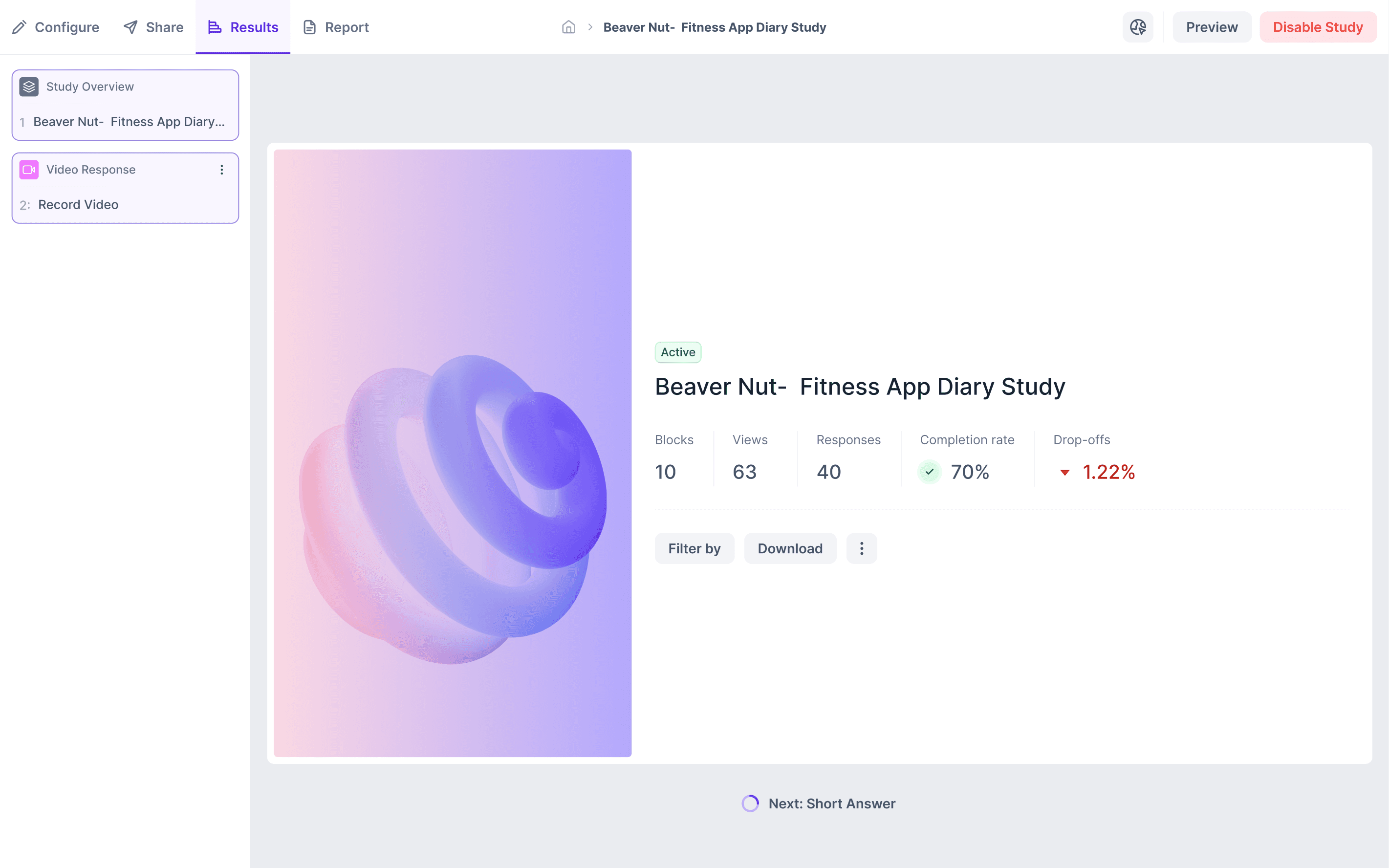
Entropik Decode is a unified research platform combining emotion AI, behavioral intelligence, and generative AI analysis into one system. Rather than cobbling together separate tools, researchers manage entire diary studies within a single platform.
Core Capabilities
Rich Media Collection: Participants submit video, voice, image, or text entries. Diversity of formats accommodates different preferences and capture styles.
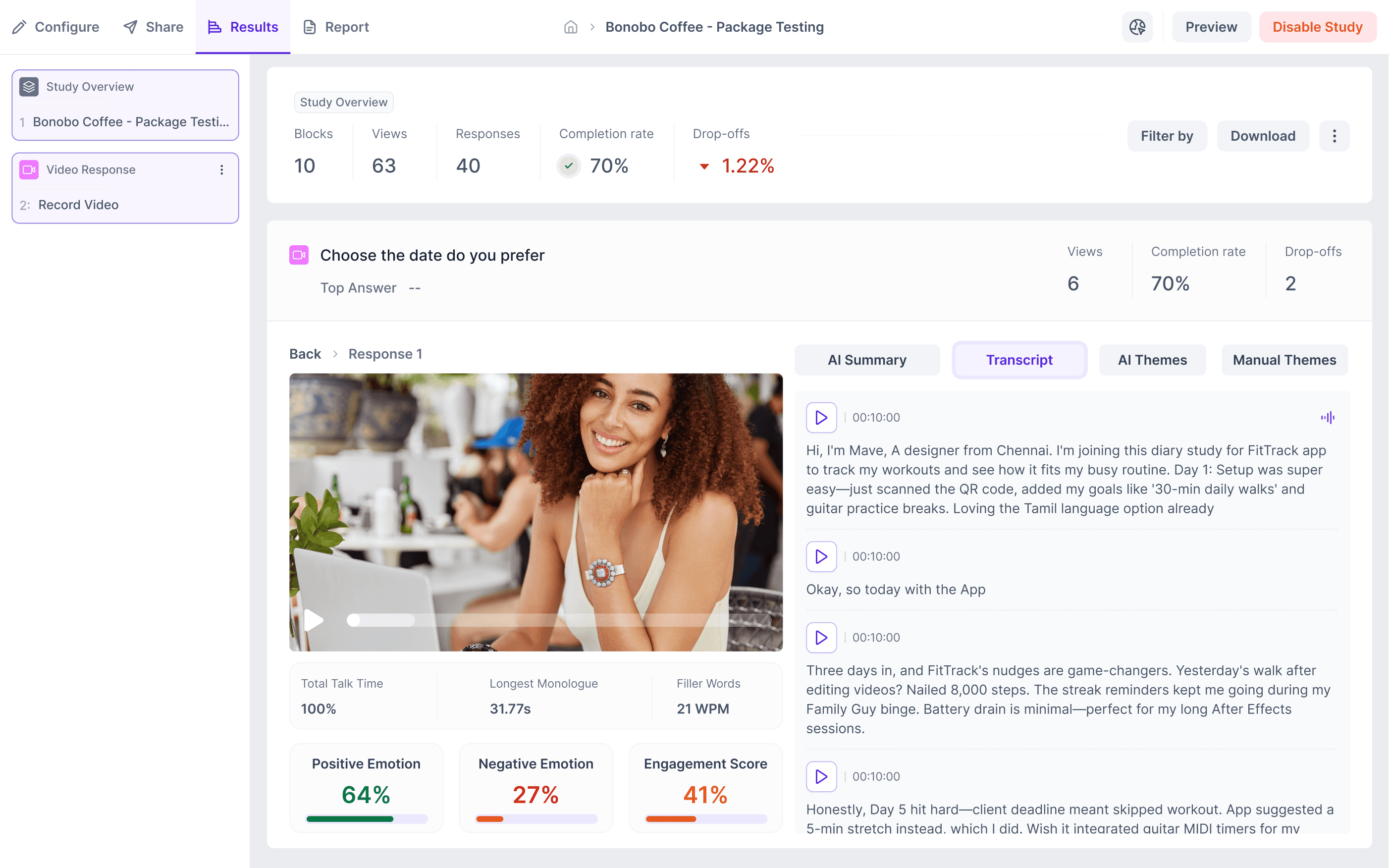
Automated Emotion Analysis: Every video entry is analyzed for 10 distinct emotions (happy, surprised, interested, neutral, confused, frustrated, disgusted, sad, fearful, angry) with intensity and frequency metrics. Voice entries analyze tone, pace, and confidence indicators.
Automatic Transcription: Multi-language transcription (27+ languages) with searchable transcripts linked to video timestamps. Speech metrics include WPM, filler words, and engagement scores.
Aggregated Emotion Metrics: Emotion summaries at study level showing overall positive/neutral/negative distribution. Longitudinal tracking reveals emotional timeline—when did sentiment shift? What might have caused it?
AI-Powered Thematic Analysis: Automated theme tagging with manual review layer. Frequency counting shows what percentage of participants mentioned each theme. AI generates summary insights with supporting evidence.
Unified Research Hub: Combine diary studies with surveys, interviews, and user testing in one platform. Map diary emotions to survey ratings; connect interview themes to diary data; validate findings with behavioral analytics.
Time Savings in Practice
Transcription: 30-50 hours → 0 hours (automated)
Manual emotion analysis: 20-40 hours → 0 hours (automated)
Theme tagging: 15-30 hours → 2-5 hours (AI-assisted)
Report generation: 10-20 hours → 2-5 hours (AI drafts)
Total: 40-60% reduction in analysis time, allowing researchers to focus on interpretation and strategic recommendations.
Real-World Example
A fitness app company conducts a 2-week diary study with 15 users to understand why engagement drops after initial excitement.
Day 1-2: Emotion dashboard shows 85% positive emotion; joy and interest prominent.
Day 3: Sentiment shifts; frustration appears in 7 entries (47%); confusion in 5 entries (33%).
Day 4-5: Frustration peaks at 45% of entries; neutral emotion becomes dominant.
Day 6+: Emotion stabilizes but remains lower than day 1-2.
Automated Finding: "Critical engagement cliff occurs between day 3-5. Emotion analysis shows 40% decline in positive sentiment correlating with entries mentioning 'having to remember to log' and 'complicated interface for quick logging.' This suggests onboarding doesn't address real barriers to sustained behavior."
Deeper Investigation: Filter entries with "frustrated" emotion tag during day 3-5. Watch videos where frustration spikes. Notice common moment: Users opening the app, getting distracted by metrics/social features, losing focus on original task (logging workout).
Validation: Check behavioral analytics. Do session duration and app abandonment match the day 3-5 emotion dip? Yes—average session time drops from 2.3 minutes (day 1-2) to 1.1 minutes (day 3-5).
Recommendation: Redesign logging flow to minimize friction (1-tap logging option) and move social/metrics features behind secondary tab, allowing focus on core behavior first.
Best Practices for Diary Study Success
1. Start with a Pilot Study: Test prompts, tools, and processes with 2-3 pilot participants before launching the full study. Adjust materials based on feedback.
2. Maintain Researcher Accessibility: Respond to questions within 24 hours. Use participant names; reference specific entries. This human connection increases commitment.
3. Design for Mobile First: Most entries happen on mobile. Optimize for one-handed submission with 2-5 minute maximum entry time.
4. Balance Structure with Flexibility: Provide clear prompts and required fields for consistency, but allow flexibility for natural expression and additional entries.
5. Compensate Appropriately: Follow the $40-50 per hour guideline. For 2 entries/day × 14 days × 5 minutes each = 140 minutes (2.3 hours) → Compensate $80-120. Include performance incentives for completion.
6. Conduct Rolling Analysis: Review entries daily, noting themes and probing for clarity. Consolidate weekly. This approach yields faster insights and allows course-correction.
7. Integrate with Other Methods: Combine diary studies with surveys to validate themes, interviews to explore specific insights, behavioral analytics to confirm findings, and usability testing on identified pain points.
Entropik vs. Traditional Diary Study Approaches
Aspect | Traditional Tools | Entropik Decode |
Data Collection | WhatsApp, Google Forms, separate tools | Unified native app with rich media support |
Transcription | Manual or external service ($500-2000+) | Automated, included |
Emotion Analysis | Manual review or generic sentiment tools | Built-in facial + voice emotion AI (95%+ accuracy) |
Thematic Tagging | Fully manual coding | AI-assisted with human review |
Emotion Tracking | Manual note-taking | Automated visual dashboards |
Time to Insights | 40-60 hours analysis | 15-20 hours analysis |
Multi-Method Integration | Multiple separate tools | One unified platform |
Researcher Probing | Email/separate messaging | Built-in contextual commenting |
Conclusion: Diary Studies in Modern Research
Diary studies represent a fundamental shift in how organizations understand user behavior. Rather than asking users what they think they do (surveys) or observing them in artificial conditions (labs), diary studies watch people interact with products in real life, over time, capturing both behaviors and emotions.
The introduction of emotion AI and behavior analysis tools like Entropik Decode transforms diary studies from labor-intensive research methods into scalable, systematic approaches to uncovering user truth. What once required 40+ research hours of manual analysis can now be completed in 15-20 hours, with greater consistency, reduced researcher bias, and richer emotional insights.
Key Takeaways
Diary studies excel at understanding behavior evolution over time. Use them when you need longitudinal insight, not snapshots.
Design carefully with clear prompts, appropriate participant selection, realistic commitments, and active monitoring. The difference between successful and failed studies is often engagement strategy.
Emotion is gold. Understanding not just what users do but how they feel doing it reveals the "why" behind behaviors. Facial expressions and voice tone often tell stories that words can't.
AI accelerates analysis without replacing judgment. Emotion AI and automated transcription eliminate grunt work, freeing researchers to focus on interpretation and strategic storytelling.
Combine methodologies. Diary studies are most powerful when triangulated with surveys, interviews, behavioral analytics, and usability testing.
Invest in tools that match your complexity. Whether WhatsApp or Entropik Decode, align selection with research complexity and team resources.
In an era where product teams have access to endless metrics but often miss the human story, diary studies offer a way to restore human understanding to user research. They're effort-intensive, yes. But the insights they surface—about how people actually behave, what actually frustrates them, and what actually delights them—are often worth far more than the effort invested.
With emotion AI platforms like Entropik making diary studies more feasible for time-constrained teams, the barrier to running sophisticated longitudinal research has never been lower. The organizations embracing this method will develop deeper customer empathy and more user-centered products than those relying solely on surveys and one-off testing.
Your users' stories are rich, complex, and deeply human. Diary studies are the method designed to capture that humanity at scale.
Resources
Recommended Reading:
Nielsen Norman Group: "Diary Studies: Understanding Long-Term User Behavior"
Looppanel: "A Complete Guide to Diary Studies in UX Research"
Indeemo: "How to Plan and Conduct a Diary Study Research Project"
Frequently asked questions
1. What is a diary study?
A diary study is a longitudinal research method where participants record their experiences, behaviors, and emotions over a set period, often via an app or written log, to capture real-world context.
2. What are the benefits of diary studies?
They capture authentic, in-the-moment behavior and emotion rather than relying on recall, revealing patterns and pain points that one-off interviews might miss.
3. How long should a diary study run?
Duration varies by research goal, but most diary studies run anywhere from a few days to several weeks, long enough to capture recurring behaviors or habits.
4. What are the challenges of running a diary study?
Common challenges include participant drop-off, inconsistent entry quality, and the time needed to analyze large volumes of qualitative data.
5. What tools are used to run a diary study?
Diary studies are commonly run through dedicated research apps, messaging platforms, or simple journaling tools that let participants log entries with text, photos, or voice notes.
Related Topic: