AI qualitative data analysis uses machine learning to automatically transcribe, tag, and cluster themes across interviews, focus groups, and open-ended survey responses, cutting down the manual work of coding raw conversations. It doesn't replace human interpretation, but it speeds up the mechanical parts of analysis so researchers can spend more time on meaning-making and recommendations.

Why Interview Data Often Becomes a Bottleneck
Qualitative interviews can produce some of the richest research data a team can get. They reveal motivations, hesitations, unmet needs, language patterns, emotional reactions, and decision context in ways surveys often cannot.
But collecting conversations is only half the job.
The real challenge begins after the interviews are done. Teams are left with transcripts, notes, recordings, observations, and open-ended responses that all need to be reviewed, coded, compared, and turned into something useful. That is where the process often slows down.
This is why AI qualitative data analysis is becoming more relevant. As teams use AI moderated interviews to collect more qualitative feedback at greater speed and scale, they also need a better way to analyze that growing volume of data and turn it into clear, actionable insight.
What Is AI Qualitative Data Analysis?
AI qualitative data analysis refers to the use of artificial intelligence to help researchers organize, review, code, summarize, and synthesize qualitative data more efficiently.
In traditional qualitative data analysis, researchers often work through transcripts manually. They read through interviews, identify themes, apply codes, compare responses, and build summaries by hand. That work is valuable, but it is also time-intensive and difficult to scale.
AI can support this process by helping teams:
review transcripts faster
group related responses into themes
support qualitative coding
identify repeated patterns across interviews
summarize large volumes of responses
speed up research synthesis
The goal is not to remove researchers from the process. It is to reduce manual friction so teams can move from raw conversation to usable insight faster.
Why Interview Analysis Becomes a Bottleneck
The more interviews a team runs, the more analysis work follows.
A single study can generate:
multiple transcripts
open-ended responses
moderator notes
follow-up observations
repeated themes across participants
contradictions that require interpretation
This is why interview analysis often becomes the slowest part of the workflow.
For teams doing user interview analysis, the problem is familiar. The conversations may be rich, but manually reviewing every response, spotting patterns, and turning that into a clear set of insights takes time. The same challenge shows up in customer interview analysis, where teams may have a lot of feedback but still struggle to turn it into a clear picture of what matters most.
Common bottlenecks include:
transcript overload
repeated manual review
inconsistent tagging or coding
slow theme clustering
delayed reporting
missed connections across interviews
When analysis is too slow, the value of the research is delayed. In some cases, teams gather great qualitative data but fail to act on it quickly enough.
How AI Helps Teams Analyze Qualitative Interviews Faster
This is where AI qualitative data analysis becomes useful.
AI can help researchers move through large volumes of interview data more efficiently by supporting several parts of the analysis workflow.
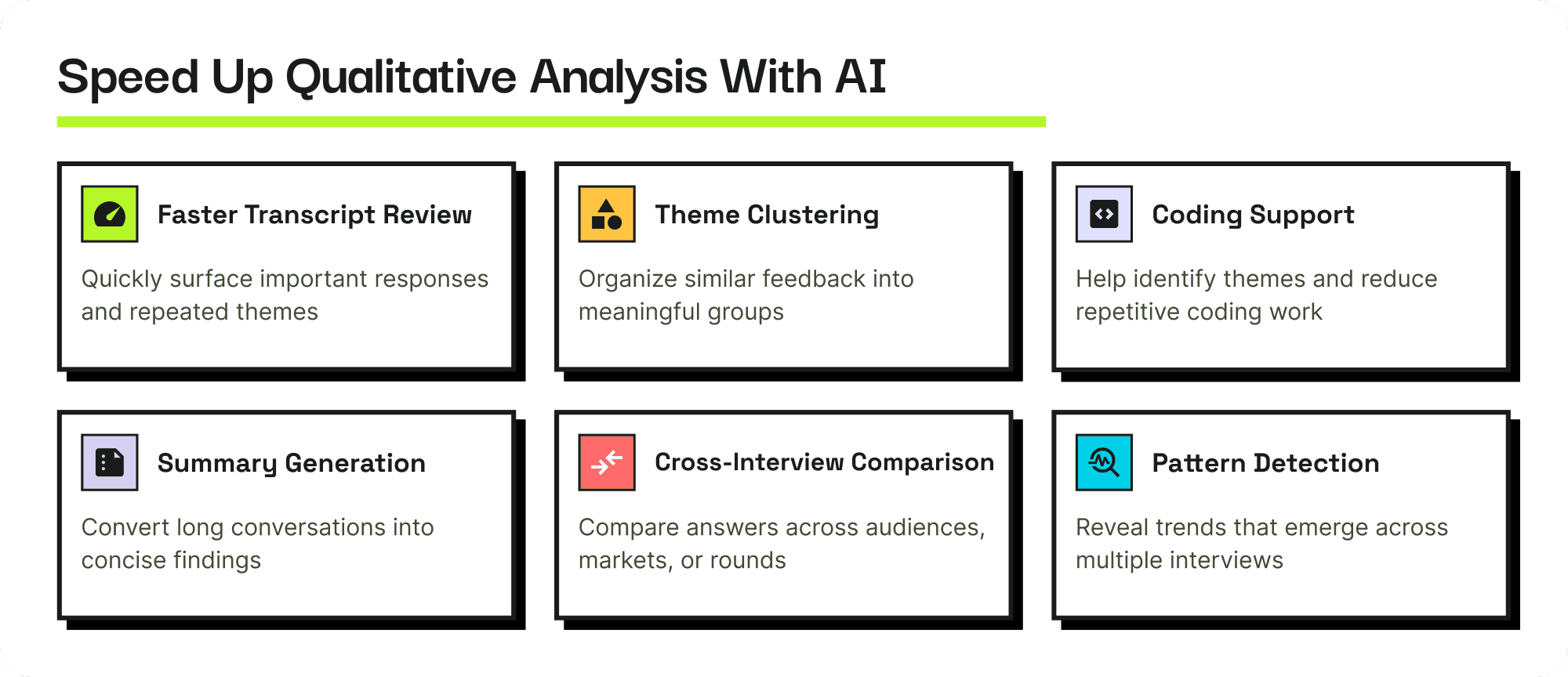
1. Faster transcript review
Instead of reading every transcript line by line from scratch, teams can use AI to surface key moments, repeated themes, and high-signal responses faster.
2. Theme clustering
AI can help group similar responses together, which makes it easier to spot recurring patterns across participants.
3. Coding support
One of the most time-consuming parts of analysis is applying and refining codes. AI can support both qualitative coding and qualitative data coding by helping researchers identify likely themes, cluster similar ideas, and reduce repetitive tagging work.
4. Summary generation
Researchers often need to move from dozens of responses to a few clear findings. AI can help summarize interview content in a way that makes the next stage of research synthesis easier.
5. Cross-interview comparison
AI can make it easier to compare responses across segments, geographies, user types, or interview rounds.
6. Pattern detection
Some signals are obvious. Others only emerge when teams compare multiple interviews together. AI can help surface patterns that might otherwise take longer to identify manually.
This is where qualitative analysis software becomes especially relevant. Teams are no longer only looking for a place to store transcripts. They need tools that help them move faster from raw conversation to structured understanding.
From AI Moderated Interviews to Insight
AI moderated interviews help teams collect open-ended qualitative feedback faster and at greater scale. That is useful, but it also creates a new operational challenge: more conversations mean more data to analyze.
Without a better analysis workflow, teams can still bottleneck after data collection.
A practical workflow looks like this:
Run AI moderated interviews to collect rich open-ended feedback
Review and structure the responses
Use AI to support coding, theme detection, and synthesis
Turn those patterns into insights the team can act on
This is especially important in user interview analysis, where teams often need to process many responses quickly without losing the meaning and nuance inside them.
The value of scaled qualitative research does not come from collecting more conversations alone. It comes from being able to interpret them in time to influence decisions.
What AI Can Do Well, and Where Human Judgment Still Matters
AI can make qualitative data analysis much more efficient, but it is not a substitute for researcher judgment.
AI is strong at:
speeding up review
identifying repeated themes
supporting coding
clustering responses
generating summaries
helping organize messy data
But researchers still matter for:
interpreting meaning in context
resolving ambiguity
challenging weak conclusions
deciding what is strategically important
connecting findings to business decisions
This matters because research synthesis is not just about summarizing what people said. It is about understanding what the patterns mean, which findings matter most, and what should happen next.
The best approach is not AI instead of researchers. It is AI supporting researchers.
How Teams Can Build a Better Qualitative Analysis Workflow
Teams usually do better when they treat analysis as a workflow, not a one-time cleanup step after research ends.
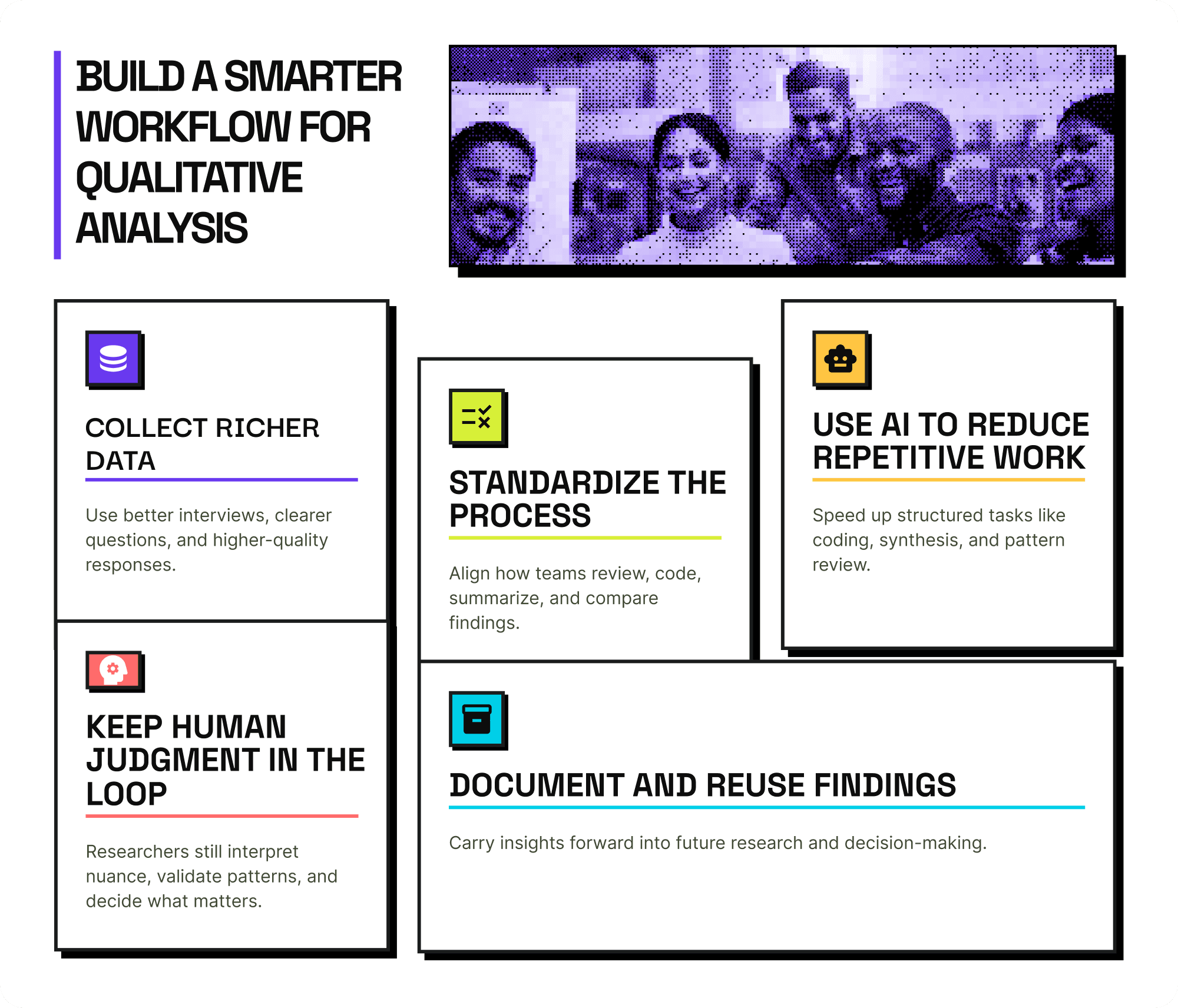
A stronger workflow often includes:
Collect richer data
The more useful the input, the stronger the analysis. That means better interviews, clearer questions, and higher-quality responses.
Standardize the analysis process
Teams should align on how they review, code, summarize, and compare responses across studies.
Use AI to reduce repetitive work
AI is especially helpful when the task is heavy on structure, repetition, and pattern review.
Keep human judgment in the loop
Teams still need researchers to interpret nuance, validate patterns, and decide what insights actually matter.
Document and reuse findings
Analysis becomes more useful when insights are not trapped inside one project. Teams should make it easier to carry findings forward into future research and decision-making.
This is also where qualitative research tools become more valuable. The best tools do not just hold data. They help teams move through the workflow more effectively.
How Decode by Entropik Helps
For teams using AI moderated interviews, Decode helps make the full workflow more practical, not just the data collection stage.
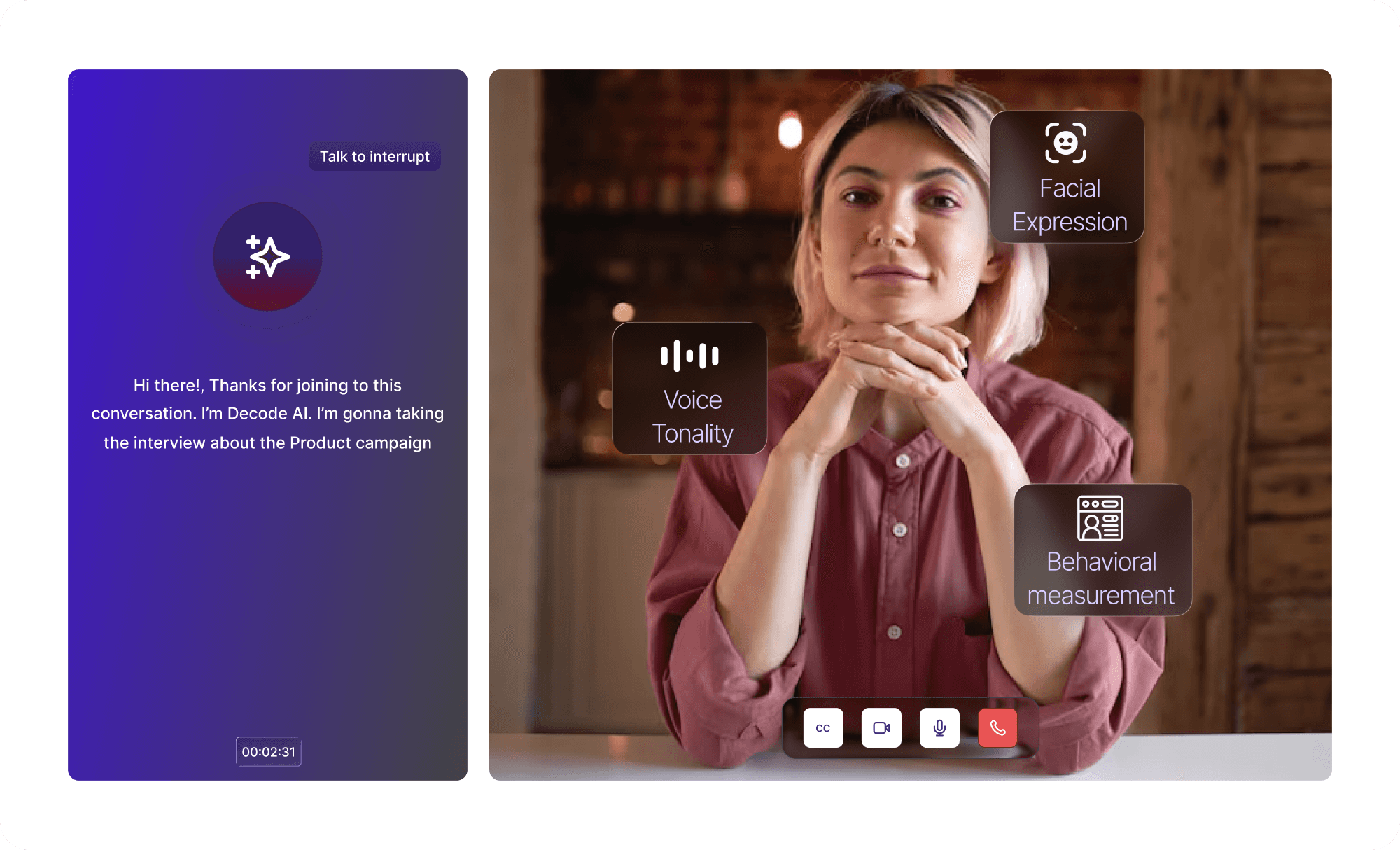
Decode AI Moderator can help teams:
run interviews at scale
collect richer open-ended responses
use adaptive questioning based on participant input
capture emotional and behavioral signals
support response analysis and insight compilation
get real-time insight generation as interviews progress
That matters because faster interview collection only creates value when teams can also analyze responses and compile insights efficiently.
Final Thoughts
Collecting conversations is only half the job.
The real value of qualitative research comes from analysis, interpretation, and action. As teams run more interviews and gather more open-ended feedback, that analysis step becomes harder to manage manually.
That is why AI qualitative data analysis matters. It helps teams move from transcripts, notes, and responses to patterns, themes, and insight faster.
When paired with AI moderated interviews, it makes large-scale qualitative research more practical, more efficient, and more usable for real decision-making.
The teams that do this well will not just collect more feedback. They will be better at turning conversation into insight.
Frequently asked questions
1. What is AI qualitative data analysis?
It's the use of AI to automatically transcribe, code, and identify themes and sentiment within qualitative data like interviews and open-ended survey responses.
2. How does AI speed up qualitative analysis?
AI can process large volumes of interview transcripts in minutes, automatically tagging themes and sentiment that would take a human analyst much longer to identify manually.
3. Is AI qualitative analysis as accurate as manual coding?
AI analysis is highly efficient and improving in accuracy, but is often best used alongside human review to validate nuanced or ambiguous themes.
4. What types of qualitative data can AI analyze?
AI can analyze interview transcripts, open-ended survey responses, chat logs, and even video or audio recordings for themes, sentiment, and emotion.
5. Does AI qualitative analysis eliminate the need for human researchers?
No, it significantly speeds up analysis, but human researchers remain important for validating nuanced findings and applying strategic judgment to results.
Related Topic: