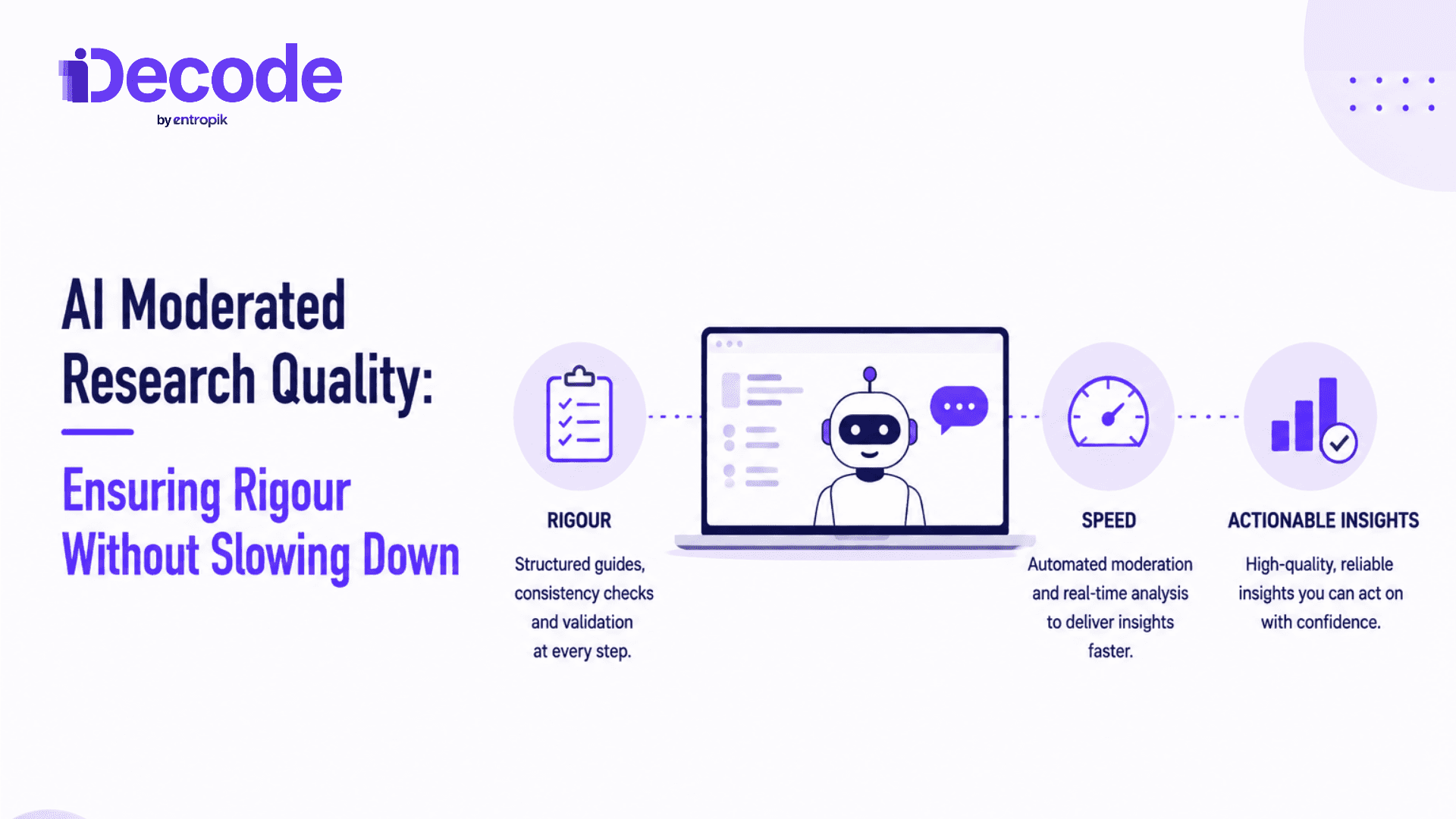
AI moderated research quality refers to how reliably an AI-led interview produces valid, defensible qualitative findings. It depends on consistent probing, engagement monitoring, bias controls, and human oversight of analysis. High quality means the data meets the same standards of validity, reliability, and interpretive depth expected of skilled human moderators, delivered at greater speed and scale.
Summary:
|
What is AI moderated research quality?
AI moderated research quality refers to how reliably an AI-led interview produces valid, defensible qualitative findings. It depends on consistent probing, engagement monitoring, bias controls, and human oversight of analysis. High quality means the data meets the same standards of validity, reliability, and interpretive depth expected of skilled human moderators, delivered at greater speed and scale.
This is a broader idea than it first sounds. Quality is not just about how many AI moderated interviews a team can complete or how clean the transcripts look. It spans the entire arc of a study: how the conversation is structured, how deeply the platform probes beyond a surface-level answer, and how carefully the resulting themes are interpreted afterward.
The researcher's role does not disappear in this process. Someone still has to set the standard for what "good" looks like, review the outputs, and decide whether a finding is strong enough to act on. An AI moderation guide for research teams can help set that standard early, before a program scales across markets.
Why quality is harder to guarantee at speed
Qualitative research has traditionally forced a choice between depth and scale. Researchers could either speak to a handful of people in rich, unhurried conversations, or survey thousands of people with structured, shallow questions. AI moderation exists precisely to remove that trade-off, but removing the trade-off does not automatically remove the risk.
One risk is treating qualitative interview data as if it were quantitative output. A transcript full of responses can look tidy and complete while hiding inconsistent depth of engagement across participants. Some respondents give thoughtful, considered answers. Others satisfice, offering the shortest response that will let them move to the next question. If that difference in engagement is not detected and flagged, it can quietly distort the findings, a gap in stated versus actual behaviour that shows up across research methods more broadly, not just in AI-moderated interviews.
This pressure is not unique to AI moderation. Recent industry research signals that pressure is widespread in modern research operations. Forrester's research on consumer insights teams has found that as organizations' need for speed escalates, so do the markers of what separates a successful insights team from an unsuccessful one, with breadth and focus both expected to hold up under that pressure rather than one being sacrificed for the other. AI moderation is often positioned as the answer to that pressure, but only if the speed it enables does not come at the cost of probing depth. Disengaged or satisficing participants, combined with shallow follow-up questions, are the two failure points most likely to undermine an otherwise well-designed study.
The dimensions of methodological rigour in AI research
Rigour is not a single quality score. It is a collection of related standards that researchers have used for decades to judge qualitative work: reliability, validity, credibility, transferability, dependability, and confirmability. Each of these applies just as directly to an AI-moderated study as it does to a traditionally moderated one, though the mechanics of achieving them look different.
Reliability asks whether the same study, run again, would produce comparable findings. Validity asks whether the study actually measured what it set out to measure. Credibility and confirmability ask whether an outside reviewer would trust the interpretation of the data. Transferability and dependability ask whether the findings hold up across contexts and over time.
The distinction worth holding onto is between surface consistency and genuine interpretive validity. A study can look highly consistent, every participant asked the same questions in the same order, and still fail to capture what actually matters to the audience being studied. Consistency is necessary. It is not sufficient on its own.
Reliability and consistency across interviews
One of the clearest advantages AI moderation brings to qualitative research is the removal of moderator drift. A human moderator, even a skilled one, will naturally vary their tone, phrasing, and follow-up questions across a long fieldwork period, especially during a demanding project. An AI moderator asks every participant with the same underlying logic, session after session, which improves reliability in a way that is difficult to match manually. This is one of the clearest advantages covered in how AI moderated interviews actually work.
That said, consistency alone does not guarantee that the discussion guide was asking the right questions in the first place. A perfectly reliable process built on a flawed line of inquiry will still produce flawed findings, just very consistently. This is why reliability has to be paired with validity, not treated as a substitute for it.
Validity and interpretive depth
Construct validity, in a conversational research context, is about whether the interview actually captures the underlying attitude, motivation, or behaviour it claims to measure. Interpretive validity goes a step further and asks whether the themes drawn from the conversation reflect what participants genuinely meant, rather than a convenient reading of the transcript.
This is where human review remains essential. AI can surface patterns across dozens or hundreds of interviews far faster than a human analyst working alone, but AI still lacks the contextual judgment to reliably distinguish a passing comment from a meaningful signal. Researchers working in UX contexts run into a related problem when they mistake correlation for causation, and the same discipline applies here: a pattern across transcripts is not automatically the reason behind it. A researcher reviewing AI-surfaced themes for interpretive depth protects the study from conclusions that look statistically tidy but miss the point participants were actually making.
Quality controls in AI moderated interviews
Strong AI moderation platforms build quality control directly into the interview process rather than treating it as a step that happens only after fieldwork closes. Real-time response monitoring can automatically flag participants who appear disengaged or who are giving low-effort, one-word answers, allowing the system or the researcher to intervene before the data becomes unusable.
Adaptive probing is the other core mechanism. Rather than moving through a static script, a well-built AI moderator adjusts its follow-up questions based on what a participant has just said, moving from surface-level attributes toward the underlying motivations behind them. This mirrors what a skilled human moderator does instinctively: notice an interesting thread and pull on it.
Consistency checks and audit trails round out the picture. Platforms that produce a clean, timestamped AI transcription of every session make it far easier to trace a theme back to the exact exchange that produced it, which matters when findings need to be defended to a client, a stakeholder, or an internal skeptic.
Some of the practical controls worth looking for include:
Real-time flagging of disengaged or satisficing participants
Adaptive, context-aware probing rather than a fixed script
Consistency checks across interviews and cohorts
Full audit trails connecting probes to responses
Guides that walk through AI moderator quality controls in more depth are worth reviewing before a study goes live, not after fieldwork has already started.
Keeping the human in the loop
None of this replaces the researcher. It changes where their time goes. AI accelerates first-pass analysis, condensing dozens of hours of interviews into a workable set of themes far faster than manual coding ever could. But accelerating first-pass analysis is not the same as replacing expert judgment.
Researchers need to stay actively involved in a few specific places: framing the research objective clearly enough that the AI moderator has something meaningful to probe toward, designing the initial set of probes, validating the themes that come out of the analysis, and interpreting what those themes mean for the business question at hand. The discipline behind building an effective research question still applies here. AI can execute a well-framed study brilliantly; it cannot write the brief for you. Skipping any of these steps trades depth for speed in a way that is difficult to notice until a decision made on the findings turns out to be wrong.
Documenting how AI was used in a given study also matters more than it might first appear. As governance expectations around AI in research mature, being able to show exactly where AI supported the process and where a human made the final call is becoming part of what makes a study defensible. This gap is not hypothetical. The 2026 GRIT Insights Practice Report points to an AI governance gap in the research industry and a shift toward aligning AI use with research rigour, which suggests that documentation and oversight are becoming as important to buyers as the underlying technology itself.
Keeping a human in the loop is not a concession to AI's limitations. It is what allows a research team to move faster with confidence, because someone is still accountable for the judgment calls a model cannot make on its own. Debates over AI moderator versus human moderator often frame this as an either-or choice, when in practice the strongest programs combine both.
How to evaluate AI moderation quality before you adopt
Choosing an AI moderation platform is easier with a structured checklist rather than a general impression of polish. Before adopting a platform, it is worth evaluating each of the following:
Probing depth: does the system move beyond surface answers, or does it ask a fixed list of questions regardless of what the participant says?
Engagement detection: can the platform identify disengaged or satisficing respondents while fieldwork is still live?
Language coverage: does quality hold up consistently across every market and language the study needs, not just the primary one? This matters more than it might seem, since multilingual research tends to expose weaknesses in probing logic that a single-language pilot never surfaces.
Bias handling: what steps does the platform take to identify and reduce bias introduced by the AI itself, not just bias in participant responses?
Analysis transparency: can a researcher trace a theme back to the specific responses that generated it?
Running a validation study against a known method, comparing AI-moderated results with a traditionally moderated study such as focus groups or in-depth interviews on the same topic, is one of the more reliable ways to see how a platform performs before committing to it at scale. It is also worth asking a vendor directly how they measure and report on quality internally. A vendor who can answer specifically, rather than in general terms, is usually one that has actually built quality controls into the product rather than bolting them on afterward.
Maintaining rigour across markets with Decode
Decode's AI moderated qualitative interviews are built around the idea that consistency and depth should not be competing goals. The platform conducts adaptive, probing interviews across more than 70 languages without introducing the moderator variability that naturally creeps into large, multi-market, human-moderated programs. The same underlying logic and quality standards apply whether a study is running in one market or twenty.
Behavioural signals add a further layer of quality on top of what participants say out loud. Decode's facial coding operates at more than 90% accuracy and its eye tracking at 96% accuracy, which means what a participant reports in an interview can be corroborated against how they actually reacted in the moment. This kind of cross-check is difficult to achieve with a stated-response interview alone.
That behavioural depth is backed by scale: Decode detects 62 distinct facial expressions, holds 17 patents in its measurement technology, and is used by more than 150 global brands. These are the kinds of credibility markers that matter when a research team needs to defend a methodology internally, not just present a finished report. Once fieldwork is done, findings still need a place to live; a reliable single source of truth for research data is what lets teams compare studies over time rather than starting from zero each time.
For teams evaluating platforms against the checklist above, comparisons of top ai moderation platforms are a useful starting point before narrowing to a shortlist.
Frequently Asked Questions
1. What is AI moderated research quality?
It is the degree to which an AI-led interview produces valid, reliable, and defensible findings, spanning consistent probing, engagement monitoring, bias controls, and human oversight of the resulting analysis.
2. Are AI moderated interviews as reliable as human-moderated ones?
AI moderation typically improves reliability by removing moderator drift, since every participant is asked with the same underlying logic. Validity still depends on well-designed probes and human review of the resulting themes, much as it does in human-moderated research.
3. How do you measure the quality of an AI moderated interview?
By assessing probing depth, participant engagement levels, consistency across sessions, and whether the resulting themes can be traced back to specific responses through an audit trail.
4. Does AI moderation reduce bias or introduce it?
It can do both. Removing moderator drift reduces one source of bias, but the AI system itself can introduce bias if it is not evaluated and monitored for how it phrases probes and interprets responses.
5. How does AI moderation maintain depth while increasing speed?
Through adaptive probing that follows up on what a participant actually says rather than working through a fixed script, combined with real-time monitoring that flags shallow or disengaged responses as they happen.
6. What quality controls should an AI moderation platform have?
Real-time engagement monitoring, adaptive probing, consistency checks across interviews, and a full audit trail connecting each probe to the response that triggered it.
7. When should you not use AI moderated research?
When a topic requires the kind of nuanced, in-the-moment human judgment that current systems cannot reliably replicate, or when a study has not yet been validated against a known method for the specific audience and market involved.
8. How much human oversight does AI moderated research still need?
Researchers should remain involved in framing the study, designing probes, validating themes, and interpreting findings. AI accelerates first-pass analysis but does not replace that judgment.
Related Topics: