AI moderated interviews support multilingual research by automatically transcribing and translating conversations across dozens of languages, letting teams run consistent, structured interviews in a participant's native language without needing bilingual researchers on staff for every market. This removes a major logistical barrier to global qualitative research, since teams no longer need to coordinate moderators or translators separately for each language they want to study.

Why Multilingual Research Is Valuable but Hard to Run Well
Multilingual research helps teams understand how people think, feel, and decide across different markets. It is often essential in international market research, especially when brands want to test concepts, understand customer needs, or compare behavior across regions.
But multilingual research is rarely simple.
The challenge is not only language. It is also coordination, consistency, cultural context, and the operational effort required to run interviews across multiple markets. A study that feels manageable in one language can become much more complex when teams need to recruit participants in different regions, run interviews across time zones, and compare findings across diverse contexts.
For many teams, the question is not whether multilingual qualitative research is useful. It is how to run it efficiently without losing quality or depth. This is where AI moderated interviews can become especially relevant. They can help teams scale multilingual research more effectively while reducing some of the operational strain that traditional cross-market workflows often create.
Why Multilingual Research Is Harder Than It Looks
A lot of teams underestimate how much work multilingual research actually involves.
On the surface, it may seem like a matter of translating the discussion guide and running interviews in a few more languages. In practice, it is much more complex than that. Good international market research depends on more than translation alone. It depends on whether the research design, interview flow, and interpretation still make sense across markets.
That is where cross cultural research becomes important.
A phrase that works in one country may sound unnatural or too direct in another. A question that performs well in one cultural context may produce flatter or less useful responses in another. Interview pacing, comfort with open-ended responses, attitudes toward authority, and willingness to express criticism can all vary by market.
So the challenge is not just collecting responses in multiple languages. It is making sure those responses are comparable, meaningful, and usable.
Where Traditional Multilingual Interview Workflows Break Down
Traditional qualitative research interviews can work well in a single market. But once teams expand across languages and regions, several problems start to appear.
Limited moderator availability across languages
Finding strong moderators in every relevant language and market can be difficult. Even when teams do find them, availability may vary and quality can be uneven.
Uneven interview consistency
Different moderators often bring different styles, probing patterns, and emphasis. In multilingual studies, that variation becomes even harder to manage because differences in moderation style can get confused with differences in participant behavior.
Scheduling complexity
Cross-market work often means multiple time zones, separate recruitment streams, and different coordination needs. What should be one study can quickly feel like several studies running at once.
Slower execution
Each added language or market increases the effort needed to recruit, schedule, moderate, translate, review, and compare findings. This slows turnaround and can delay decisions.
Higher operational cost
More moderators, more coordination, and more manual review make multilingual work more resource-intensive than many teams expect.
These are common issues in both customer research and international user research. The challenge is not just running more interviews. It is running them in a way that stays consistent and manageable across markets.
How AI Moderated Interviews Can Help in Multilingual Research
This is where AI moderated interviews can make a meaningful difference.
They do not remove the need for strong research design or thoughtful interpretation. But they can reduce many of the workflow problems that make multilingual research hard to scale.
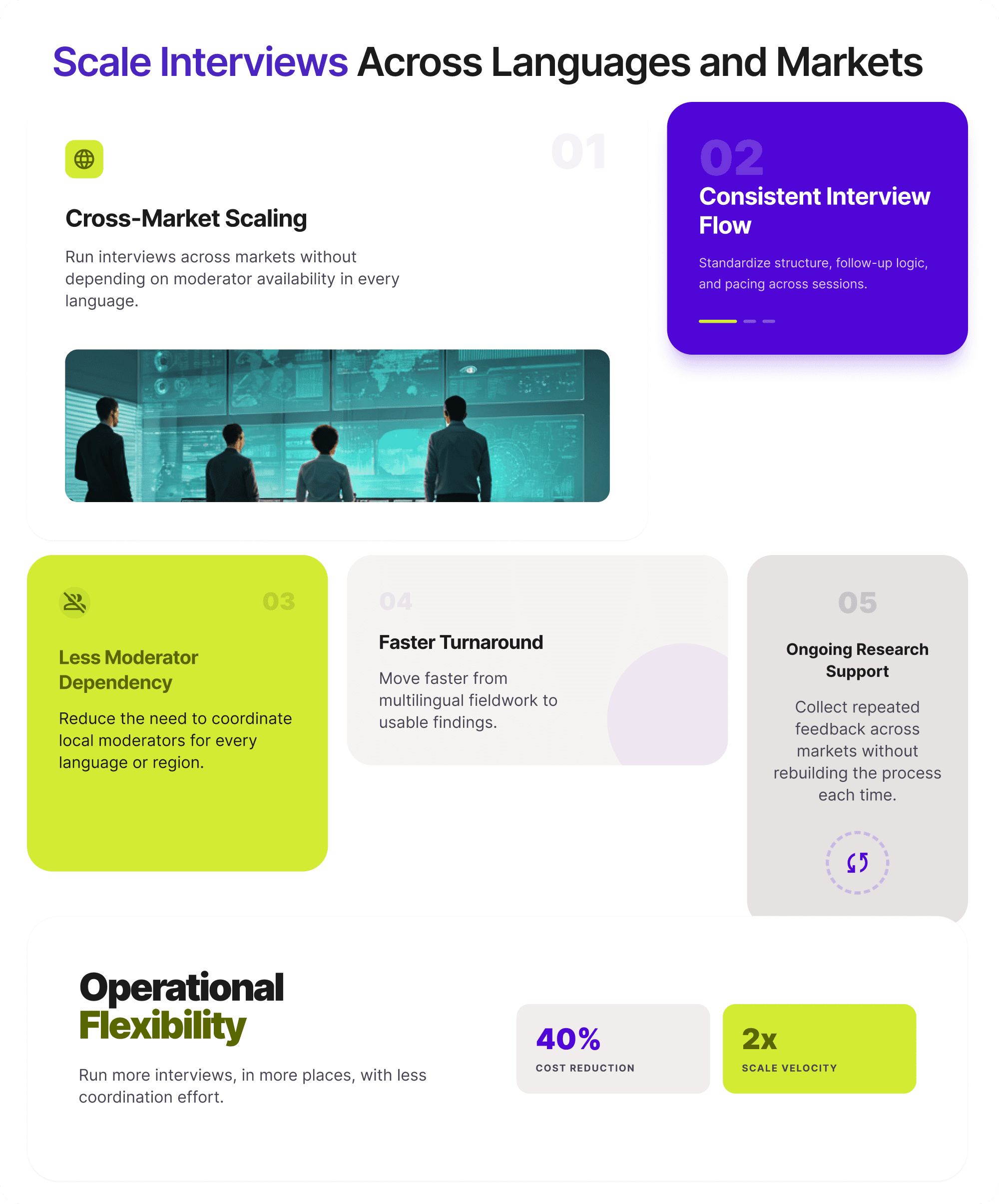
Easier cross-market scaling
AI can help teams run multilingual interviews across markets without depending on moderator availability in every language. That makes it easier to expand research reach without increasing operational load at the same rate.
More consistent interview flow
One of the biggest challenges in multilingual work is keeping the interview experience consistent enough to support comparison. AI moderation can help standardize the interview structure, follow-up logic, and pacing more effectively across sessions.
Reduced dependency on local moderator bandwidth
Traditional multilingual studies often depend on finding and coordinating local moderators. AI moderation reduces that dependency, which can make execution smoother for global teams.
Faster turnaround
Because AI can support interviews across time zones and languages without relying on manual scheduling in the same way, teams can often move faster from fieldwork to findings.
Stronger support for ongoing research
When teams want to collect repeated feedback across markets, manual moderation can become too heavy. This is where AI can support a more scalable workflow and fit naturally into a broader research automation strategy.
Better operational flexibility
In multilingual studies, one of the biggest advantages of AI is not just speed. It is the ability to run more interviews, in more places, with less operational friction. This is part of why conversational AI research is becoming more useful in international settings.
What AI Still Does Not Solve on Its Own
AI can help with scale, consistency, and execution. But it does not automatically solve the deeper challenges of multilingual research.
Good multilingual research is not just about conducting interviews in different languages. It is also about making sure the findings are interpreted correctly.
Even with AI moderation, teams still need to think carefully about:
Research design
Questions need to be built for comparability across markets, not just translated word for word.
Cultural sensitivity
A response that sounds neutral in one market may carry a very different meaning in another. This is why cross cultural research still requires human judgment.
Interpretation in context
Patterns across markets are rarely self-explanatory. Teams still need researchers to interpret what differences actually mean and which ones matter.
Synthesis across languages
Running interviews in multiple languages creates a richer dataset, but also a more complex one. Comparing and interpreting findings across those responses still requires careful thought.
So AI can improve how teams run multilingual qualitative research interviews, but it should not be treated as a substitute for strong cross-market research thinking.
Best Practices for Running Multilingual Research With AI Moderation
Teams usually get better results when they treat multilingual research as both an execution challenge and an interpretation challenge.
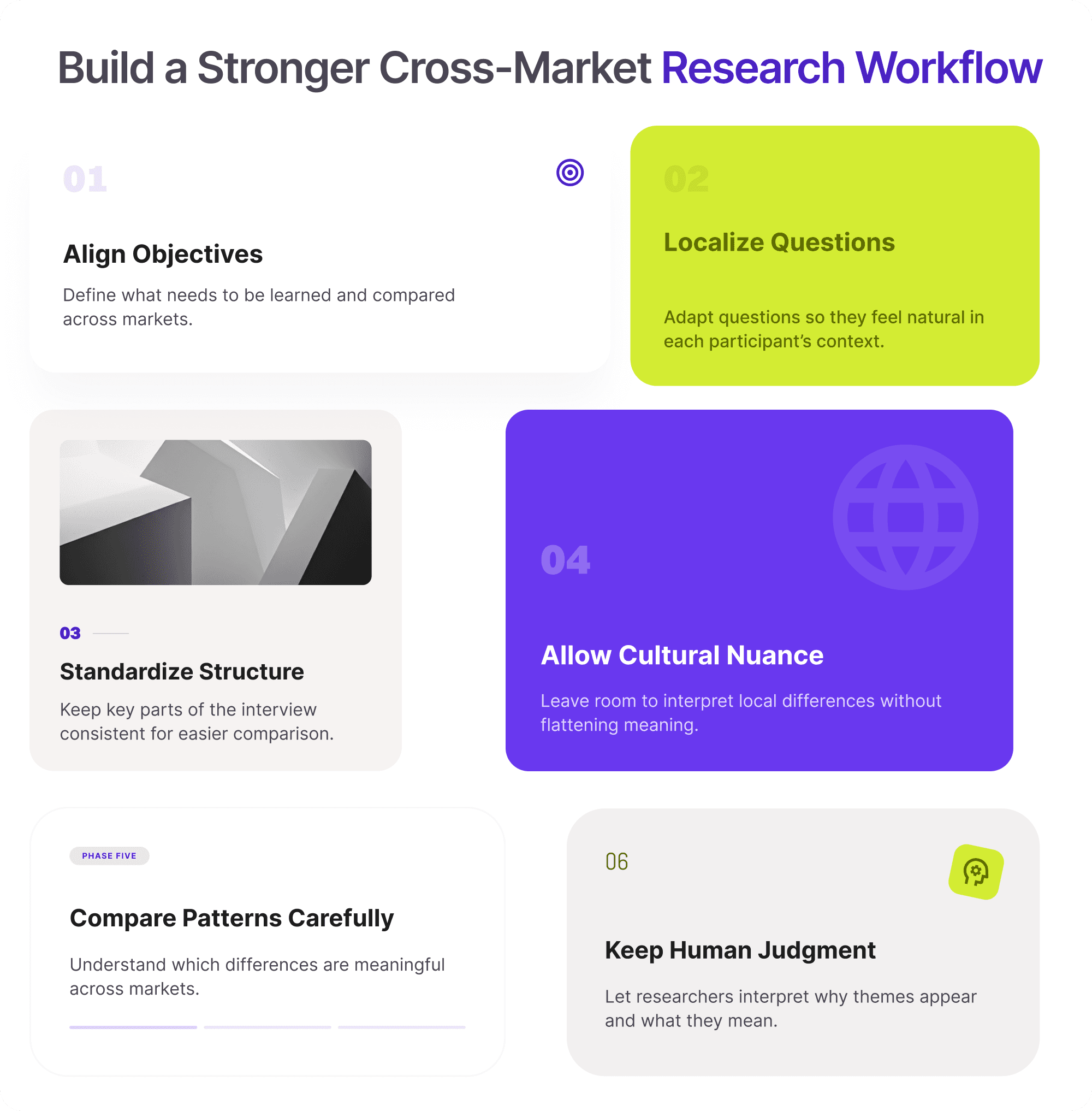
Align the research objective across markets
Before the study begins, teams should define exactly what they need to learn and what needs to stay comparable across markets.
Localize questions, not just language
Direct translation is often not enough. Questions should be adapted so they feel natural and make sense in the participant’s context.
Standardize what should remain consistent
Some parts of the interview should stay aligned across markets, especially when the goal is comparison. This is where AI moderation can help by keeping structure more consistent.
Allow for cultural nuance in analysis
Consistency in execution should not mean flattening real market differences. Teams need room to interpret local nuance carefully.
Compare patterns thoughtfully
Cross-market differences should be interpreted with care. Not every variation is equally meaningful, and not every similarity means the same thing in context.
Keep human judgment in the interpretation layer
AI can support scale and structure, but human researchers still play a critical role in understanding why certain themes appear and what they mean for the business.
When This Approach Makes the Most Sense
There are some situations where this method becomes especially useful.
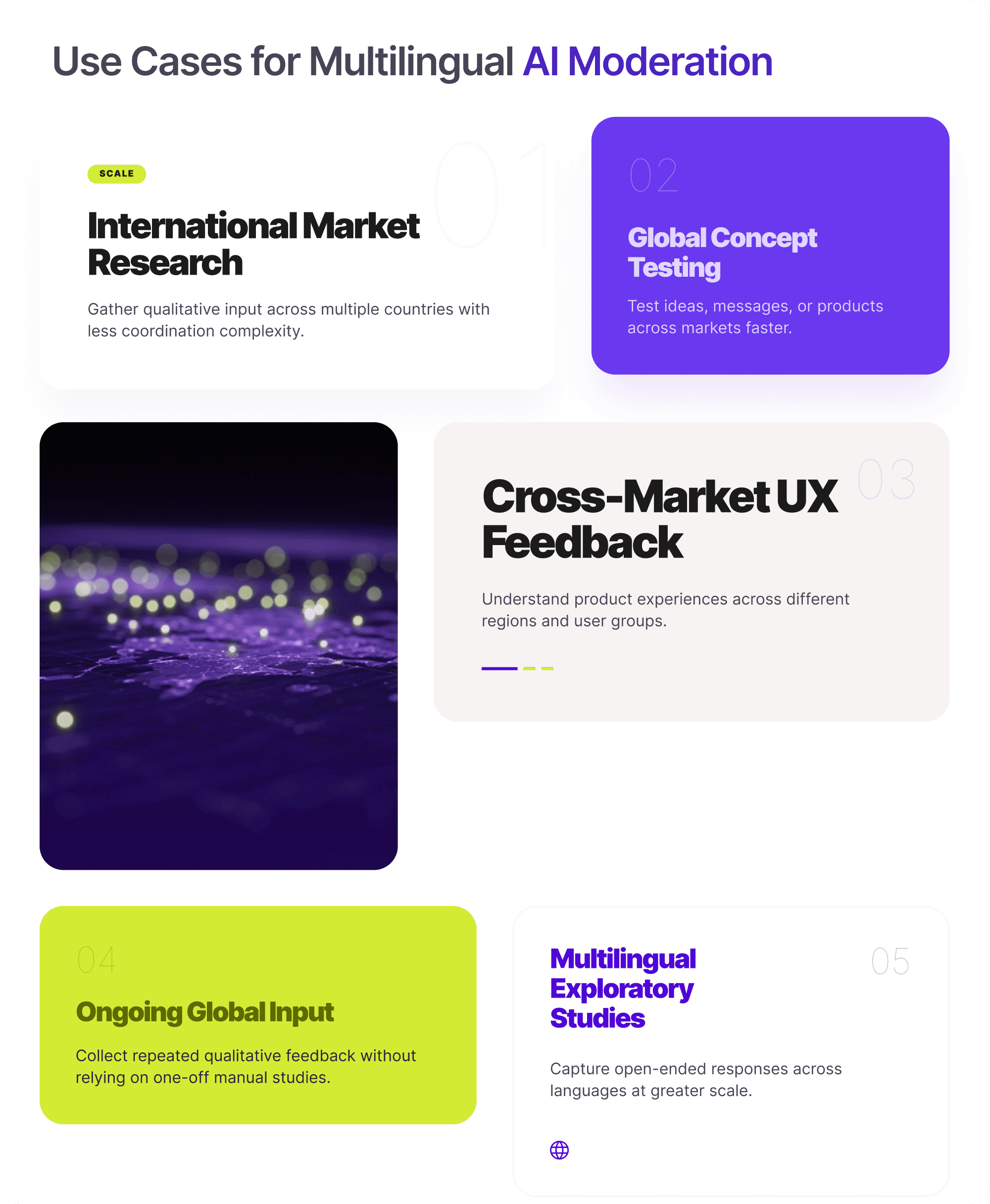
International market research
When teams need qualitative input across multiple countries, AI moderation can help reduce operational complexity and improve consistency.
Global concept testing
Testing messages, products, or ideas across markets often requires fast directional feedback. AI can help teams gather that input at scale.
Cross-market UX feedback
For product teams running research in more than one market, AI can make multilingual exploratory work more practical.
Ongoing global qualitative input
If teams want repeated feedback from different markets instead of one-off studies, AI moderation can support a more sustainable workflow.
Multilingual exploratory studies
When the goal is to gather rich open-ended responses across languages without building a fully manual process for every market, AI moderation can be a strong fit.
In all of these cases, the value comes from making international market research more scalable without losing the benefits of qualitative depth.
How Decode by Entropik Helps
For teams trying to run multilingual research more efficiently, Decode AI Moderator helps make that workflow more practical across markets.
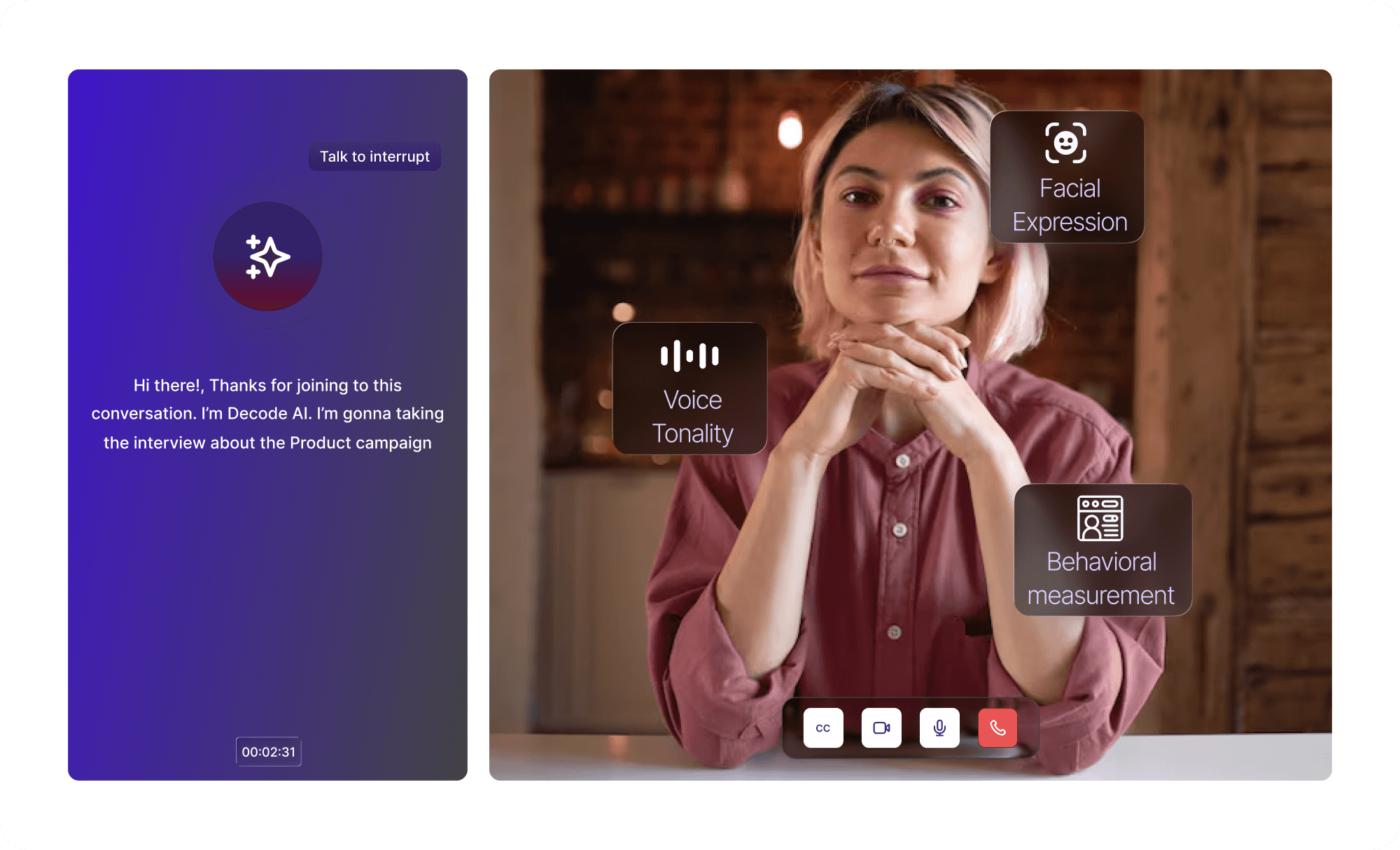
With Decode AI Moderator, teams can:
conduct interviews across 70+ languages automatically
use adaptive questioning based on participant responses
reduce human moderator bias and improve consistency across sessions
let participants complete interviews anytime, anywhere
capture emotional and behavioral signals alongside verbal feedback
get preliminary insights as interviews complete
support response analysis and reporting across interviews
That makes Decode AI Moderator useful for teams that want to scale multilingual qualitative research without turning it into a slow, fragmented, or overly manual process.
Final Thoughts
Multilingual research is a workflow challenge as much as a research challenge.
The difficulty is not only in asking questions across languages. It is in coordinating interviews, maintaining consistency, interpreting cultural nuance, and turning responses into usable insight across markets.
That is where AI moderated interviews can help.
They can make international market research more scalable, more consistent, and easier to manage operationally. But strong design, cultural sensitivity, and human interpretation still matter.
The teams that do this well will not just run more multilingual interviews. They will build better cross-market research workflows and make better use of the insight they collect.
Frequently asked questions
1. How do AI-moderated interviews support multilingual research?
AI moderation tools can conduct interviews in multiple languages using natural language processing, allowing consistent research across global markets without needing separate human moderators per language.
2. What are the benefits of AI-moderated multilingual research?
Benefits include faster scaling across markets, consistent question delivery, and reduced cost compared to hiring separate native-language moderators for each region.
3. What challenges exist in multilingual AI-moderated research?
Challenges include ensuring translation accuracy, cultural nuance in question wording, and maintaining consistent quality across different languages and dialects.
4. How can researchers ensure quality when running multilingual AI interviews?
Researchers should validate translations with native speakers, pilot test questions in each language, and review a sample of AI-moderated sessions for quality assurance.
5. Is AI-moderated multilingual research suitable for all research topics?
It works well for many standardized research topics, though highly nuanced or culturally sensitive topics may still benefit from human moderators fluent in the local language and context.
Related Topic: