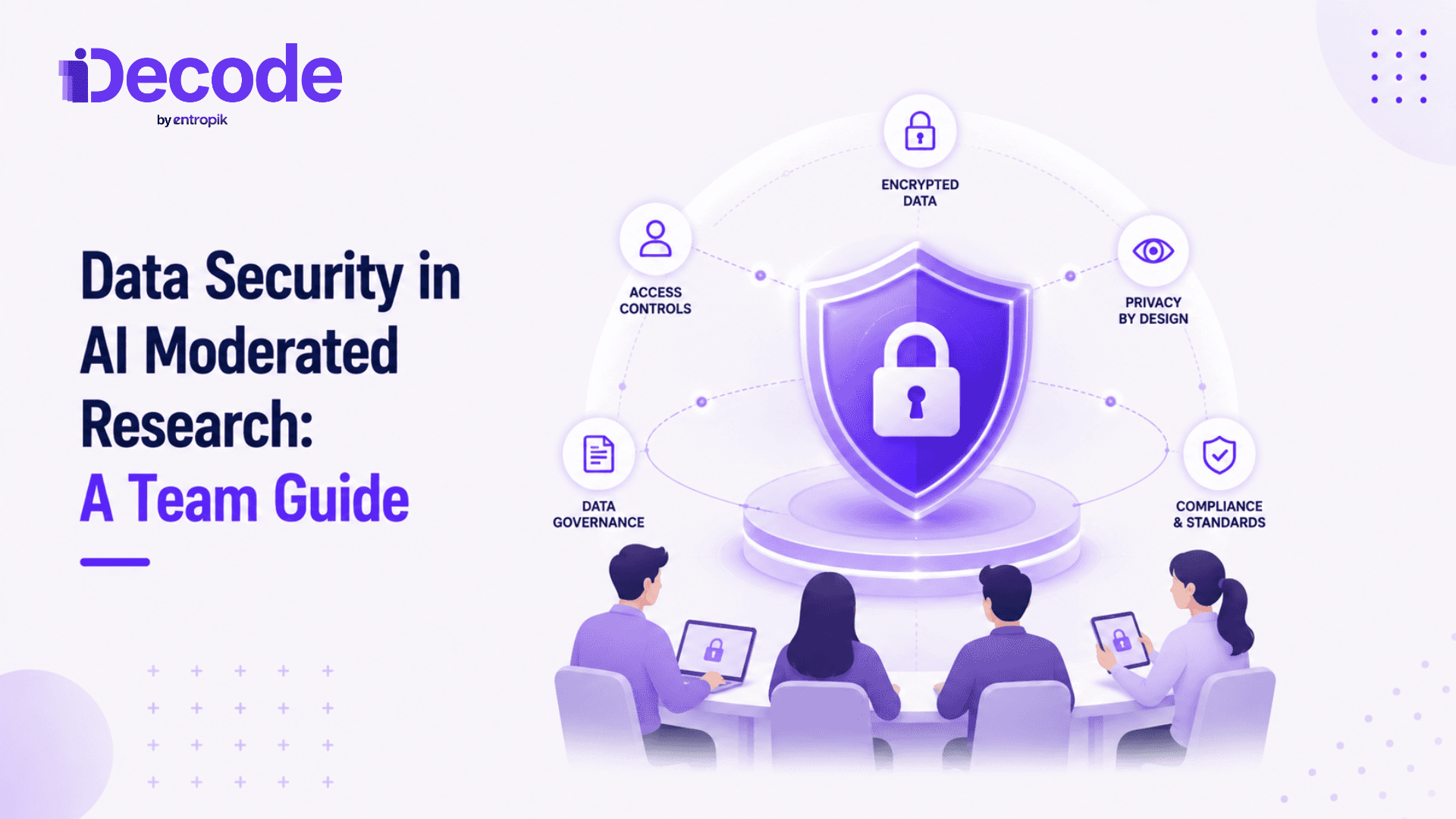
Data security in AI moderated research is the set of controls that protect participant data collected and processed during AI-moderated studies. It spans encryption in transit and at rest, access controls, consent and data minimization, and compliance with standards like SOC 2, ISO 27001, and GDPR. Strong controls keep sensitive interview data, PII, and behavioral signals protected across the research lifecycle.
Summary:
|
What Is Data Security in AI Moderated Research?
Data security in AI moderated research is the set of controls that protect participant data collected and processed during AI-moderated studies. It covers everything from the moment a participant joins a session to the point findings are archived or deleted, spanning collection, transcription, analysis, storage, and sharing.
AI moderation adds processing layers that a traditional survey never touches. An AI moderator generates and adapts questions in real time, a transcription engine converts audio into text, and an analysis layer extracts themes and emotional signals from that transcript. Each of these steps is a separate point where sensitive data is handled, which is worth understanding before evaluating any platform's security posture. A quick primer on what AI moderation actually is makes it easier to map each processing step to the safeguard that should protect it.
It is worth separating data security from two terms it often gets confused with. Security is about protecting data from unauthorized access, loss, or misuse. Privacy and compliance are about whether that data is being used lawfully and with proper consent. A platform can have strong technical security and still fall short on privacy if it is not transparent about how AI moderated interviews handle consent and data use. Teams evaluating a platform need to check both.
Why AI Moderated Research Carries Higher Security Stakes
Interview data is rarely just an opinion. A single AI moderated session can contain participant names, contact details, health or financial disclosures, unreleased product concepts, and competitive information a business would never want exposed. That combination of personal and commercially sensitive data is what makes research data attractive to attackers and expensive to lose.
AI moderation compounds this because it introduces more data types and more processors into the pipeline than a standard survey tool. Instead of a single set of structured responses, a research team now has raw audio, video, verbatim transcripts, and derived signals like facial expressions or vocal tone, each flowing through a different part of the system. Understanding how AI moderated interviews actually work end to end is what lets a security reviewer, not just a researcher, see exactly where each data type is created and where it needs to be protected.
This is precisely why so many promising research tools clear product evaluation with a research team, then stall the moment procurement loops in the security team. The average global cost of a data breach reached USD 4.44 million in IBM's 2025 Cost of a Data Breach Report, and the same report found that breaches involving unauthorized or ungoverned AI systems were both more common and more damaging than those involving traditional software. For a research function handling sensitive participant data, that risk profile is exactly why security review has become a required gate rather than a formality.
What Participant Data AI Moderated Research Collects
Before evaluating any safeguard, it helps to know exactly what is being protected. AI moderated studies typically collect several distinct categories of data.
Personally identifiable information (PII): names, email addresses, and any demographic or screening data collected during recruitment.
Audio and video recordings: the raw session capture, which often contains a participant's face, voice, and surroundings.
Transcripts and verbatims: the text output of the session, including direct quotes that may reference sensitive personal or professional details. Reliable AI transcription is the step that turns raw audio into this searchable, storable record, which makes its own security handling worth understanding on its own terms.
Behavioral and emotion signals: facial expression data, vocal tone, hesitation patterns, and attention metrics generated by the analysis layer.
That last category deserves its own attention. Behavioral and emotion data is inferred rather than stated, which makes it a distinct and sensitive class of information. A participant can choose what to say in a transcript, but facial coding and voice analysis capture signals they are not consciously controlling. Richer data types like this raise both the value of a study and the risk profile, since there is simply more sensitive material to protect if a breach occurs, which is also why improving data quality and reducing bias in that pipeline is as much a security concern as an analytical one.
Compliance Standards Teams Should Verify
Compliance is the baseline most procurement and security teams check first, before they ever look at technical architecture. It is worth remembering that no single certification covers everything. Security certifications, data protection regulations, and industry-specific rules are complementary, and a vendor that only points to one is not showing the full picture.
SOC 2 Type II
SOC 2 Type II is evidence that an organization's security controls were tested and operated effectively over a period of time, typically several months, rather than assessed once. This distinction matters because a point-in-time audit can miss operational gaps that only show up over time. SOC 2 covers how security operations are run day to day, but it does not establish lawful basis for processing personal data or define participants' data subject rights, which is where privacy regulation takes over.
ISO 27001
ISO 27001 is a certified information security management standard that evaluates how an organization identifies, manages, and reduces information security risk across its entire operation, not just a single product. For global and enterprise buyers, ISO 27001 alongside SOC 2 signals that security is built into organizational process, not bolted onto one platform feature.
GDPR and CCPA
GDPR and CCPA govern the lawful basis for collecting and processing personal data, consent requirements, and data subject rights such as access, correction, and deletion. For research teams working with US-based vendors and international participants, this also means checking for standard contractual clauses (SCCs) that govern cross-border data transfer, and understanding what data residency options exist if certain markets require data to stay within their borders. This matters most for teams running multilingual research across global markets, where a single study can touch several regulatory regimes at once.
HIPAA and Regulated Industries
Research that touches health, financial, or other regulated data carries obligations beyond standard security certifications. Healthcare-adjacent studies in particular may require documented safeguards under HIPAA or equivalent frameworks, and regulated buyers will often ask for evidence of these controls specifically, not just a general security overview.
Gartner has projected that by the end of 2024, 75% of the world's population would have its personal data covered under modern privacy regulations, up from just 10% in 2020. For research teams, that trajectory means compliance is no longer a concern limited to the EU or California. It is close to a global default, and a platform's ability to keep up with it matters as much as its features.
Core Technical Safeguards to Look For
Compliance certifications describe an organization's overall posture. Technical safeguards are what actually protect a specific study's data day to day, and teams should look for a specific set of controls.
Encryption and Access Controls
Encryption in transit and at rest is the baseline expectation for any platform handling recorded interviews, transcripts, or derived behavioral data. Alongside encryption, role-based access controls determine who inside an organization, whether a client team or a vendor's own staff, can view, edit, or export participant data. Without granular access controls, encryption alone cannot stop someone with the wrong level of access from seeing data they should not.
Data Retention, Deletion, and AI Training
Two questions matter here that are easy to overlook during a product demo. First, does the platform have defined retention periods, and can a specific participant's record be deleted individually rather than only as part of a bulk purge? Second, is there an explicit, documented confirmation that participant data is not used to train third-party AI models? This second point has become one of the most common questions in vendor security reviews, since it directly affects whether sensitive interview content could resurface in ways a participant never consented to. Teams that maintain a structured research repository tend to handle this more cleanly, since retention and deletion policies are far easier to apply consistently when studies are not scattered across disconnected tools.
Data Residency and Infrastructure
Where data is hosted, and whether an organization can choose or restrict that location, is increasingly a hard enterprise requirement rather than a nice-to-have, particularly for global brands running studies across regulated markets. This is also the point at which comparing an AI moderator to a traditional human-led process becomes relevant from a security lens, not just a research one, since centralized AI infrastructure is often easier to secure consistently than data scattered across individual moderators' devices and notes.
Participant Privacy and Consent in AI Moderated Sessions
Technical safeguards protect data once it exists. Consent practices determine whether collecting it was appropriate in the first place, and this is where participant trust has to be built into the session design itself, not treated as a formality before the study begins.
Participants should be told plainly that they are speaking with an AI moderator, and informed consent should be captured before recording starts, not buried in a terms-of-service link they are unlikely to read. Studies should also apply data minimization, meaning teams collect only the information a study actually needs rather than defaulting to capturing everything available because the technology makes it easy. Finally, anonymization or pseudonymization should be applied when storing and sharing findings, so that a stakeholder reviewing a summary report is not looking at data that could identify a specific participant unless there is a clear reason they need to.
Getting this right is not just a compliance exercise. It is also an ethical one. A responsible and ethical approach to research practices treats consent and transparency as part of good research design, not a separate legal checkbox, and teams that build this transparency into how sessions are run tend to see fewer participant drop-offs and more candid responses, since people are more forthcoming when they understand exactly what is happening with their data. That same transparency is part of what helps build user trust through AI-driven research in the first place.
An Enterprise Security Checklist for Evaluating Platforms
Security review moves faster when a research team arrives with the right questions already answered, ideally before a specific study makes it clear when AI moderated interviews are the right fit for a given project. A useful checklist covers three areas.
Documentation to request:
A signed data processing agreement (DPA)
A current list of sub-processors, since most platforms rely on third-party infrastructure and services
The specific transfer mechanism used for cross-border data, such as SCCs
Evidence to verify:
Current SOC 2 Type II and ISO 27001 certificates, not just a claim of compliance
Evidence of regular penetration testing
Availability of audit trails covering who accessed or exported participant data, and when
Traceability to confirm:
Whether individual insights can be traced back to their source responses, sometimes called data lineage, which matters both for quality assurance and for responding to a data subject access request. A single source of truth for research data makes this kind of traceability practical rather than a manual reconstruction exercise every time a stakeholder asks where a finding came from.
Security and privacy weigh heavily in how enterprise teams choose software in general, not just research tools. In a 2024 Gartner Digital Markets survey of software buyers, security certification and data privacy ranked as the top reason respondents selected a vendor, cited by 46% of buyers, ahead of most product-specific features. For research and insights teams, treating this checklist as a standard part of platform evaluation, rather than a final hurdle, is what keeps a promising pilot from being shelved at the finish line.
Running AI Moderated Research on Enterprise-Ready Infrastructure
Security review should not be the reason a research program stalls. It should be the reason a research program is trusted enough to scale.
Decode is built as an ai moderator qualitative interviews for exactly this kind of scrutiny. It has achieved SOC 2 Type II and ISO 27001 certifications, demonstrating operating discipline that enterprise procurement teams can verify rather than take on faith. Security features include end-to-end encryption, role-based access controls, comprehensive audit logging, and compliance with GDPR, the same categories of controls research and security teams should be checking for when comparing ai moderation platforms during procurement.
That infrastructure sits underneath a platform already trusted by more than 150 global brands and backed by 17 patents in the measurement technology behind it. Defensible data handling is not a separate conversation from defensible insights. They depend on each other, and building AI moderated research on infrastructure that can pass enterprise security review is what lets Decode by Entropik support studies that need to hold up to both a stakeholder audience and a compliance team.
Frequently Asked Questions
1. Is AI moderated research secure enough for enterprise use?
Yes, when the platform carries verifiable certifications such as SOC 2 Type II and ISO 27001, applies encryption and access controls consistently, and gives teams clear answers on data retention, deletion, and AI training exclusion.
2. What participant data does an AI moderator collect?
Typically PII from recruitment, audio and video recordings, transcripts and verbatims, and behavioral or emotion signals such as facial expressions and vocal tone captured during analysis.
3. Which compliance standards should an AI research platform meet?
At minimum, SOC 2 Type II and ISO 27001 for security operations, plus GDPR or CCPA compliance for lawful data use. Studies touching regulated data may require additional standards such as HIPAA.
4. What is the difference between SOC 2 and GDPR for research tools?
SOC 2 evidences that security controls are operating effectively over time. GDPR governs the lawful basis, consent, and individual rights around how personal data is collected and used. A platform needs both, since one does not substitute for the other.
5. Does AI moderated research use my participant data to train AI models?
This should never be assumed. Ask any vendor for an explicit, documented confirmation of whether participant data is excluded from third-party AI model training before running a study.
6. How is participant data protected during an AI moderated interview?
Through encryption in transit and at rest, role-based access controls limiting who can view or export data, and defined retention and deletion policies applied at the individual record level.
7. What should a security checklist for AI research vendors include?
A signed DPA, a current sub-processor list, the applicable data transfer mechanism, proof of SOC 2 Type II and ISO 27001 certification, evidence of penetration testing, audit trail access, and confirmation that insights can be traced back to source responses.
8. How do teams handle consent in AI moderated sessions?
By disclosing that an AI moderator is conducting the session, obtaining informed consent before recording begins, minimizing the data collected to what the study needs, and anonymizing or pseudonymizing findings when they are shared.
Related Topics:
Enterprise AI Moderated Research
Configure AI Moderator Sensitive Topics
AI Moderated Research For Financial Services
AI Moderated Research Data Quality
AI Moderated Research For Healthcare