A diary study with a research agent is a longitudinal study in which an AI agent drafts the task schedule, reviews each entry as it arrives, asks adaptive follow-up probes, flags thin or off-topic responses, and synthesizes findings wave by wave. Researchers set objectives, approve the protocol, and own interpretation, while the agent handles daily moderation and rolling analysis.
Summary:
|
Organizations are adopting AI quickly. Stanford's AI Index reports that 78% of organizations used AI in 2024, up from 55% the year before. Diary studies are an obvious candidate because they generate more material than any team can moderate by hand.
A diary study asks participants to record experiences over days or weeks. The hard part is the workload. Someone has to read every entry, ask follow-ups while the moment is fresh, chase quiet participants, and synthesize everything at the end. A research agent takes on that daily load. This guide walks through how it works across three phases, and where the researcher stays in charge.
What Is a Diary Study With a Research Agent?
A diary study with a research agent is a longitudinal study in which an AI agent drafts the task schedule, reviews each entry as it arrives, asks adaptive follow-up probes, flags thin or off-topic responses, and synthesizes findings wave by wave. Researchers set objectives, approve the protocol, and own interpretation, while the agent handles daily moderation and rolling analysis.
A diary study has participants log experiences in context over days or weeks. This reduces recall bias, because people capture events close to when they happen instead of reconstructing them in an interview later.
A research agent is an AI that works across the whole study lifecycle: design support, daily moderation, and rolling synthesis. That separates it from two simpler tools. Survey branching logic follows pre-written rules and cannot respond to what a participant actually said. A single-session moderator, which is what most AI moderated interviews are, runs one conversation and stops. An agent keeps memory across days, so a probe on day six can refer to what the participant said on day two.
Not every product labeled an agent earns the name. Gartner predicts that over 40% of agentic AI projects will be canceled by the end of 2027, citing escalating costs, unclear value, and weak risk controls. For research buyers, the lesson is to test claims against specific behaviors. Does the system remember earlier entries, escalate to a human, and show the evidence behind its summaries?
Traditional vs AI-Moderated Diary Studies
Dimension | Traditional diary study | Agent-run diary study |
Follow-up timing | Days later, if at all | Soon after each entry arrives |
Entry quality control | Reviewed in batches | Scored as each entry arrives |
Synthesis timing | After fieldwork ends | After each wave |
Researcher hours | Heavy daily moderation | Focused on review and judgment |
Multilingual scale | Limited by moderator languages | Automated transcription and translation |
The gap matters most for thin entries. If a participant writes "it was fine" on day four, a human moderator may notice on day six. By then the moment has passed and the detail is gone. In-session probing asks what made it fine while the memory is still available.
Compliance data shows why entry quality needs active control. In a BMJ study of 80 chronic pain patients, participants reported 90% compliance with paper diaries, but actual compliance was 11%, against 94% for an electronic diary. Self-reported diligence is not proof of diligence. Timestamped digital entries that an agent reviews on arrival make gaps visible while they can still be fixed.
When to Use a Research Agent for a Diary Study
An agent earns its place on sequence-dependent questions, where what happens on day five depends on what happened on day one. This is the core of longitudinal consumer research. Good fits include:
Onboarding and habit formation: how first-use friction turns into routine or abandonment.
Product trials and in-home use tests: reactions that change as novelty fades.
Purchase triggers and shopper journeys: the events that start a path to purchase across store and online.
Consumption occasions: when, where, and with whom a product gets used.
Patient and financial journeys: long decisions with emotional ups and downs, such as treatment adherence or a first loan application.
A traditional or human-moderated diary is the better fit in three cases. The first is unprompted, self-initiated logging, where participants write when they choose and no probing is wanted. The second is emotionally sensitive work, where a person's presence matters, although teams can configure an AI moderator for sensitive research topics with tight guardrails. The third is prevalence questions, because a survey answers "how many" better than any diary.
Phase 1: How the Agent Helps Design the Diary Study
In design, the agent drafts and the researcher approves. Given a brief, it proposes objectives, duration, cadence, sample, tasks, and probe rules. Nothing launches until a human signs off.
Translating Research Objectives Into a Diary Protocol
Each objective maps to four decisions: the behaviors to capture, the study length, the entry cadence, and the segments to compare. For a question like "why do new users stop using the app after week one," the agent might propose a two-week window, daily entries in the first week, and separate segments for users who kept going and users who lapsed.
Size duration and sample to the behavior cycle, not to habit. If the behavior is a weekly shop, you need at least two full shopping loops, so a seven-day diary captures one trip and cannot show change. For participants, qualitative diaries run on small, well-chosen samples, recruited above target to absorb dropout. Each segment still needs enough people to compare patterns rather than anecdotes.
Choosing Logging Protocols and Entry Formats
The agent recommends a logging protocol based on how often the behavior occurs:
Interval-contingent: entries at fixed times, such as every evening. This suits daily routines.
Signal-contingent: the agent prompts at set or random moments, as in experience sampling method (ESM) designs.
Event-contingent: participants log whenever a defined event happens. This suits behaviors that are rare or irregular.
Snippet technique: participants capture quick notes or photos in the moment and elaborate later, which suits behaviors where long entries are impractical.
Entry formats follow the behavior. Video and voice suit emotion and context, photos suit physical environments, screen recording suits digital tasks, and text suits quick notes. For a mobile diary study, video and audio response collection lets participants record entries on the phone they already carry.
Writing Tasks, Probe Rules and Guardrails
Tasks should be specific, neutral, and answerable in a few minutes. "Record what you did when you opened the app and what you expected" beats "tell us about your experience." The probe rules set the agent's boundaries: maximum probes per entry, neutral phrasing, off-limits topics, and the triggers that escalate a participant to a human.
Then run a pilot day with a handful of participants and read every entry and every probe. A pilot exposes confusing tasks and probes that lead. It is cheap to run a pilot study before launch compared with discovering the problem in week two.
Onboarding, Consent and Incentive Design
Tell participants plainly that an AI will moderate their entries. Consent should cover every wave and any re-contact for debrief interviews, so you do not have to renegotiate mid-study.
Incentives deserve equal care. A meta-analysis of 477 articles on repeated daily-life assessment found an average compliance of 79%, with higher compliance in studies that offered financial incentives. Structure payment as milestones, for example at the end of each week, so participants have a reason to stay once the novelty of logging wears off.
Phase 2: How the Agent Runs Daily Probing
Daily moderation is a loop. An entry arrives, the agent reviews it, probes, scores quality, and updates the participant's record. This is asynchronous moderation: participants answer at their own pace, but the agent responds soon after each entry lands.
Platforms built for AI moderated qualitative interviews extend the same logic from a single conversation to a multi-day record. Probing in the moment captures context that delayed human follow-up loses, such as the room, the mood, or what was on the shelf.
Reviewing Each Entry as It Arrives
The agent transcribes and translates video, voice, and text, and interprets photos and screen content to understand what happened. Multimodal entries are rich but heavy, so a transcript and short summary come first.
The agent also scores quality. Vague, off-topic, or low-effort entries are flagged, and the agent decides whether to probe, restate the task, or alert a researcher.
Adaptive Follow-Up Probes
Adaptive follow-up questions fall into a few types:
Clarifying: "What did you mean by 'confusing'?"
Context: "Where were you, and who else was there?"
Emotion: "How did that moment feel?"
Laddering: "Why did that matter to you?" repeated to reach the underlying value.
Contrast: "On day two you said the pack opened easily. Today it took effort. What changed?"
The contrast probe is where agent memory pays off, because it compares today's entry with the participant's earlier ones.
Cap probe depth, usually one or two per entry, to protect participant burden. Keep probes non-leading by asking "what happened next?" rather than "was that frustrating?" Leading wording is a major source of bias in AI-moderated research, so audit probe transcripts regularly.
Managing Engagement and Dropout
Dropout threatens every longitudinal study. The agent sends personalized reminders that reference the participant's own earlier entries. It detects disengagement patterns such as shortening entries or late submissions, and it flags backfilled entries, where several days are logged at once.
It should also know when to step aside. Hand a participant to a human researcher when they show distress, raise an off-limits topic, report a technical problem the agent cannot fix, or go silent after several reminders.
Adaptive Tasking Mid-Study
As patterns emerge, the agent can propose new tasks, such as asking everyone who mentioned a workaround to photograph it. The researcher approves each one before release. Keep core tasks constant across waves so results stay comparable. Scheduled tasking stays fixed, and adaptive tasking layers on top of it.
Phase 3: How the Agent Synthesizes Across Waves
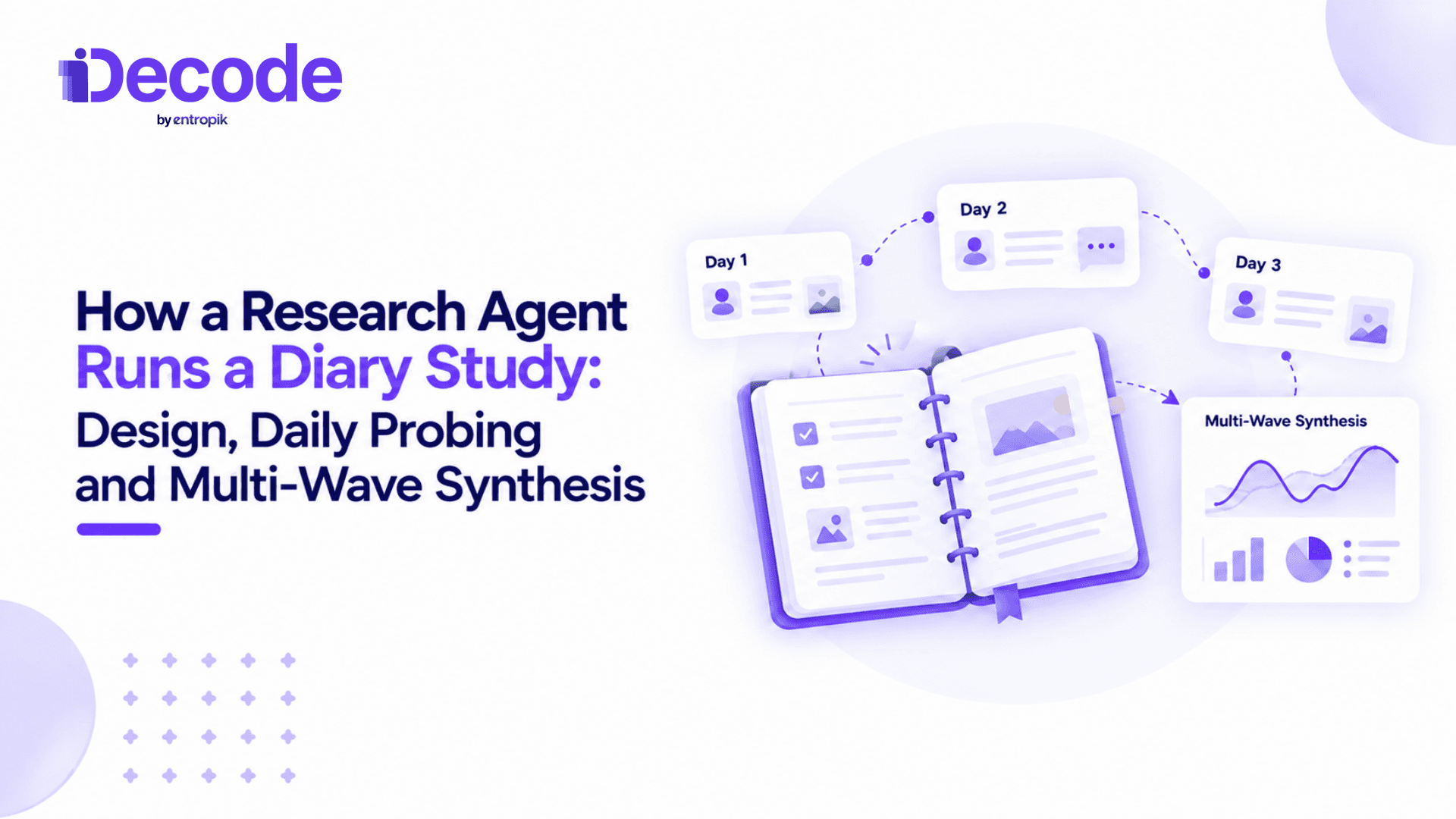
Traditional diary analysis happens after fieldwork closes, which is too late to change anything. A research agent shifts to rolling synthesis, summarizing each wave as it ends. Longitudinal synthesis also has a different job than standard thematic analysis. It must track change over time, not just count recurring themes.
Rolling Synthesis After Each Wave
After each wave, the agent produces a wave summary, emerging themes, evidence gaps, and recommended tasks for the next wave. Evidence gaps are especially useful. They show which segments or moments are thinly covered while there is still time to target them.
Tracking Change Within Each Participant
The agent builds individual trajectories, marks turning points, notes sentiment shifts, and surfaces contradictions between what participants said and what they later did. A person who calls a product "easy" on day one and describes three workarounds by day eight is telling you something no single interview would catch. This is a practical way to watch the say-do gap open, rather than discovering it after the fact.
An endpoint interview records a final opinion, but not the path that produced it.
Cross-Wave Themes, Journeys and Evidence Trails
Across participants, the agent assembles cross-wave themes, segment comparisons, and journey maps that show where experiences diverge.
Every theme should link back to timestamped verbatims and clips. This traceability lets a reviewer check a claim in seconds and lets stakeholders watch the moment behind a finding. Teams that store these trails in a research repository can reuse them in later studies.
The agent can also choose whom to call. Participants with the sharpest turning points or the biggest say-do contradictions become candidates for a debrief interview, where a human researcher explores what the diary could not.
The Researcher's Role in an Agent-Run Diary Study
The agent handles moderation and organization. The researcher owns judgment and interpretation. That division works only when human checkpoints are built in:
Protocol approval: sign off on objectives, cadence, tasks, and probe rules.
Pilot review: read the pilot day's entries and probes before launch.
Probe audits: sample probes for leading wording and excess depth.
Mid-study review: check coverage, dropout, and proposed adaptive tasks.
Synthesis validation: test each theme against its linked evidence.
Stakeholder storytelling: turn findings into a narrative the business can act on.
Human-in-the-loop oversight is what keeps an AI research agent trustworthy. The agent organizes the evidence, and the researcher decides what it means.
When you compare AI moderation platforms, ask which of these checkpoints each one supports and how easy it is to inspect the agent's work.
Risks and Guardrails for AI-Moderated Diary Studies
Four risks come up most often:
Over-probing and participant fatigue: cap probes per entry and watch for shrinking entries.
Leading probes: use neutral templates and audit transcripts.
Misreading sarcasm or cultural context: route ambiguous entries to a human and review translations for key markets.
Unsupported themes in synthesis: require every theme to cite timestamped evidence.
Privacy needs its own attention. Video and screenshots can expose faces, addresses, messages, and account details. Tell participants what to avoid capturing, redact where needed, set retention limits, and follow data security practices for AI moderated research. Request fresh consent before adding a new wave.
Frequent probing can also amplify reactivity bias, the tendency for observation to change behavior. A systematic review of the Hawthorne effect found that most of the 19 purposely designed studies it examined showed some evidence of research participation effects, though the size and conditions remain unclear. To mitigate it, limit probes, keep wording neutral, compare early and late entries, and ask participants in the debrief whether logging changed their behavior.
Capturing Emotional Change Across Diary Waves
Diary entries capture what participants say they felt. Emotion and attention signals show how reactions shift across days, for example from first use to repeat use of a product.
Decode by Entropik supports longitudinal and multi-wave consumer research that combines AI-moderated interviews with facial coding and eye tracking on real participants.
Decode's facial coding delivers 90%+ accuracy across 62 facial expressions, and its eye tracking delivers 96% accuracy. The platform supports 70+ languages, is backed by 17 patents, and is used by 150+ global brands, which matters when a diary wave spans several markets.
Pairing stated diary entries with observed emotional response strengthens multi-wave synthesis. Suppose a participant writes that repeat use is "fine" while facial coding shows a weaker positive response than in week one. The agent can flag the gap for the researcher to explore. That is a hypothesis to test in the debrief, not a verdict.
Teams ready to apply this can run diary studies that track behavior over time.
Emotion also adds a second layer to every journey map, which is the idea behind consumer journey mapping with emotion at each step.
See Diary Study Insights Unfold Wave by Wave
A research agent keeps every diary entry deep and every wave analyzed as it closes. Adding emotion and attention data shows how reactions change over time, not just what participants report. Decode brings AI-moderated interviews, facial coding, and eye tracking together across 70+ languages for longitudinal and multi-wave consumer research.
Frequently Asked Questions
1. What is an AI-moderated diary study?
It is a diary study in which an AI moderator reviews each entry and asks follow-up questions while the participant is still engaged. The researcher defines the protocol and guardrails, and the AI handles daily probing and quality checks.
2. Can an AI agent run a diary study without a researcher?
No. The agent can draft the protocol, moderate entries, and summarize waves, but a researcher should approve the protocol, audit probes, validate synthesis, and interpret findings. Human checkpoints keep the study rigorous and accountable.
3. How does an AI moderator decide which follow-up questions to ask?
It reads each entry against the study objectives and the participant's earlier entries. If detail is missing, it selects a clarifying, context, emotion, laddering, or contrast probe within the researcher's rules on depth and wording.
4. How long should a diary study last?
Match the length to the behavior cycle. The study should span enough full cycles to show change, such as two weekly shopping loops, rather than defaulting to a fixed number of days.
5. How many participants do you need for a diary study?
Qualitative diaries use small, well-chosen samples. Recruit above your target to absorb dropout, and make sure each segment you plan to compare has enough participants to show patterns.
6. How do you reduce dropout in a diary study?
Brief participants clearly, keep tasks short, and pay milestone incentives. Use personalized reminders, watch for disengagement signals such as shorter entries, and hand struggling participants to a human researcher.
7. How is diary study data analyzed across multiple waves?
Analyze after each wave for themes, evidence gaps, and next-wave tasks. Then track within-participant change, compare segments, build journey maps, and link every finding to timestamped verbatims or clips.
8. Is AI moderation suitable for sensitive diary study topics?
It can be, with strict guardrails: off-limits topics, escalation triggers, explicit consent, and human review. For highly emotional subjects, a human-moderated diary is often the safer choice.