Strategic Industry Resource
How to evaluate, compare, and choose the right human insights platform for your research team.

SECTION 01 /06
The problem with traditional research
Most research today relies on what people say. Surveys and interviews are fast and scalable, but they depend entirely on self-reported data.
The reality is that people are not always accurate in describing their own behavior. Bias, memory gaps, and social expectations shape responses, often creating a disconnect between what users say and what they actually do.
What this leads to:
Insights that look convincing but lack real-world accuracy
Decisions based on incomplete or biased data
Missed signals that impact product, marketing, and UX outcomes
If your research only captures responses, you’re only seeing part of the truth.
SECTION 02 /06
The say-do gap is where decisions break down
Consumers often express preferences that do not match their actual behavior. They may say they like a product but never engage with it. They may claim intent to buy but lose interest within seconds. These moments reveal the gap between stated feedback and real experience.
Without capturing behavioral signals like attention, emotion, and engagement, this gap remains invisible, making it harder to trust the insights behind critical decisions
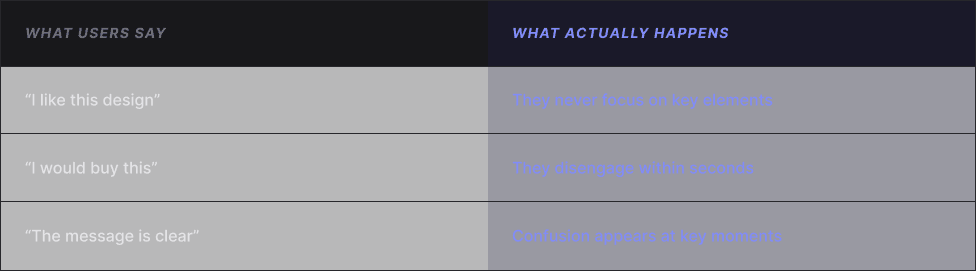
Without capturing behavioral signals like attention, emotion, and engagement, this gap remains invisible, making it harder to trust the insights behind critical decisions
Key takeaway:
The say-do gap is not an exception. It is the default in research based on words alone.
SECTION 03 /06
A shift toward behavioral intelligence
A new generation of platforms is changing how research is done.Instead of relying only on responses, behavioral intelligence platforms capture how people actually react in real time. They combine traditional inputs with signals like facial expressions, eye movement, voice tone, and attention patterns.
What you can measure with behavioral intelligence:
Emotion: How users feel in each moment
Attention: Where users look and what they ignore
Engagement: When interest rises or drops
Reaction patterns: Subconscious responses that users cannot articulate
This provides a deeper understanding of what users feel, what they focus on, and how they respond in the moment.
Result:
Insight that reflects real behavior, not just reported opinions.
Engagement
How users feel in each moment
Attention
Where users look and what they ignore
Emotion
When interest rises or drops
Reaction patterns
Subconscious responses users can't articulate
This provides a deeper understanding of what users feel, what they focus on, and how they respond in the moment.
Result:
Insight that reflects real behavior, not just reported opinions.
SECTION 04 /06
How to evaluate the right platform
Choosing the right platform requires looking beyond features. Start by understanding how quickly you can move from a research question to a clear decision. Speed matters, but it should not come at the cost of depth. Evaluate the effort required to run studies, including setup, analysis, and reporting. A strong platform reduces manual work and simplifies workflows.
Three things that matter most:
Speed to insight
How fast can you go from question to actionable finding?Cost to insight
What is the true effort required, including time and resources?Depth of insight
Are you capturing real behavior or just responses?
What to look for in a platform:
Behavioral and emotional signal capture
End-to-end research workflow support
Automated analysis and synthesis
Scalable study execution
Key takeaway:
If a platform only makes research faster, but not deeper, it limits your decisions.
1
Speed to insight
How fast can you go from question to actionable finding?
2
Cost to insight
What is the true effort required, including time and resources?
3
Depth of insight
Are you capturing real behavior or just responses?
SECTION 05 /06
From fragmented tools to continuous insights
Many teams rely on multiple tools for surveys, interviews, usability testing, and reporting. This creates silos, slows down analysis, and increases operational complexity.
A unified behavioral intelligence platform brings everything together.
Instead of disconnected workflows, you get a single system where insights build over time and inform each other.
What this enables:
Faster and more confident decisions
Lower cost per study
Deeper understanding of customer behavior
Research that keeps pace with business needs
Bottom line:
Research shifts from a one-time activity to an always-on capability.
SECTION 06 /06
FAQ's
What is a behavioral intelligence platform?
A platform that captures behavioral, emotional, and attention-based signals alongside traditional research data to understand how people actually respond.
Why are surveys alone not enough?
Surveys rely on self-reported data, which is often influenced by bias and incomplete recall. Behavioral signals provide a more accurate view of real responses.
What is the say-do gap?
It is the difference between what people say and what they actually do. This gap can lead to misleading insights if not addressed.
What should I look for in a platform?
Look for platforms that combine speed, depth of insight, and full lifecycle support, including behavioral data capture.
Who is this guide for?
Research teams, product managers, marketers, and UX professionals who want to improve decision-making with better insights.
How can I learn more?
Download the full Buyer’s Guide to access the complete evaluation framework, platform comparisons, and checklist.