Overall Score
85 / 100
Highest Focus
88 at 18s
Focus peaks during the structured indoor scenes (therapy-room setup), where:
Visual clutter is minimal
The framing is tight and centered
The contrast between the bear and the human setting is instantly readable
These controlled visuals allow viewers to fully process the joke and the emotional subtext, strengthening narrative comprehension.
Lowest Focus
50 at 36s
Focus dips during later high-energy sequences with:
Crowds
Dynamic lighting
Multiple simultaneous points of action
While emotionally exciting, these scenes slightly diffuse visual hierarchy, making it harder for the eye to settle on a single focal element.
Highest Clarity
84 at 18s
Clarity is strongest when the bear is placed in a familiar human context with a clear visual metaphor (therapy couch, note-taking human).The scene communicates its intent instantly — humor through contrast — without requiring dialogue or explanation.
Lowest Clarity
50 at 26s
Clarity drops during fast transitions between environments (interior → city → social scenes).Although entertaining, the rapid context shifts briefly weaken narrative continuity, making the brand message less explicit in that moment.
Highest Attention
54 at 34s
Attention peaks during the large-scale social moments:
Concert/stadium visuals
Bright blue stage lighting
Crowd reactions and pointing gestures
Oversized screens featuring the bears
These elements combine scale, motion, and emotional payoff, naturally pulling the viewer’s gaze and sustaining engagement.
Lowest Attention
18 at 14s
Attention dips during a quieter connective scene with:
Limited motion
Fewer emotional or social cues
This moment functions as a narrative bridge rather than a highlight, resulting in lower attention intensity.
Summary
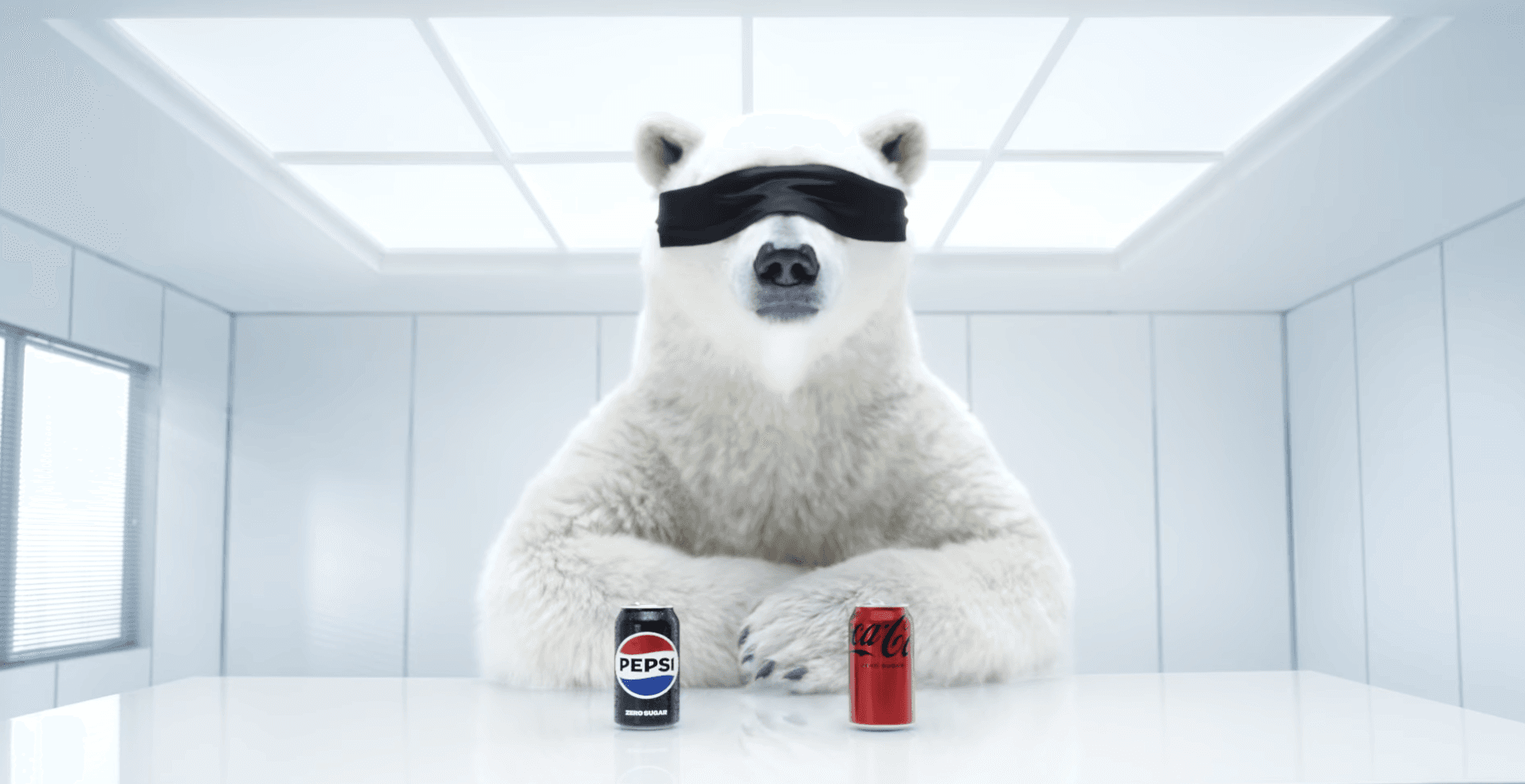
Pepsi uses anthropomorphic storytelling to explore modern social behaviors through humor. By placing a polar bear in recognizably human situations — blind taste tests, therapy sessions, social hangouts, and live entertainment — the film creates a sense of ironic distance that makes introspection and emotion feel fun rather than heavy.
Pepsi appears as a social companion, not a narrative hero. The product is woven into moments of bonding, observation, and shared enjoyment, reinforcing the brand’s role in contemporary social culture rather than tradition or nostalgia.
Emotional Insights
The film delivers a strongly positive emotional profile (82%), anchored by high happiness (78%) and notable surprise (32%), creating a tone that is humorous, curious, and socially inviting rather than sentimental.
Negative emotions remain intentionally low (anger 5%, fear 6%, disgust 4%), ensuring the humor never turns awkward or uncomfortable. This emotional balance supports Pepsi’s brand personality — light, self-aware, and culturally playful, rather than emotionally earnest.
The emotional arc moves from curiosity → amusement → social joy, keeping viewers engaged without emotional fatigue.
The Commercial
Heatmap Video
Fogmap Video
Suggestion for Improvement
Extend key social moments (group dining, concert scenes) by 0.5–1 second to allow emotional payoff to fully land before transitions.
Introduce a stronger recurring visual anchor for Pepsi in the final third to reinforce brand recall without disrupting the narrative flow.
Slightly reduce visual competition in crowd scenes to improve late-stage focus without sacrificing energy.
These refinements could lift the lower focus and clarity moments while preserving the film’s playful, high-energy tone.