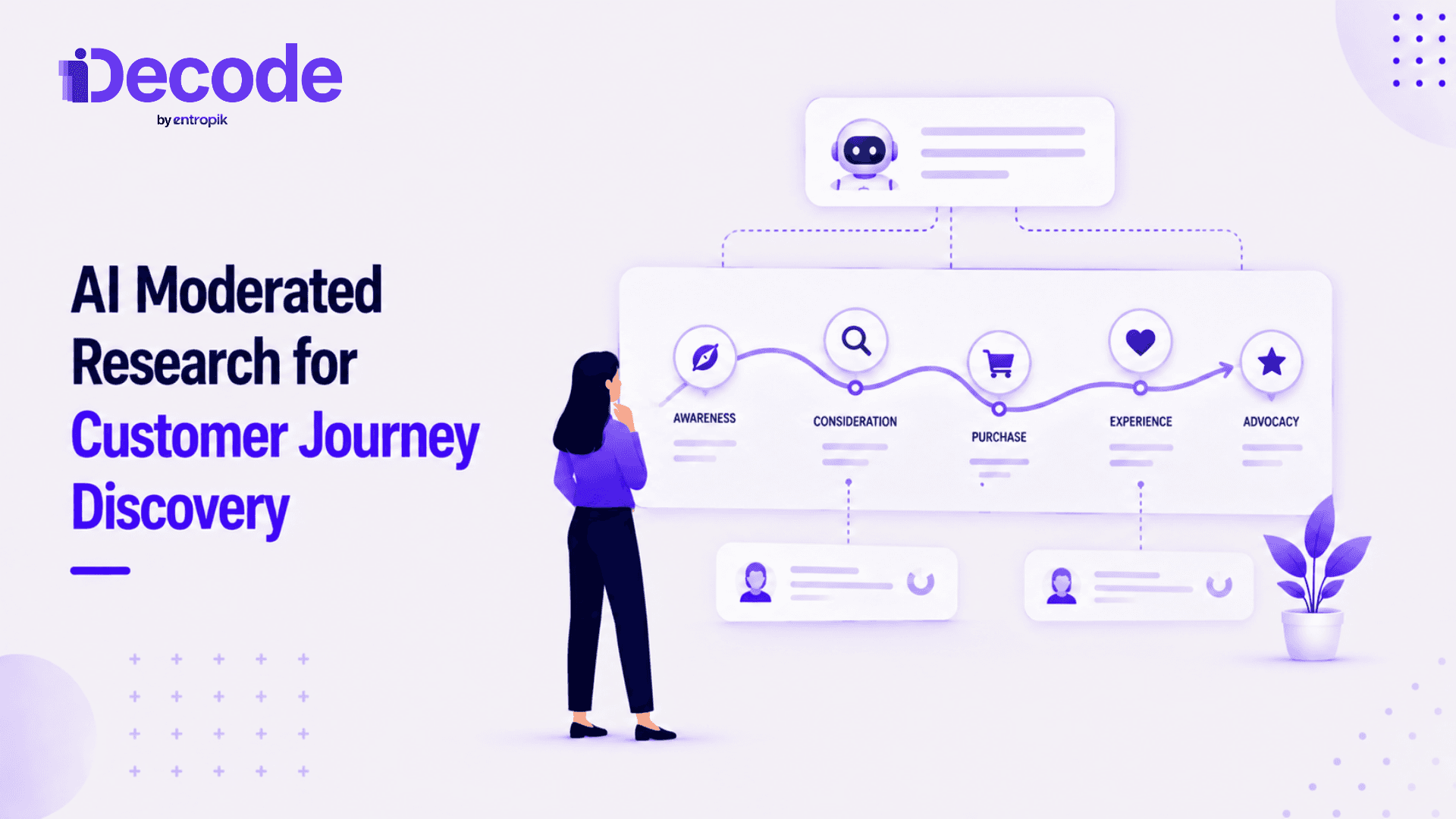
AI moderated research for customer journey discovery uses AI interviewers to ask real customers to narrate their experience at each journey stage, then analyzes the transcripts at scale. It replaces internally assumed journey maps with evidence, surfacing the actual touchpoints customers use, the pain points where experience breaks down, and the emotions at each stage, with results in days rather than months.
Summary:
|
What is AI moderated research for customer journey discovery?
AI moderated research for customer journey discovery uses AI interviewers to ask real customers to narrate their experience at each stage of a journey, then analyzes the resulting transcripts at scale. The distinction between journey research and journey mapping matters here: research is the input, the actual evidence gathered from customers, while mapping is the output, the visual artifact a team builds from that evidence.
Done well, this kind of research produces three distinct evidence layers: the actual process customers go through (as opposed to the assumed one), a friction map of where experience breaks down, and an emotional landscape showing how customers feel at each stage, not just whether they completed it. AI moderated interviews are well suited to generating all three layers at once, since a single adaptive conversation can capture process, friction, and emotion in the same session.
Why assumed journey maps miss the real experience
Internal journey maps tend to show clean transitions between stages because no single team actually owns the messy gap between them. Marketing owns acquisition, product owns onboarding, and support owns the ticket queue, but the transition from "just signed up" to "actively using the product" often belongs to nobody specifically, which is exactly why it tends to get mapped as a straight arrow instead of the confusing period it usually is.
Funnel thinking and happy-path mapping compound the problem by hiding the recovery moments where loyalty is actually won or lost. A customer who hits a confusing step, gets stuck, then finds a workaround and succeeds anyway has a very different relationship with a brand than one who sails through without friction, even though both end up counted the same way in a completion metric. Rating scales flatten this further, reducing a stage to a single satisfaction number that leaves the actual why behind a low score invisible.
The commercial stakes of getting this right are significant. Forrester's 2026 Customer Experience Index found that 26% of North American brands posted statistically significant experience score gains this year, against just 7% that declined, a meaningful reversal after several years of stagnant scores industry-wide (Forrester, 2026 Customer Experience Index). The brands moving that needle are, almost by definition, the ones actually finding and fixing the gaps an assumed map would never reveal. McKinsey's 2026 Global B2B Pulse research reinforces the same point from the buyer's side: decision-makers now engage across an average of ten distinct touchpoints before a purchase (McKinsey, The Surprising Economics of B2B Growth), meaning a map with even one poorly understood touchpoint is missing a real fraction of the experience that shapes a decision.
Research methods that reveal the real journey
Four methods make up the core toolkit, and each one targets a genuinely different dimension of the journey rather than duplicating the others. Adaptive probing is the mechanism that ties them together, since it is what surfaces both the specific pain points and the emotional texture around them.
Touchpoint interviews
Focus each study on a single moment, onboarding, support, billing, or renewal, with customers who just experienced that specific touchpoint while it is still fresh. Probe the actual steps they took, where friction showed up, any gap between what they expected and what happened, and what they would change if they could.
Transition interviews
Research the gaps between touchpoints specifically, the periods that tend to break down precisely because no team owns them. Surface the decisions and emotions that happen in a stretch like the time between sign-up and genuinely first using a product, a period where a lot of quiet churn risk tends to live unnoticed.
Emotional mapping
Move beyond a binary satisfied-or-dissatisfied read and toward specific, named emotions: confused, anxious, relieved, frustrated. Tie each named emotion to the behavioral outcome it implies and the design or process fix it points toward, since "confused during setup" leads to a very different intervention than "frustrated by a slow response." This is worth pairing with dedicated AI moderated brand research when an emotional pattern at one stage seems to be shaping broader brand perception, not just satisfaction with a single interaction.
Longitudinal tracking
Interview the same customers across multiple stages, onboarding, then 30 days, then 90 days, then renewal, to see how perception actually evolves rather than assuming it stays static. This method is specifically built to identify inflection points, the moments where a customer's trajectory bends toward becoming genuinely loyal or quietly at-risk.
How to design a journey discovery program
Start with touchpoint studies at the highest-impact stages, the moments most closely tied to activation, retention, or revenue, before expanding elsewhere. Add transition research once those touchpoint studies are established, specifically targeting the unowned gaps between them. Layer emotional probing into studies already running at near-zero added effort, since the interview is already happening and the additional prompts add depth without adding a separate fielding cycle. Add longitudinal tracking for strategically important segments once the earlier phases have proven their value and earned the additional investment a tracking program requires. Teams researching journeys specific to a regulated or high-consideration category may also find financial market research a useful companion read, given how differently journeys unfold in categories with longer decision cycles and higher trust requirements.
How AI moderated interviews capture emotional nuance
Laddering follow-up questions turn a flat emotion label like "frustrated" into a complete narrative tied to a specific moment: what triggered it, how it built, and what would have prevented it. That narrative is what a design or product team can actually act on, in a way a satisfaction score alone cannot support.
The conversational format captures nuance a survey checkbox structurally cannot. A five-point emotion scale forces a customer's genuinely mixed feelings, relieved the problem got solved but frustrated it took three attempts, into a single flattened number. An open conversation lets both feelings surface, and adaptive follow-ups tie each one to the specific part of the journey that caused it. This kind of nuance maps more directly to concrete design fixes than a satisfaction score ever manages to, since the emotion is already attached to the moment that produced it rather than floating free of context. A systematic review of qualitative interview sample sizes found that most homogenous, narrowly scoped studies reach thematic saturation between 9 and 17 interviews (Social Science & Medicine, systematic review of saturation studies), a useful benchmark when sizing a touchpoint or transition study per stage.
How to validate and refresh journey maps over time
Treat validation as a continuous background activity rather than a project with an end date. Every new study, regardless of its original purpose, is an opportunity to check its findings against the current map and flag where reality has drifted from what the map assumes.
Run dedicated refresh studies at least annually per stage, and more frequently for fast-changing stages like onboarding, where a product's own evolution can outdate a map within a single quarter. Watch for three specific failure modes: mapping the funnel instead of the journey (which hides everything outside a narrow conversion path), mapping only the happy path (which hides the recovery moments where loyalty is actually decided), and treating a finished map as permanently finished (which guarantees it goes stale the moment the product, market, or competitive set shifts again). Gartner's research on customer feedback loops found that companies who regularly act on customer feedback see a 15% increase in retention (Gartner, cited in Key Customer Experience Statistics), a direct payoff for treating journey validation as continuous rather than a project with a fixed end date.
Mapping the journey with emotion and attention signals
Text-only analysis captures what a customer says about their experience, but not always how they felt while going through it. Decode's AI Moderator adds a layer on top of language with facial coding at over 90% accuracy across 62 facial expressions, surfacing emotional reactions a transcript alone would miss. Eye tracking at 96% accuracy pinpoints exactly where friction shows up on digital touchpoints during usability moments within the broader journey.
Multi-market journey research is supported in over 70 languages, and the platform is used by more than 150 global brands, backed by 17 patents. This kind of structured, evidence-based validation mirrors a broader shift in how organizations approach decisions: PwC's research on responsible AI adoption found that roughly 69% of mature organizations now build formal evaluation and testing capabilities into how they validate a process before scaling it (PwC, Responsible AI Survey), which is precisely the discipline a continuously validated journey map depends on to stay trustworthy over time. Teams comparing platforms for a research program at this scale can also review this roundup of AI moderation platforms.
For teams deciding whether AI moderation fits this kind of program, when you need AI moderated interviews is a useful starting point, and multilingual research with AI moderated interviews covers how to keep a journey program consistent across markets with different cultural norms around candor. Journey discovery also connects closely to onboarding and usability work specifically, where AI moderated usability testing covers the touchpoint-level detail this article's framework references, and human-in-the-loop oversight is worth reviewing given how much strategic weight journey findings tend to carry once they inform a product roadmap.
Journey research overlaps naturally with several adjacent disciplines. A formal customer journey mapping process gives structure to how touchpoint and transition findings actually get turned into the visual artifact stakeholders will reference, and understanding path to purchase research is directly relevant for teams focused specifically on the pre-purchase stages of a broader journey. On the retention side, pairing journey research with data on the impact of customer churn helps prioritize which stages deserve the first round of touchpoint studies. Centralizing findings across all of these studies in an AI-powered research intelligence platform makes it far easier to compare a refreshed journey map against every prior study a team has already run.
Frequently Asked Questions
1. What is AI moderated research for customer journey discovery?
A method where AI interviewers ask real customers to narrate their experience at each stage of a journey, then analyze the transcripts at scale to reveal the actual process, friction points, and emotions involved.
2. How is journey research different from journey mapping?
Journey research is the evidence-gathering input, real customer interviews and data. Journey mapping is the visual output a team builds from that evidence to communicate and act on it.
3. What is a touchpoint interview and how does it work?
It is a focused study on a single journey moment, conducted with customers who just experienced that specific touchpoint, probing their steps, friction, and expectation gaps while the experience is still fresh.
4. How do you research the gaps between touchpoints?
Through transition interviews, which specifically target the periods between defined touchpoints where ownership is unclear and experience often quietly breaks down.
5. How many interviews does a complete journey research project need?
It depends on how many touchpoints, transitions, and segments are in scope, since each stage and segment is typically researched as its own smaller study rather than one large combined effort.
6. How does AI moderation capture emotion at each journey stage?
Through laddering follow-up questions that turn a single emotion label into a complete narrative tied to a specific moment, paired with facial coding for platforms that support behavioral signal capture.
7. How often should you refresh a customer journey map?
At least annually per stage, more frequently for fast-changing stages like onboarding, and continuously in the background by checking every new study's findings against the current map.
8. Can AI moderated research run across multiple markets and languages?
Yes, platforms built for multi-market research can field a consistent journey discovery protocol across many languages without redesigning the study for each region.
Replace the assumed journey map with real customer evidence across every touchpoint, pain point, and emotion, in days rather than months.
Related Topics: