Brand safety in creative testing means screening an advert for reputational risk before it launches, rather than controlling where it appears. It checks whether the creative could be misread, cause offence in any target market, breach advertising claims rules, or conflict with brand guidelines. Testing combines quantitative screening with open-ended and behavioral response data.
Summary:
|
When most marketers hear "brand safety," they think of media placement: keeping ads away from harmful content, blocklists, and verification vendors. That is only half the picture. Brand safety in creative testing is about the ad itself. It asks whether the creative could be misread, cause offence in a target market, breach advertising rules, or undermine the brand before a single impression is served.
A perfectly placed ad can still create a crisis if the message lands the wrong way. This guide gives you a practical pre-launch checklist, the testing methods that catch each type of risk, and a workflow that keeps screening fast enough to fit real production timelines.
What Is Brand Safety in Creative Testing?
Brand safety in creative testing is the process of screening an advertising asset for reputational risk before it launches. Instead of asking "where will this ad run?", it asks "what will people take away from this ad, and could any of it hurt us?"
It sits within the broader discipline of ad testing, but with a different lens. Standard pre-testing asks whether an ad will work. Risk screening asks whether it could backfire.
Creative-side brand safety protects three things:
Brand trust, which takes years to build and can be damaged by a single misjudged campaign.
Regulatory standing, since misleading or non-compliant claims can trigger complaints, rulings, and forced withdrawals.
Campaign spend, because a pulled campaign wastes production and media budgets at once.
The stakes are high because trust drives purchase. Edelman's special report on brands found that 81% of consumers across eight markets say they must be able to trust a brand to do what is right before buying. The same research found that 56% believe too many brands use societal issues as a marketing ploy, which is a warning for any purpose-led creative that has not been screened.
Creative-Side vs Media-Side Brand Safety
The two disciplines are complementary, but they control different things.
Dimension | Media-side brand safety | Creative-side brand safety |
What is controlled | Where the ad appears | What the ad says and shows |
Who owns it | Media, programmatic, and ad ops teams | Brand, insights, creative, and legal teams |
When it happens | During and after launch | Before launch |
Main tools | Blocklists, keyword exclusions, verification vendors | Consumer screening, open ends, facial coding, eye tracking |
Risk it prevents | Harmful adjacency | Misreading, offence, non-compliance |
Blocklists and verification vendors cannot catch a creative that is itself the problem. If an ad contains an unintended double meaning or an insensitive stereotype, placing it next to premium content does not make it safe.
The two areas overlap when context changes meaning. A playful joke may work in an entertainment environment but read as tone-deaf next to news coverage of a related tragedy. This is where brand suitability comes in: the same creative can be safe in one context and unsuitable in another, so creative screening should flag contexts where the ad should not run.
Why Creative Risk Screening Belongs Before Launch
The economics are simple. A screening study costs a fraction of a campaign's media budget. A pulled campaign loses the production cost, the media already bought, and the goodwill damaged in the process. Teams that routinely pre-test a video ad before media spend are already protecting performance; adding risk checks to the same study adds little cost.
Speed is the second reason. Once a misread creative is live, social platforms amplify reactions within hours. Screenshots, stitches, and commentary spread far faster than any brand statement, and the story often becomes about the brand's judgment rather than the ad. Strong reputation management starts with not creating the incident in the first place.
The third reason is that internal review misses things. Creative, brand, and legal teams have seen the idea evolve for weeks, share the same context, and know what the ad is supposed to mean. A consumer sample sees it cold, which is exactly how the market will see it.
Regulators are also scanning more ads than ever. The UK Advertising Standards Authority reported that in 2024 it secured the amendment or withdrawal of 33,903 ads, with its AI monitoring system processing 28 million ads. A risky claim is now far more likely to be found, whether or not a consumer complains.
What to Check Before Launch
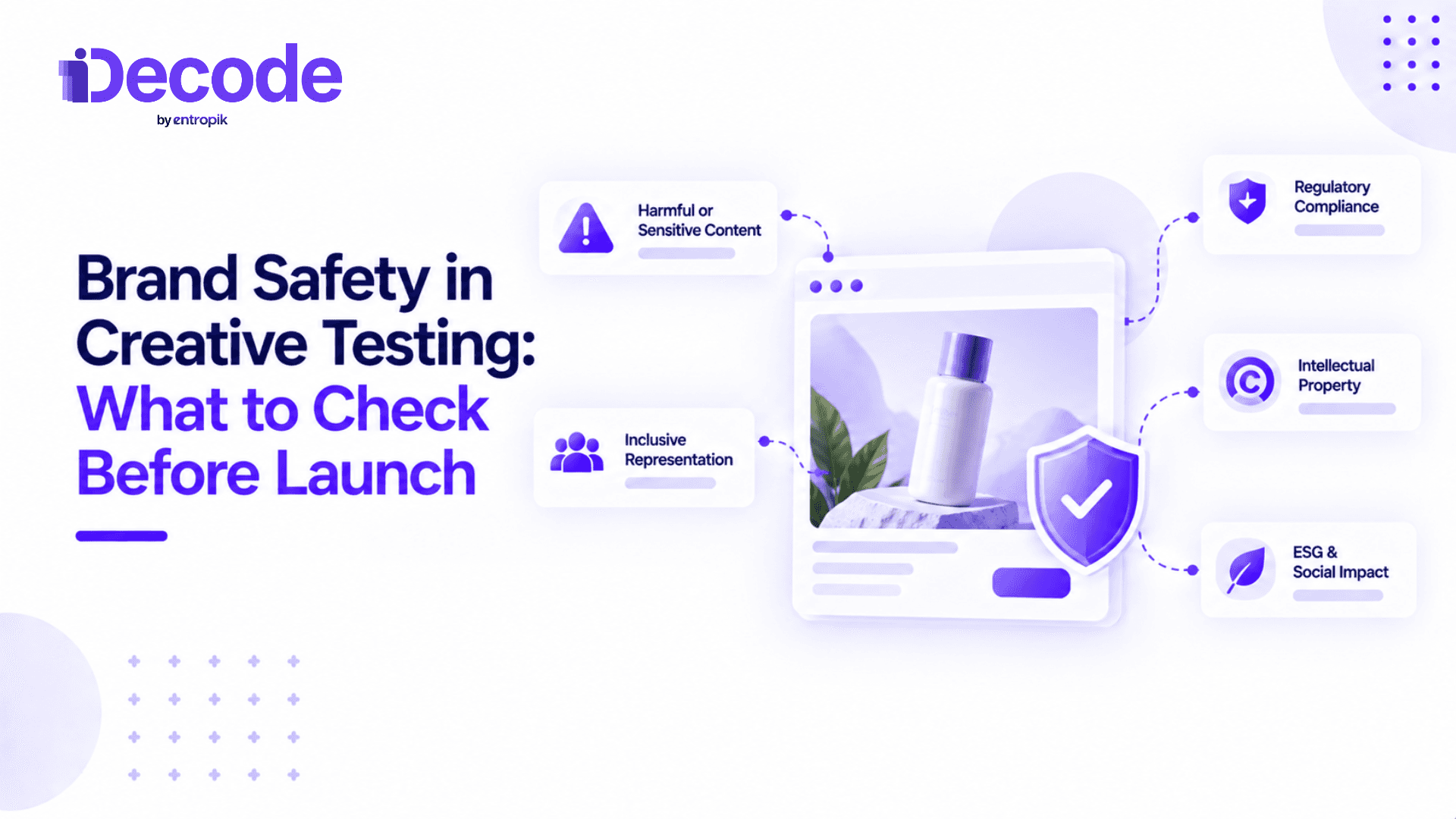
Treat the checklist as six distinct risk categories, each with its own test. Some checks are mandatory for every asset, while others depend on the market, category, or theme.
Risk category | Mandatory or conditional |
Message misinterpretation | Mandatory |
Cultural and regional sensitivity | Mandatory for multi-market campaigns |
Representation and stereotyping | Mandatory when people are depicted |
Claims and regulatory compliance | Mandatory; stricter in regulated categories |
Visual and audio asset risk | Mandatory |
Brand guideline compliance | Mandatory |
Message Misinterpretation
The first question is whether the intended takeaway is the one people actually receive. Ask viewers, unprompted, what the ad was trying to say, then compare their answers with the creative brief.
Pay special attention to humour, wordplay, and irony. These devices often carry an unintended second reading, and that second reading is usually what goes viral. Dedicated message testing helps confirm that the core idea survives without explanation.
Cultural and Regional Sensitivity
Gestures, colours, idioms, religious references, and historical associations shift meaning between markets. A hand gesture that signals approval in one country can be offensive in another, and a colour associated with celebration in one culture can signal mourning elsewhere.
A translated creative still needs local screening. Translation handles words, not context. Local audiences should see the final localized asset, because visual cues, casting, and settings may carry meaning the central team did not intend.
Representation and Stereotyping
Review casting, role portrayal, and body and age representation. Who is shown as the expert, the caregiver, the decision-maker, or the punchline?
Test with the depicted group, not only the target buyer. A campaign aimed at one audience may portray another group in a way that group finds reductive. Many audiences already feel overlooked: Kantar's Brand Inclusion Index found that 19% of UK respondents say they are rarely or never well represented, rising to 26% among people with disabilities, so a careless portrayal lands on groups that are already sensitive to being misrepresented.
Getting this right is not only about avoiding backlash. A World Federation of Advertisers summary of the Unstereotype Alliance and Oxford Saïd study of 392 brands across 58 countries found progressive ads delivered a 3.46% short-term and 16.26% long-term sales uplift, with 1.52x higher pricing power. Representation screening protects both reputation and effectiveness.
Claims, Compliance and Regulatory Risk
Identify every claim that needs substantiation, including comparative claims ("better than"), performance claims ("lasts twice as long"), and environmental claims.
Just as important are implied claims: conclusions consumers draw even when the ad never states them. If viewers believe a product cures, guarantees, or outperforms something, regulators may treat that as a claim. Open-ended screening is the best way to surface what people infer.
Apply category-specific rules for health, financial services, alcohol, gambling, and advertising to children. These categories face stricter codes from bodies such as the ASA in the UK and the FTC in the US.
Visual and Audio Asset Risk
Check background details, on-screen text, props, and signage that may carry unintended messages. Confirm licensing for music, fonts, and stock imagery, and verify the provenance of any stock or AI-generated visuals.
Review accessibility factors too, including flashing sequences that may affect people with photosensitive epilepsy and caption legibility on small screens.
Brand Guideline Compliance
Check logo usage, colour palette, typography, tone of voice, and brand asset usage against the guideline document. Then run a simple test: does the creative still read as your brand when the logo is removed? If not, the ad may build category awareness rather than brand equity, which is a quieter but real form of brand risk.
How to Test Creative for Reputational Risk
No single method catches every risk. Surveys miss what people will not say, facial coding cannot explain why someone reacted, and qualitative interviews cannot quantify how common a reaction is. A layered stack built from proven creative testing methods closes those gaps.
Quantitative Risk Screening
Add offence, discomfort, and confusion scales alongside standard diagnostics such as appeal, branding, and comprehension. Report the share of respondents giving high negative scores, not just the average, because risk lives in the tail.
Base sizes matter. Low-incidence but high-severity reactions, such as a small group finding an ad deeply offensive, need enough respondents to be detected reliably. For most screening studies, 150 to 300 respondents per key audience cell gives a workable read, with boosted samples for depicted or sensitive groups.
Open-Ended and AI-Moderated Qualitative
Unprompted verbatims are the fastest route to unanticipated readings. Ask what people noticed, what the ad meant, and how it made them feel before showing any scaled questions.
When a response is flagged, probe it rather than accepting the score alone. AI-moderated interviews can follow up with every respondent who reported discomfort, asking what triggered it and how strongly they felt, at a scale human moderators cannot match. This also helps with a known problem: people often hold back in research, especially on sensitive topics, and a patient follow-up question surfaces more than a checkbox.
Facial Coding and Eye Tracking
Some reactions never make it into a survey answer. Respondents may feel discomfort, confusion, or contempt but choose not to report it. Fleeting microexpressions reveal these responses as they happen.
Decode's facial emotion AI reads 62 facial expressions with 90%+ accuracy, pinpointing the exact frame where discomfort spikes. Eye tracking at 96% accuracy then shows what viewers were looking at in that moment. Combined with AI-powered attention analysis, this tells you whether the problem is a specific visual, a line of copy, or a background detail nobody on the team noticed.
Multi-Market Screening
Run the same stimulus across markets to isolate market-specific risk. If one country shows sharply higher confusion or offence, the issue is likely cultural rather than creative.
Decode supports 70+ languages, allowing identical screening across regional rollouts. Watch for cultural response bias, since some markets use rating scales more positively than others. Behavioral signals and multilingual AI-moderated interviews help separate genuine risk from scale-use habits.
Building a Pre-Launch Review Workflow
A reliable workflow follows five steps:
Internal review. Brand, creative, and legal teams check the asset against guidelines and claims requirements.
Risk screening study. The asset is tested with target, depicted, and adjacent audiences in each launch market.
Escalation on flags. Any result above a pre-agreed threshold goes to a named decision-maker.
Retest. Revised assets are screened again, focusing on the flagged element.
Sign-off. Approval is documented with the evidence that supported it.
Ownership should be explicit. Insights owns the study, brand owns guideline compliance, legal owns claims, and regional teams own local sensitivity reviews. Without named owners, flags stall.
To avoid becoming the bottleneck, plan screening into the production calendar from the start. Book a screening slot at rough cut and another at final edit, so testing happens in parallel with finishing rather than after it.
Setting Risk Thresholds and Go or No-Go Rules
Agree thresholds before results arrive, so decisions are not shaped by deadline pressure. A simple structure works:
Note: a minor issue that can be fixed in the edit without retesting.
Rework: an issue above threshold that requires revision and a retest.
Stop: a severe issue that makes the creative unsuitable to run.
Weight severity against reach. A small segment that is strongly offended can still be decisive if that group is vocal, depicted in the ad, or central to the brand's future. Average scores hide this, so always review the distribution.
Document every decision, including the data, the threshold, and who approved it. If a campaign is later challenged, a clear record shows the brand acted responsibly.
Where Pre-Launch Screening Gets Missed
Even well-run teams leave gaps in three common places:
Testing the hero film but not the variants. Cutdowns, stills, and social media creative often remove the context that made the hero film work, which can change the meaning completely.
Sampling only the target buyer. The depicted group and adjacent audiences who will see the ad anyway are often missing from the sample.
Late-stage edits shipping without re-screening. A last-minute line change or new shot can introduce exactly the risk the original test cleared.
Best Practices for Creative Risk Screening
Screen twice: once at concept stage and again on the finished asset.
Always start with an unprompted open end before any scaled question, so answers are not led.
Screen every variant that will run, including display and social formats, not just the master asset.
Combine stated and behavioral data so unreported reactions are caught.
Include depicted and adjacent audiences in every sample.
When Risk Screening Matters Most
Every campaign benefits from screening, but some carry more risk than others:
Global rollouts, where cultural meaning varies by market.
Purpose-led and cause marketing, where authenticity is scrutinized closely.
Humour-led creative, where second readings are most likely.
Regulated categories such as health, finance, alcohol, and children's products.
Campaigns featuring real people or sensitive themes, including grief, identity, or social issues.
Rebrands and the first creative under a new positioning, where the brand has little existing equity to cushion a misstep.
High-reach formats deserve extra care too. Decode's TV and display ads testing is built for assets where one mistake reaches millions of viewers.
Screening Creative Without Delaying Launch
What compresses a screening study from weeks to days is integration. When recruitment, survey, facial coding, eye tracking, qualitative follow-up, and reporting run in one system, there are no handoffs between vendors.
Last-minute checks need three things: fast panel access in every launch market, language coverage that matches the rollout, and automated reporting that flags risk without waiting for manual analysis. When evaluating ad creative testing platforms, ask how each handles these requirements, not just standard diagnostics.
A dedicated creative insights platform brings these capabilities together so risk screening becomes part of routine testing rather than a separate project.
Decode by Entropik combines survey, facial coding, eye tracking, and AI-moderated research in one platform, backed by 17 patents and used by 150+ global brands.
What Is Changing in Creative Risk Screening
Three trends are reshaping the discipline.
AI-generated creative is increasing volume. Gartner found that among marketing organizations using generative AI, 77% have adopted it for creative development tasks, based on a survey of 418 marketing leaders. More assets mean shorter review windows and more variants to check, including AI-generated imagery with uncertain provenance.
Automated pre-screening is moving ahead of consumer testing. Tools such as predictive creative AI can score attention and flag weak elements before a consumer ever sees the ad, so human testing focuses on the assets and risks that matter most. This is the natural evolution of AI creative testing.
Expectations are rising. Audiences, regulators, and platforms are all scrutinizing representation and claims more closely, which makes structured, documented screening a standard expectation rather than a nice-to-have.
Frequently Asked Questions
1. What does brand safety mean?
Brand safety means protecting a brand's reputation in advertising. Traditionally it refers to keeping ads away from harmful content, but it also covers screening the creative itself for messages that could mislead, offend, or damage trust.
2. Can you give me an example of brand safety?
A media example is blocking ads from appearing next to violent content. A creative example is testing a humorous ad before launch and discovering that a significant share of viewers read the joke as mocking a specific group, then revising it before release.
3. What is the difference between brand safety and brand suitability?
Brand safety avoids content that is harmful for almost any brand. Brand suitability is more tailored, defining which contexts fit a specific brand's values and tone. A creative can be safe overall but unsuitable in particular contexts.
4. What should be checked in a creative review before launch?
Check message comprehension, cultural sensitivity, representation, claims and regulatory compliance, visual and audio asset risk, and brand guideline compliance.
5. How do you test an advert for cultural sensitivity?
Show the final localized asset to audiences in each market, ask unprompted open-ended questions, include scales for offence and confusion, and use facial coding to catch reactions people do not report.
6. How long does pre-launch creative screening take?
With an integrated platform and online panels, a screening study can often be fielded and reported within a few days. Multi-market studies may take slightly longer depending on audience availability.
7. What sample size is needed to detect offence or confusion?
Around 150 to 300 respondents per key audience cell is a common starting point, with boosted samples for depicted or sensitive groups where low-incidence reactions matter.
8. Does creative testing cover regulatory compliance?
Creative testing can reveal implied claims and misunderstandings that create regulatory risk, but it does not replace legal review. Use both together.
Treat Screening as Insurance, Not Another Approval Gate
A pulled campaign costs far more than a screening study. Pre-launch brand safety checks catch misreadings, cultural missteps, and risky claims while they are still cheap to fix.
Decode helps teams catch the discomfort and confusion viewers will not report, using facial coding and eye tracking across every market a campaign will run in