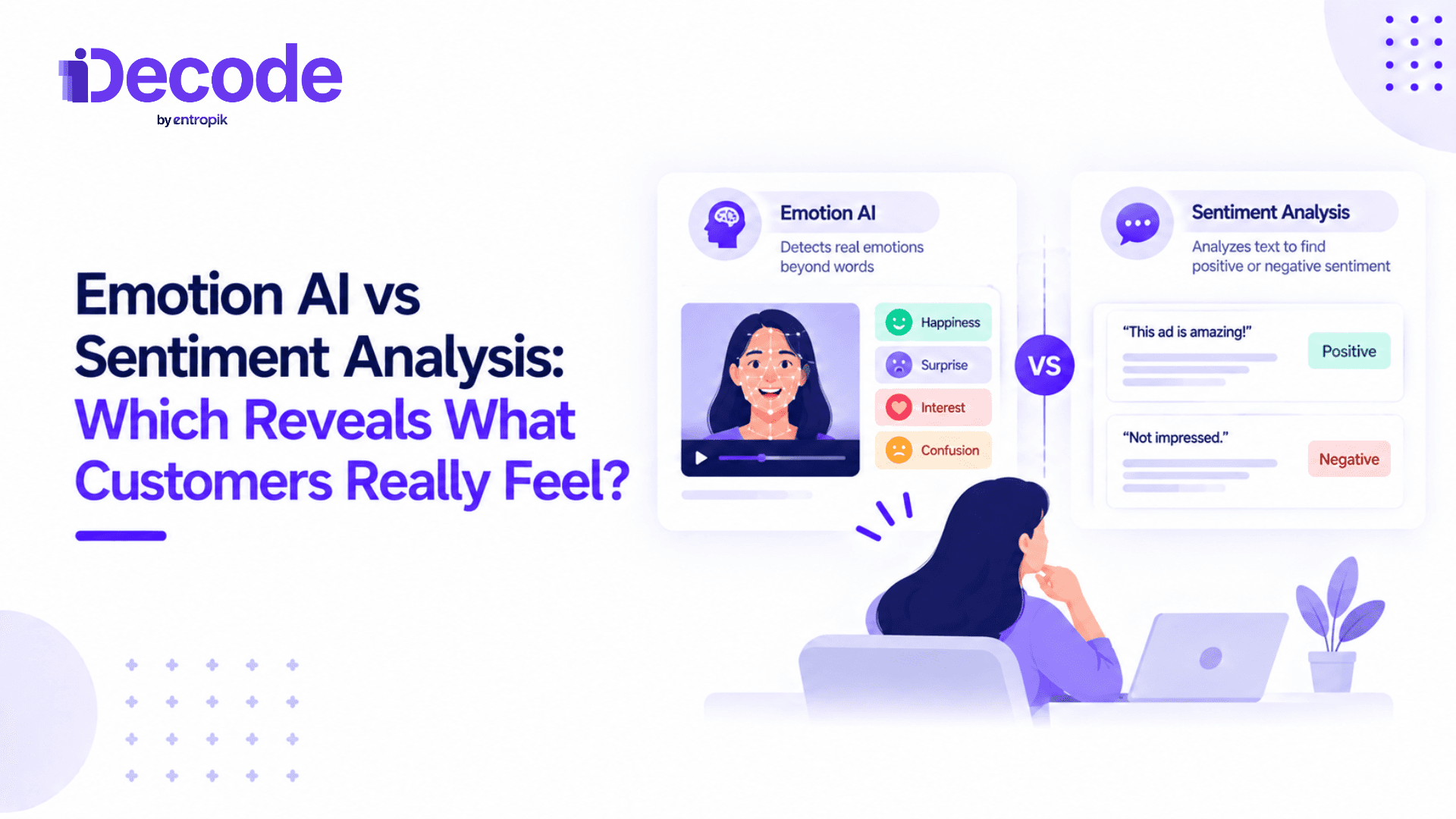
Emotion AI vs sentiment analysis differs in the emotional signals each technology interprets. Sentiment analysis primarily classifies expressed opinions as positive, negative, or neutral, while Emotion AI can analyze facial expressions, voice patterns, and other signals to estimate emotional responses. Both approaches offer complementary insights, particularly when researchers combine verbal feedback with observable nonverbal reactions.
Summary:
|
A customer writes "it's fine" in a review. Sentiment analysis scores that as mildly positive or neutral. A recording of the same customer opening the product might show a frown, a long pause, and a sigh. Which one tells you what they actually felt? Teams building consumer insights programs run into this question constantly.
This guide explains how the two technologies differ, what each can and cannot reveal, and when to use one, the other, or both.
Emotion AI vs Sentiment Analysis: Understanding the Core Difference
Sentiment analysis reads expressed opinion. Emotion AI observes inferred emotional response. One works on what people write or say, and the other works on how they react while they do it.
Think of it as surface versus deep emotion. Sentiment captures the verbal surface: the opinion a customer chooses to put into words. Emotion AI looks at nonverbal cues that customers may not articulate, or may not even notice themselves.
Emotional granularity is the key distinction. Sentiment analysis usually answers "positive, negative, or neutral?" Emotion AI aims to answer a richer question: which emotions appeared, how intense they were, and at which moment. That gap matters most where stated opinion and real reaction diverge, a pattern researchers call the say-do gap.
What Is Sentiment Analysis and How Does It Work?
Sentiment analysis uses natural language processing (NLP) to classify text as positive, negative, or neutral. For a broader primer, see this sentiment analysis guide.
The process follows a few steps. The system cleans and breaks text into units, interprets context such as negation and intensifiers, and assigns a sentiment score. Modern models handle context well on clean text. A Stanford benchmark built on movie reviews showed a model reaching 85.4% accuracy on single-sentence positive or negative classification, up from about 80% before it. That is strong, but notice what is being measured: a two-way polarity call on well-formed sentences, not the emotion behind them.
Common applications include:
Customer reviews and ratings
Open-ended survey responses
Social media posts and comments
Support tickets and chat transcripts
Social channels are a major source. A social listening guide explains how teams collect and organize that unsolicited feedback at scale.
What Is Emotion AI and How Does It Work?
Emotion AI, also called affective computing, analyzes observable signals to estimate emotional responses. Instead of reading words, it reads behavior.
Several signal types feed it:
Facial coding: detects facial movements over time, as explained in this primer on facial expression analysis
Voice analysis: tone, pitch, and pacing
Behavioral cues: gaze, hesitation, and interaction patterns
Multimodal data: several signals combined and time-aligned
Voice adds a channel that transcripts lose. Tone and pace can reveal enthusiasm or doubt even when the words are neutral, which is the idea behind voice analysis in research settings.
Outputs typically include emotion classifications, valence (positive to negative), and arousal (intensity), tracked moment by moment. That makes it possible to see exactly when a reaction changed, which is central to approaches that combine emotion, attention, and behavior.
Evidence suggests these signals carry real information. In a study of 1,223 people viewing 170 ads, MIT and Affectiva researchers found that webcam facial responses predicted ad liking with 0.85 AUC, while predicting a change in purchase intent was harder at 0.78. Facial data can forecast outcomes without asking viewers anything, yet it works best alongside what people say.
Emotion AI vs Sentiment Analysis: Key Differences
Parameter | Sentiment analysis | Emotion AI |
Primary focus | Expressed opinions | Inferred emotional responses |
Typical inputs | Text and transcripts | Facial, vocal, and other signals |
Outputs | Sentiment polarity and scores | Emotion-related classifications |
Granularity | Broad to aspect-specific | Model-dependent emotional detail |
Applications | Feedback monitoring | Experience and response measurement |
Some caveats apply. Advanced text models can detect specific emotions such as anger or joy from language, so the line is not absolute. And Emotion AI outputs depend heavily on the model and the context in which signals are captured.
The outputs also feel different in practice. A sentiment dashboard shows trend lines and scores across thousands of comments. An Emotion AI report shows a timeline for each stimulus, with peaks and dips tied to specific moments. The first answers "how do customers feel overall?" and the second answers "what happened at second 14?"
Each technology also interprets customer responses differently, and its limits show up in different places. Sentiment tools struggle with sarcasm and ambiguity. Emotion AI struggles with context and individual differences in expressiveness. For a voice-specific view, see this comparison of voice AI vs sentiment analysis.
Surface vs Deep Emotion: What Can Each Technology Reveal?
Stated opinions and observable reactions often differ. People soften criticism, forget how they felt, or simply lack the words. This is the core weakness of explicit feedback, and the limits of survey data show how often self-report alone leaves gaps.
Consider a packaging study. Participants might rate a new design as "good" in a questionnaire, scoring it positive. Frame-by-frame reaction data could still show a brief frown when they read the claim on the front. The score and the reaction are both real, and together they tell the team where to fix the pack.
Facial coding can capture reactions customers do not articulate, such as a flash of confusion at a package or a smile at a brand reveal. Those implicit signals help explain why an ad or product works, not only whether people say they like it.
Inferred emotion is not direct access to inner feelings. A review of more than 1,000 studies by Barrett and colleagues found that people scowl when angry only about 25% of the time, and that expressions vary across cultures and situations. Treat every inferred emotion as a hypothesis that needs contextual validation.
Benefits and Limitations of Emotion AI and Sentiment Analysis
Sentiment analysis offers:
Scalable processing of large feedback volumes
Fast opinion tracking over time
Aspect-level insight, such as sentiment about price versus quality
Its limits include sarcasm, slang, mixed opinions, and context. A manual analysis of 4,334 tweets found that only 15% of tweets labelled sarcastic were truly sarcastic, which shows how noisy the training data behind some tools can be.
Even so, sentiment analysis is widely used to guide decisions, including how CMOs use customer sentiment analysis to inform sales strategy.
Emotion AI offers:
Additional nonverbal measurement channels
Temporal insight into when reactions change
Evidence of responses customers may not mention
Its limits include interpretation risk, dependence on capture quality, and the need for informed consent.
Both approaches share challenges: cultural differences, data quality, privacy and consent requirements, and model bias. Neither should be treated as definitive on its own.
Emotion AI vs Sentiment Analysis: Customer Research Use Cases
Advertising research. Analyze observable reactions to creative alongside expressed campaign feedback. Traditional ad testing often misses moment-level emotion, which is why teams turn to TV and display ad testing with Emotion AI.
Product and UX testing. Facial coding, behavioral observation, and user comments together reveal interaction friction. Work on emotion-centered UX research shows how emotional signals guide design fixes.
In practice, teams often run prototype testing with both verbal feedback and facial reactions captured.
Customer experience research. Sentiment tracking monitors trends across touchpoints, while Emotion AI investigates emotional responses at critical moments. See why Emotion AI can improve CX.
The stakes are real. Forrester's annual CX Index surveys nearly 90,000 US adults and finds that emotion has a bigger impact on loyalty than effectiveness or ease, so satisfaction scores alone understate what drives retention.
Can Emotion AI and Sentiment Analysis Work Together?
Yes, and the combination is often the strongest design. Explicit feedback tells you what customers say. Nonverbal signals show how they reacted. Together they provide complementary evidence.
A simple workflow looks like this:
Collect feedback through text, surveys, or interviews.
Capture emotional signals such as facial and voice responses.
Synchronize both data streams by timestamp.
Interpret gaps and agreements between what was said and what was observed.
Where the two disagree, you have found something worth investigating. This is the logic behind multimodal research, which supports more detailed advertising, product, and customer experience evaluations.
Applying Emotion AI in Customer Research with Decode
Decode applies facial coding to emotion-focused customer research, with 90%+ facial coding accuracy and 62 facial expressions measured.
It adds eye tracking at 96% accuracy so teams can see what drew attention before an emotional reaction. The platform supports 70+ languages, holds 17 patents, and is used by 150+ global brands.
Teams that want these signals alongside surveys and interviews can bring them together in a consumer insights platform.
Choosing Between Emotion AI, Sentiment Analysis, and a Combined Approach
Match the approach to the objective:
Text-based sentiment tracking: large volumes of existing feedback, ongoing monitoring, and low-cost trend detection
Nonverbal measurement: moment-level reactions to ads, products, or experiences
Combined research: decisions where stated and observed responses must be compared
Also weigh data availability, the emotional granularity you need, and implementation requirements. When you compare consumer research platforms, check which signals they capture and whether they let you align them.
Two quick examples show the logic. A retailer monitoring thousands of weekly reviews needs sentiment analysis, because the volume is too large for any other method. A brand pretesting a launch film needs Emotion AI, because the question is what viewers feel scene by scene, not what they type afterward.
Whichever you choose, validate findings in context, obtain participant consent, and interpret results responsibly. Emotion estimates are evidence to weigh, not verdicts.
Understand Customer Reactions Beyond Verbal Feedback
Complement stated customer feedback with nonverbal response measurement to build a fuller picture of customer experiences. Decode connects facial coding and eye tracking to advertising, product, and UX research, with 90%+ facial coding accuracy, 96% eye tracking accuracy, 62 facial expressions, 70+ languages, 17 patents, and 150+ global brands.
Frequently Asked Questions
1. What is the main difference between Emotion AI and sentiment analysis?
Sentiment analysis classifies expressed opinions, usually as positive, negative, or neutral. Emotion AI estimates emotional responses from signals such as facial expressions and voice.
2. Is Emotion AI more accurate than sentiment analysis?
Not necessarily. They measure different things. Accuracy depends on the model, data quality, and context, so compare them by research objective rather than a single score.
3. Can sentiment analysis detect specific customer emotions?
Advanced text models can estimate emotions such as anger or joy, but most sentiment tools stop at polarity and rely only on the words customers use.
4. How is facial coding different from text analysis?
Facial coding analyzes facial movements over time, while text analysis interprets written language. One reads nonverbal reaction and the other reads stated opinion.
5. Can Emotion AI detect emotions that customers do not verbally express?
It can capture nonverbal reactions customers may not mention, but those are inferences that need contextual validation.
6. What are the limitations of Emotion AI?
Expressions vary by culture, person, and situation. Interpretation, data quality, privacy, consent, and model bias all need careful handling.
7. Can Emotion AI and sentiment analysis be used together?
Yes. Combining verbal feedback with nonverbal signals gives complementary evidence and highlights gaps between what customers say and how they react.