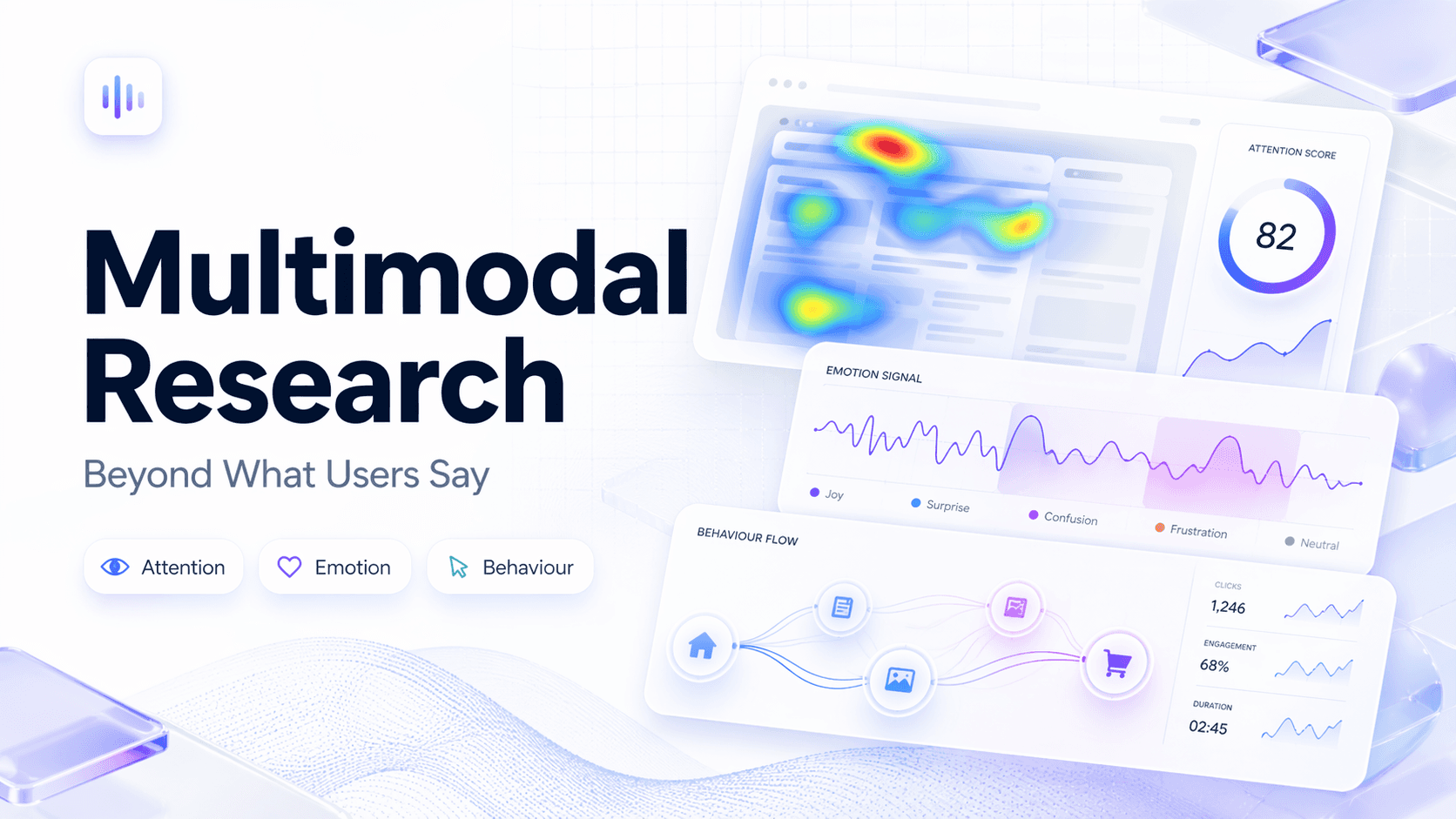
Multimodal research combines multiple signal types, such as facial coding, voice tonality, eye tracking, and stated survey responses, within a single study to build a fuller picture of consumer behavior. Rather than relying on what people say alone, it layers in how they emotionally and physically respond, revealing gaps between stated preference and actual reaction.
Why Traditional Research Is No Longer Enough
For decades, brands relied on surveys, focus groups, and analytics dashboards to understand people. But traditional methods leave an important gap. Consumers do not always say what they feel, behaviour does not always match intent, and many decisions happen below the level of conscious explanation.
That is why this approach is becoming more important. Instead of depending on one source of input, it brings together multiple signals to create a fuller picture of human response. For brands trying to strengthen consumer insights, that shift matters because it helps connect what people say, what they feel, and what they actually do.
What Is Multimodal Research?
Multimodal research combines multiple data sources and signals to build a more complete understanding of behaviour and decision-making.
This can include:
eye tracking research to understand attention and visual focus
facial coding research to understand emotional response
voice or speech analysis
behavioural interaction data such as clicks, scrolling, and navigation
physiological signals such as heart rate or skin response
The value is not in collecting these signals separately. It comes from integrating them into one view. When these inputs are interpreted together, teams can detect patterns that are easy to miss in single-source studies.
The result is a deeper understanding of how people think, feel, and act across a real experience.
Why Multiple Signals Matter
Human decisions are rarely linear. They are shaped by:
attention — what people notice
emotion — how they feel
memory — what they retain
behaviour — what they actually do
This approach captures the full chain. For example, eye tracking research can show what grabs attention first, facial coding research can show emotional engagement, and interaction data can reveal whether the person moved forward or dropped off.
When these signals are brought together, brands get a clearer decision narrative. This is one reason it is becoming more valuable within consumer behavior research. It helps teams move beyond isolated observations and toward a more realistic picture of decision-making.
Why It Is Rising
The shift is being driven by three major changes.
1. The attention economy
Consumers face constant visual and cognitive overload. That makes attention one of the most valuable signals in modern research. Eye tracking research has become especially relevant because it helps teams understand what people actually notice, what they miss, and what gets ignored.
2. The rise of subconscious decision-making
Many purchase and experience decisions are shaped by signals that people cannot fully explain in a survey response. By combining emotional, visual, and behavioural signals, brands can uncover reactions that remain hidden in self-reported feedback.
3. The need for greater accuracy
Single-source studies can be biased or incomplete. It improves accuracy by cross-validating signals, reducing self-report bias, and capturing real-time reactions. For teams that depend on strong consumer insights, this leads to more reliable interpretation.
A Practical Scenario: Where Brands Get It Wrong
Imagine a brand launches a new product page.
Traditional research says:
users like the design
the page feels clean and modern
But a multimodal approach reveals something different:
users never notice the CTA
emotional signals suggest confusion
attention clusters around less important areas
behaviour shows hesitation before conversion
The result is a familiar problem: high satisfaction, low performance.
This is the gap between what users say and what users actually experience. It is also why this kind of analysis can add value to both consumer behavior research and digital experience optimisation.
Key Benefits for Brands
1. Deeper understanding
This approach provides a richer view of how people respond by combining attention, emotion, and action. That leads to stronger consumer insights than a single survey score or interview answer can provide.
2. Stronger predictive power
When signals are combined, brands can better predict:
purchase intent
engagement levels
campaign effectiveness
3. Better UX and customer experience
Teams can identify:
friction points
drop-off moments
attention gaps
emotional disconnects
This makes optimisation more grounded in real behaviour, not just stated opinion.
4. Better marketing ROI
When brands understand how people actually respond, they can:
improve ad effectiveness
reduce wasted spend
increase conversion potential
Multimodal Research vs Traditional Research
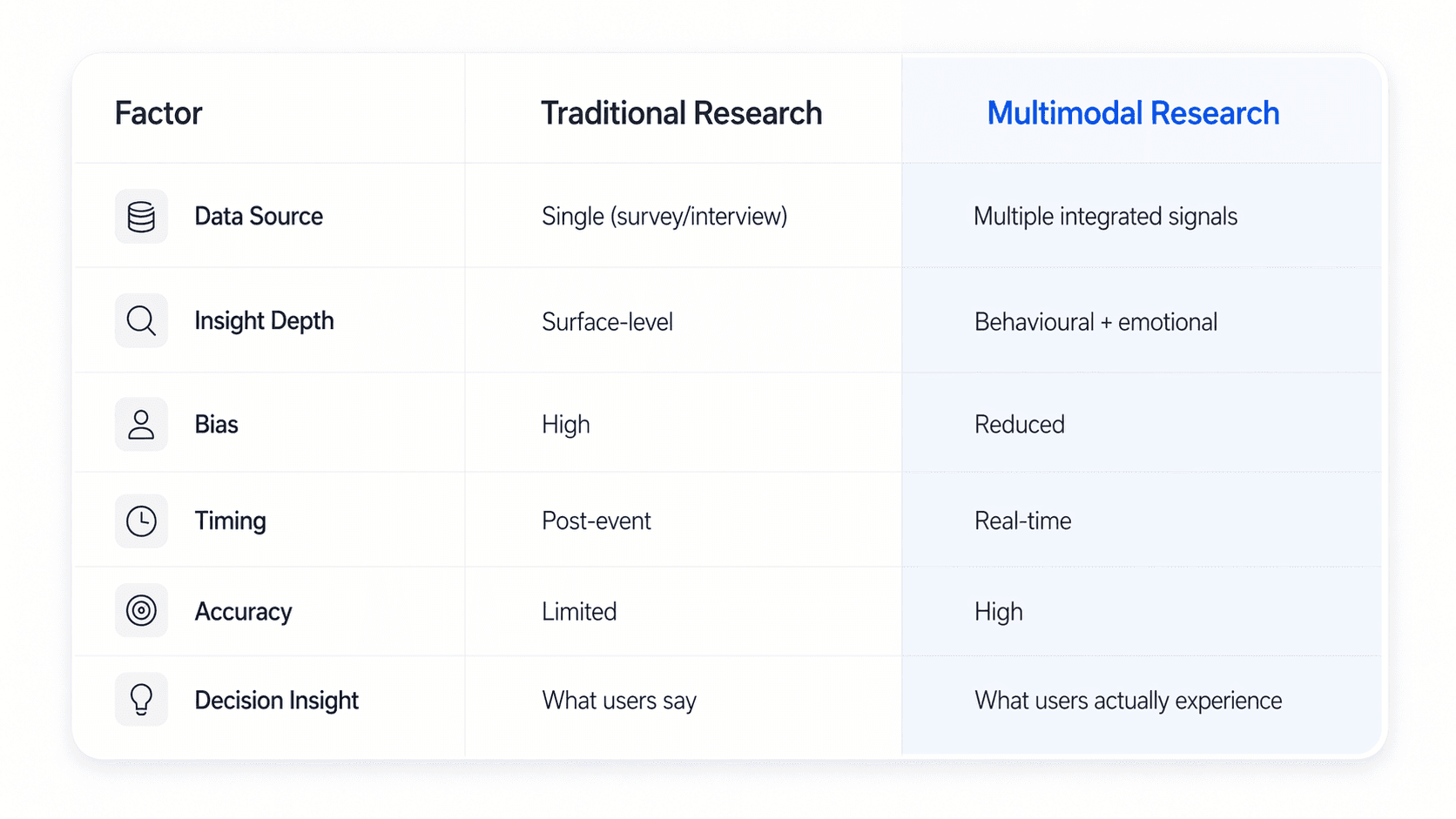
Traditional research often depends on one source such as a survey, interview, or post-event response. A multimodal approach uses integrated signals instead.
That changes the quality of insight:
traditional research often captures what users say
multimodal research captures what users say, feel, notice, and do
This is where it starts to overlap with broader behavioral research. The difference is that it does not rely on behaviour alone. It combines behavioural, emotional, and attentional data to improve interpretation.
Challenges to Consider
This approach is powerful, but it comes with challenges:
complex data integration
synchronisation across tools
higher setup effort at the beginning
However, AI-driven platforms are making this easier by simplifying signal capture, analysis, and interpretation.
The Future: From Research to Human Understanding
The future of research is not just about collecting more data. It is about understanding humans more completely.
This approach helps brands:
move beyond assumptions
decode subconscious behaviour
design experiences that resonate more effectively
As this becomes more common, brands that invest in better consumer insights will be in a stronger position than those still relying on fragmented data alone.
How Decode by Entropik Enables This Shift
As it becomes more practical at scale, brands need platforms that can unify these signals in one place.
Decode by Entropik helps teams:
capture attention, emotion, and behaviour in one platform
analyse how people interact with digital and physical experiences
identify friction points across journeys
generate actionable insights for marketing, UX, and product teams
test creatives and concepts before launch
This makes the approach more usable in everyday decision-making, while helping teams improve analysis, optimisation, and execution with greater confidence.
Final Thought
Consumers are complex. Their decisions are shaped by multiple signals, not just words.
Multimodal research reflects that reality. In a competitive market, brands that understand people more holistically will outperform those that still rely on disconnected signals and partial views.
Frequently asked questions
1. What is multimodal research?
Multimodal research combines multiple data types and methods such as facial coding, voice analysis, eye tracking, and surveys into a single study for a fuller picture of consumer behavior.
2. Why is multimodal research considered the next evolution of consumer insights?
It overcomes the limitations of relying on a single data source by triangulating emotional, behavioral, and verbal data for more reliable, holistic insights.
3. What are examples of multimodal research in practice?
Examples include combining eye tracking with facial coding during ad testing, or pairing voice tonality analysis with survey responses in customer interviews.
4. What challenges come with combining multiple research modes?
Challenges include ensuring data from different methods is properly synchronized and interpreted together, and managing the added cost and complexity of multiple data streams.
5. Which industries benefit most from multimodal research?
Industries like advertising, CPG, and entertainment particularly benefit, since emotional and attentional nuance strongly influences success in these fields.
Related Topic: