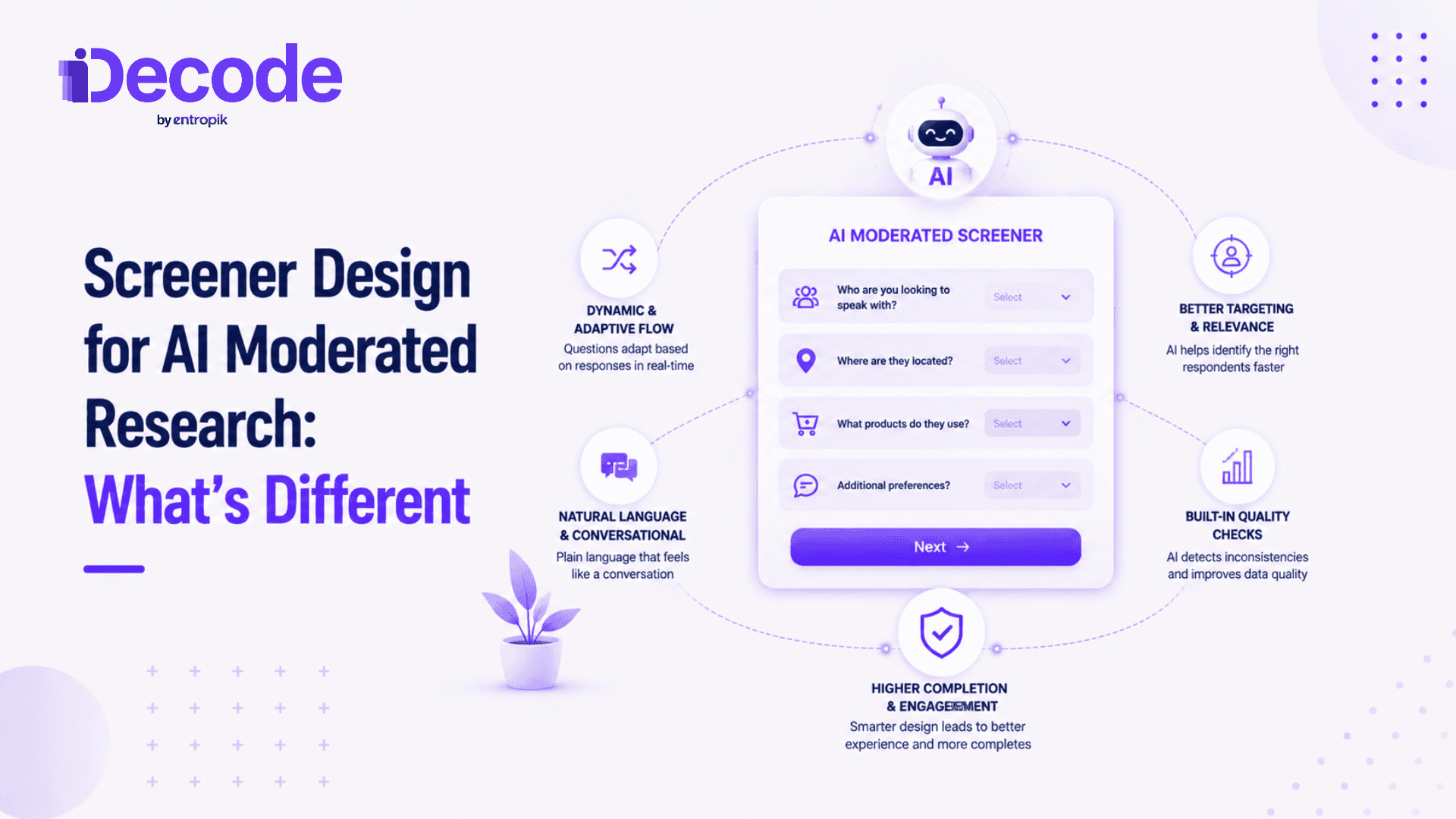
Screener design for AI moderated research is the process of building qualifying questions that filter for the right participants before interviews run automatically at scale. It differs from traditional screening by prioritizing behavioral eligibility over demographics, defending against AI-generated and fraudulent responses, and using the interview itself as a second quality check.
Summary:
|
What is a screener in AI moderated research?
A screener is the short qualifying questionnaire that sits in front of every study. It asks a handful of questions, scores the answers against a set of criteria, and decides whether a respondent moves forward or gets a polite thank-you-and-goodbye. In traditional research, that decision fed into a recruiter's spreadsheet, and a human being scheduled the interview days or weeks later. In AI moderated research, the screener feeds an automated, always-on interview that can start within minutes of someone qualifying.
That difference changes what the screener has to do. It is no longer just a filter; it is the ceiling on interview quality. If the screener lets in the wrong person, or lets in someone who is answering carelessly, the AI moderated interviews built on top of it inherit every one of those problems. A well-designed qualitative research platform can probe brilliantly, but it cannot retroactively fix who showed up.
Why screener design changes when interviews run at scale
Traditional qualitative studies fill 8 to 12 participants. A researcher reviews each application, maybe calls a few candidates, and builds a small, curated sample. Nielsen Norman Group's guidance on interview sample sizes reflects this: most exploratory studies with a tightly defined audience need only 5 to 8 interviews, with broader discovery research typically settling in the 10 to 15 range. That's a small enough number that a screener with a minor flaw is annoying, not catastrophic.
AI moderated studies commonly fill 50 to 200 participants because the interview itself is no longer the bottleneck. A small error rate that was tolerable at 10 participants multiplies fast at 150. If 5% of respondents slip through a soft screener, that's half a person in a small study and eight ruined interviews in a large one. The screener now has to be self-serve, instant, and resistant to gaming, without a recruiter reviewing every profile by hand. This is part of a broader shift toward automated, AI-assisted workflows, and it puts new pressure on research quality and rigor at every stage, not just the interview. It's worth understanding what AI moderation actually involves before rebuilding a screener around it.
What's different: four shifts from traditional screening
Four concrete changes separate screener design for AI moderated research from screener design for a scheduled, human-moderated study. Each one changes a specific design decision, not just the general approach.
The screener-to-interview lag collapses to near zero
In a traditional study, a qualified respondent waits for a scheduling email, picks a slot, and sometimes no-shows days later. In AI moderated research, qualification and interview happen back to back. There's no calendar, no re-contact, and often no delay at all.
The design implication is straightforward: drop the scheduling section entirely. Any question written to coordinate a future session, from availability windows to time zone confirmations, is dead weight. Some teams still run synchronous and asynchronous AI-moderated interviews depending on the study, and the screener should be built with that choice in mind, but in both cases the respondent moves from qualifying question to conversation faster than a traditional screener was ever designed to handle.
The interview becomes a second quality gate
This is the most useful structural change, and most teams underuse it. A traditional screener has to catch everything, because once someone reaches a human moderator, correcting a bad match mid-session is awkward and expensive. An AI interview, by contrast, can run consistency and articulation checks in the flow of conversation, catching respondents who gamed the screener but can't sustain the story once asked to elaborate.
That means the screener can lean on faster, simpler behavioral qualification up front, while the interview verifies claims in context, closing some of the gaps that come up when survey data alone isn't enough to judge whether a respondent is genuine. Teams running human-in-the-loop AI moderated research often use this second gate as a formal checkpoint, flagging interviews where behavior contradicts screener answers for researcher review before the data ever reaches analysis.
The fraud surface grows, including AI-written answers
Low-friction, high-volume recruiting attracts more than careless respondents. It attracts duplicate identities, scripted bots, and increasingly, screener answers written or polished by generative AI. A recent academic study of research participants found this is no longer a fringe concern: roughly a third of respondents admitted to using LLMs to help answer open-ended survey questions, and the resulting text tends to be more homogeneous and more positive than genuine human responses, which quietly erodes the variation a study is trying to capture.
The scale of the underlying bot problem is well documented outside market research too. Pew Research Center's landmark study of online opt-in polling found that the standard defenses barely work: the large majority of bogus respondents pass a basic trap question, and an even larger share pass a check for answering too quickly. That's a strong argument for building fraud defenses into the screener itself rather than relying on a single attention-check question, and it's why detecting fraud in AI moderated studies has become its own discipline rather than an afterthought. Research organizations are responding directly: NORC at the University of Chicago recently built a dedicated classifier for exactly this problem, treating AI-generated responses as a data quality threat serious enough to justify a purpose-built detection tool.
The design implication is to use recent, specific-example prompts ("describe the last time you did X") rather than opinion questions, since generic AI text tends to fail when asked for a concrete, recent memory.
Recruitment math rewards realistic eligibility criteria
Overly narrow qualifying criteria that filled a 10-person study can make a 100-person study impossible to recruit within a reasonable timeline. A criterion that felt safely conservative at low sample size becomes the single biggest bottleneck once the target moves into the hundreds.
The design implication is to pressure-test qualifier incidence against the actual supply pool before launch, not after the study stalls. This is closely tied to how eligibility criteria interact with quota sampling and target segment sizing, and it's a step teams skip more often than they'd like to admit.
Writing behavioral qualifying questions
The strongest screeners ask what someone did, not who they claim to be. Behavioral questions are harder to fake convincingly and harder to answer on autopilot than identity or opinion questions.
A few practical rules hold up across most studies:
Screen for behavior in a recent, specific window ("in the past 30 days") rather than general habits, which are easy to overstate.
Never reveal the study topic or the "correct" qualifying answer. Use generic category framing so respondents can't reverse-engineer what gets them in.
Place the hardest knockout question first, so unqualified respondents drop out before investing time in the rest of the screener.
Getting this wrong is one of the more common screener mistakes in AI moderated studies, and it's usually the same mistake: leading questions that unintentionally coach respondents toward the profile the researcher wants.
Setting eligibility criteria and target audience filtering
Translating a participant profile into a working screener means turning fuzzy criteria ("frequent users," "decision-makers") into explicit behavioral thresholds and exclusion rules. A vague criterion invites both false positives and honest confusion from respondents who genuinely aren't sure if they qualify.
Quotas and skip logic do the heavy lifting here, routing respondents into segments so that one easy-to-recruit group doesn't quietly fill every available slot. This is standard practice in quantitative research too, and the same discipline that prevents selection bias in a survey sample applies directly to qualitative recruitment, particularly when a study is segmented the way a stratified sample would be.
The last check matters as much as the first: does the respondent have the lived experience the study is actually mining, or just a label that happens to match?
Building recruitment logic for automated fielding
A screener built for automated fielding needs a clear sequence: knockouts first, behavioral qualification next, demographics last. Demographics are the easiest thing to fake and the least useful early filter, so they belong at the end, not the beginning.
Qualifier thresholds and routing rules need to be specific enough that a platform can enforce them without manual review, since manual review is exactly what AI moderated research is designed to remove from the pipeline. And length matters more than most teams expect. Kantar's research on respondent behavior found that a survey over 25 minutes loses more than three times as many respondents as one under five minutes, and that drop-off curve starts well before the 25-minute mark. For a screener specifically, the practical target is six to ten questions, completed in under three minutes, to protect both completion rates and the quality of the answers that do come in.
Quality control against fraud and low-effort responses
Beyond the screener's structure, a few specific tactics catch the respondents who make it through anyway.
An open-ended articulation question, scored for length and specificity rather than sentiment, prioritizes high-signal respondents and tends to filter out both bots and disengaged humans in one pass. Red herring options and attention checks still have a place, even with Pew's finding that most bogus respondents pass them, because they catch the least sophisticated fraud cheaply. And the most valuable check happens after the screener closes: flagging interviews where in-conversation behavior contradicts screener answers, so those cases can be excluded before they reach analysis rather than after.
Common screener mistakes in AI moderated studies
A few mistakes show up repeatedly across studies, and they're worth naming directly:
Telling respondents the topic upfront, or asking leading questions that prime the profile a study is looking for.
Over-disqualifying with brittle exclusion logic that shrinks the eligible field below what's actually recruitable.
Putting demographics before behavior, and reusing a static screener with a stale recall window long after it stopped matching current behavior.
Each of these is fixable, but each one also compounds. A leading question doesn't just bias one respondent's answer; it biases the entire funnel of people who make it past that question. Some of this overlaps with a much older problem in research: understanding why people misrepresent themselves in studies in the first place, whether the motivation is a cash incentive, social desirability, or simply wanting to seem like a better fit for the study.
A reusable screener structure for AI moderated research
A screener built for this environment tends to follow the same order regardless of topic:
Intro and consent, with no topic disclosure.
Hardest knockout question, placed first to filter out clearly ineligible respondents immediately.
Behavioral qualifier, asking about a specific, recent action rather than a general habit.
Category-fit routing, using quotas and skip logic to balance segments.
Articulation test, an open-ended question scored for specificity.
Demographics, last, since they're the easiest to fake and the least useful as an early filter.
The AI interview absorbs the verification work a traditional screener had to carry alone, so the screener itself can stay lean. A team studying, say, streaming habits for a concept test might knock out anyone who hasn't streamed in the past two weeks, qualify on a specific recent viewing behavior, route by content genre, and ask one open-ended question about a recent viewing decision before moving straight into the AI interview.
Screening and verifying participants at scale with Decode
Decode's AI Moderator is built around exactly this handoff. Qualified respondents route straight from the screener into the interview, with screening and interviews running across 70+ languages, which matters when studies expand well beyond the reach of a manually managed multilingual recruitment process.
The bigger differentiator is the in-interview verification layer that a pure text screener can't offer on its own. Decode reads engagement and emotional response through facial coding with more than 90% accuracy, eye tracking accuracy above 96%, and detection across 62 facial expressions, adding a behavioral quality gate on top of whatever the screener already caught. That's a meaningfully different kind of check than a written attention question, since it's measuring genuine engagement rather than a self-report that can be gamed. Decode holds 17 patents in this space and is used by 150+ global brands to run AI moderated interviews at scale without the recruitment bottlenecks a manual process creates, backed by a dedicated participant recruitment guide for teams building out their sourcing strategy.
A screener built for scale and verified inside the interview keeps AI moderated studies fast without sacrificing participant quality. That combination, not either piece alone, is what makes screening work at the volumes AI moderated research is designed to handle. Teams evaluating AI moderation platforms for the first time often focus entirely on interview quality and treat the screener as an afterthought; the teams that get the best data tend to do the opposite.
Frequently Asked Questions
1. What is a screener in AI moderated research?
It's the qualifying questionnaire that filters respondents before an AI-moderated interview begins, deciding who is eligible based on behavior, demographics, and quota fit.
2. How is screener design different for AI moderated research versus traditional studies?
The screener has to work without a human reviewer, hold up across a much larger sample, and defend against fraud and AI-generated answers on its own, since qualification often leads straight into the interview within minutes.
3. What is the difference between demographic fit and behavioral fit in screening?
Demographic fit checks who someone is; behavioral fit checks what they've actually done. Behavioral criteria are harder to fake and better predictors of whether someone has the experience a study needs.
4. How long should a screener be for an AI moderated study?
Most well-designed screeners run six to ten questions and take under three minutes, which protects both completion rates and the quality of the answers collected.
5. How do you write qualifying questions that participants cannot game?
Ask about specific, recent behavior instead of general habits or opinions, and never reveal the study topic or which answer qualifies someone.
6. How do you keep AI-generated and fraudulent responses out of a screener?
Use recent-specific-example prompts that generic AI text struggles to answer convincingly, add an articulation question scored for specificity, and treat the interview itself as a second verification layer.
7. How do you set eligibility criteria without making recruitment impossible?
Pressure-test qualifier incidence against the actual supply pool before launch, and avoid stacking multiple narrow criteria that individually seem reasonable but combine into an unrecruitable segment.
8. Can the AI interview catch participants who passed the screener dishonestly?
Yes. Consistency and articulation checks during the conversation, along with behavioral signals like engagement and emotional response, can flag respondents whose in-interview behavior contradicts their screener answers.
Ready to screen for quality at scale?
A screener that's built for AI moderated research from the start saves far more time than one retrofitted after a study runs into trouble. Explore Entropik to see how Decode's AI Moderator combines fast, behavior-first screening with in-interview verification.
Related Topics: