Live Website Testing
Company
UK-based Financial Institution
Date
Content
Entropik Team
Overview
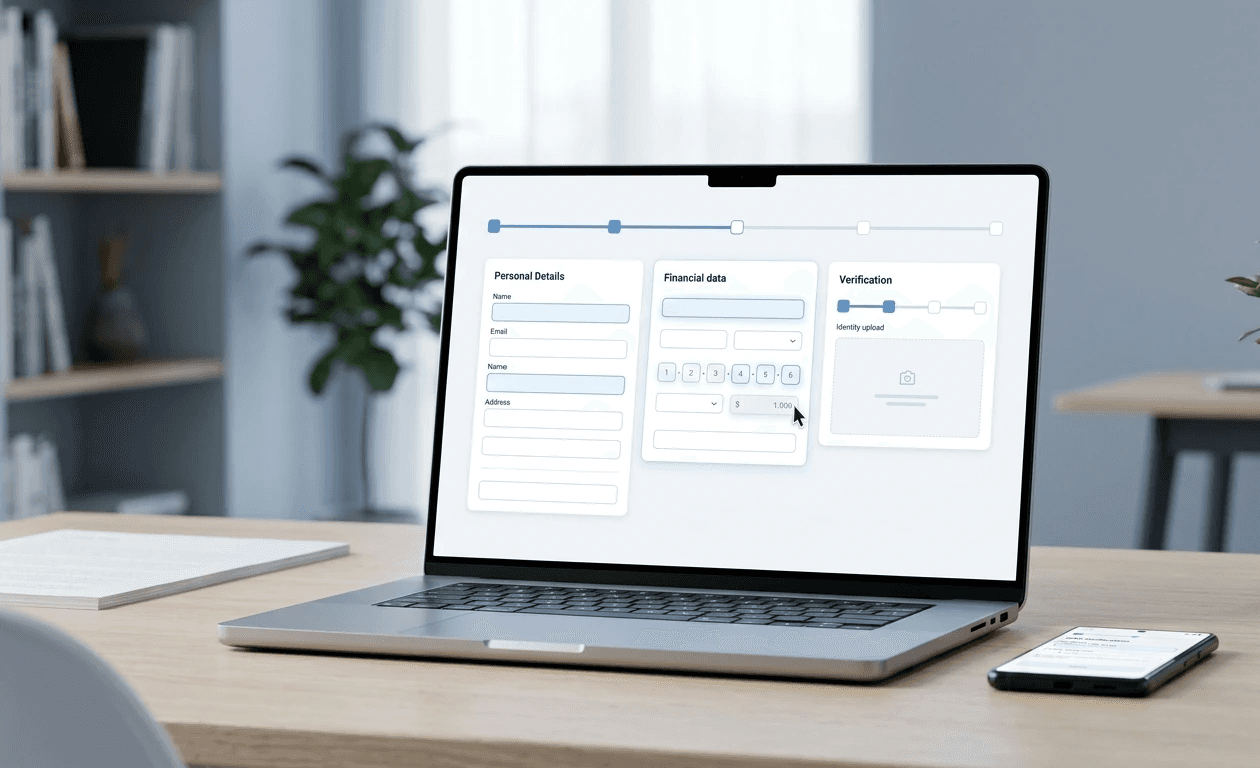
A leading global bank partnered with Entropik to evaluate the usability and effectiveness of its digital account opening journey. The objective was to understand how users navigate a complex, multi-step application form and identify friction points that could impact completion rates, confidence, and overall experience.
Using Decode, we analyzed user behavior across the entire journey - from login creation to final submission, uncovering deep insights into cognitive load, decision-making patterns, and usability gaps.
The Challenge
Opening a bank account digitally requires users to share sensitive personal and financial information across multiple stages. While the application flow was comprehensive, it also introduced complexity that could lead to hesitation, errors, or drop-offs.
The bank needed to answer critical questions:
Where do users experience friction or fatigue?
Which steps create the highest cognitive load?
How do validation errors and unclear instructions impact completion?
What prevents users from moving smoothly from start to finish?
Approach
The study was conducted using unmoderated website testing on Decode, capturing real user interactions across the live application journey.
Key elements of the approach included:
Participants: 11 UK-based users aged 25–34
Method: End-to-end task-based testing of the account opening journey
Data captured: Eye gaze, behavioral patterns, interaction delays, and survey feedback
Metrics analyzed:
Time spent per step
Drop-offs across stages
Error rates and rework behavior
User satisfaction and ease of completion
This enabled a comprehensive understanding of both user behavior and underlying cognitive effort across the journey.
Understanding the Experience
The journey revealed a consistent pattern: users were able to complete the process, but not without effort.
Early stages such as login creation and eligibility checks introduced friction due to validation errors and lack of progress visibility. Users often encountered repeated attempts when setting passwords and remained uncertain about how long the process would take.
As users progressed, the experience became increasingly demanding. Financial and personal information sections required users to recall multiple data points simultaneously, leading to pauses, hesitation, and slower completion. By the time users reached later stages such as tax details and wealth declaration, fatigue had already set in.
Verification steps added another layer of complexity. Users spent significant time understanding instructions, switching between devices, or hesitating due to lack of clarity around document requirements. In some cases, users skipped verification steps altogether, impacting completion quality.
Despite these challenges, the final stages of the journey—particularly review and submission—were relatively smooth. However, even here, inefficiencies emerged due to full-page reviews and unexpected verification prompts.
Observed Performance Metrics:
Stage | Avg. Time Spent | Observed Drop-off Rate |
Login & Eligibility | 2–3 minutes | Low (5–8%) |
Personal Details | 5+ minutes | Moderate (12–15%) |
Financial Information | 4–6 minutes | High (18–22%) |
Tax Identification | 3–5 minutes | High (20–25%) |
Verification (KYC) | 2–4 minutes | Critical (25%+) |
Review & Submit | 2 minutes | Moderate (10–12%) |
Findings
The Decode analysis surfaced several critical, measurable insights across the journey:
High cognitive load in key sections significantly increased completion time
Certain steps such as Personal Details (~303s), Employment & Income (~257s), and Tax Identifier (~191s) recorded the highest time spent, indicating heavy information processing and user fatigueDrop-offs concentrated in complex, high-effort stages
The journey flow showed multiple drop-offs across stages, particularly in information-heavy sections, highlighting the impact of fatigue and uncertainty on completionValidation errors drove repeated attempts and rework
Password creation, address fields, and tax inputs caused multiple retries due to delayed or unclear validation, increasing task time and frustrationVerification steps introduced delays and uncertainty
Users spent up to 70–140 seconds reviewing verification instructions without taking action, and ~25% exited verification flows prematurelyStrong satisfaction despite usability gaps
100% of users reported satisfaction, with 56% rating the experience as extremely satisfying, indicating strong trust and clarity despite friction points
Key Insights
The study highlighted that friction was not driven by a single issue but by the cumulative effect of multiple small inefficiencies across the journey.
The absence of progress indicators created early uncertainty, making users feel unsure about the length and effort required. This uncertainty compounded as users moved through the journey.
Mid-journey stages introduced the highest cognitive load. Users were required to recall financial details, interpret unfamiliar terminology, and navigate dense forms—all of which slowed completion and increased mental effort.
Validation design played a critical role in shaping experience. Errors that appeared only after submission disrupted flow and forced users into repetitive correction cycles.
Verification emerged as a key friction point. Lengthy instructions, unclear next steps, and lack of reassurance around data usage reduced user confidence and delayed action.
Finally, the review stage—intended to simplify completion—added unnecessary effort by requiring users to reprocess all information rather than scan and confirm key details.
Impact
The insights enabled the bank to identify high-impact opportunities to simplify and optimize the onboarding journey.
By introducing progress indicators, improving real-time validation, and simplifying complex sections, the bank could significantly reduce cognitive load and improve completion efficiency. Enhancing guidance around financial inputs and verification steps further improved user confidence and reduced hesitation.
Restructuring the review experience into a more scannable format helped streamline final completion, minimizing fatigue at the most critical stage.
These changes collectively contribute to a faster, more intuitive, and more trustworthy onboarding experience.
Conclusion
This study demonstrates how even well-designed digital journeys can benefit from deeper behavioral analysis. While users were able to complete the process, Decode revealed the hidden effort behind their actions—highlighting where experience could be made more intuitive and efficient.
By addressing these friction points, the bank is better positioned to deliver a seamless digital onboarding experience that balances compliance requirements with user ease and confidence.