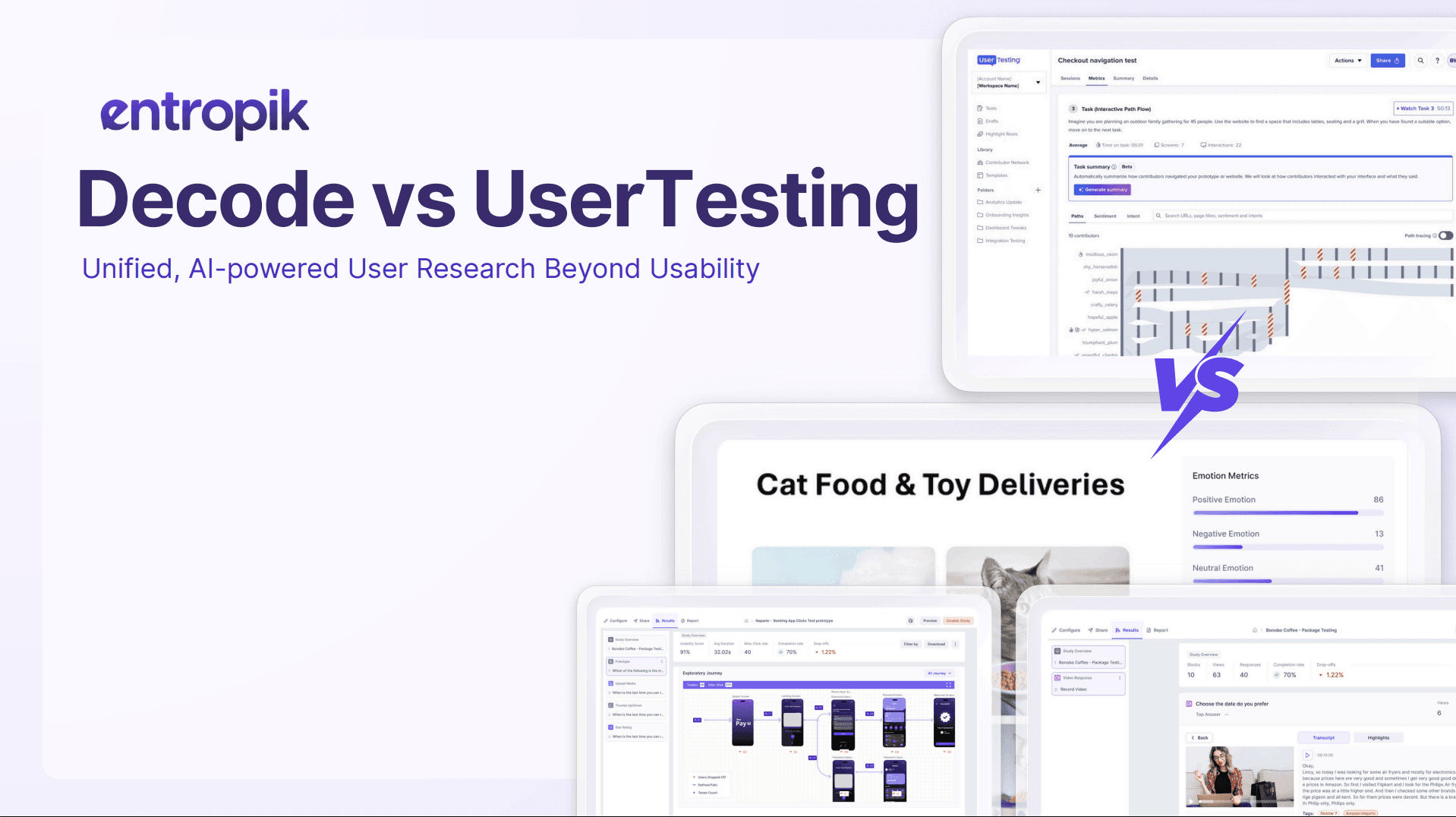
Decode vs. UserTesting: A Complete Breakdown for Modern User Research Teams
In today’s experience-driven world, user research cannot stop at usability - it must decode behaviour, emotion, and intent. While UserTesting has long been a go-to platform for gathering task-based feedback, organisations now demand deeper, faster, and more scalable insight generation.
This is where Decode (Entropik) stands apart.
Decode unifies behavioural analytics, emotion AI, attention tracking, and AI automation into one platform, offering a more holistic approach to user research compared to UserTesting’s traditional video-feedback model.
This blog compares both platforms across capabilities, use cases, panel quality, and overall value, helping you choose the right solution for your user research maturity.
Decode vs. UserTesting: Quick Snapshot
UserTesting captures user reactions.
Decode understands behaviour.
Here’s how the two platforms position themselves:
UserTesting | Decode (Entropik) |
|---|---|
On-demand usability testing and video feedback tool | Mixed-method user research powered by Emotion & Attention AI |
Focus on task-based usability and qualitative feedback | End-to-end research: usability, interviews, diary studies, behavioural analytics |
UX & product teams needing fast feedback | ResearchOps, UX, Product & CX teams seeking scale, depth & governance |
The Problem with Traditional User Research Tools
Most organisations using legacy testing tools face one or more of these challenges:
Fragmented tools and workflows
Teams juggle separate platforms for surveys, interviews, usability, recruitment and analysis.Lack of emotional context
Clicks show what users did—not why.Manual and time-consuming analysis
Hours of tagging, scrubbing videos and building reports.Siloed insights
Studies get repeated because no unified repository exists.High operational cost
Complex workflows slow down time-to-insight.
Decode addresses all of these with an AI-first architecture built for enterprise scale.
Decode vs. UserTesting: Strengths and Limitations
Where Decode Leads
Decode’s Strengths | UserTesting’s Limitations |
|---|---|
AI Copilot automates transcription, tagging, summaries | No AI capabilities; requires manual review |
Emotion & Attention AI for behavioural depth | No emotional or behavioural analytics |
Insights delivered up to 6× faster | Manual workflows slow scaling |
Global panel of 80M+ participants + BYOP | Small, repetitive tester pool |
Combines qual, quant & behavioural signals in one flow | Siloed studies without a repository |
Prototype analytics, sentiment tracking, auto-insights | Limited to video-based task feedback |
Decode is intelligent, integrated, and enterprise-ready.
UserTesting remains manual and siloed.
Product & Feature Comparison
Below is a detailed use-case comparison to help evaluate the platforms.
Feature-by-Feature: Decode vs UserTesting
Use Case | Decode (Entropik) | UserTesting |
|---|---|---|
Prototype & Design Testing | AI Copilot surfaces friction using Emotion & Attention AI | Basic task tests; manual analysis |
Website & Experience Testing | Tracks gaze & emotional reactions on live pages | No behavioural or emotional metrics |
Concept & Ad Validation | Combines qualitative insights with Emotion AI | Collects opinions only |
Moderated & Unmoderated Studies | Auto transcript, tagging, sentiment maps | Manual review |
Repository & Insight Reuse | Unified, searchable research memory | Siloed studies; no reuse |
Participant Pool | 80M+ global users + BYOP | Small, experienced, repetitive testers |
One platform. Multiple layers of capability.
The AI Advantage of Decode
UserTesting is built around video captures.
Decode is built around AI-driven intelligence.
Advantage | Decode | UserTesting |
|---|---|---|
Insight Generation | AI Copilot auto-synthesizes insights | Manual tagging and reporting |
Behaviour Analysis | Emotion & Attention AI | Basic clicks; no emotion |
Panel Quality | Global, diverse + BYOP | Limited, repetitive testers |
Research Scale | AI accelerates throughput | Slows as data volume increases |
Knowledge Reuse | Unified research repository | Scattered insights |
How Decode Wins
Decode enables organisations to:
Scale behavioural research globally
Decode emotion, attention, and behavioural cues—not just usability
Generate insights 10× faster with AI automation
Avoid redundant work with a unified repository
Reduce dependency on agencies and manual analysis
Build a governed, searchable research memory
Decode doesn’t just show what users do.
It reveals how they feel, why they act, and where experiences break.
Key Value for Buyers
Teams choose Decode because it provides:
Depth
Emotion, attention, and behavioural signals in every study.
Speed
AI reduces manual effort and accelerates reporting.
Continuity
A unified repository ensures research reuse across teams.
Diversity
80M+ participants with BYOP flexibility.
Cost Efficiency
Enterprise-grade research at lower total cost.
Proof of Impact
Across global enterprises, Decode has delivered measurable impact:
6× faster insight generation
95% knowledge retention & reuse through the repository
Reduction in redundant research across teams
Lowered costs by replacing external research vendors
One platform. One source of truth.
Final Takeaway
UserTesting helps you see what users do.
Decode helps you understand why they do it.
If your organisation’s goal is scalable, automated, emotion-aware user research—Decode offers a clear advantage.