Decode and Suzy are consumer insights platforms that help organizations gather, analyze, and act on customer feedback. While both support market research and insight generation, they differ in research methodologies, AI capabilities, analytics, and scalability. Comparing Decode vs Suzy helps teams identify the platform that best aligns with their research objectives and business needs.
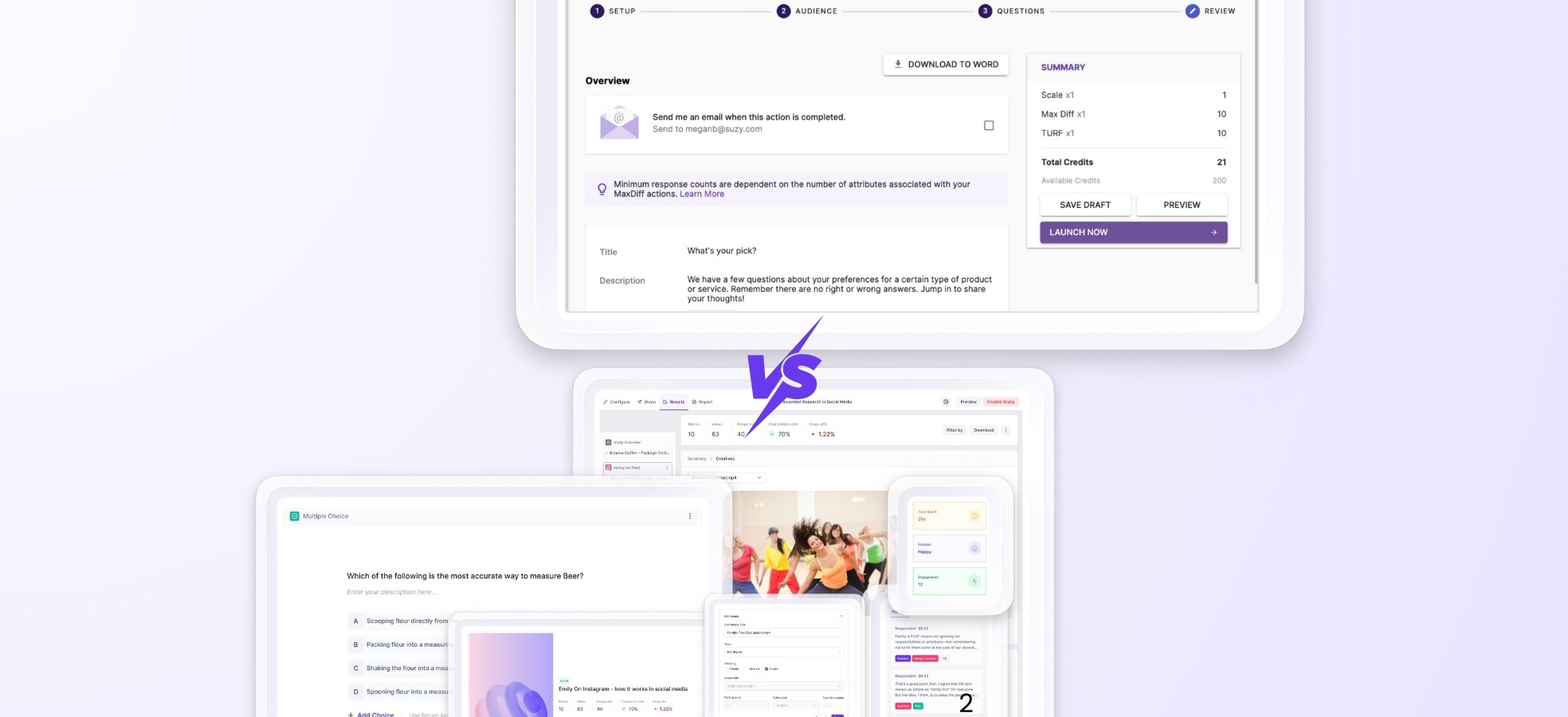
Summary
|
Suzy is a consumer insights and survey platform. Decode's Consumer Insights module is the equivalent — one of five products within Decode's unified research platform. The other four are AI Moderator (AI-moderated qualitative interviews), User Research (UX and usability), AI Creative Insights (ad and creative testing), and Insights Hub (research repository). When teams evaluate this comparison, they are often comparing a specialist survey-and-insights tool against a single module of a platform that also runs qualitative interviews at scale, measures emotional and attentional response to creative work, and stores findings across all study types in one searchable archive.
The Consumer Insights comparison itself is worth making carefully. Suzy focuses on fast survey research, AI-moderated conversations, and access to verified consumer panels. Decode's Consumer Insights adds behavioral measurement — facial coding, eye gaze tracking, and voice emotion analysis to the same research session, capturing how people react rather than only what they report.
Decode vs Suzy at a glance
Suzy is purpose-built for fast consumer survey and conversational research, primarily in the US market. Decode is a behavioral research platform whose Consumer Insights module covers the same use case with measured emotion, attention, and gaze added plus four other products that extend the research program well beyond what Suzy covers. The core differences at the Consumer Insights layer:
Measurement signals: Suzy captures what people say via surveys and AI-moderated conversations. Decode also captures facial expression, eye gaze, and voice emotion as dedicated measurement technology.
Research modes: Both support quant and qual. Decode adds a behavioral layer in the same study session.
Language and market coverage: Suzy is strongest in the US market. Decode supports 70+ languages for multi-market research.
AI capability: Suzy's AI summarizes and surfaces trends. Decode's AI measures, scores, and predicts behavioral response.
Repository: Both store findings. Decode's Insights Hub combines behavioral and attitudinal data in one searchable archive.
It is worth stating upfront: Suzy is a strong fit for US-focused, high-velocity survey programs. This comparison is for teams evaluating which layer of evidence their research decisions actually need.
What is Suzy?
Suzy is an AI-native consumer insights platform founded in 2017 and headquartered in New York. Led by founder Matt Britton, Suzy targets mid-market and enterprise insights teams running recurring learning programs.
Its product suite includes Suzy Insights (survey builder), Suzy Audiences (panel and targeting), Suzy Live (moderated interviews and focus groups), Suzy Speaks (AI-moderated conversations), Suzy Signals (trend and cultural intelligence), Ask Suzy (conversational AI agent), and BIOTIC (proprietary bot detection).
Typical use cases: concept testing, packaging and message testing, shopper insights, consumer profiling, competitive analysis, and trend monitoring. Primary buyers are research directors, insights VPs, and brand strategy teams.
What is Decode by Entropik?
Decode is Entropik's Emotion AI and human insights platform that combines quantitative, qualitative, and behavioral research so teams can measure what consumers say, feel, and where they focus.
Core technology stack:
Platform modules include Consumer Insights, User Research, AI Creative Insights, Insights Hub, and AI Moderator.
Verified platform figures: 90%+ facial coding accuracy, 96% eye tracking accuracy, 62 facial expressions tracked, 70+ languages supported, 17 patents, 150+ global brands.
Typical use cases: ad and creative testing, packaging and shelf testing, UX and usability research, brand and campaign diagnostics, multi-market studies.
Decode vs Suzy: side-by-side comparison
| Decode by Entropik | Suzy |
Platform category | Behavioral + multimodal insights | Survey + qual + trend intelligence |
Core strength | Measured emotion, attention, eye gaze | Fast quant + AI-moderated conversations |
Research modes | Quant, qual, behavioral | Quant, qual, trend monitoring |
Behavioral signals | Facial coding, eye tracking, voice emotion, attention | Text and voice sentiment via conversations |
AI capabilities | AI Moderator, Predictive Creative AI, emotion scoring | Suzy Signals, Ask Suzy, AI summaries |
Panel model | BYO + external partners (103M+ participants, 120 countries) | Proprietary + partner panels, US-primary |
Language/market coverage | 70+ languages, global | Primarily US and English-language markets |
Predictive modeling | ✅ Predictive Creative AI | Limited |
Research repository | ✅ Insights Hub (behavioral + attitudinal) | Dashboards + AI synthesis |
Typical buyer | Consumer insights, CPG, UX, creative teams | Mid-market brand and insights teams |
Pricing | Custom / enterprise | Subscription + credits + enterprise contracts |
The category difference matters more than the feature checkboxes. Suzy is a faster way to collect what people tell you. Decode adds a layer for what people actually do and feel.
How each platform approaches research methodology
Quantitative research and survey capabilities
Both platforms support survey-based quantitative research with standard question types, logic, and templates. Advanced methods — monadic and sequential monadic testing, MaxDiff, TURF, van Westendorp, and Gabor-Granger are available on Suzy. Decode supports these methods alongside behavioral enrichment, meaning survey responses from the same respondent can be matched to their facial, gaze, and voice signals from the same session rather than analyzed in isolation.
Public reviews on G2 and Capterra note recurring constraints with Suzy around question programming flexibility and attribute character limits in complex survey designs. Teams running highly customized quantitative instruments have flagged this as a limitation in comparison with more open-ended survey builders.
Qualitative and conversational research
Suzy Live covers one-on-one interviews, focus groups, and in-home use tests. Suzy Speaks runs AI-moderated conversational surveys. Both generate transcripts and AI-generated themes.
Decode's AI Moderator (Mira) runs automated, multilingual moderated interviews at scale adaptive probing, real-time follow-up, available in 70+ languages. Qualitative output is directly analyzable alongside quantitative and behavioral data in the same platform.
A useful framing for methodology choice: what people say (survey), how people explain (qualitative), how people react (behavioral). Most platforms cover the first two. Decode covers all three in one session.
Behavioral and emotion measurement
This is the decisive difference and deserves the clearest explanation.
Self-reported answers capture considered, rational responses — what a participant consciously decided to say after processing the question. Behavioral signals capture the fast, non-conscious layer: where attention goes in the first two seconds, what triggers a micro-expression before the participant has composed a sentence, what tone and hesitation in speech reveal about confidence or discomfort.
Research published by NCSolutions found that creative quality drives approximately 49% of advertising's incremental sales impact more than targeting, reach, or recency combined. Understanding creative quality at that level of precision requires measuring how attention and emotion respond to the creative, not only what participants say about it afterward.
Kantar's attention research distinguishes between passive and active attention, and its effectiveness databases consistently show emotionally resonant ads producing disproportionate long-term brand impact. Both findings point to the same measurement requirement: facial and gaze data.
Audience access, panel quality, and global reach
Suzy's panel model combines proprietary verified audiences with partner panels, with BIOTIC bot detection for fraud prevention. Its panel depth is strongest in the US market. Public reviews and competitor analyses consistently note constrained coverage outside English-speaking markets, and panel diversity concerns for specific demographic segments.
Decode supports bring-your-own-panel research with full flexibility, plus integration with external panel providers giving access to 103M+ profiled participants across 120 countries via Cint and Dynata. The 70+ language support means study design, moderation, and synthesis run in local languages rather than requiring post-study translation.
Why this matters operationally: localized moderation produces fundamentally different data quality than translated surveys administered in a second language. For CPG teams running multi-market studies where cultural calibration in responses is itself a research variable this distinction affects the validity of the findings.
Data quality controls: both platforms apply fraud detection, speeding, straightlining, and attention checks. Decode's behavioral signals add an additional validity layer — facial and gaze data reveal disengaged respondents that survey-based attention checks frequently miss.
| Decode | Suzy |
Audience model | BYO + external partners | Proprietary + partner panels |
Geographic reach | 120 countries | US-primary |
Language support | 70+ languages | Primarily English |
BYO panel | ✅ | ✅ |
Bot/fraud detection | ✅ | ✅ BIOTIC |
AI capabilities compared
Both platforms lead with AI. The distinction buyers need is between AI that summarizes data you already collected, and AI that expands what you can collect.
Suzy's AI layer: Suzy Signals monitors trend and cultural intelligence, Ask Suzy acts as a conversational agent for launching studies and querying results, AI summaries synthesize open-ended responses, and Suzy Speaks moderates conversations.
Decode's AI layer: the AI Moderator conducts adaptive qualitative interviews at scale, Predictive Creative AI models pre-launch performance based on attention and emotion signals, and automated emotion and attention scoring runs across every study in Insights Hub.
A three-tier distinction that clarifies the comparison:
AI for synthesis — faster processing of data you collected (both platforms)
AI for collection — automated moderation at scale (both platforms)
AI for measurement — predicting and scoring behavioral response before launch (Decode)
According to McKinsey & Company, AI feature adoption has accelerated rapidly across enterprise functions, but measurable value from those features varies significantly. For research teams, the question is whether AI is improving what you measure or only how quickly you report what you already measured.
Insights repository and workflow
An insights repository is a centralized, searchable store of past studies, findings, and assets — one that prevents duplicate research and compounds institutional knowledge over time. According to Forrester Research, enterprise teams frequently fund repeat research on questions already answered internally because findings are inaccessible or unconnected across tools.
Decode's Insights Hub stores quantitative, qualitative, and behavioral data in one searchable archive. Teams can search across past studies for specific themes, emotion patterns, or attention findings and reuse clips and verbatims across decks.
Suzy offers dashboards, AI synthesis, and reporting integrations. Its model is study-centric rather than archive-centric.
For enterprise teams running 20+ studies per year, the long-term value of a repository compounds with use. The platform that stores behavioral signals alongside survey data is the one that gets more useful over time.
Pricing
Suzy operates on a subscription and credit model, with self-serve tiers and enterprise contracts. Based on publicly available information, entry tiers are reported in the hundreds of dollars per month, with enterprise annual contracts scaling substantially depending on usage volume, question count, and seat licensing. Historical criticism across review platforms notes that costs scale with questions and seats rather than responses, which affects the economics of complex or high-volume designs. Verify current pricing directly at suzy.com.
Decode is enterprise-priced with custom contracts based on research scope, platform access, and panel sourcing.
Total cost of research is a more useful comparison than sticker price. The relevant dimensions: platform licence, respondent cost, seat policy, onboarding, support, and cost per usable insight. A platform priced lower per question may cost more per actionable finding if it requires additional tools for behavioral, creative, or non-English market coverage.
Where Suzy is the stronger choice
US-focused programs where panel depth in a single market matters more than global reach
High-velocity, high-volume survey programs where turnaround time is the dominant constraint
Teams that want always-on trend and cultural signal monitoring as a standing capability
Organizations standardizing on a self-serve survey tool for broad internal adoption
Teams whose decisions do not require creative diagnostics or attention-level evidence
Where Decode is the stronger choice
One framing before the specifics: Suzy competes with Decode's Consumer Insights module — one of five Decode products. Teams that choose Decode aren't just switching consumer insights tools; they're moving to a platform that also runs AI-moderated qualitative interviews at scale (AI Moderator), creative and ad testing (AI Creative Insights), usability and UX research (User Research), and institutional knowledge management (Insights Hub). If your team uses separate tools for any of those today, that consolidation is part of the Decode value case.
The Consumer Insights-to-Consumer Insights comparison:
Ad and creative testing where the team needs to know which three seconds lost attention, not only that the ad scored 6.2 out of 10
Packaging and shelf research where gaze sequence and fixation reveal what shoppers actually notice in a competitive set
Multi-market and non-English research, supported by 70+ languages
UX and usability research where attention and frustration signals explain drop-off that think-aloud narration misses
Programs where the same respondent needs to be measured across survey, interview, and behavioral layers in one session
Enterprise teams building a compounding research repository rather than running isolated studies
Decision framework: If your research question is what, how much, or how many — a survey platform is often sufficient. If your question is why, where exactly, or how strongly you need behavioral measurement alongside the survey.
Why teams look for Suzy alternatives
Based on publicly available reviews on G2 and Capterra, the most common evaluation triggers when teams look beyond Suzy are:
Global and multilingual coverage: Teams expanding beyond North American markets find panel availability and language support limited
Question programming flexibility: Complex survey logic and character limits on attribute batteries create friction for experienced researchers
Behavioral and biometric measurement: Teams running creative testing or attention research need facial coding and eye tracking that Suzy doesn't offer natively
Panel diversity: Some buyer profiles, particularly non-standard demographics, report under-representation in panel compositions
Pricing structure: Costs scaled by question volume and seat count rather than by responses affect the economics of high-complexity designs
Each of these reflects a genuine buyer consideration, not a defect. Suzy is built for a specific use case and serves it well. Teams whose research has outgrown that use case are the ones evaluating alternatives.
Decode vs Suzy: the bottom line
Suzy is a fast, well-built survey and conversational research platform with strong US panel access and growing AI capabilities. It serves mid-market and enterprise teams running high-velocity quant and qual programs efficiently.
Decode is a behavioral measurement platform that adds facial coding, eye tracking, and voice emotion analysis to the same research workflow. It is built for teams whose decisions depend on emotional, attentional, and behavioral evidence particularly across multiple markets and languages.
The two are not always mutually exclusive. Some enterprise teams run both: Suzy for fast domestic survey velocity, Decode for behavioral depth on creative testing and multi-market programs.
Choose Suzy if the priority is US survey speed and depth. Choose Decode if decisions depend on how consumers actually react not only what they tell you.
How Decode helps
Understanding what consumers say is the starting point. What they look at, how they react before they compose an answer, and whether their stated preference matches their actual behavioral response, that's what Decode measures.
Decode's AI Moderator (Mira) runs adaptive qualitative interviews at scale across 70+ languages. Consumer Insights handles quantitative and behavioral research across categories. AI Creative Insights applies Facial Emotion AI, Eye Gaze Tracking, and Attention Measurement to ad and creative pre-testing. Insights Hub stores all findings — verbal, behavioral, and attitudinal in one searchable archive.
For teams whose research questions depend on what consumers actually do and feel — not only what they tell you — that combination is what Decode is built for.
Frequently asked questions
1. Can I switch from Suzy to Decode without losing past research data?
Decode supports data import and integration with external files, and its Insights Hub is designed to store findings from multiple research sources. For specific data migration requirements, contact Decode directly before switching.
2. Is Decode more expensive than Suzy?
Both platforms are enterprise-priced with variable contracts. Suzy's credit-based model means cost scales with question volume and seat count. Decode's pricing is based on research scope and platform access. Total cost of research — including panel sourcing, additional tools for behavioral coverage, and seat licensing — is a more accurate comparison than entry price alone.
3. Does Suzy offer facial coding or eye tracking?
No. Suzy captures text and voice-based sentiment through conversational research. It does not offer dedicated facial coding or eye gaze tracking. Decode provides both — facial coding at 90%+ accuracy across 62 expressions, and eye tracking at 96% accuracy.
4. Which platform is better for US-focused consumer research?
Suzy's proprietary panel depth and BIOTIC bot detection are well-suited for high-volume US market research programs. For US-focused programs that also require creative testing or behavioral diagnostics, Decode supports the same market with additional behavioral measurement layers.
5. Does Suzy support global or non-English markets?
Suzy's panel is primarily US-based, with limited coverage in non-English markets. Decode supports 70+ languages with external panel access across 120 countries, designed for teams running simultaneous multi-market studies.
6. What is BIOTIC and does Decode have equivalent fraud controls?
BIOTIC is Suzy's proprietary bot detection system for panel quality. Decode applies standard fraud and quality controls including speeding, straightlining, and attention checks, with behavioral signal data providing an additional validity layer — facial and gaze activity identify disengaged respondents that survey-based checks frequently miss.
7. Which platform is better for ad and creative testing?
Decode is the stronger choice for ad and creative testing. Pre-launch creative performance requires knowing where attention goes, when it drops, and what emotional response the creative triggers. Decode's Facial Emotion AI, Eye Gaze Tracking, and Attention Measurement provide this. Suzy supports concept validation through surveys and conversations but does not offer frame-level attention or emotion measurement.
Try Decode
See how leading brands measure real consumer reactions before launch — across surveys, interviews, and behavioral data — in one platform.