Strategic Industry Resource Copy

Introduction: The Problem with Traditional Research
Consumer research has always faced a trade-off:
Move fast with surveys but get shallow insights
Go deep with qualitative research but spend more time and money
But there’s a deeper issue most methods miss:
Consumers often say one thing and do another.
This is known as the say-do gap — the difference between what people claim and how they actually behave. For example:
Someone says they like a design but never looks at it
They claim they’d buy a product but scroll past it instantly
Traditional research methods — and even newer AI tools — mostly capture what people say, not what they feel or do.
That’s the limitation this new category of behavioral intelligence platforms aims to solve.
The Core Problem: Research That Only Captures Words
AI-native research tools have improved speed and reduced costs. But most still rely heavily on language — surveys, responses, or AI-led conversations.
The assumption is simple:
What people say reflects what they think and feel.
But behavioral science shows that:
People are influenced by social desirability bias
Memory is unreliable
Many reactions are subconscious
As a result, self-reported data often diverges from real behavior.
Understanding the Say-Do Gap
Here’s how the gap shows up in real scenarios:
“I love this design” → never looks at key elements
“I’d buy this” → leaves the page in seconds
“The ad was clear” → shows confusion during key moments
“I prefer this concept” → engagement drops quickly
This isn’t rare — it’s the default in research based only on words.
To close this gap, research needs to measure:
What people feel
Where they look
How they respond in real time
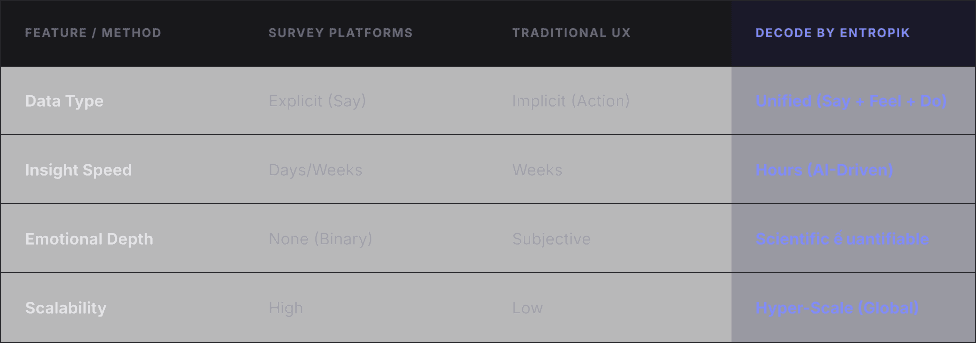
The Research Platform Landscape
Not all research tools capture the same kind of data. Understanding this is key before evaluating platforms.
1. Survey Platforms
Capture: Stated opinions
Limitations: No behavioral or emotional data
2. AI-Moderated Tools
Capture: Richer responses with AI follow-ups
Limitations: Still language-only
3. Traditional UX Tools
Capture: Behavioral actions (clicks, navigation)
Limitations: No emotional context
4. Research Agencies
Capture: Deep qualitative insights
Limitations: Expensive, slow, hard to scale
5. Behavioral Intelligence Platforms
Capture:
Language
Emotion
Attention
Gaze
Voice
These are designed to bridge the say-do gap by combining multiple signals.
What Behavioral Signals Reveal
Modern platforms go beyond surveys by capturing signals like:
Facial expressions → emotions like joy, confusion, surprise
Eye tracking → what users actually focus on
Voice tonality → sentiment and hesitation
Attention tracking → engagement patterns
Predictive AI → forecast performance before launch
These signals provide a more accurate view of real behavior because they’re biological and harder to fake.

Diagnosing Your Research Problems
Before choosing a platform, identify your biggest challenge.
Common Issues:
1. Stale Insights
Research takes too long → insights become outdated
2. Data Vacuum
Research is expensive → decisions rely on guesswork
3. Shallow Understanding
You have data, but not the “why”
4. Surface-Level Signals
People say positive things, but results don’t match
5. Fragmented Tools
Multiple vendors → siloed data and inefficiency
Most teams face at least one of these problems.
What to Optimize For
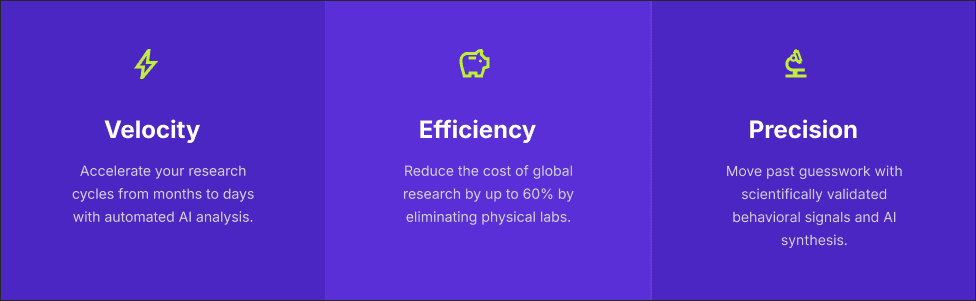
When evaluating any research platform, focus on three core metrics:
1. Speed to Insight
How quickly can you go from question to decision?
2. Cost to Insight
What is the total cost (tools + team effort)?
3. Depth of Insight
Are you uncovering real behavior or just better surveys?
Strong platforms balance all three, not just speed.

The Five Stages of a Research Study
A complete platform should support the entire research lifecycle:
1. Study Creation
Designing objectives and research setup
2. Recruitment
Finding and qualifying participants
3. Moderation / Fieldwork
Running interviews, surveys, or tests
4. Analysis
Identifying patterns and insights
5. Presentation
Sharing findings with stakeholders
If a platform only helps in one or two stages, your team still carries the workload.

The Case for a Unified Platform
Most teams use multiple tools:
Survey tools
UX testing platforms
Qual interview tools
Creative testing tools
Insight repositories
This leads to:
Data silos
Manual synthesis
Higher costs
A unified platform brings everything together, allowing:
Cross-study insights
Faster decisions
Lower operational overhead