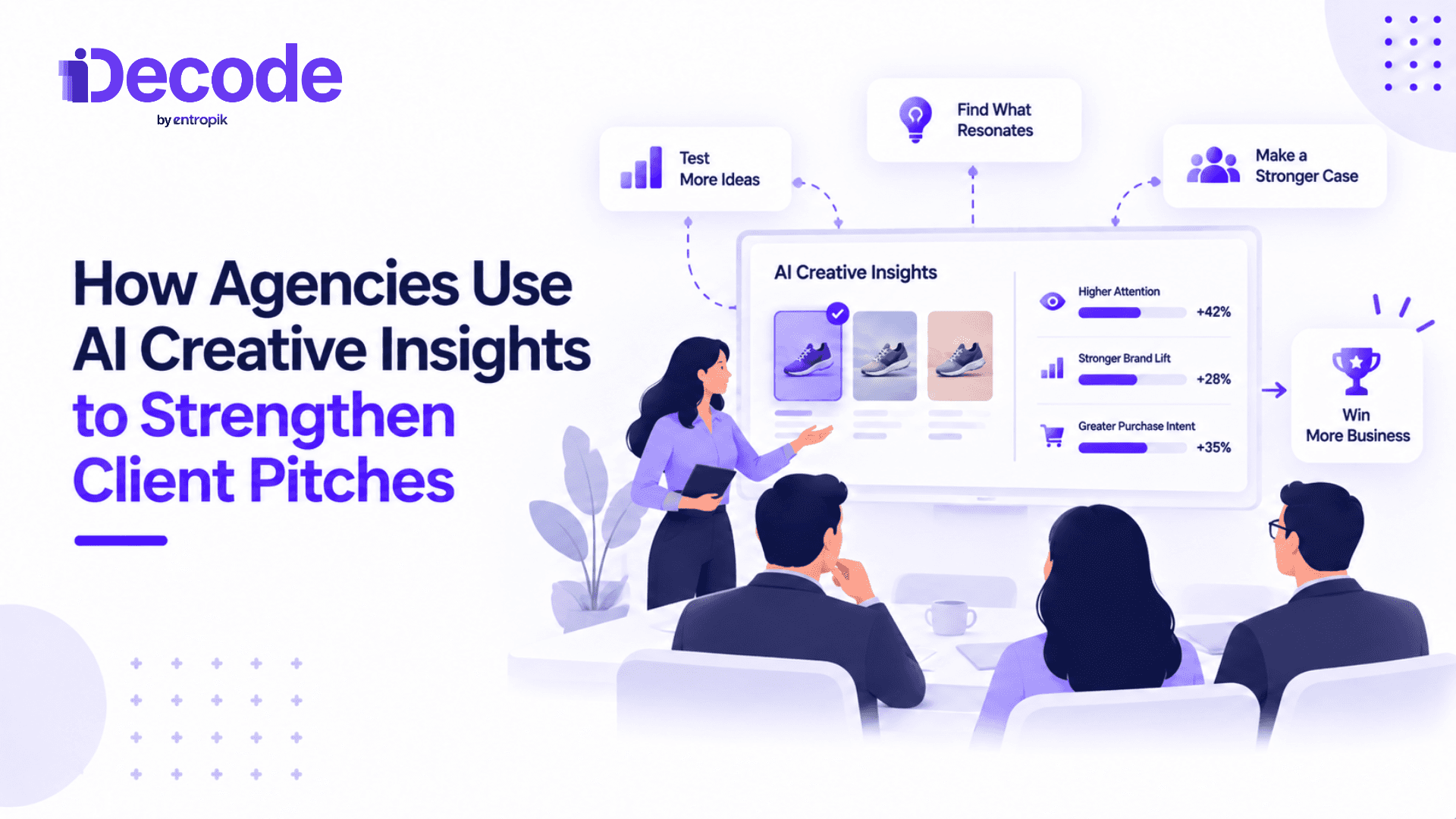
AI creative insights for agencies use predictive analytics, creative testing, attention data, emotional response, and audience evidence to evaluate advertising ideas before presentation or launch. Agencies can use these insights to support creative recommendations, compare concepts, identify optimization opportunities, and give clients measurable evidence alongside strategic and creative judgment
Summary:
|
Almost every agency now says it uses AI. According to Forrester's The State Of AI Inside US Marketing Agencies, 2026, nine in 10 US agencies use generative AI and half use agentic AI for marketing execution. When nearly everyone makes the same claim, it stops being a reason for a client to choose you.
What still sets an agency apart is the quality of its thinking and how convincingly it can back that thinking up. Clients want to know why one creative route deserves their budget over another, and "our team loves it" is a weak answer. This is where AI creative insights earn their place in the pitch: they give agencies observable evidence about how audiences are likely to respond, so the conversation can move from taste to creative effectiveness.
This guide covers what AI creative insights are, where they fit in pitch development, which metrics belong in a deck, and how to present them without overclaiming.
What Are AI Creative Insights for Agencies?
AI creative insights for agencies are data-driven analyses that evaluate advertising concepts, executions, and messaging before presentation or launch. They combine predictive analytics, attention data, emotional response measurement, and audience feedback to show how a creative idea is likely to perform and why.
In practice, agencies use AI creative testing across strategy development, concept screening, creative refinement, and pre-launch validation. The output is not a creative idea. It is evidence about an idea: where audiences look, when they react, what they remember, and whether the intended message lands.
This distinction matters. Using generative AI to write pitch copy or produce mood boards is a productivity gain, and most agencies already do it. Using predictive creative AI and behavioral measurement to validate the work is different. One helps you make more content. The other helps you prove which content deserves investment.
Why AI Alone Is No Longer an Agency Differentiator
The same Forrester research found that improving staff productivity remains the primary goal behind agency use of genAI (81%) and AI agents (63%). That is a sensible objective, but efficiency gains are easy for competitors to match. If every shop can generate ten concepts in an afternoon, speed becomes table stakes.
Clients are also under pressure to justify every decision. The Gartner 2026 CMO Spend Survey found that marketing budgets rose only slightly, to 7.8% of company revenue in 2026 from 7.7% in 2025. The same survey showed that while 70% of CMOs call becoming an AI leader a critical goal, only 30% report mature AI readiness. For agencies, that gap is an opening. Clients want partners who can turn AI into better decisions, not just faster output.
Creative judgment still matters. McKinsey's analysis of creativity and business performance found that 67% of companies in the top quartile of its Award Creativity Score delivered above-average organic revenue growth. Creativity drives results. The agencies that stand out will pair strong creative instincts with evidence that shows clients those instincts are sound.
How AI Creative Insights Strengthen an Agency Pitch
Creative is not a minor variable in campaign performance. Nielsen's analysis of nearly 500 FMCG campaigns found that creative remained the single biggest driver of sales lift from advertising, even as media's contribution rose from 15% to 36% over 11 years. If creative carries that much weight, clients deserve more than opinion when choosing between routes.
AI creative insights add measurable evidence behind recommendations. They help teams explain why a particular concept, message, visual treatment, or execution deserves investment, and they shift client discussions from subjective preference toward observable signals.
Turn Creative Opinions Into Testable Hypotheses
Every creative team works from assumptions. "The hero shot will stop the scroll." "The product reveal lands at the right moment." "The tagline makes the benefit clear." Each of these can become a measurable question.
Attention data can show whether the hero shot actually draws the eye. Emotional response data can show whether the reveal creates a lift. Structured message testing can confirm whether audiences take away the intended benefit. Framing assumptions this way lets you compare alternative routes before deciding which one reaches the client.
Make Strategic Recommendations Easier to Defend
A pitch recommendation is stronger when each claim connects to evidence. Instead of showing a dashboard and hoping the client draws the right conclusion, show the relationship between an observed signal and the proposed action.
For example: "Viewers noticed the brand in the first three seconds, but attention dropped during the price message. We recommend moving the offer earlier." Tools such as predictive creative scoring can add a comparative view, but the score should support the reasoning, not replace it.
Where AI Creative Insights Fit Into the Pitch Development Process
The most useful time to apply creative insights is before recommendations become fixed or expensive to change. Evidence gathered late can only confirm or embarrass. Evidence gathered early shapes the work. AI evidence should also complement, not replace, client discovery, human research, and strategic judgment.
Before Creative Development
Start by identifying the audience tensions, category patterns, and assumptions that need validation. What does the audience believe about the category? What do competitors keep saying? Which parts of the brief are guesses?
Qualitative inputs such as AI-moderated interviews can surface audience language and motivations quickly, which helps sharpen the strategic problem the creative needs to solve.
During Concept Shortlisting
Most pitches begin with more ideas than the agency can present. This stage is where consistent evaluation criteria matter most. Compare each route against the same measures of attention, emotional engagement, clarity, and brand linkage.
Early-stage routes can also be explored through AI moderated concept testing, which captures why audiences react the way they do, not just whether they like an idea.
Structured concept testing at this point helps narrow the list without handing the decision to a single automated score. Keep the creative team in the room when results are interpreted, since a weaker-scoring idea may simply need a better execution.
Before the Client Presentation
Once a route is chosen, test the recommended execution to identify strengths, weaknesses, and optimization opportunities. If the work is a film, it helps to pre-test a video ad at the animatic or rough-cut stage so changes remain affordable.
Then convert the findings into a small number of concise proof points that fit the pitch narrative.
Which Creative Insights Are Most Useful in a Client Pitch?
Prioritize metrics that directly answer the client's creative or business question. Attention, emotional response, branding, and message communication are usually the most relevant, supported by benchmarks that give individual results context.
Benchmarks matter because a single score means little on its own. Kantar and WARC matched around 450 ads from Kantar's Link database, which covers more than 250,000 ads, with profit data and found that the most creative and effective ads generated more than four times as much profit. The takeaway for agencies is that pre-launch creative measures, read against a meaningful norm, can signal commercial value, not just likability.
Attention and Visual Engagement
Attention data shows which elements attract the eye and whether key brand and message cues are noticed. It can reveal when a busy background competes with the product, or when the logo appears too late to register.
AI-powered attention analysis highlights where visual hierarchy needs refinement, often with heatmaps and gaze plots that clients grasp immediately.
For live-audience validation, eye gaze tracking confirms what real viewers actually look at, frame by frame.
Emotional Response
Emotional response shows how reactions change across an execution. The goal is to connect those reactions to specific narrative, product, or branding moments. A strong emotional peak that arrives before the brand appears may be entertaining but poorly attributed.
Emotion is worth measuring because it links to value. Harvard Business Review research on customer emotions found that customers who are fully emotionally connected to a brand are on average 52% more valuable than those who are merely highly satisfied. Creative that builds that connection deserves evidence behind it.
Facial coding captures these reactions passively, second by second, without relying on viewers to describe feelings they may not consciously notice.
Brand and Message Effectiveness
An ad can hold attention and generate emotion yet still fail to communicate. Brand and message diagnostics check whether the intended proposition and brand cues come through clearly, and which creative elements strengthen or weaken delivery.
Established ad testing metrics such as recall, message takeaway, and brand linkage belong here, because they speak directly to what most clients care about.
How to Turn Creative Data Into Pitch Deck Evidence
Most pitch decks fail with data in one of two ways: too little context or too many charts. The fix is a simple sequence. Present the business question first, then the evidence, then its strategic implication. Use only metrics that materially support the recommendation.
Show the Finding
Surface the single most decision-relevant signal, whether that is an attention drop, an emotional peak, or a message comprehension gap. Add benchmark or comparison context wherever it exists, so the client knows whether a result is strong, average, or weak.
Explain the Implication
Explain what the finding means for the campaign objective or the audience response. Keep observed evidence and agency interpretation visibly separate. "Attention fell 40% during the voiceover" is evidence. "The copy is too dense for a six-second cut" is interpretation. Clients trust agencies more when they can see the difference.
Connect It to the Recommendation
Show how the evidence shaped the proposed direction. Be clear about which elements should be retained, changed, or explored further. AI creative recommendations can help translate diagnostics into specific edits, which your team can then refine with craft and brand knowledge.
Using AI Insights to Compare Creative Routes Before the Pitch
Testing alternative concepts, key visuals, scripts, or edits against consistent criteria turns route selection into a transparent choice. Compare individual dimensions rather than relying only on an overall winner. One route may win on attention while another wins on message clarity, and that trade-off is itself a valuable conversation to have with the client.
Comparison testing also shows which elements can be borrowed across routes. Agencies that optimize creative assets before production often end up presenting a stronger hybrid than any original concept.
Competitive Creative Analysis as a Pitch Differentiator
Few pitches arrive with genuine evidence about the category's creative landscape. Analyzing competitor ads reveals recurring visual codes, overused messages, and attention patterns, which in turn reveal where a brand can be more distinctive.
The discipline of competitor benchmarking applies directly here: measure competing executions on the same criteria you use for your own work.
Public examples such as Decode's Ads of the Week analyses show how attention and emotion data can break down well-known campaigns. Connect every category observation back to the proposed strategy, so the analysis reads as insight rather than homework.
How AI Creative Evidence Changes Client Conversations
When a client asks why one route is recommended, evidence gives the agency something to point to beyond conviction. It also creates a shared reference point for creative, strategy, media, research, and client stakeholders, who often evaluate work through very different lenses.
Testing can also make iteration more affordable. One consumer brand cut creative testing costs by 70% using Emotion AI, which makes it realistic to test more often rather than save research for the final round.
Position AI output as input to a discussion, not a verdict. The aim is a better conversation, not the end of one.
AI Creative Insights vs Traditional Creative Research
Traditional creative research, including surveys, focus groups, and live audience testing, offers depth and rich human context. It can also be slow and expensive at pitch speed. AI-based analysis is faster and more scalable, and when it includes behavioral signals like attention and facial expressions, it captures reactions that people struggle to articulate.
Neither approach wins in every situation. High-stakes pitches with mature creative may justify full audience testing, while early concepts may only need rapid predictive screening. Reviewing the available ad creative testing platforms can help agencies choose tools that combine predictive speed with human validation.
Common Mistakes When Using AI Data in Agency Pitches
Even strong evidence can backfire if it is presented poorly. Watch for these pitfalls:
Presenting predictions as guarantees: AI forecasts likely response. It does not promise campaign outcomes, and clients will remember if you implied otherwise.
Overloading slides with metrics: Every number should support a decision. Remove anything without a clear strategic implication.
Treating scores as substitutes for context: An automated score cannot account for brand history, cultural moment, or the client's commercial constraints.
Ignoring methodology questions: Be ready to explain sample, audience, and benchmark sources. Vague answers undermine otherwise solid findings.
Testing too late: Evidence that arrives after the route is locked can only create awkward conversations.
Building a Repeatable Evidence-Led Pitch Workflow
The agencies that benefit most treat creative evidence as a process, not a one-off stunt. A repeatable flow might look like this:
Brief and hypotheses: Identify the assumptions the creative must prove.
Concept screening: Test routes against consistent criteria.
Execution testing: Validate the chosen route and diagnose weaknesses.
Interpretation: Separate findings from agency judgment.
Recommendation and presentation: Build the narrative around a few decisive proof points.
Using a single creative insights platform keeps metrics and benchmarks consistent across concepts and clients, while still letting you adapt the questions to each objective.
Preserve testing outputs and campaign learnings in a research repository, so each pitch starts smarter than the last. Over time, that accumulated evidence becomes a genuine differentiator that competitors cannot copy overnight.
Agencies looking to formalize this capability can explore Decode's partner program, which supports research-led client work.
Combining Attention and Emotion Evidence With Agency Creative Judgment
The strongest pitches combine behavioral measures, such as attention and emotional response, with explicit audience feedback and strategic interpretation. Behavioral data shows what people did. Survey and interview data show what they think. Agency judgment explains what it means for the brand.
Granular attention measurement pinpoints the exact moments where an execution gains or loses viewers, while emotion data shows how they feel at those moments. Together, they give creative teams precise, actionable feedback instead of a vague "it didn't test well."
The final call should always sit with people who understand the brand, the audience, and the craft. AI creative insights make that call better informed and easier to explain.
Frequently Asked Questions
1. What are AI creative insights for agencies?
They are data-driven analyses that evaluate creative concepts, ads, and messaging using attention, emotional response, and audience data. Agencies use them to validate ideas and support recommendations before presenting to clients.
2. How can agencies use AI creative insights in client pitches?
Agencies can test concepts during shortlisting, validate the recommended execution before the pitch, and present a few key findings as proof points that support the creative recommendation.
3. What creative data should agencies include in a pitch deck?
Include only metrics that answer the client's question, typically attention, emotional response, brand recall, and message takeaway, supported by benchmarks. Each metric should connect to a clear recommendation.
4. Can AI creative testing help agencies differentiate from competitors?
Yes. Since most agencies now use AI for productivity, evidence-backed recommendations and competitive creative analysis offer a more meaningful point of difference.
5. How can agencies validate creative concepts before presenting them to clients?
Test concepts against consistent criteria using predictive analysis, attention and emotion measurement, and audience feedback, then refine the strongest route before the pitch.
6. What is the difference between AI creative testing and traditional creative research?
AI creative testing is faster and more scalable and can capture behavioral signals. Traditional research offers deeper human context. Most agencies benefit from combining both.
7. How should agencies present attention and emotion data to clients?
Lead with the business question, show the finding with benchmark context, explain the implication, and connect it to a specific creative decision. Visuals like heatmaps and emotion curves work well.
8. Can AI creative insights predict whether a campaign will succeed?
They indicate likely audience response and highlight risks, but they cannot guarantee outcomes. Media, timing, and market conditions also shape results.
Bring Evidence to Your Next Pitch
Clients are asking harder questions about creative investment, and agencies that can answer with evidence will win more of the conversations that matter. Decode by Entropik helps agencies support creative judgment with attention, emotion, and audience-response insights, using facial coding with 90%+ accuracy, eye tracking with 96% accuracy, 62 facial expressions measured, and support for 70+ languages. Backed by 17 patents and trusted by 150+ global brands, Decode fits into pitch timelines without slowing the creative process.