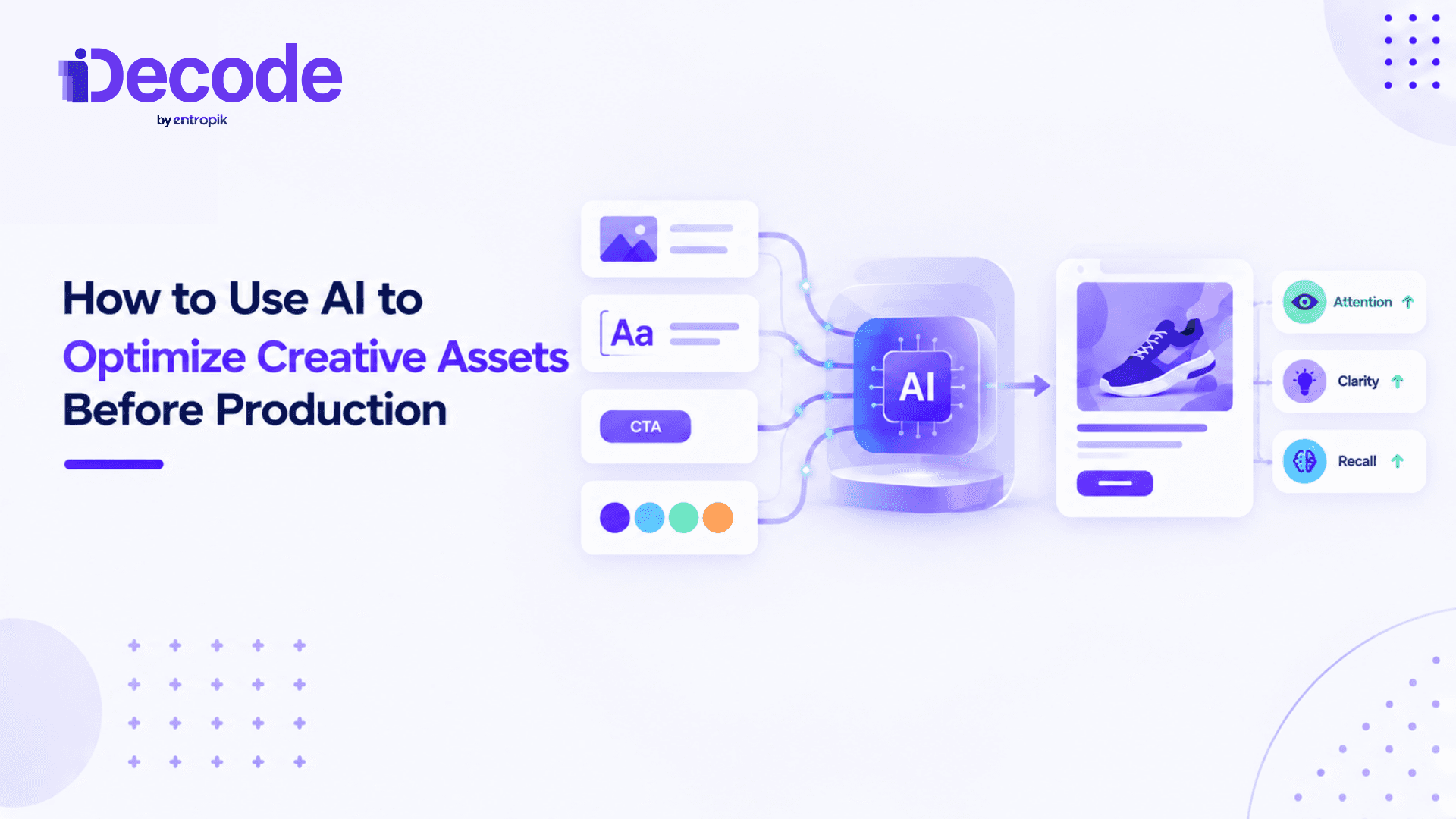
Using AI to optimize creative assets before production means testing concepts, visuals, and messaging with AI-based prediction tools before committing to full production or media spend. Teams upload early drafts or concepts, get attention, emotion, or performance scores, then iterate based on that feedback before finalizing assets, reducing wasted production budget on underperforming creative.
Summary:
|
What makes creative expensive isn't the idea; it's the shooting, the editing, the licensing, and the media involved. Once most teams have worked out whether a concept will work, all of those costs have already been paid.
The sequence is reversed during pre-production testing: rather than having to wait until live performance data is available, you receive the signal on early ideas, and while changes still take up an entire afternoon instead of requiring a reshoot.
The guide describes the workflow, including what is possible for AI to assess before an asset is completed, the five steps which make the workflow repeatable, and the errors that render the exercise pointless.
Why Optimize Creative Before Production
Two facts sit behind this whole approach.
The first is that creative matters more than most processes assume. In a meta-study of nearly 450 CPG campaigns, NCSolutions found that advertising creative drives 49 percent of incremental sales, ahead of brand at 21 percent and targeting at 11 percent. The largest lever in a campaign is the one usually approved by opinion.
The second is that the cost of getting it wrong lands late. An analysis of 12,000 FMCG product launches found that 76 percent did not survive a year of sales. Not all of that is creative, but the pattern holds: validation arrives after the money.
The tooling is now widely available. McKinsey's global survey found 88 percent of organizations report regular AI use in at least one business function, and Gartner found marketing leaders expect AI-driven automation of marketing work to more than double, from 16% in 2026 to 36% by 2028. The question is no longer whether to use AI in the creative pipeline but at which stage it earns its place, and pre-production is where changes are still cheap.
What AI Can Evaluate Before Production Starts
AI has no need for a fully completed asset; storyboards, animatics, static mockups, rough cuts, and even key frames have sufficient visual and semantic structure to be evaluated.
What it can assess at that stage:
Visual attention: Where the eye is likely to go, and whether branding and the CTA sit in high-attention zones. The mechanics are covered in this explainer on eye gaze tracking and visual attention testing.
Emotional response: Predicted affective reaction, and whether the intended tone is likely to land.
Concept clarity: Whether the core idea reads quickly, which is usually the difference between a concept that works in the room and one that works in a feed.
Message strength: Which framing communicates the proposition most directly, the same question addressed by structured message testing.
The entire process comes down to one point: generative AI produces the variations while predictive AI evaluates them. They are different systems carrying out opposite functions, and it is by confusing these two that teams end up with an AI which generates work and then assesses its own homework. The generation stage and the evaluation stage should therefore be kept separate, preferably coming from different sources.
Step 1: Define What You Are Testing For
Scores cannot be acted on when there is no hypothesis to guide the testing.
Begin with a specific comparison; rather than asking which is better, ask whether an opening based on a problem performs better than one based on an outcome for this audience. If the answer to that question is no, then you know what changes to make.
Name the KPI that the test should provide information on. Attention capture, message clarity, and emotional resonance may lead in different directions, and a concept might manage to attract attention without conveying anything.
In the end, it is necessary to keep one key variable constant. When variant A alters the headline, the colour scheme, and the opening shot, the difference in score gives you no indication as to which of the changes caused it. The whole foundation of attribution lies in isolating the variable, and it is precisely at this stage that most pre-production tests fail quietly.
Carrying out an assumption mapping exercise before the brief is issued is a quick method of discovering what the team truly believes and where it actually disagrees, since this is generally where the most effective test hypothesis is concealed.
Step 2: Generate Early Concept Variants
It is good to use generative tools at this stage since low fidelity is the objective. You want six directions completed within the afternoon, not a single fully polished one. There are three rules which make the output testable.
Keep variants meaningfully distinct.
Six near-identical layouts produce six near-identical scores and one wasted cycle. Distinct strategic directions produce differences you can learn from.
Hold brand fundamentals constant.
Logo, palette, typography, and tone stay fixed across variants. Otherwise you are testing brand recognition rather than the creative idea.
Keep the fidelity honest.
A polished variant will often score better than a rough one for reasons unrelated to the idea. Compare like with like, or the production quality becomes the variable.
One caution about generated creative reaching the market. Gartner's consumer research found that 50 percent of consumers prefer brands that avoid using generative AI in consumer-facing content, and 68 percent frequently wonder whether the content they see is real. Using generative AI to explore directions internally is a different decision from shipping generated assets, and the second one carries brand risk the first does not.
Step 3: Run Predictive Testing on Draft Concepts
Upload the drafts and score them before anything moves into production.
Compare, do not evaluate in isolation.
A single score of 74 means very little. Variant C scoring well above the other five means something you can act on. Predictive models are far more reliable at ranking than at forecasting absolute outcomes, so use them for what they are good at.
Read the diagnostics, not the headline number.
An attention heatmap showing that the eye lands on the background image and never reaches the product tells you what to fix. An overall score of 61 tells you only that something is wrong.
Look for the pattern across variants.
If every version underperforms in the same place, the problem is upstream in the brief rather than in any execution. That is the most valuable finding pre-production testing produces, and the one a single-concept test can never surface.
This stage sits comfortably inside an existing ai creative testing practice, and the practical setup is covered in more depth in this guide to AI creative testing for ad performance.
Step 4: Apply the Creative Refinement Loop
The results serve as input for the revision process, not as a judgment of the work.
The loop consists of three sections; from the diagnostic determine the weak element rather than the general concept, make revisions to that element and do not touch the other parts, then re-test to make sure that the correction has led to an improvement.
The fourth section is the one that teams leave out; a change which appears to be clearly better when discussed in the room usually ends up scoring worse since the alteration has introduced a new problem. You have in effect replaced a weakness that had been identified with one that has not been measured.
Before you begin, establish a limit for the number of cycles. Generally, two or three iterations is about where the returns start to diminish, and if the loop has no end it will become a bottleneck in terms of output. Make a prior decision regarding how many rounds you will carry out and what score threshold is needed for a concept to be advanced.
The lightweight methods mentioned in this guide for carrying out low-cost creative tests work well when used in a loop, since each iteration has to be cheap enough for three to be carried out without the cost exceeding that of the product you are trying to protect.
Step 5: Move Only Validated Concepts Into Full Production
The output of steps one through four is a shortlist, usually two concepts rather than six.
Commit production budget only to what cleared the threshold.
Shoots, animation, licensing, and final design are the expensive part, which is the whole point of the exercise.
Document the decision.
Which concept won, what its scores were, and what the team believed those scores meant. Over a year this becomes a library of what performs in your category, which is more valuable than any individual test result.
Carry the same criteria into post-launch.
Compare predicted rank against actual performance. Where they matched, trust the model more. Where they diverged, you have learned something specific about its limits in your category. Post-launch monitoring for creative fatigue closes the loop, since a concept that validated well can still decay after enough impressions.
McKinsey's analysis of 300 publicly listed companies found that top-quartile design performers delivered 32% points higher revenue growth than industry peers over five years, and one of the behaviors distinguishing them was continuous testing and iteration with users rather than research treated as a one-time phase. The advantage comes from the loop, not from any single test.
Common Mistakes When Optimizing Creative With AI
Testing too many variables at once: If three things changed, a score difference is uninterpretable.
Treating scores as guarantees: They are directional signals derived from historical patterns, not forecasts of your campaign result.
Skipping the re-test: An unverified fix is an assumption wearing the costume of a finding.
Testing polished against rough: Fidelity becomes the hidden variable.
Letting the model kill distinctive work: Convention-breaking creative often scores below average because it looks unlike the training data. Build a review path for high-strategy, low-score concepts.
Never auditing predictions: Without comparing predicted rank against real outcomes, you have no idea whether the tool works in your category.
Teams comparing tooling can start with this roundup of ad creative testing platforms, keeping the audit question in the evaluation criteria.
Pairing AI Prediction With Measured Human Response
Predictive models are trained on how people responded to other creative, at some earlier point. They are useful precisely because of that, and limited for the same reason. A score is a statement about historical patterns, not about your audience today.
The fix is to validate the shortlist with real viewers before production, not after. That means running the top two concepts past actual people and measuring where attention went and how they reacted, rather than asking whether they liked it.
Facial coding captures emotional response at the moment each element appears, and eye tracking shows whether the branding, claim, or CTA was actually seen. Decode's emotion AI reads 62 facial expressions with 90 plus percent accuracy and eye gaze tracking runs at 96 percent accuracy, so a top-scoring concept can be confirmed against measured human response before a shoot is booked. Running the predictive creative AI layer and the validation layer on one creative insights platform keeps the comparison consistent, and standard creative testing workflows carry both.
For concept-stage questions about whether the idea itself holds up, concept testing with real respondents remains the right method, and live A/B testing still decides the winner in market. Pre-production optimization narrows what gets there.
Frequently Asked Questions
1. How do you use AI to test creative before production?
Upload draft concepts, storyboards, or rough cuts to a predictive testing tool, compare variants side by side on attention and emotional response, refine the weak elements, re-test, then produce only what cleared your threshold.
2. What can AI predict about a creative concept before it's finished?
Visual attention and likely fixation points, predicted emotional response, concept clarity, and relative ranking against other variants. It cannot predict campaign results, which depend on targeting, placement, and budget.
3. How many creative variants should you test before production?
Four to eight distinct directions gives a model enough to differentiate without creating an unmanageable review. Narrow to two for human validation.
4. What is the difference between generative AI and predictive AI in creative testing?
Generative AI produces creative variants. Predictive AI scores them against models trained on past performance. Keep them separate so the system that made the work is not also grading it.
5. How do you know if an AI creative score is reliable?
Ask what data the model was trained on and how closely it matches your category and format, then audit predicted rankings against your own live campaign results each quarter.
6. Can AI replace traditional creative testing entirely?
No. AI narrows the field quickly and cheaply. Real human response, whether pre-production research or in-market testing, is what confirms the decision.
7. How do you build a repeatable creative optimization workflow with AI?
Fix the five steps in the process, set a cycle limit and a score threshold, document every decision, and compare predictions against actual outcomes so the criteria improve over time.
The Practical Takeaway
The value here is not the score. It is the sequencing.
Testing before production means you find out the product never gets looked at while the fix is a layout change rather than a reshoot. That argument holds even if the model is only roughly accurate, because ranking six concepts correctly is a much easier problem than forecasting what any one of them will earn.
Run the loop, cap the iterations, validate the shortlist with real viewers, and check afterward whether the predictions held. Teams that do all four end up with creative effectiveness measurement that gets sharper each quarter rather than a tool nobody quite trusts.